Well Control Equipment
Sarwar Salam-QHSE Sup.
Eurasia Drilling Company-EDC
Well Control
• Well control;
Blowout Preventers
• Blowout preventers (BOPs), in conjunction with
other equipment and techniques, are used to close
the well in and allow the crew to control a kick
before it becomes a Blowout.
• Blowout preventer equipment should be designed
to:
1. Close the top of the hole.
2. Control the release of fluids.
3. Permit pumping into the hole.
4. Allow movement of the inner string of pipe.
These requirements mean that there;
• Must be enough casing in the well to Provide an anchor
for the wellhead equipment,
• There must be provision for equipment to close the hole
with or without pipe in well,
• The Equipment must provide for the attachment of lines
for bleeding off pressure (Bleeding Off BOP control lines)
• It must allow pumping into the working string or
annulus.
B. O. Preventer Requirement
Preventer Types
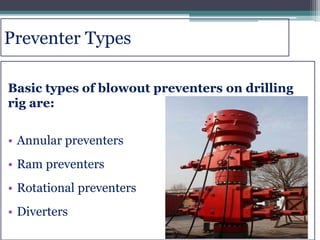
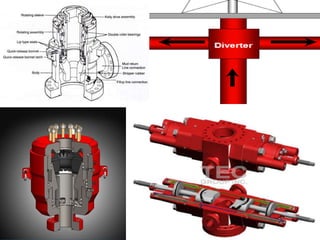
Basic types of blowout preventers on drilling
rig are:
• Annular preventers
• Ram preventers
• Rotational preventers
• Diverters
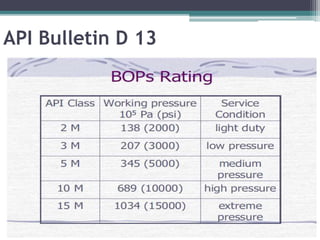
API Bulletin D 13
Well Control Diagram
• Valve and Tools Drilling
Company, Rig 3 ;
Well Control Equipment Diagram;
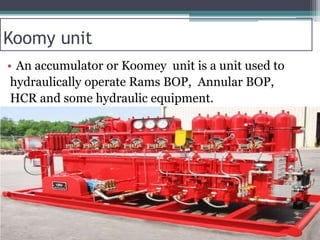
Koomy unit
• An accumulator or Koomey unit is a unit used to
hydraulically operate Rams BOP, Annular BOP,
HCR and some hydraulic equipment.
Chock Manifold
Inside preventers
• Kelly cock (Upper and Lower)
• Inside blowout preventer (iBOP)
• Drill pipe float valve, or
• Drop in check valve
• Should be available for use when stripping the drill
String into or out of the hole.
• The valve(s), sub(s), or profile nipple should
Be equipped to screw into any drill string member in use.
(X/O)
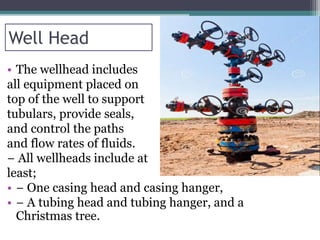
Well Head
• The wellhead includes
all equipment placed on
top of the well to support
tubulars, provide seals,
and control the paths
and flow rates of fluids.
− All wellheads include at
least;
• − One casing head and casing hanger,
• − A tubing head and tubing hanger, and a
Christmas tree.
Testing and Maintenance of surface BOP
• All operational components of the BOP equipment
should be functioned at least once a weak to verify the
component’s intended operations, Function tests may
or may not include pressure tests.
• They should be alternated from the driller’s panel and
from mini-remote panels, if on location.
• Actuation times should be recorded as a data base for
evaluating trends.
Thanks For Your
Time and
Attention

Well control equipment

  • 1.
    Well Control Equipment SarwarSalam-QHSE Sup. Eurasia Drilling Company-EDC
  • 2.
  • 3.
    Blowout Preventers • Blowoutpreventers (BOPs), in conjunction with other equipment and techniques, are used to close the well in and allow the crew to control a kick before it becomes a Blowout. • Blowout preventer equipment should be designed to: 1. Close the top of the hole. 2. Control the release of fluids. 3. Permit pumping into the hole. 4. Allow movement of the inner string of pipe.
  • 4.
    These requirements meanthat there; • Must be enough casing in the well to Provide an anchor for the wellhead equipment, • There must be provision for equipment to close the hole with or without pipe in well, • The Equipment must provide for the attachment of lines for bleeding off pressure (Bleeding Off BOP control lines) • It must allow pumping into the working string or annulus. B. O. Preventer Requirement
  • 5.
    Preventer Types Basic typesof blowout preventers on drilling rig are: • Annular preventers • Ram preventers • Rotational preventers • Diverters
  • 7.
  • 8.
    Well Control Diagram •Valve and Tools Drilling Company, Rig 3 ; Well Control Equipment Diagram;
  • 9.
    Koomy unit • Anaccumulator or Koomey unit is a unit used to hydraulically operate Rams BOP, Annular BOP, HCR and some hydraulic equipment.
  • 10.
  • 11.
    Inside preventers • Kellycock (Upper and Lower) • Inside blowout preventer (iBOP) • Drill pipe float valve, or • Drop in check valve • Should be available for use when stripping the drill String into or out of the hole. • The valve(s), sub(s), or profile nipple should Be equipped to screw into any drill string member in use. (X/O)
  • 12.
    Well Head • Thewellhead includes all equipment placed on top of the well to support tubulars, provide seals, and control the paths and flow rates of fluids. − All wellheads include at least; • − One casing head and casing hanger, • − A tubing head and tubing hanger, and a Christmas tree.
  • 13.
    Testing and Maintenanceof surface BOP • All operational components of the BOP equipment should be functioned at least once a weak to verify the component’s intended operations, Function tests may or may not include pressure tests. • They should be alternated from the driller’s panel and from mini-remote panels, if on location. • Actuation times should be recorded as a data base for evaluating trends.
  • 14.
    Thanks For Your Timeand Attention

Editor's Notes

  • #3 is the technique used in oil and gas operations such as drilling, well workover, and well completions to maintaining the fluid column hydrostatic pressure and formation pressure to prevent influx of formation fluids into the wellbore. This technique involves the estimation of formation fluid pressures, the strength of the subsurface formations and the use of casing and mud density to offset those pressures in a predictable fashion.[1] Understanding of pressure and pressure relationships are very important in well control.
  • #5 Casing head and tubing head Other types of BOP, Pipe Ram, Blind or Shear Ram, Annular Ram, Diverters. Koomy unnit
  • #6 -In the BOP stack they are always positioned in such way, that annular preventer is the working preventer positioned on the top of the stack, and -Ram preventer is on the bottom as thebackup -Working preventer is always positioned far from the source of danger, to be in position to change it if fails Rotational preventers are used: 1- For drilling in layers that are suspected to cause possible kick off. 2- When drilling on the balance or under balanced (drilling the rocks of great permeability or porosity; to avoid pollution with mud). 3- When using indirect circulation When the drilling is done using air or gas.
  • #7 Rotational preventer is always positioned at the top of the stack above annular preventer. It is used when differential pressure at the wellhead does not exceed 34,5.105 Pa (500 PSI),
  • #11 In oil and gas production a choke manifold is used to lower the pressured from the well head. It consist of a set of high pressure valves and at least two chokes >>> Hydraulic operated chock control & Manual Operated Chock conrol. These chokes can be fixed or adjustable or a mix of both.
  • #12 *Upper kelly has on the top the left-hand screw to avoid uncontrolled screw of, and on the bottom there will be a right-hand screw. *The inside blowout preventer protects the rotary swivel, drilling hose, standpipe and mud pumps when a kick occurs through the drill string. It will effectively seal against the pressures up to 69 MPa. Permits downward flow of circulation fluid through the drill pipe while preventing upward flow after circulation stops. Always on the working floor near the rotary table.
  • #14 When testing BOP stack the hole is separated by the use of so called “cup tester”.