Well Control System
Ashwani Kumar Sinha
Roll No. 180012680005
M.Sc Applied Geology 3rd Sem.
Well control & Kick
Functions of the well control system: detect,
stop, and remove any undesired entrance of
formation fluids into the borehole.
KICK: An undesired entrance of formation
fluid into the borehole.
Or,
Simply controlled Blowout
Kick and may occur due to several reasons
high pressure formations,
insufficient drilling fluid density,
drillstring swab,
loss of circulation,
formation fracture,
etc.
Blowout
If the undesired entrance of fluid feedbacks
and the fluid continuously enters the borehole
reaching the surface, it is called blowout.
Blowouts (in particular gas blowouts) are
extremely dangerous and put the crew, the
rig, the drilling operation, and the reservoir at
risk.
Well control system constituent
The well control system must detect, control, and
remove the undesired entrance of fluids into the
borehole.
The system is composed of:
sensors (flow rate, surface volume, annular and drillstring
pressure, and etc,) capable to detect an increase of flow or
volume in the fluid system,
the blowout preventer (BOP),
the circulating pressure control manifold (choke manifold),
the kill and choke lines.
Blowout Preventer (BOP)
The BOP is a set of pack–offs capable of shutting
the annular space between the surface casing
and the drillstring.
Because of the diversity in shape of the annular,
several different device types exist and they are
normally assembled together (and in various
configurations) called BOP stack.
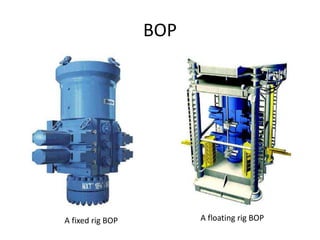
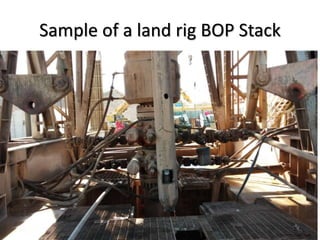
The BOP stack is located
under the rotary table in land and fixed marine rigs,
and on the bottom of the sea in mobile and floating rigs.
Pressure Control Equipment
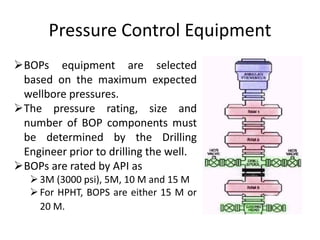
BOPs equipment are selected
based on the maximum expected
wellbore pressures.
The pressure rating, size and
number of BOP components must
be determined by the Drilling
Engineer prior to drilling the well.
BOPs are rated by API as
3M (3000 psi), 5M, 10 M and 15 M
For HPHT, BOPS are either 15 M or
20 M.
BOP
A fixed rig BOP A floating rig BOP
Sample of a land rig BOP Stack
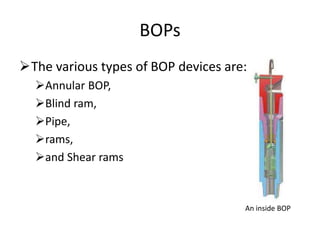
BOPs
The various types of BOP devices are:
Annular BOP,
Blind ram,
Pipe,
rams,
and Shear rams
An inside BOP
Blind & Pipe rams
Blind ram:
• The blind rams (normally one at the top of all other rams) allows
shutting the borehole with no drillstring element in front of it. If the
blind ram is applied to a drillpipe, the pipe will be flatten but no
seal is obtained.
Pipe rams:
• The pipe rams allows shutting the annular in front a compatible drill
pipe (not in front of tool joints.)
Normally two rams are used
• a special spool between the two is used where the kill and
• choke line is connected. (the lower ram in the figure)
The use of two pipe rams also permit to snub the drillstring during the
well control operation.
Thank You…

Well control system

  • 1.
    Well Control System AshwaniKumar Sinha Roll No. 180012680005 M.Sc Applied Geology 3rd Sem.
  • 2.
    Well control &Kick Functions of the well control system: detect, stop, and remove any undesired entrance of formation fluids into the borehole. KICK: An undesired entrance of formation fluid into the borehole. Or, Simply controlled Blowout
  • 3.
    Kick and mayoccur due to several reasons high pressure formations, insufficient drilling fluid density, drillstring swab, loss of circulation, formation fracture, etc.
  • 4.
    Blowout If the undesiredentrance of fluid feedbacks and the fluid continuously enters the borehole reaching the surface, it is called blowout. Blowouts (in particular gas blowouts) are extremely dangerous and put the crew, the rig, the drilling operation, and the reservoir at risk.
  • 5.
    Well control systemconstituent The well control system must detect, control, and remove the undesired entrance of fluids into the borehole. The system is composed of: sensors (flow rate, surface volume, annular and drillstring pressure, and etc,) capable to detect an increase of flow or volume in the fluid system, the blowout preventer (BOP), the circulating pressure control manifold (choke manifold), the kill and choke lines.
  • 6.
    Blowout Preventer (BOP) TheBOP is a set of pack–offs capable of shutting the annular space between the surface casing and the drillstring. Because of the diversity in shape of the annular, several different device types exist and they are normally assembled together (and in various configurations) called BOP stack. The BOP stack is located under the rotary table in land and fixed marine rigs, and on the bottom of the sea in mobile and floating rigs.
  • 7.
    Pressure Control Equipment BOPsequipment are selected based on the maximum expected wellbore pressures. The pressure rating, size and number of BOP components must be determined by the Drilling Engineer prior to drilling the well. BOPs are rated by API as 3M (3000 psi), 5M, 10 M and 15 M For HPHT, BOPS are either 15 M or 20 M.
  • 8.
    BOP A fixed rigBOP A floating rig BOP
  • 9.
    Sample of aland rig BOP Stack
  • 10.
    BOPs The various typesof BOP devices are: Annular BOP, Blind ram, Pipe, rams, and Shear rams An inside BOP
  • 11.
    Blind & Piperams Blind ram: • The blind rams (normally one at the top of all other rams) allows shutting the borehole with no drillstring element in front of it. If the blind ram is applied to a drillpipe, the pipe will be flatten but no seal is obtained. Pipe rams: • The pipe rams allows shutting the annular in front a compatible drill pipe (not in front of tool joints.) Normally two rams are used • a special spool between the two is used where the kill and • choke line is connected. (the lower ram in the figure) The use of two pipe rams also permit to snub the drillstring during the well control operation.
  • 12.