Azmat Ali Khan 12mt34 
Usman Nazir 12mt35 
Naveed Imran 12mt28 
Haseeb Ahmad 12mt32 
Muhammad Farhan 12mt13 
Qamar Zia 12mt10 
Mazhar Hussain 12mt33
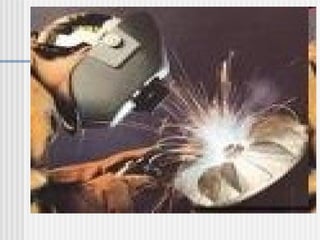
What is WELDING 
 in engineering, any process in which 
two or more pieces of metal are 
joined together by the application of 
heat, pressure, or a combination of 
both.
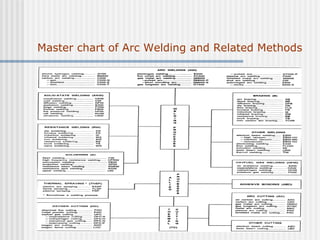
Master chart of Arc Welding and Related Methods
Common Welding Types 
 Arc Welding (AW) 
 Oxyfuel Gas Welding(OFW) 
Resistance Welding
Types of ArC Welding 
 ConsumAble eleCTrodes ArC 
Welding 
 non ConsumAble eleCTrodes ArC 
Welding
Types of ConsumAble 
eleCTrode AW proCesses 
 shielded meTAl ArC Welding 
(smAW) 
 submerged ArC Welding (sAW) 
 flux Cored ArC Welding (fCAW) 
 meTAl ArC Welding (gmAW or 
mig)
Types of non ConsumAble 
eleCTrodes AW proCesses 
gAs TungsTen ArC Welding 
(gTAW) 
plAsmA ArC Welding (pAW) 
CArbon ArC Welding (CAW)
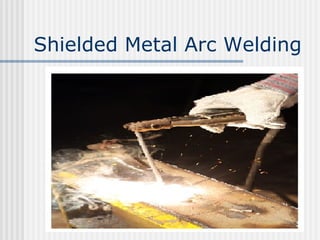
Shielded Metal Arc Welding
sheilded meTAl ArC 
Welding 
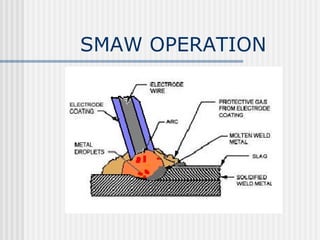
 It is performed by striking an arc 
between a coated-metal electrode 
and the base metal. 
 Flux- the coating of the metal 
electrode will form as shield to the 
molten metal.
SMAW OPERATION
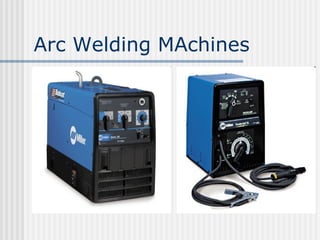
Arc Welding MAchines
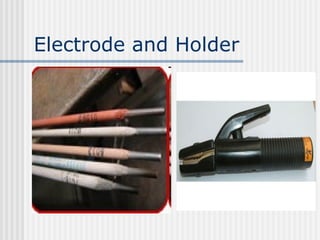
Electrode and Holder
AdvAnTAges of smAW 
 High quality welds are made rapidly 
at a low cost. 
 Can be used easily even to thick and 
wide work piece to be joined. 
 Can be used from thinner to thicker 
materials.
disAdvAnTAges smAW 
 Consumes bigger electric current 
 Dirty work finish 
 Root pass is lower than TIG and MIG 
 Prone to slag inclusions 
 Weld deposits is prone to blue holes
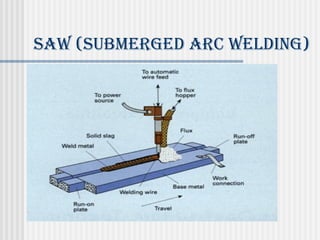
sAW (submerged ArC Welding)
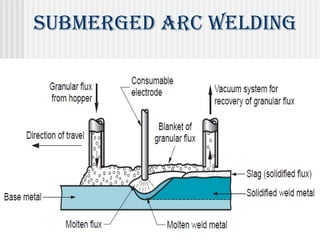
submerged ArC Welding 
(sAW) 
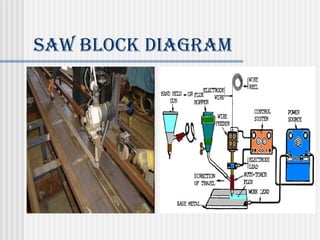
 Is a process in which welding is 
done by an automatic electrode 
feeding machine wherein the tip of 
the electrode is submerged into a 
granular flux which shields the arc 
and the molten metal.
submerged ArC Welding
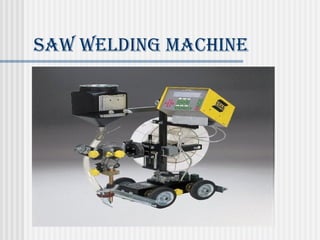
sAW Welding mAChine
SAW block diAgrAm
SAW APPlicATioNS 
 widely used in heavy steel plate 
fabrication work. 
 welding of structural shapes. 
 longitudinal seam of larger diameter pipe. 
 manufacture of machine components for 
all types of heavy industry. 
 manufacture of vessels. 
 pressure and storage tanks.
AdvANTAgeS of SAW 
 high quality of the weld metal. 
 extremely high deposition rate and speed. 
 smooth, uniform finished weld with no spatter. 
 little or no smoke. 
 no arc flash, thus minimal need for protective 
clothing. 
 high utilization of electrode wire. 
 easy automation for high-operator factor. 
 normally, no involvement of manipulative skills.
diSAdvANTAgeS of SAW 
 used only to weld mild and low-alloy high-strength 
steels. 
 Unseen arc and puddle can cause poor 
penetration. 
 high-heat input, slow-cooling cycle can be 
a problem when welding quenched and 
tempered steels. 
 limited-position welding process only flat 
and horizontal
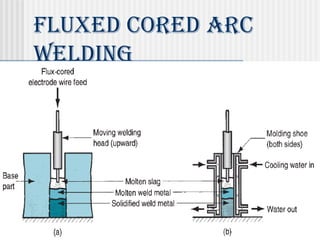
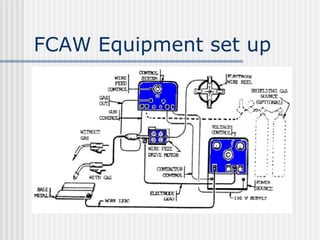
flUXed cored Arc 
WeldiNg
flUX cored Arc WeldiNg 
(fcAW) 
 is an automatic or semi-automatic 
electric arc welding process that 
uses an arc between a continuously 
fed flux-filled electrode and the weld 
pool. The process is used with 
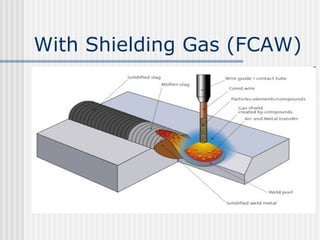
shielded gas from a flux contained 
within the tubular electrode with or 
without additional shielding from an 
externally supplied gas.
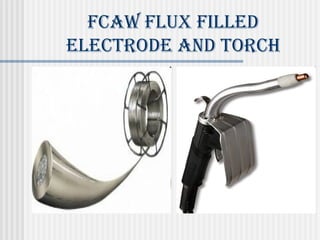
fcAW flUX filled 
elecTrode ANd Torch
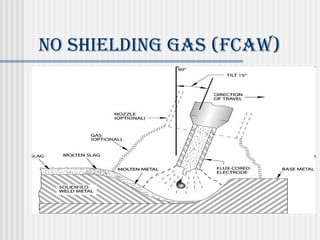
No ShieldiNg gAS (fcAW)
With Shielding Gas (FCAW)
Two Types of FCAW 
 no shielding gas 
- using flux core in the tubular consumable 
electrode 
 uses a shielding gas 
- gas that must be supplied by an external 
supply. This is known informally as "dual shield" 
welding.
Uses of FCAW 
Mild and low alloy steels 
Stainless steels 
Some high nickel alloys 
Some wear facing/surfacing 
alloys
Advantages of FCAW 
 FCAW may be an "all-position" process with the 
right filler metals (the consumable electrode) 
 No shielding gas needed making it suitable for 
outdoor welding and/or windy conditions 
 A high-deposition rate process (speed at which 
the filler metal is applied) in the 1G/1F/2F 
 Some "high-speed" (e.g., automotive 
applications) 
 Less pre cleaning of metal required 
 Metallurgical benefits from the flux such as the 
weld metal being protected initially from external 
factors until the flux is chipped away
diSAdvANTAgeS of fcAW 
 Melted Contact Tip – happens when the electrode actually 
contacts the base metal, thereby fusing the two metals. 
 Irregular wire feed – typically a mechanical problem 
 Porosity – the gases (specifically those from the flux-core) 
don’t escape the welded area before the metal hardens, 
leaving holes in the welded metal 
 More costly filler material/wire as compared to GMAW 
 Less suitable for applications that require painting, such as 
automotive body works. 
 Cannot be used in a rugged environment limited to shop 
use only.
FCAW Equipment set up
meTAl iNerT gAS 
WeldiNg
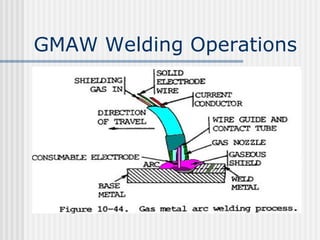
GMAW or MIG 
 is an electric arc welding process which joins 
metals by heating them with an arc established 
between a continuous filler metal (consumable) 
electrode and the work. 
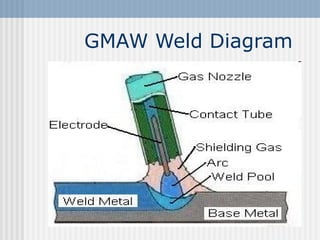
 Shielding of the arc and molten weld pool is 
obtained entirely from an externally supplied 
gas or gas mixture both inert and reactive 
gases.
GMAW Welding Operations
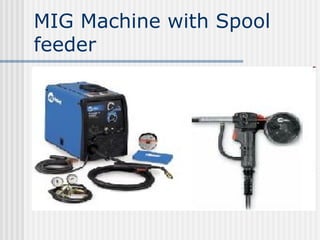
MIG Machine with Spool 
feeder
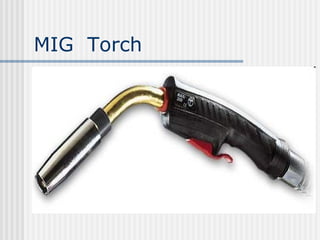
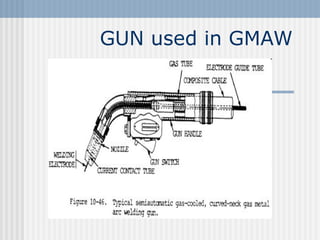
GUN used in GMAW
MIG Torch
GMAW Weld Diagram
Advantages of GMAW 
 Produced High quality welds & much faster than with 
SMAW and TIG welding. 
 No flux is used no slag entrapment in the weld metal. 
 Very little loss of alloying elements as the metal 
transfers across the arc. 
 Minor weld spatter is produced, and it is easily 
removed.
Advantages of GMAW 
 Versatile and can be used with a wide variety of 
metals and alloys, such as Aluminum, Copper, 
Magnesium, 
Nickel, Iron and many of their alloys. 
 The process can be operated in several ways, including 
semi- and fully automatic. 
 MIG welding is widely used by many industries for 
welding a broad variety of materials, parts, and 
structures.
Disadvantages of GMAW 
 IT cannot be used in the vertical or overhead welding 
positions due to the high heat input and the fluidity of 
the weld puddle. 
 Has complex equipment compared to equipment used 
for the shielded metal-arc welding process.
NON 
CONSUMABLE 
ELECTRODES
Gas Tungsten Arc Welding 
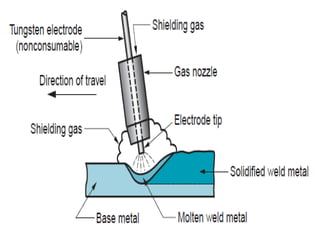
 Gas tungsten arc welding (GTAW) is an AW 
process that 
 uses a nonconsumable tungsten electrode and 
an inert gas for arc shielding. The term TIG 
 welding (tungsten inert gas welding) is often 
applied to this process (in Europe, WIG 
 welding is the term—the chemical symbol for 
tungsten is W, for Wolfram).
Temperature and shelding 
gases 
 Tungsten is a good electrode 
material due to its high melting 
point of 3410C (6170F). 
 Typical shielding gases include 
argon, helium, or a mixture of these 
gas elements.
APPLICATION 
 GTAWisapplicable tonearly allmetals 
in a wide range of stock thicknesses. 
 It can also be used for joining 
various combinations of dissimilar 
metals. 
 Its most common applications are 
for aluminum and stainless steel.
LIMITATIONS 
 Cast irons, wrought irons, and of 
course tungsten aredifficult to weld 
by GTAW. 
 In steel welding applications, GTAW 
is generally slower and more costly 
than the consumable electrode AW 
processes, except when thin 
sections are involved and very-high-quality 
welds are require.
ADVANTAGES 
 Advantages of GTAW in the 
applications to which it is suited 
include high-quality welds, no weld 
spatter because no filler metal is 
transferred across the arc, and little 
or no post weld cleaning because no 
flux is used.
PLASMA ARC 
WELDING
Plasma Arc Welding 
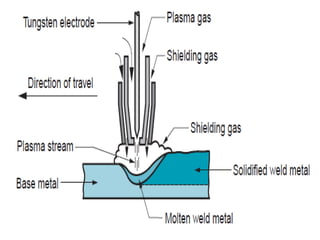
 Plasma arc welding (PAW) is a special 
form of gas (TAW) in which a constricted 
plasma arc is directed at the weld area. 
 In PAW, a tungsten electrode is 
contained in a specially designed nozzle 
that focuses a high-velocity stream of 
inert gas (e.g., argon or argon–hydrogen 
mixtures) into the region of the arc to 
form a highvelocity,intensely hot plasma 
arc stream
TEMPERATURES 
 Temperatures in plasma arc welding 
reach 17,000C (30,000F) or greater, 
hot enough to melt any known 
metal. 
 The reason why temperatures are so 
high in PAW (significantly) higher 
than those in GTAW) derives from 
the constriction of the arc.
ADVANTAGES 
 its advantages in these applications 
include good arc stability,better 
penetration control than most other 
AW processes, high travel speeds, 
and excellent weld quality. 
 The process can be used to weld 
almost any metal, including 
tungsten.
LIMITATIONS 
 Difficult-to-weld metals with 
PAWinclude bronze, cast irons, lead, 
and magnesium. 
 Other limitations include high 
equipment cost and larger torch size 
than other AW operations,which 
tends to restrict access in some joint 
configurations.
Carbon arc welding 
 Carbon arc welding (CAW) is an arc-welding 
process in which a non 
consumable carbon (graphite) 
electrode is used. 
 It has historical importance because 
it was the first arc-welding process 
to be developed, but its commercial 
importance today is practically nil.
APPLICATIONS 
 The carbon arc process is used as a 
heat source for brazing and for 
repairing iron castings. 
 It can also be used in some 
applications for depositing wear-resistant 
materials on surfaces. 
 Graphite electrodes for welding have 
been largely superseded by 
tungsten(in GTAW and PAW).
GAS WELDING 
AND ITS TYPES
Oxygen Fuel Gas Welding 
(OFW) 
is a group of welding processes 
which join metals by heating with 
a fuel gas flame or flares with or 
without the application of pressure 
and with or without the use of filler 
metal.
Types of Oxy-fuel Gas Welding 
 Oxy-Acetylene or Oxygen- Acetylene Gas 
Welding 
 Oxy-Hydrogen or Oxygen- Hydrogen Gas 
Welding 
 Methylacetone-Propadiene Gas Welding 
 Pressure Gas Welding.
Advantages of Oxy-fuel 
Gas Welding 
 Easy to use both welding and cutting 
 Controlled heat input 
 Controlled bead size 
 Convenient to use in welding thin sheets, tubes 
and small diameter pipes
Disadvantages of Oxy-Fuel 
Gas Weldinmoo 
 Cannot be use to weld on thick work 
piece. 
 Expensive gas
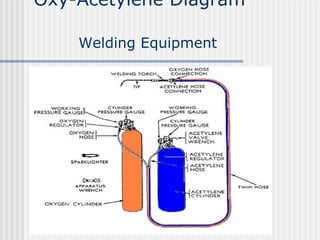
Oxy-Acetylene Diagram 
Welding Equipment
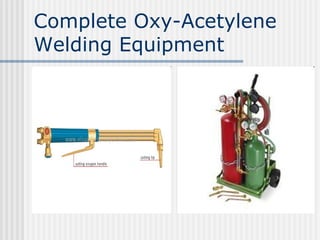
Complete Oxy-Acetylene 
Welding Equipment
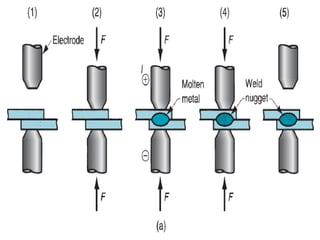
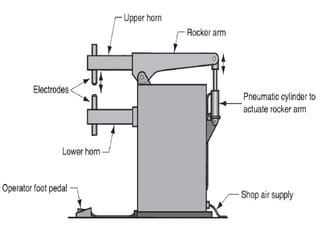
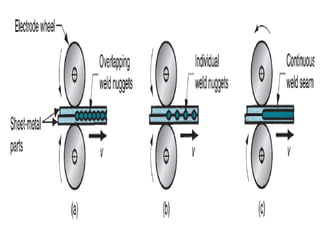
Resistance Welding 
 is a process in which the fusing temperature is 
generated at the joint by the resistance to the flow of an 
electrical current. 
 is accomplished by clamping two or more sheets of 
metal between copper electrodes and then passing an 
electrical current through them. When the metals are 
heated to a melting temperature, forging pressure is 
applied through either a manual or automatic means to 
weld the pieces together. 
 Two common types are Spot and Seam welding
2 Types of Resistance 
Welding 
SPOT WELDING 
SEAM WELDING
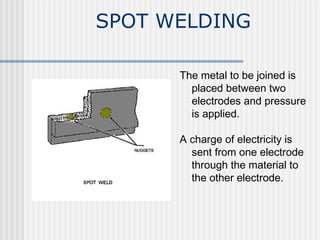
SPOT WELDING 
The metal to be joined is 
placed between two 
electrodes and pressure 
is applied. 
A charge of electricity is 
sent from one electrode 
through the material to 
the other electrode.
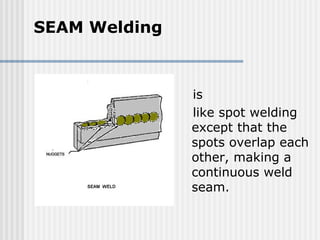
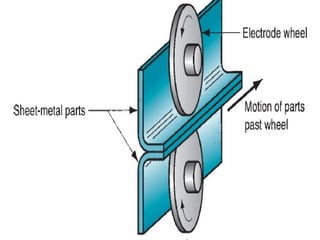
SEAM Welding 
is 
like spot welding 
except that the 
spots overlap each 
other, making a 
continuous weld 
seam.
Types of welding
Types of welding

Types of welding

  • 1.
    Azmat Ali Khan12mt34 Usman Nazir 12mt35 Naveed Imran 12mt28 Haseeb Ahmad 12mt32 Muhammad Farhan 12mt13 Qamar Zia 12mt10 Mazhar Hussain 12mt33
  • 3.
    What is WELDING  in engineering, any process in which two or more pieces of metal are joined together by the application of heat, pressure, or a combination of both.
  • 4.
    Master chart ofArc Welding and Related Methods
  • 5.
    Common Welding Types  Arc Welding (AW)  Oxyfuel Gas Welding(OFW) Resistance Welding
  • 6.
    Types of ArCWelding  ConsumAble eleCTrodes ArC Welding  non ConsumAble eleCTrodes ArC Welding
  • 7.
    Types of ConsumAble eleCTrode AW proCesses  shielded meTAl ArC Welding (smAW)  submerged ArC Welding (sAW)  flux Cored ArC Welding (fCAW)  meTAl ArC Welding (gmAW or mig)
  • 8.
    Types of nonConsumAble eleCTrodes AW proCesses gAs TungsTen ArC Welding (gTAW) plAsmA ArC Welding (pAW) CArbon ArC Welding (CAW)
  • 9.
  • 10.
    sheilded meTAl ArC Welding  It is performed by striking an arc between a coated-metal electrode and the base metal.  Flux- the coating of the metal electrode will form as shield to the molten metal.
  • 11.
  • 12.
  • 13.
  • 14.
    AdvAnTAges of smAW  High quality welds are made rapidly at a low cost.  Can be used easily even to thick and wide work piece to be joined.  Can be used from thinner to thicker materials.
  • 15.
    disAdvAnTAges smAW Consumes bigger electric current  Dirty work finish  Root pass is lower than TIG and MIG  Prone to slag inclusions  Weld deposits is prone to blue holes
  • 16.
  • 17.
    submerged ArC Welding (sAW)  Is a process in which welding is done by an automatic electrode feeding machine wherein the tip of the electrode is submerged into a granular flux which shields the arc and the molten metal.
  • 18.
  • 19.
  • 20.
  • 21.
    SAW APPlicATioNS widely used in heavy steel plate fabrication work.  welding of structural shapes.  longitudinal seam of larger diameter pipe.  manufacture of machine components for all types of heavy industry.  manufacture of vessels.  pressure and storage tanks.
  • 22.
    AdvANTAgeS of SAW  high quality of the weld metal.  extremely high deposition rate and speed.  smooth, uniform finished weld with no spatter.  little or no smoke.  no arc flash, thus minimal need for protective clothing.  high utilization of electrode wire.  easy automation for high-operator factor.  normally, no involvement of manipulative skills.
  • 23.
    diSAdvANTAgeS of SAW  used only to weld mild and low-alloy high-strength steels.  Unseen arc and puddle can cause poor penetration.  high-heat input, slow-cooling cycle can be a problem when welding quenched and tempered steels.  limited-position welding process only flat and horizontal
  • 24.
  • 25.
    flUX cored ArcWeldiNg (fcAW)  is an automatic or semi-automatic electric arc welding process that uses an arc between a continuously fed flux-filled electrode and the weld pool. The process is used with shielded gas from a flux contained within the tubular electrode with or without additional shielding from an externally supplied gas.
  • 26.
    fcAW flUX filled elecTrode ANd Torch
  • 27.
  • 28.
  • 29.
    Two Types ofFCAW  no shielding gas - using flux core in the tubular consumable electrode  uses a shielding gas - gas that must be supplied by an external supply. This is known informally as "dual shield" welding.
  • 30.
    Uses of FCAW Mild and low alloy steels Stainless steels Some high nickel alloys Some wear facing/surfacing alloys
  • 31.
    Advantages of FCAW  FCAW may be an "all-position" process with the right filler metals (the consumable electrode)  No shielding gas needed making it suitable for outdoor welding and/or windy conditions  A high-deposition rate process (speed at which the filler metal is applied) in the 1G/1F/2F  Some "high-speed" (e.g., automotive applications)  Less pre cleaning of metal required  Metallurgical benefits from the flux such as the weld metal being protected initially from external factors until the flux is chipped away
  • 32.
    diSAdvANTAgeS of fcAW  Melted Contact Tip – happens when the electrode actually contacts the base metal, thereby fusing the two metals.  Irregular wire feed – typically a mechanical problem  Porosity – the gases (specifically those from the flux-core) don’t escape the welded area before the metal hardens, leaving holes in the welded metal  More costly filler material/wire as compared to GMAW  Less suitable for applications that require painting, such as automotive body works.  Cannot be used in a rugged environment limited to shop use only.
  • 33.
  • 34.
  • 35.
    GMAW or MIG  is an electric arc welding process which joins metals by heating them with an arc established between a continuous filler metal (consumable) electrode and the work.  Shielding of the arc and molten weld pool is obtained entirely from an externally supplied gas or gas mixture both inert and reactive gases.
  • 36.
  • 37.
    MIG Machine withSpool feeder
  • 38.
  • 39.
  • 40.
  • 41.
    Advantages of GMAW  Produced High quality welds & much faster than with SMAW and TIG welding.  No flux is used no slag entrapment in the weld metal.  Very little loss of alloying elements as the metal transfers across the arc.  Minor weld spatter is produced, and it is easily removed.
  • 42.
    Advantages of GMAW  Versatile and can be used with a wide variety of metals and alloys, such as Aluminum, Copper, Magnesium, Nickel, Iron and many of their alloys.  The process can be operated in several ways, including semi- and fully automatic.  MIG welding is widely used by many industries for welding a broad variety of materials, parts, and structures.
  • 43.
    Disadvantages of GMAW  IT cannot be used in the vertical or overhead welding positions due to the high heat input and the fluidity of the weld puddle.  Has complex equipment compared to equipment used for the shielded metal-arc welding process.
  • 44.
  • 45.
    Gas Tungsten ArcWelding  Gas tungsten arc welding (GTAW) is an AW process that  uses a nonconsumable tungsten electrode and an inert gas for arc shielding. The term TIG  welding (tungsten inert gas welding) is often applied to this process (in Europe, WIG  welding is the term—the chemical symbol for tungsten is W, for Wolfram).
  • 47.
    Temperature and shelding gases  Tungsten is a good electrode material due to its high melting point of 3410C (6170F).  Typical shielding gases include argon, helium, or a mixture of these gas elements.
  • 48.
    APPLICATION  GTAWisapplicabletonearly allmetals in a wide range of stock thicknesses.  It can also be used for joining various combinations of dissimilar metals.  Its most common applications are for aluminum and stainless steel.
  • 49.
    LIMITATIONS  Castirons, wrought irons, and of course tungsten aredifficult to weld by GTAW.  In steel welding applications, GTAW is generally slower and more costly than the consumable electrode AW processes, except when thin sections are involved and very-high-quality welds are require.
  • 50.
    ADVANTAGES  Advantagesof GTAW in the applications to which it is suited include high-quality welds, no weld spatter because no filler metal is transferred across the arc, and little or no post weld cleaning because no flux is used.
  • 51.
  • 52.
    Plasma Arc Welding  Plasma arc welding (PAW) is a special form of gas (TAW) in which a constricted plasma arc is directed at the weld area.  In PAW, a tungsten electrode is contained in a specially designed nozzle that focuses a high-velocity stream of inert gas (e.g., argon or argon–hydrogen mixtures) into the region of the arc to form a highvelocity,intensely hot plasma arc stream
  • 54.
    TEMPERATURES  Temperaturesin plasma arc welding reach 17,000C (30,000F) or greater, hot enough to melt any known metal.  The reason why temperatures are so high in PAW (significantly) higher than those in GTAW) derives from the constriction of the arc.
  • 55.
    ADVANTAGES  itsadvantages in these applications include good arc stability,better penetration control than most other AW processes, high travel speeds, and excellent weld quality.  The process can be used to weld almost any metal, including tungsten.
  • 56.
    LIMITATIONS  Difficult-to-weldmetals with PAWinclude bronze, cast irons, lead, and magnesium.  Other limitations include high equipment cost and larger torch size than other AW operations,which tends to restrict access in some joint configurations.
  • 57.
    Carbon arc welding  Carbon arc welding (CAW) is an arc-welding process in which a non consumable carbon (graphite) electrode is used.  It has historical importance because it was the first arc-welding process to be developed, but its commercial importance today is practically nil.
  • 58.
    APPLICATIONS  Thecarbon arc process is used as a heat source for brazing and for repairing iron castings.  It can also be used in some applications for depositing wear-resistant materials on surfaces.  Graphite electrodes for welding have been largely superseded by tungsten(in GTAW and PAW).
  • 59.
  • 60.
    Oxygen Fuel GasWelding (OFW) is a group of welding processes which join metals by heating with a fuel gas flame or flares with or without the application of pressure and with or without the use of filler metal.
  • 61.
    Types of Oxy-fuelGas Welding  Oxy-Acetylene or Oxygen- Acetylene Gas Welding  Oxy-Hydrogen or Oxygen- Hydrogen Gas Welding  Methylacetone-Propadiene Gas Welding  Pressure Gas Welding.
  • 62.
    Advantages of Oxy-fuel Gas Welding  Easy to use both welding and cutting  Controlled heat input  Controlled bead size  Convenient to use in welding thin sheets, tubes and small diameter pipes
  • 63.
    Disadvantages of Oxy-Fuel Gas Weldinmoo  Cannot be use to weld on thick work piece.  Expensive gas
  • 64.
  • 65.
  • 66.
    Resistance Welding is a process in which the fusing temperature is generated at the joint by the resistance to the flow of an electrical current.  is accomplished by clamping two or more sheets of metal between copper electrodes and then passing an electrical current through them. When the metals are heated to a melting temperature, forging pressure is applied through either a manual or automatic means to weld the pieces together.  Two common types are Spot and Seam welding
  • 67.
    2 Types ofResistance Welding SPOT WELDING SEAM WELDING
  • 68.
    SPOT WELDING Themetal to be joined is placed between two electrodes and pressure is applied. A charge of electricity is sent from one electrode through the material to the other electrode.
  • 71.
    SEAM Welding is like spot welding except that the spots overlap each other, making a continuous weld seam.