UNIT I
GAS AND ARC WELDING
PROCESSES
INTRODUCTION
 The manufacturing technology primarily involves
sizing, shaping and imparting desired
combination of the properties to the material so
that the component or engineering system being
produced to perform indented function for design
life.
 There are four chief manufacturing processes
1. Casting: zero process
2. Forming: zero process
3. Machining: negative process
4. Joining (welding): positive process
 Three types of joining methods namely
mechanical joining (nuts & bolts, clamps, rivets),
adhesive joining (epoxy resins, fevicol), welding
(welding, brazing and soldering) are commonly
used for manufacturing variety of engineering
product/component.
 The following factors considered while selecting
type of joining for an application:
1. type of joint required for an application is
temporary or permanent
2. Whether similar or dissimilar materials are to be
joined
3. type and nature of loading conditions
4. economy or cost effectiveness
WELDING
 Welding is a process for joining two similar or
dissimilar metals by fusion. It joins different
metals/alloys, with or without the application of
pressure and with or without the use of filler metal.
 The fusion of metal takes place by means of heat.
 The heat may be generated either from combustion
of gases, electric arc, electric resistance or by
chemical reaction.
 It is therefore usually accompanied by post weld
heat treatment for most of the critical components.
ADVANTAGES
 Large number of metals and alloys both similar
and dissimilar can be joined by welding.
 Welding is more economical and is much faster
process as compared to other processes
(riveting, bolting, casting etc.)
 Welding, if properly controlled results permanent
joints having strength equal or sometimes more
than base metal.
Laser Beam Welding: A318/A380
 Riveting consumes 40% of man hours on
structure
 LBW cuts time by half (8 m/min!)
 Less expensive (fewer mfg steps)
 Less corrosion (no holes, crevices)
 Lighter (no sealing)
 Stronger than rivets
 Same fatigue life
DISADVANTAGES
 Labour cost is high as only skilled welder can
produce sound and quality weld joint.
 Heat during welding produces metallurgical
changes as the structure of the welded joint is not
same as that of the parent metal.
 Hazardous fumes and vapours are generated
during welding. This demands proper ventilation
of welding area.
TYPES
 Plastic Welding or Pressure Welding
The piece of metal to be joined are heated to a
plastic state and forced together by external
pressure
(Ex) Resistance welding
 Fusion Welding or Non-Pressure Welding
The material at the joint is heated to a molten
state and allowed to solidify
(Ex) Gas welding, Arc welding
Classification of welding processes:
(i). Arc welding
 Carbon arc
 Metal arc
 Metal inert gas
 Tungsten inert gas
 Plasma arc
 Submerged arc
 Electro-slag
(ii). Gas Welding
 Oxy-acetylene
 Air-acetylene
 Oxy-hydrogen
(iii). Resistance Welding
 Butt
 Spot
 Seam
 Projection
 Percussion
(iv)Thermit Welding
(v)Solid State Welding
Friction
Ultrasonic
Diffusion
Explosive
(vi)Newer Welding
Electron-beam
Laser
(vii)Related Process
Oxy-acetylene cutting
Arc cutting
Hard facing
Brazing
Soldering
Gas Welding
 It is a fusion welding in which strong gas flame is
used to generate heat and raise temperature of
metal pieces localized at the place where joint is
to be made.
 In this welding metal pieces to be joined are
heated. The metal thus melted starts flowing
along the edges where joint is to be made.
 A filler metal may also be added to the flowing
molten metal to fill up the cavity at the edges. The
cavity filed with molten metal is allowed to solidify
to get the strong joint.
 Different combinations of gases can be used to
obtain a heating flame. The popular gas
combinations are oxy-hydrogen mixture, oxygen-
acetylene, etc.
 Different mixing proportion of two gases in a mixture
can generate different types of flames with different
characteristics.
Oxy-Acetylene Welding
 Acetylene mixed with oxygen when burnt under a
controlled environment produces large amount of heat
giving higher temperature rise. This burning also
produces carbondioxide which helps in preventing
oxidation of metals being welded. Highest temperature
that can be produced by this welding is 3200°C.
 This welding does not require the components to be
forced together under pressure until the weld forms
and solidify.
 on the basis of supply pressure of gases oxy-
acetylene welding is categorized as high pressure
welding in this system both gases oxygen and
acetylene supplied to welding zone are high
pressure from their respective high pressure
cylinders.
 The other one is low pressure welding in which
oxygen is supplied from high pressure cylinder but
acetylene is generated by the action of water on
calcium carbide and supplied at low pressure. In
this case high pressure supply of oxygen pulls
acetylene at the welding zone.
The Oxy-acetylene welding Flame
Neutral Welding Flame
 A neutral flame results when approximately equal
volumes of oxygen and acetylene are mixed in
the welding torch and burnt at the torch tip. The
temperature of the neutral flame is of the order of
about 5900°F (3260°C).
 It has a clear, well defined inner cone, indicating
that the combustion is complete. The inner cone
is light blue in colour. It is surrounded by an outer
flame envelope, produced by the combination of
oxygen in the air and superheated carbon
monoxide and hydrogen gases from the inner
cone.
 A neutral flame is named so because it affects no
chemical change on the molten metal and,
therefore will not oxidize or carburize the metal.
Carburising or Reducing Welding Flame
 The carburizing or reducing flame has excess of
acetylene
 The outer flame envelope is longer than that of the
neutral flame and is usually much brighter in colour.
 A reducing flame may be distinguished from
carburizing flame by the fact that a carburizing
flame contains more acetylene than a reducing
flame. A reducing flame has an approximate
temperature of 3038°C.
 With iron and steel, carburizing flame produces very
hard, brittle substance known as iron carbide.
 It is used for welding with low alloy steel rods and
for welding those metals, (e.g., non-ferrous) that do
not tend to absorb carbon. This flame is very well
Oxidising Welding flame
 The oxidizing flame has an excess of oxygen over
the acetylene. An oxidizing flame can be recognized
by the small cone, which is shorter, much bluer in
colour and more pointed than that of the neutral
flame.
 It is the hottest flame (temperature as high as
6300°F) produced by any oxy-fuel gas source.
 It would be an advantage if it were not for fact that
the excess oxygen especially at high temperatures
tends to combine with many metals to form hard and
brittle.
 A slightly oxidizing flame is helpful when welding (i)
Copper-base metals (ii) Zinc-base metals and (iii) A
few types of ferrous metals such as manganese steel
Equipment used in Oxy-Acetylene
welding
 Gas cylinders (two)
 Hose pipes and valves
 Cylinder pressure gauge
 Outlet pressure gauge
 Pressure regulators
 Blow pipe or torch and spark lights
 Goggles, screens, gloves and apron
 Wire brush, trolley, chipping hammer.
The oxygen and acetylene hose pipes
Reinforced rubber hoses.
Acetylene hose has left hand thread couplings and colour coded red.
Oxygen hose has right handed thread couplings and colour coded
blue
Gases used
Oxygen extracted from air and compressed into cylinders at high
pressure. Cylinder is black. Oil should never be brought into
contact and should not be used on fittings
Acetylene (C2H2) is a fuel gas. Cannot be compressed directly as
explodes at high pressures. Cylinders are packed with porous
material which is filled with acetone. Acetone absorbs acetylene.
Cylinder colour coded maroon
CYLINDER
 Acetylene and oxygen gas is stored in compressed
gas cylinders. These gas cylinders differ widely in
capacity, design and colour code.
 The standard size of these cylinders is 6 to 7 m3
and is painted black for oxygen and maroon for
acetylene.
 An acetylene cylinder is filled with some absorptive
material, which is saturated with a chemical solvent
acetone. Acetone has the ability to absorb a large
volume of acetylene and release it as the pressure
falls.
 If large quantities of acetylene gas are being
consumed, it is much cheaper to generate the gas
at the place of use with the help of acetylene gas
Gas Pressure Regulators
A pressure regulator is connected between the
cylinder and hose leading to welding torch. The
cylinder and hose connections have left-handed
threads on the acetylene
regulator while these are right handed on the
oxygen regulator.
1. To reduce high pressure of the gas in the
cylinder to a suitable working pressure
Welding torch
Oxygen and acetylene are delivered to the torch by separate
hoses. Each gas is controlled by a valve on the torch. The two
gases mix in the torch and after they are ignited burn at the
nozzle.
There are two basic types of gas welding torches:
(1)High pressure or equal presure
(2) Low pressure or injector type
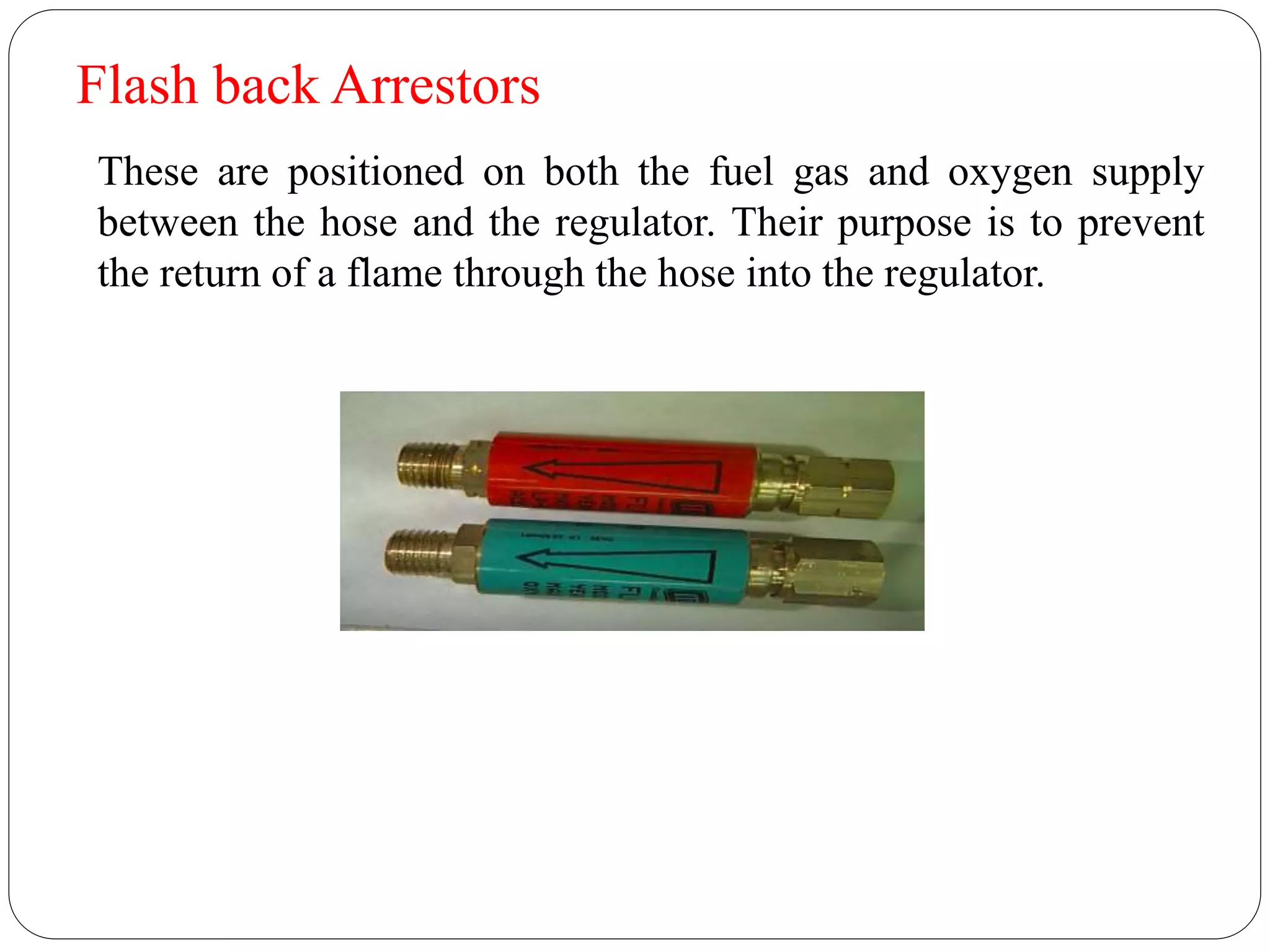
Flash back Arrestors
These are positioned on both the fuel gas and oxygen supply
between the hose and the regulator. Their purpose is to prevent
the return of a flame through the hose into the regulator.
Filler Rods and fluxes
Filler rods are used when additional filler metal is required in the
weld area they come in different diameters.
Fluxes protect the weld pool from contamination by oxygen and
nitrogen, they are normally in paste form placed on a heated filler
rod before welding begins
Additional Filler
Metal is fed in by
hand into the weld
pool, at regular
intervals where it
becomes molten
and joins with the
parent metal.
ARC WELDING PROCESSES
 This welding process, that use an electric arc to
produce the heat required for melting the metal
and filler material.
 The arc temperature may reach 10000°F
(5500°C), which is sufficient for fusion the work
piece edges and joining them.
 Metals at high temperatures tend to react
chemically with elements in the air - oxygen and
nitrogen.
 When metal in the molten pool comes into
contact with air, oxides and nitrides form which
destroy the strength and toughness of the weld
joint.
 Neutral shielding gases (argon, helium)
and/or shielding fluxes are used for protection of
Power supplies
 The most common classification is
constant current power supplies and
constant voltage power supplies.
 In arc welding, the voltage is directly related to the
length of the arc, and the current is related to the
amount of heat input.
 SMA welding normally uses constant current type of
power source with welding current 50-600A and
voltage 20-80V.
 Constant current power supplies are most often used
for manual welding processes.
 Constant voltage power supplies hold the voltage
constant and vary the current, and as a result, are
 In welding, the positively charged anode will have a
greater heat concentration and, as a result, changing
the polarity of the electrode has an impact on weld
properties.
 If the electrode is positively charged, it will melt more
quickly, increasing weld penetration and welding
speed.
 This process can use both AC and DC. The constant
current DC power source is invariably used with all
types of electrode irrespective of base metal.
Welding electrodes
 The electrode core itself acts as filler material,
making a separate filler unnecessary.
 The electrode rod is made of a material that is
compatible with the base material being welded and
is covered with a flux that gives off vapours that
serve as a shielding gas and provide a layer of slag,
both of which protect the weld area from
atmospheric contamination.
Electrode coating performs many functions
depending upon coating constituents, during welding
to improve weld metal properties.
The important functions are as follows:
1. Formation of shielding gas to protect molten
metal.
2. Alloying with certain elements such as Cr, Ni, Mo
to improve weld metal properties.
3. Improve the electric conductivity in the arc region
to improve the arc ignition and stabilization of the
arc.
Applications
 Today, almost all the commonly employed metals
and their alloys can be welded by this process.
 Shielded metal arc welding is used both as a
fabrication process and for maintenance and repair
jobs.
 The process finds applications in
(a) Building and Bridge construction
(b) Automotive and aircraft industry, etc.
(c) Air receiver, tank, boiler and pressure
vessel fabrication
(d) Ship building
(e) Pipes
Advantages
 Shielded Metal Arc Welding (SMAW) can be carried
out in any position with highest weld quality.
 MMAW is the simplest of all the arc welding
processes.
 This welding process finds innumerable
applications, because of the availability of a wide
variety of electrodes.
 Big range of metals and their alloys can be welded
easily.
 The MMAW welding equipment is portable and the
cost is fairly low.
Disadvantages
 Due to limited length of each electrode and brittle
flux coating on it, mechanization is difficult.
 Not as productive as continuous wire processes
 Likely to be more costly to deposit a given
quantity of metal
 Frequent stop/starts to change electrode
 Current limits are lower than for continuous or
automatic processes (reduces deposition rate)
Arc Welding Processes
1. Carbon Arc Welding
2. Shielded Metal Arc Welding
3. Submerged Arc Welding
4. Gas Tungsten Arc Welding
5. Gas Metal Arc Welding
6. Plasma Arc Welding
7. Atomic Hydrogen Welding
8. Electro-slag Welding
9. Stud Arc Welding
10. Electro-gas Welding
Carbon Arc Welding
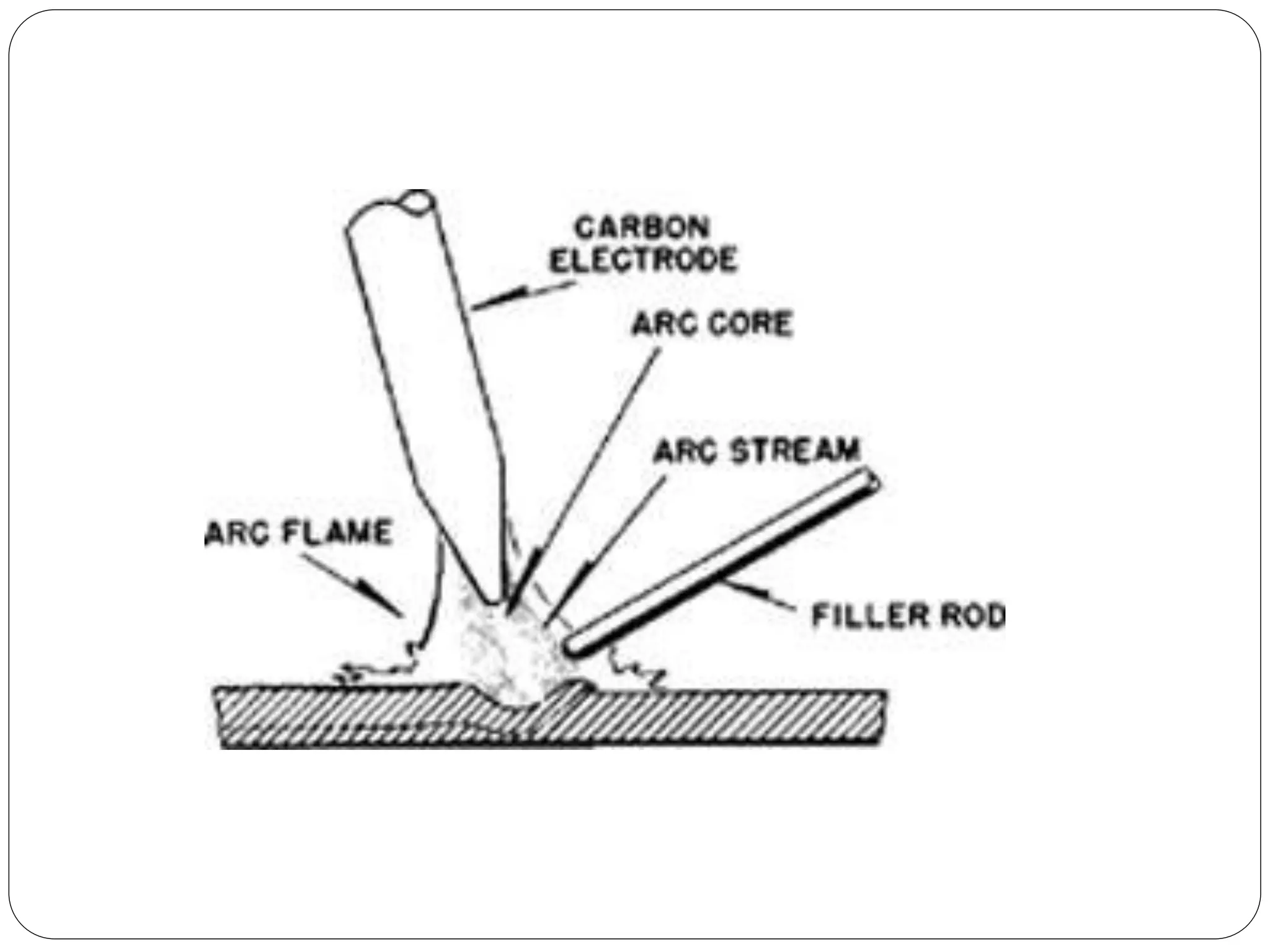
 Heat is generated by an electric arc struck between
an carbon electrode and the work piece.
 If required, filler rod may be used in Carbon Arc
Welding.
 Shields (neutral gas, flux) may be used for weld pool
protection depending on type of welded metal.
EQUIPMENTS USED
 DC power source
DC current level upto 600 Amps
 Electrode Holder
air or water cooled (current abobe 200Amps)
 Electrode
copper coated carbon electrode
increase electrical conductivity of the electrode
 Filler Rod
similar chemical composition of the base
material
same size of the electrode
Advantages
 Low cost of equipment and welding operation
compared to other process.
 Heat input to the workpiece can be easily controlled
by changing the arc length.
 Process suitable for butt welding of thin workpiece
(1 to 2 mm thick).
Disadvantages
 There are chances carbon being transferred from
electrode to weld metal
 Separate filler material needed
APPLICATIONS
 Welding of steel, aluminium, nickel, copper
 Pre heating and post heating of weld joints
Twin Carbon Electrode Arc
Welding
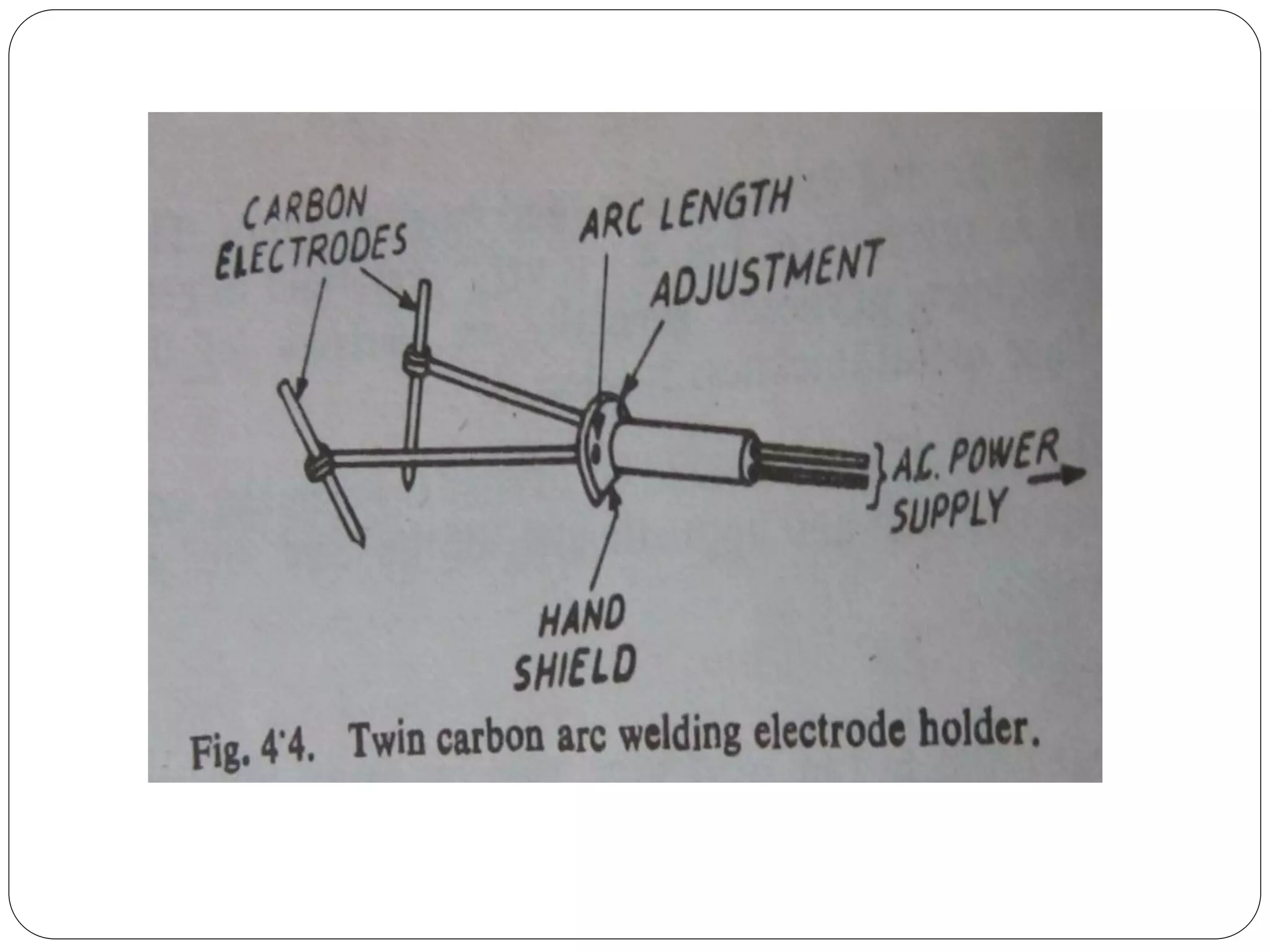
 Modification of Carbone Arc Welding is Twin
Carbon Electrode Arc Welding, utilizing arc
struck between two carbon electrodes.
 Filler metal may or may not be used.
 Work piece is not a part of welding electric
circuit in Twin Carbon Electrode Arc Welding,
therefore the welding torch may be moved from
one work piece to other without extinguishing the
arc.
• The size of arc depends upon the distance between
electrode tips, electrode diameters and welding
current.
• The heat input to the workpiece can be varied by
changing the arc size or distance between arc and
 AC power source recommended for twin carbon arc
welding process.
 DC power source produce unstable arc
 Electrodes diameter same as the workpiece
thickness
 The magnitude of arc current required for welding
depends upon both electrode diameter and plate
thickness. For example, an 8 mm diameter electrode
will need about 65 amps to weld a mild steel sheet of
thickness 3.5 mm and 80 Amps to weld a sheet of 6
mm thickness.
 Advantage that arc is independent of the job and can
be moved anywhere without getting extinguished.
FLUX SHIELDED METAL ARC
WELDING
 Shielded metal arc welding (SMAW), also known
as manual metal arc
welding (MMA or MMAW), flux shielded arc
welding.
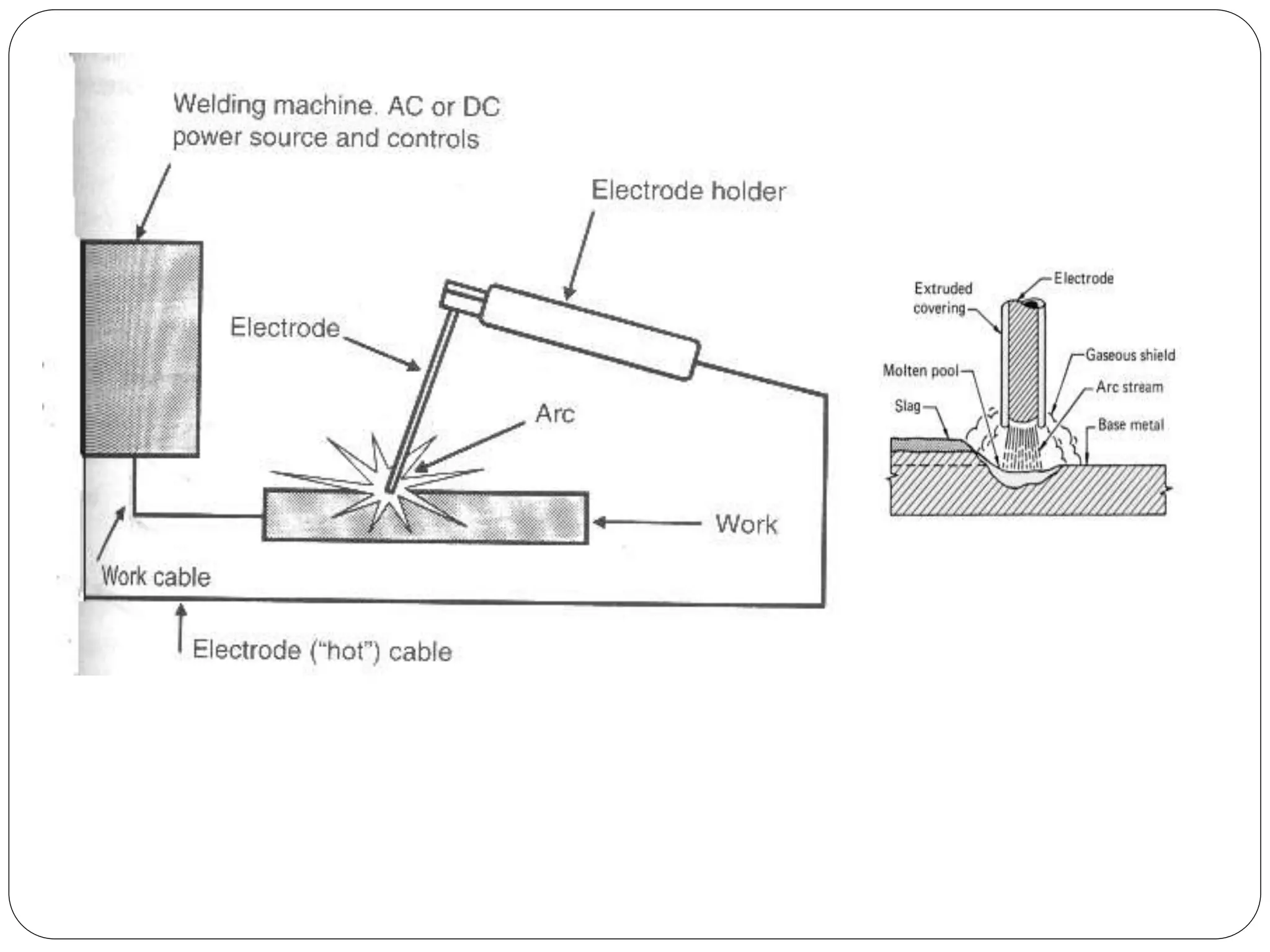
 SMAW uses a metallic consumable electrode of a
proper composition for generating arc between
itself and the parent work piece.
 The electrodes are coated with a shielding flux of
a suitable composition. The flux melts together with
the electrode metallic core, forming a gas and a
slag, shielding the arc and the weld pool.
EQUIPMENTS USED;
 AC or DC power supply
 Electrode holder
 Welding cable
AC or DC power supply
Higher AC arc current gives smooth arc, once
established the arc can be easily maintained and
controlled, it is suitable for thick sections.
As compared to DC power source AC source do
not produce noise, occupy less space, are less
costly to purchase.
DC arc is stable, arc heat can be regulated , it is
preferred for welding non ferrous metals.
 Electrode negative and electrode positive used in
d.c. welding
 DCEN (d.c. electrode negative)
 Electrode connected to negative terminal of power
source and work connected to positive terminal (current
flows from neg to pos) flow from electrode to work =
more electrode consumption.
 DCEP (d.c. electrode positive)
 Electrode connected to positive terminal of power
source and work connected to negative terminal
 Current range upto 600 Amps
 Voltage range 70 to 100 volts
ADVANTAGES:
 The equipment can be portable and cost is fairly low
 Used in all commercial purpose, due to availability of
variety of electrodes.
 Big range of metals and their alloys can be weld
 Joints (e.g., between nozzles and shell in a pressure
vessel) which because of their position are difficult to
be welded by automatic welding machines can be
easily accomplished by flux shielded metal arc
welding.
Disadvantages
 Because of the limited length of each electrode
and brittle flux coating on it mechanization is
difficult.
 In welding long joints (e.g., in pressure vessels),
as one electrode finishes, the weld is to be
progressed with the next electrode. Unless
properly cared, a defect (like slag inclusion or
insufficient penetration) may occur at the place
where welding is restarted with the new electrode.
 The process uses stick electrodes and thus it is
slower as compared to MIG welding.
APPLICATIONS
 Shielded metal arc welding is used both as a
fabrication process and for maintenance and
repair jobs.
 The process finds applications in
(a) Building and Bridge construction
(b) Automotive and aircraft industry, etc.
(c) Air receiver, tank, boiler and pressure
vessel fabrication
(d) Ship building
(e) Pipes and
(f) Penstock joining
SUBMERGED ARC WELDING
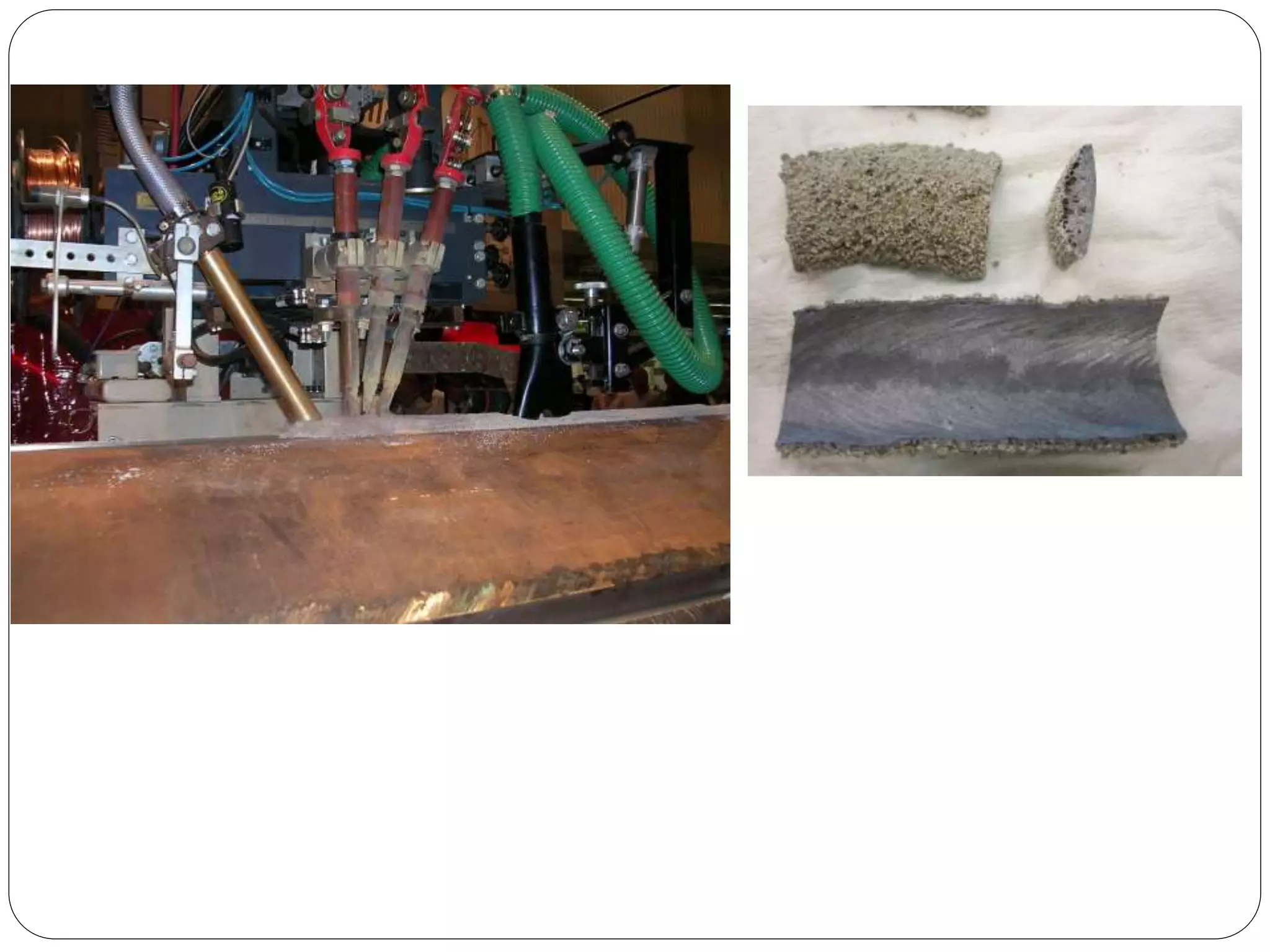
 The molten weld and the arc zone are protected
from atmospheric contamination by being
"submerged" under a blanket of granular fusible
flux consisting of lime, silica, manganese
oxide, calcium fluoride, and other compounds.
 The process is normally limited to the flat or
horizontal-fillet welding positions
 Single or multiple (2 to 5) electrode wire
variations of the process exist.
 DC or AC power can be used
 Constant voltage welding power supplies are
most commonly used.
 constant current systems in combination with a
voltage sensing wire-feeder are available.
Welding Operation
 The flux starts depositing on the joint to be
welded.
 The arc may be struck either by touching the
electrode with the job or by placing steel wool
between electrode and job.
 Flux otherwise is an insulator but once it melts
due to heat of the arc, it becomes highly
conductive and hence the current flow is
maintained between the electrode and the
workpiece through the molten flux.
 The upper portion of the flux, in contact with
atmosphere, which is visible remains granular
(unchanged) and can be reused. The lower,
 The electrode at a predetermined speed is
continuously fed to the joint to be welded.
 In semi-automatic welding sets the welding head is
moved manually along the joint. In automatic
welding a separate drive moves either the welding
head over the stationary job or the job
moves/rotates under the stationary welding head.
Material applications
 Carbon steels (structural and vessel construction)
 Low alloy steels
 Stainless steels
 Nickel-based alloys
Advantages
 Molten flux provides very suitable conditions for
high current to flow.
 Great intensities of heat generated and kept to
concentrated to weld thicker sections and deep
penetration.
 High speed welding of thin sheet steels up to 5
m/min is possible.
 Single pass welds can be made in thick plates
with normal equipment.
 50% to 90% of the flux is recoverable, recycled
and reused.
 Welds produced are sound, uniform, ductile,
corrosion resistant and have good impact value.
 Very neat appearance and smooth weld shapes
Disadvantages
 Since the operator cannot see the welding being
carried out, he cannot judge accurately the process of
welding. Therefore accessories like jigs and fixtures,
pointers, light beam focusing devices or roller guides
may be used for proper welding at the joint.
 A change in welding variables especially when using
alloyed fluxes may affect weld metal composition
adversely.
 Cast iron, Al alloys, Mg alloys, Pb and Zn cannot be
welded by this process.
 The progress is limited to welding in flat position and
on the metal more than 4.8 mm thick. In small
thicknesses burn through is likely to occur
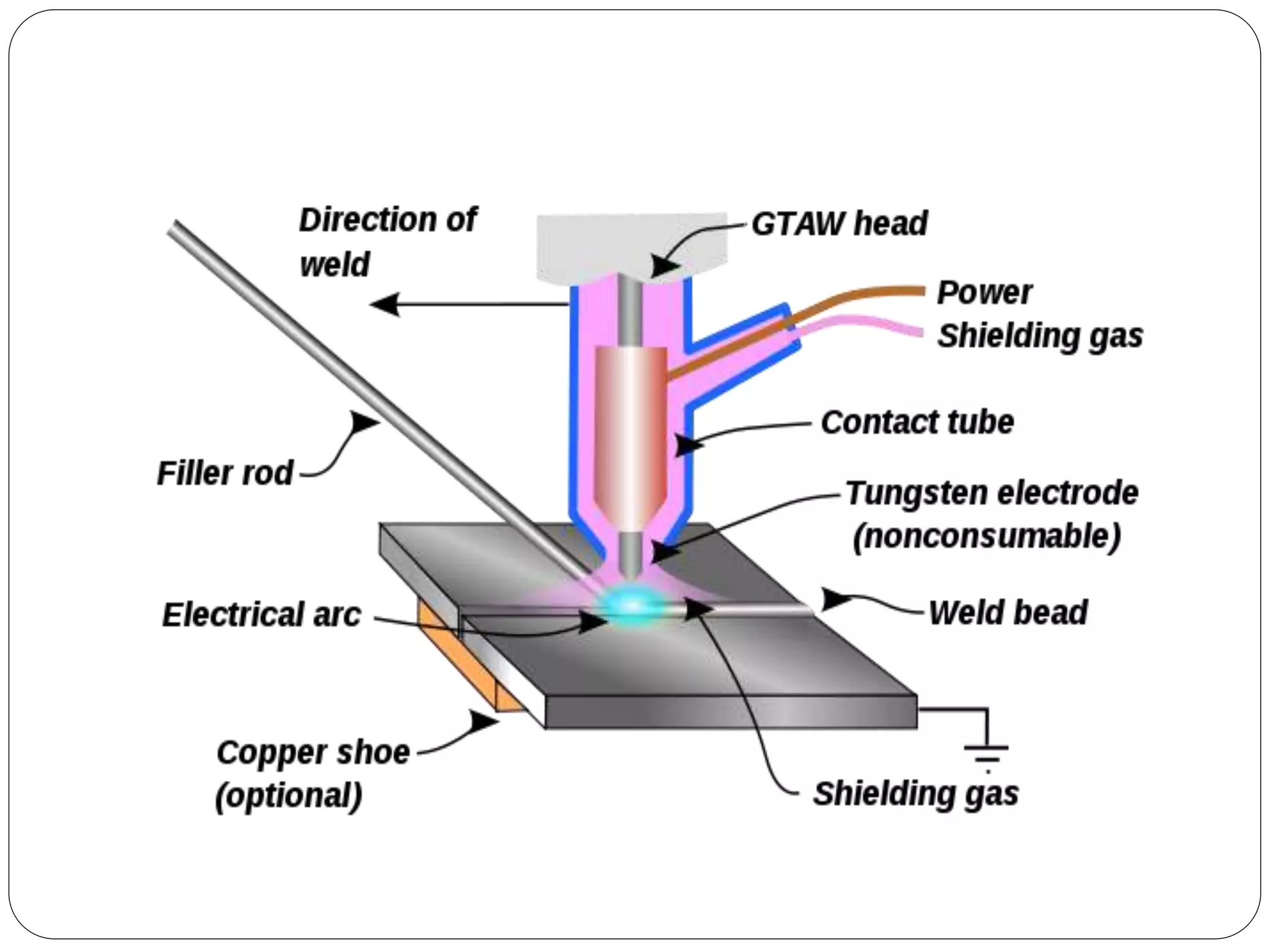
TIG WELDING
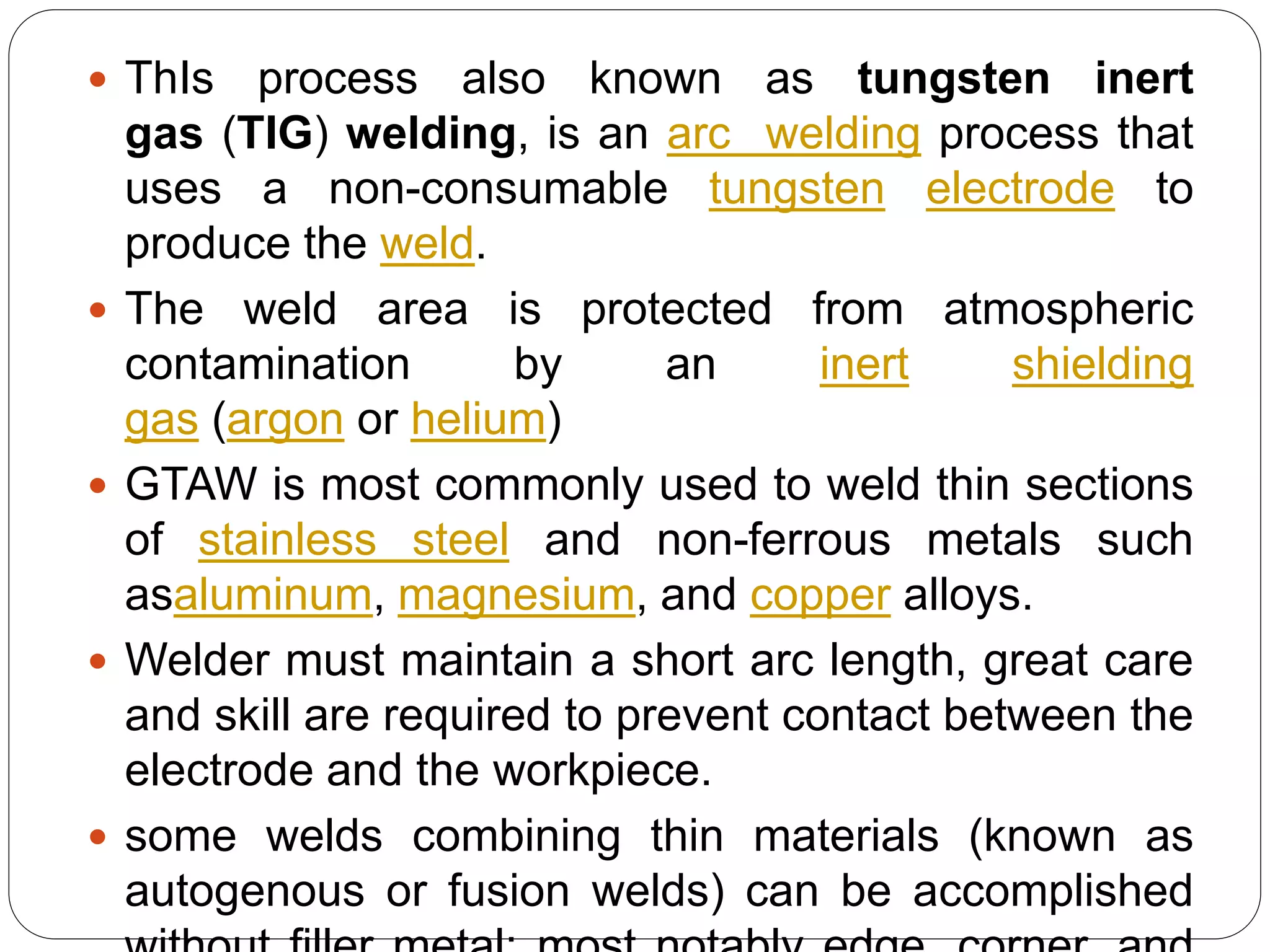
 ThIs process also known as tungsten inert
gas (TIG) welding, is an arc welding process that
uses a non-consumable tungsten electrode to
produce the weld.
 The weld area is protected from atmospheric
contamination by an inert shielding
gas (argon or helium)
 GTAW is most commonly used to weld thin sections
of stainless steel and non-ferrous metals such
asaluminum, magnesium, and copper alloys.
 Welder must maintain a short arc length, great care
and skill are required to prevent contact between the
electrode and the workpiece.
 some welds combining thin materials (known as
autogenous or fusion welds) can be accomplished
 the electrode and the workpiece are separated,
typically about 1.5–3 mm (0.06–0.12 in) apart. The
electric arc produced can reach temperatures of at
least 5000 °C.
Material Applications
Stainless steel
Alloy steel
Aluminium
Titanium
Copper
Magnesium
Nickel alloys
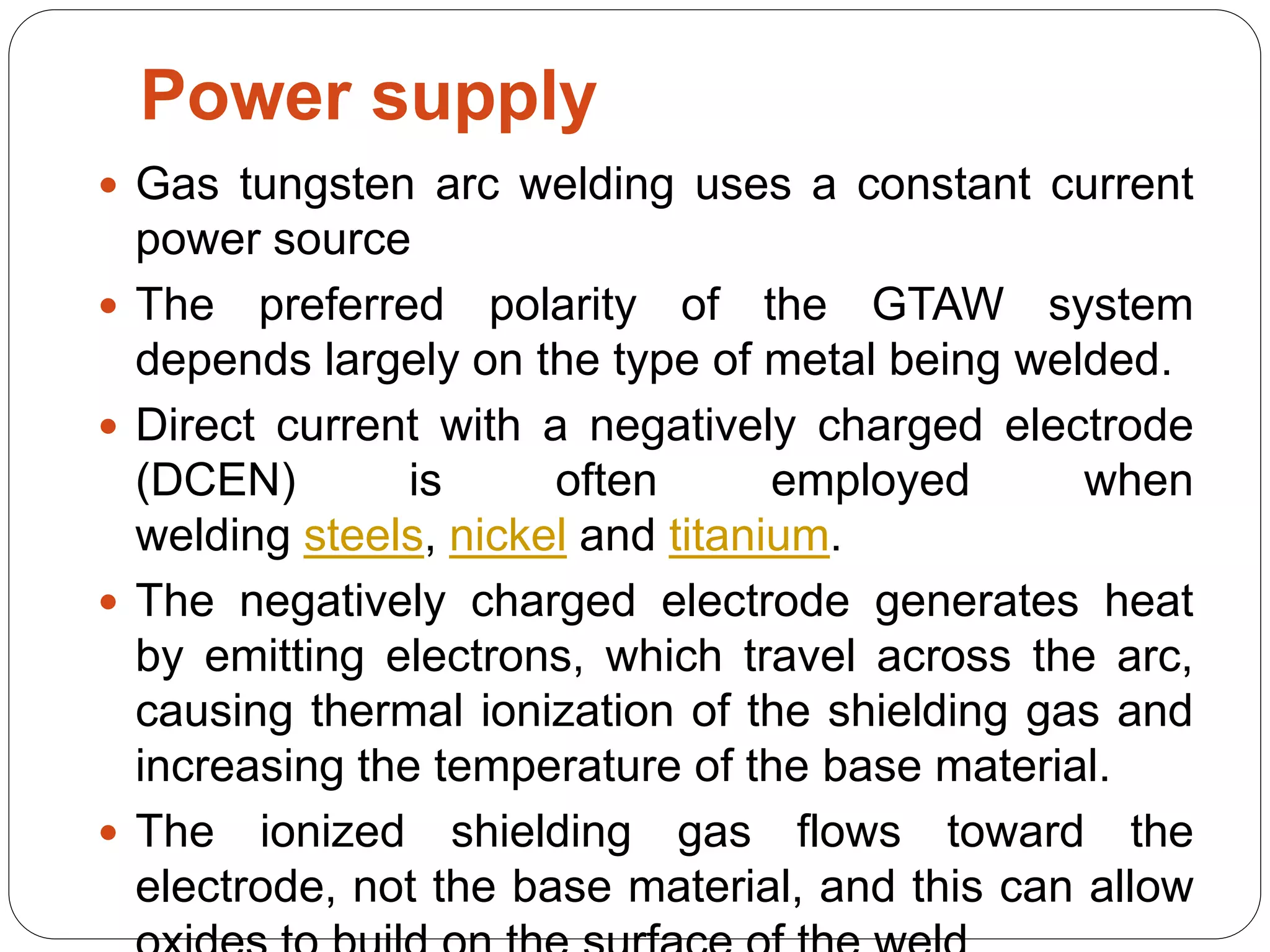
Power supply
 Gas tungsten arc welding uses a constant current
power source
 The preferred polarity of the GTAW system
depends largely on the type of metal being welded.
 Direct current with a negatively charged electrode
(DCEN) is often employed when
welding steels, nickel and titanium.
 The negatively charged electrode generates heat
by emitting electrons, which travel across the arc,
causing thermal ionization of the shielding gas and
increasing the temperature of the base material.
 The ionized shielding gas flows toward the
electrode, not the base material, and this can allow
 Alternating current, commonly used when welding
aluminum and magnesium manually or semi-
automatically.
Electrode
The electrode used in GTAW is made of tungsten or a
tungsten alloy, because tungsten has the highest
melting temperature among pure metals, at 3,422 °C
(6,192 °F). As a result, the electrode is not consumed
during welding, though some erosion (called burn-off)
can occur.
The diameter of the electrode can vary between 0.5 and
6.4 millimetres (0.02 and 0.25 in), and their length can
range from 75 to 610 millimetres
 Pure tungsten electrodes are general purpose and
low cost electrodes. They have poor heat resistance
and electron emission. They find limited use in AC
welding of e.g. magnesium and aluminium.
 Electrodes containing zirconium oxide increase the
current capacity while improving arc stability and
starting and increasing electrode life.
 Cerium oxide as an alloying element improves arc
stability
 Thorium oxide alloy electrodes were designed for DC
applications and can withstand somewhat higher
temperatures while providing many of the benefits of
other alloys.
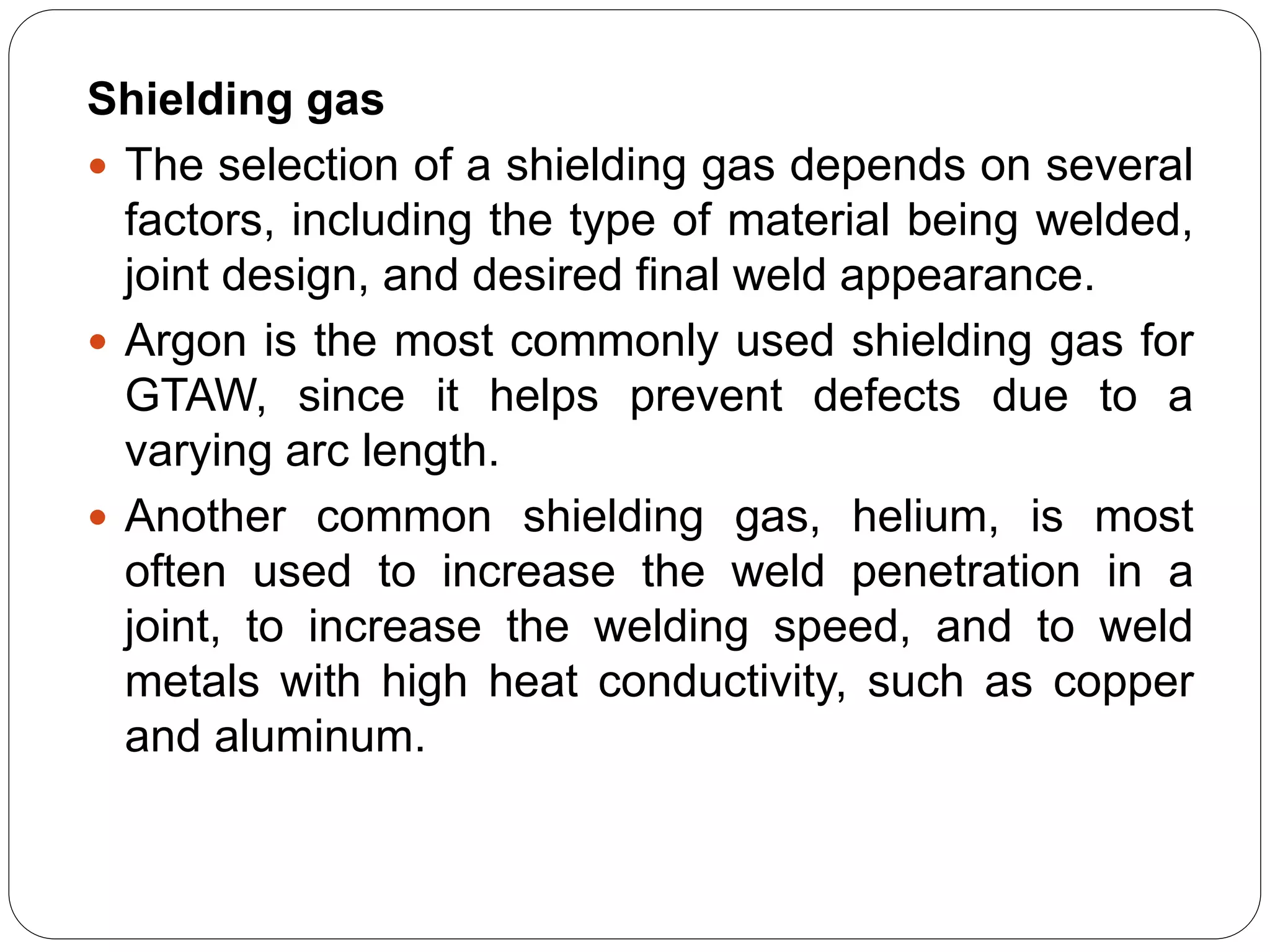
Shielding gas
 The selection of a shielding gas depends on several
factors, including the type of material being welded,
joint design, and desired final weld appearance.
 Argon is the most commonly used shielding gas for
GTAW, since it helps prevent defects due to a
varying arc length.
 Another common shielding gas, helium, is most
often used to increase the weld penetration in a
joint, to increase the welding speed, and to weld
metals with high heat conductivity, such as copper
and aluminum.
 Argon-helium mixtures are also frequently utilized in
GTAW, since they can increase control of the heat
input while maintaining the benefits of using argon.
Normally, the mixtures are made with primarily
helium (often about 75% or higher) and a balance of
argon. These mixtures increase the speed and
quality of the AC welding of aluminum, and also
make it easier to strike an arc.
Advantages
 Because of clear visibility of the arc and job, the
operator can exercise a better control on the
welding process.
 TIG welding is very much suitable for high quality
welding of thin materials (0.125mm).
 It is a very good process for welding non ferrous
metals
 This process can weld in all positions
Disadvantages
 Under similar applications MIG welding is much
faster process as compared to TIG welding.
 Tungsten if it transfers to molten weld pool can
contaminate into hard and brittle.
 Equipment's cost higher than shielded metal arc
welding
Applications
 Welding of sheet metal and thinner section.
 Precision welding in aircraft, chemical and
instrument industries.
 Rocket motor fabrications in launch vehicles.
GAS METAL ARC WELDING (GMAW)
OR
METAL INERT GAS WELDING (MIG)
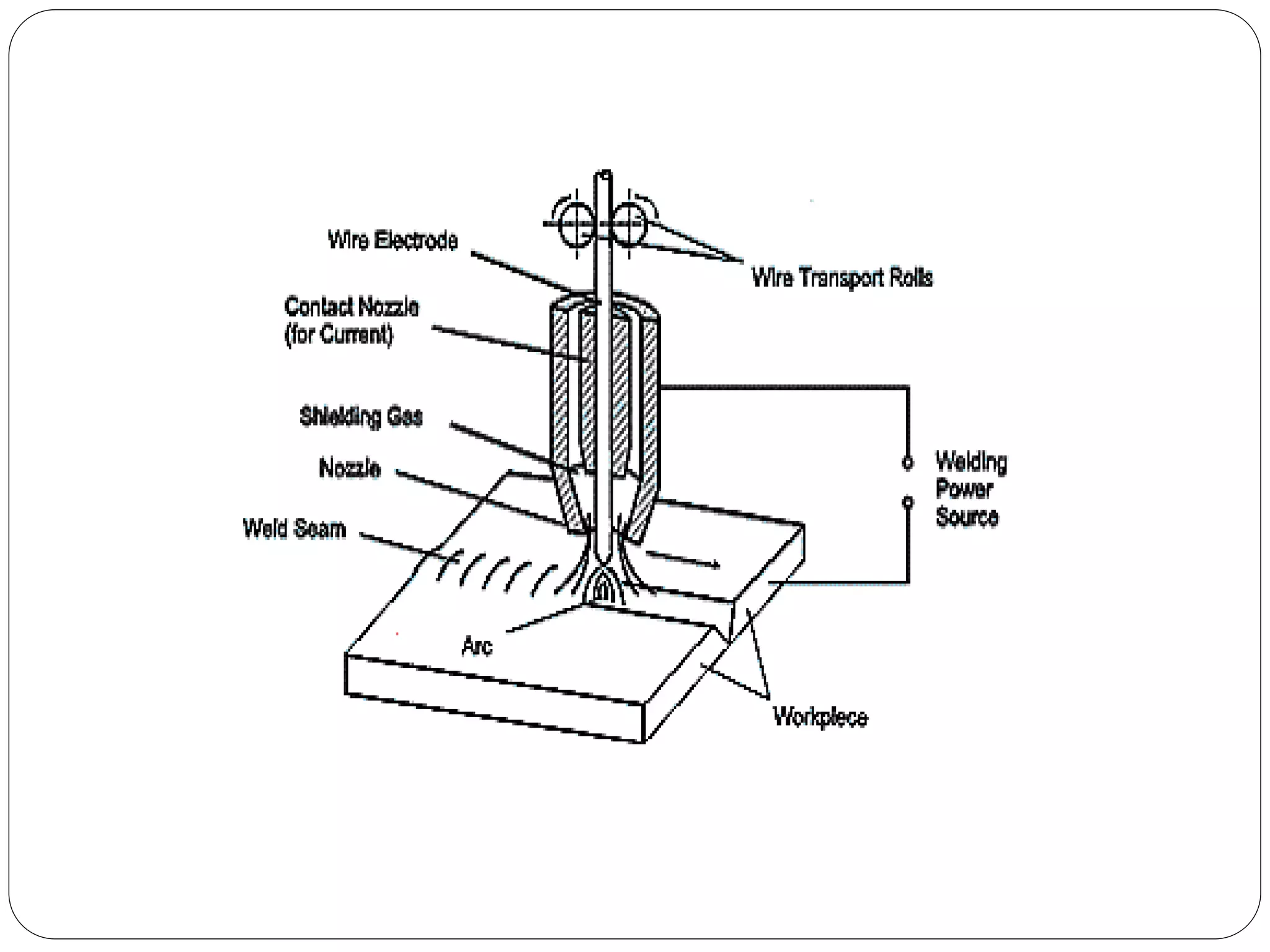
 Gas metal arc welding (GMAW), sometimes referred
to by its subtypes metal inert
gas (MIG) welding or metal active
gas (MAG) welding, is a welding process in which an
electric arc forms between a
consumable wire electrode and the workpiece metal,
which heats the workpiece metal, causing them to
melt, and join.
 Along with the wire electrode, a shielding gas feeds
through the welding gun, which shields the process
from contaminants in the air.
 The process can be semi-automatic or automatic.
 A constant voltage, direct current power source is
most commonly used with GMAW, but
constant current systems, as well as alternating
current, can be used.
PLASMA ARC WELDING
PROCESS
 When the temperature of a gas is raised to about
2000°C, the gas molecules become dissociated
into separate atoms. At higher temperatures,
30,000°C, electrons dissociate from some of the
atoms and the gas become ionized (electrically
conductive and responds to magnetism). The gas
in this stage is termed plasma.
 The electric arcis formed between
an electrode (which is usually but not always
made of sintered tungsten) and the workpiece.
 The difference from GTAW is that in PAW, by
positioning the electrode within the body of the
torch, the plasma arc can be separated from
the shielding gas envelope.
 Tungsten electrode has good electron emitting
WORKING
 In plasma welding a continuous arc is generated
between a hot tungsten cathode and the water-
cooled copper anode nozzle (non-transferred arc)
or between a tungsten/alloy tungsten electrode and
the job (transferred arc). A gas is introduced around
the cathode and flows through the anode. The
temperature, in the narrow orifice around the
cathode, reaches 28,000°C, which is enough to
produce a high-temperature plasma arc. Under
these conditions, the metal being is very rapidly
melted and welded.
Non-transferred arc process:
 The arc is formed between the electrode(-) and the
water cooled constricting nozzle(+). Arc plasma
comes out of the nozzle as a flame.
 The arc is independent of the work piece and the
work piece does not form a part of the electrical
circuit.
 Just as an arc flame, it can be moved from one
place to another and can be better controlled.
Plasma Torch
 It is either transferred arc or non transferred arc
typed.
 It is hand operated or mechanized.
 At present, almost all applications require
automated system.
 The torch is water cooled to increase the life of
the nozzle and the electrode.
 The size and the type of nozzle tip are selected
depending upon the metal to be welded, weld
shapes and desired penetration height.
Transferred arc process:
 The arc is formed between the electrode(-) and the
work piece(+).
 A transferred arc possesses high energy density
and plasma jet velocity. For this reason it is
employed to cut and melt metals. Besides carbon
steels this process can cut stainless steel and
nonferrous metals also where oxyacetylene torch
does not succeed.
 Transferred arc can also be used for welding at
high arc travel speeds.
 The temperature of a constricted plasma arc may be
of the order of 8000 - 250000C.
Shielding gases
 Most of the materials can be welded with argon,
helium, argon + hydrogen and argon + helium, as
inert gases or gas mixtures.
 Argon is very commonly used. Helium is preferred
where a broad heat input pattern and flatter cover
pass is desired.
 A mixture of argon and hydrogen supplies heat
energy higher than when only argon is used and
thus permits higher arc alloys and stainless
steels.

Welding Technology.ppt

  • 1.
    UNIT I GAS ANDARC WELDING PROCESSES
  • 2.
    INTRODUCTION  The manufacturingtechnology primarily involves sizing, shaping and imparting desired combination of the properties to the material so that the component or engineering system being produced to perform indented function for design life.  There are four chief manufacturing processes 1. Casting: zero process 2. Forming: zero process 3. Machining: negative process 4. Joining (welding): positive process
  • 3.
     Three typesof joining methods namely mechanical joining (nuts & bolts, clamps, rivets), adhesive joining (epoxy resins, fevicol), welding (welding, brazing and soldering) are commonly used for manufacturing variety of engineering product/component.  The following factors considered while selecting type of joining for an application: 1. type of joint required for an application is temporary or permanent 2. Whether similar or dissimilar materials are to be joined 3. type and nature of loading conditions 4. economy or cost effectiveness
  • 4.
    WELDING  Welding isa process for joining two similar or dissimilar metals by fusion. It joins different metals/alloys, with or without the application of pressure and with or without the use of filler metal.  The fusion of metal takes place by means of heat.  The heat may be generated either from combustion of gases, electric arc, electric resistance or by chemical reaction.  It is therefore usually accompanied by post weld heat treatment for most of the critical components.
  • 5.
    ADVANTAGES  Large numberof metals and alloys both similar and dissimilar can be joined by welding.  Welding is more economical and is much faster process as compared to other processes (riveting, bolting, casting etc.)  Welding, if properly controlled results permanent joints having strength equal or sometimes more than base metal.
  • 6.
    Laser Beam Welding:A318/A380  Riveting consumes 40% of man hours on structure  LBW cuts time by half (8 m/min!)  Less expensive (fewer mfg steps)  Less corrosion (no holes, crevices)  Lighter (no sealing)  Stronger than rivets  Same fatigue life
  • 7.
    DISADVANTAGES  Labour costis high as only skilled welder can produce sound and quality weld joint.  Heat during welding produces metallurgical changes as the structure of the welded joint is not same as that of the parent metal.  Hazardous fumes and vapours are generated during welding. This demands proper ventilation of welding area.
  • 8.
    TYPES  Plastic Weldingor Pressure Welding The piece of metal to be joined are heated to a plastic state and forced together by external pressure (Ex) Resistance welding  Fusion Welding or Non-Pressure Welding The material at the joint is heated to a molten state and allowed to solidify (Ex) Gas welding, Arc welding
  • 9.
    Classification of weldingprocesses: (i). Arc welding  Carbon arc  Metal arc  Metal inert gas  Tungsten inert gas  Plasma arc  Submerged arc  Electro-slag (ii). Gas Welding  Oxy-acetylene  Air-acetylene  Oxy-hydrogen (iii). Resistance Welding  Butt  Spot  Seam  Projection  Percussion (iv)Thermit Welding (v)Solid State Welding Friction Ultrasonic Diffusion Explosive (vi)Newer Welding Electron-beam Laser (vii)Related Process Oxy-acetylene cutting Arc cutting Hard facing Brazing Soldering
  • 10.
    Gas Welding  Itis a fusion welding in which strong gas flame is used to generate heat and raise temperature of metal pieces localized at the place where joint is to be made.  In this welding metal pieces to be joined are heated. The metal thus melted starts flowing along the edges where joint is to be made.  A filler metal may also be added to the flowing molten metal to fill up the cavity at the edges. The cavity filed with molten metal is allowed to solidify to get the strong joint.
  • 11.
     Different combinationsof gases can be used to obtain a heating flame. The popular gas combinations are oxy-hydrogen mixture, oxygen- acetylene, etc.  Different mixing proportion of two gases in a mixture can generate different types of flames with different characteristics.
  • 12.
  • 13.
     Acetylene mixedwith oxygen when burnt under a controlled environment produces large amount of heat giving higher temperature rise. This burning also produces carbondioxide which helps in preventing oxidation of metals being welded. Highest temperature that can be produced by this welding is 3200°C.  This welding does not require the components to be forced together under pressure until the weld forms and solidify.
  • 14.
     on thebasis of supply pressure of gases oxy- acetylene welding is categorized as high pressure welding in this system both gases oxygen and acetylene supplied to welding zone are high pressure from their respective high pressure cylinders.  The other one is low pressure welding in which oxygen is supplied from high pressure cylinder but acetylene is generated by the action of water on calcium carbide and supplied at low pressure. In this case high pressure supply of oxygen pulls acetylene at the welding zone.
  • 15.
  • 16.
    Neutral Welding Flame A neutral flame results when approximately equal volumes of oxygen and acetylene are mixed in the welding torch and burnt at the torch tip. The temperature of the neutral flame is of the order of about 5900°F (3260°C).  It has a clear, well defined inner cone, indicating that the combustion is complete. The inner cone is light blue in colour. It is surrounded by an outer flame envelope, produced by the combination of oxygen in the air and superheated carbon monoxide and hydrogen gases from the inner cone.  A neutral flame is named so because it affects no chemical change on the molten metal and, therefore will not oxidize or carburize the metal.
  • 17.
    Carburising or ReducingWelding Flame  The carburizing or reducing flame has excess of acetylene  The outer flame envelope is longer than that of the neutral flame and is usually much brighter in colour.  A reducing flame may be distinguished from carburizing flame by the fact that a carburizing flame contains more acetylene than a reducing flame. A reducing flame has an approximate temperature of 3038°C.  With iron and steel, carburizing flame produces very hard, brittle substance known as iron carbide.  It is used for welding with low alloy steel rods and for welding those metals, (e.g., non-ferrous) that do not tend to absorb carbon. This flame is very well
  • 18.
    Oxidising Welding flame The oxidizing flame has an excess of oxygen over the acetylene. An oxidizing flame can be recognized by the small cone, which is shorter, much bluer in colour and more pointed than that of the neutral flame.  It is the hottest flame (temperature as high as 6300°F) produced by any oxy-fuel gas source.  It would be an advantage if it were not for fact that the excess oxygen especially at high temperatures tends to combine with many metals to form hard and brittle.  A slightly oxidizing flame is helpful when welding (i) Copper-base metals (ii) Zinc-base metals and (iii) A few types of ferrous metals such as manganese steel
  • 19.
    Equipment used inOxy-Acetylene welding  Gas cylinders (two)  Hose pipes and valves  Cylinder pressure gauge  Outlet pressure gauge  Pressure regulators  Blow pipe or torch and spark lights  Goggles, screens, gloves and apron  Wire brush, trolley, chipping hammer.
  • 20.
    The oxygen andacetylene hose pipes Reinforced rubber hoses. Acetylene hose has left hand thread couplings and colour coded red. Oxygen hose has right handed thread couplings and colour coded blue Gases used Oxygen extracted from air and compressed into cylinders at high pressure. Cylinder is black. Oil should never be brought into contact and should not be used on fittings Acetylene (C2H2) is a fuel gas. Cannot be compressed directly as explodes at high pressures. Cylinders are packed with porous material which is filled with acetone. Acetone absorbs acetylene. Cylinder colour coded maroon
  • 21.
    CYLINDER  Acetylene andoxygen gas is stored in compressed gas cylinders. These gas cylinders differ widely in capacity, design and colour code.  The standard size of these cylinders is 6 to 7 m3 and is painted black for oxygen and maroon for acetylene.  An acetylene cylinder is filled with some absorptive material, which is saturated with a chemical solvent acetone. Acetone has the ability to absorb a large volume of acetylene and release it as the pressure falls.  If large quantities of acetylene gas are being consumed, it is much cheaper to generate the gas at the place of use with the help of acetylene gas
  • 22.
    Gas Pressure Regulators Apressure regulator is connected between the cylinder and hose leading to welding torch. The cylinder and hose connections have left-handed threads on the acetylene regulator while these are right handed on the oxygen regulator. 1. To reduce high pressure of the gas in the cylinder to a suitable working pressure
  • 23.
    Welding torch Oxygen andacetylene are delivered to the torch by separate hoses. Each gas is controlled by a valve on the torch. The two gases mix in the torch and after they are ignited burn at the nozzle. There are two basic types of gas welding torches: (1)High pressure or equal presure (2) Low pressure or injector type
  • 24.
    Flash back Arrestors Theseare positioned on both the fuel gas and oxygen supply between the hose and the regulator. Their purpose is to prevent the return of a flame through the hose into the regulator.
  • 25.
    Filler Rods andfluxes Filler rods are used when additional filler metal is required in the weld area they come in different diameters. Fluxes protect the weld pool from contamination by oxygen and nitrogen, they are normally in paste form placed on a heated filler rod before welding begins
  • 26.
    Additional Filler Metal isfed in by hand into the weld pool, at regular intervals where it becomes molten and joins with the parent metal.
  • 27.
  • 29.
     This weldingprocess, that use an electric arc to produce the heat required for melting the metal and filler material.  The arc temperature may reach 10000°F (5500°C), which is sufficient for fusion the work piece edges and joining them.  Metals at high temperatures tend to react chemically with elements in the air - oxygen and nitrogen.  When metal in the molten pool comes into contact with air, oxides and nitrides form which destroy the strength and toughness of the weld joint.  Neutral shielding gases (argon, helium) and/or shielding fluxes are used for protection of
  • 30.
    Power supplies  Themost common classification is constant current power supplies and constant voltage power supplies.  In arc welding, the voltage is directly related to the length of the arc, and the current is related to the amount of heat input.  SMA welding normally uses constant current type of power source with welding current 50-600A and voltage 20-80V.  Constant current power supplies are most often used for manual welding processes.  Constant voltage power supplies hold the voltage constant and vary the current, and as a result, are
  • 31.
     In welding,the positively charged anode will have a greater heat concentration and, as a result, changing the polarity of the electrode has an impact on weld properties.  If the electrode is positively charged, it will melt more quickly, increasing weld penetration and welding speed.  This process can use both AC and DC. The constant current DC power source is invariably used with all types of electrode irrespective of base metal.
  • 32.
    Welding electrodes  Theelectrode core itself acts as filler material, making a separate filler unnecessary.  The electrode rod is made of a material that is compatible with the base material being welded and is covered with a flux that gives off vapours that serve as a shielding gas and provide a layer of slag, both of which protect the weld area from atmospheric contamination.
  • 33.
    Electrode coating performsmany functions depending upon coating constituents, during welding to improve weld metal properties. The important functions are as follows: 1. Formation of shielding gas to protect molten metal. 2. Alloying with certain elements such as Cr, Ni, Mo to improve weld metal properties. 3. Improve the electric conductivity in the arc region to improve the arc ignition and stabilization of the arc.
  • 34.
    Applications  Today, almostall the commonly employed metals and their alloys can be welded by this process.  Shielded metal arc welding is used both as a fabrication process and for maintenance and repair jobs.  The process finds applications in (a) Building and Bridge construction (b) Automotive and aircraft industry, etc. (c) Air receiver, tank, boiler and pressure vessel fabrication (d) Ship building (e) Pipes
  • 35.
    Advantages  Shielded MetalArc Welding (SMAW) can be carried out in any position with highest weld quality.  MMAW is the simplest of all the arc welding processes.  This welding process finds innumerable applications, because of the availability of a wide variety of electrodes.  Big range of metals and their alloys can be welded easily.  The MMAW welding equipment is portable and the cost is fairly low.
  • 36.
    Disadvantages  Due tolimited length of each electrode and brittle flux coating on it, mechanization is difficult.  Not as productive as continuous wire processes  Likely to be more costly to deposit a given quantity of metal  Frequent stop/starts to change electrode  Current limits are lower than for continuous or automatic processes (reduces deposition rate)
  • 37.
    Arc Welding Processes 1.Carbon Arc Welding 2. Shielded Metal Arc Welding 3. Submerged Arc Welding 4. Gas Tungsten Arc Welding 5. Gas Metal Arc Welding 6. Plasma Arc Welding 7. Atomic Hydrogen Welding 8. Electro-slag Welding 9. Stud Arc Welding 10. Electro-gas Welding
  • 38.
    Carbon Arc Welding Heat is generated by an electric arc struck between an carbon electrode and the work piece.  If required, filler rod may be used in Carbon Arc Welding.  Shields (neutral gas, flux) may be used for weld pool protection depending on type of welded metal.
  • 40.
    EQUIPMENTS USED  DCpower source DC current level upto 600 Amps  Electrode Holder air or water cooled (current abobe 200Amps)  Electrode copper coated carbon electrode increase electrical conductivity of the electrode  Filler Rod similar chemical composition of the base material same size of the electrode
  • 41.
    Advantages  Low costof equipment and welding operation compared to other process.  Heat input to the workpiece can be easily controlled by changing the arc length.  Process suitable for butt welding of thin workpiece (1 to 2 mm thick). Disadvantages  There are chances carbon being transferred from electrode to weld metal  Separate filler material needed APPLICATIONS  Welding of steel, aluminium, nickel, copper  Pre heating and post heating of weld joints
  • 42.
    Twin Carbon ElectrodeArc Welding  Modification of Carbone Arc Welding is Twin Carbon Electrode Arc Welding, utilizing arc struck between two carbon electrodes.  Filler metal may or may not be used.  Work piece is not a part of welding electric circuit in Twin Carbon Electrode Arc Welding, therefore the welding torch may be moved from one work piece to other without extinguishing the arc.
  • 44.
    • The sizeof arc depends upon the distance between electrode tips, electrode diameters and welding current. • The heat input to the workpiece can be varied by changing the arc size or distance between arc and
  • 45.
     AC powersource recommended for twin carbon arc welding process.  DC power source produce unstable arc  Electrodes diameter same as the workpiece thickness  The magnitude of arc current required for welding depends upon both electrode diameter and plate thickness. For example, an 8 mm diameter electrode will need about 65 amps to weld a mild steel sheet of thickness 3.5 mm and 80 Amps to weld a sheet of 6 mm thickness.  Advantage that arc is independent of the job and can be moved anywhere without getting extinguished.
  • 46.
  • 47.
     Shielded metalarc welding (SMAW), also known as manual metal arc welding (MMA or MMAW), flux shielded arc welding.  SMAW uses a metallic consumable electrode of a proper composition for generating arc between itself and the parent work piece.  The electrodes are coated with a shielding flux of a suitable composition. The flux melts together with the electrode metallic core, forming a gas and a slag, shielding the arc and the weld pool.
  • 49.
    EQUIPMENTS USED;  ACor DC power supply  Electrode holder  Welding cable AC or DC power supply Higher AC arc current gives smooth arc, once established the arc can be easily maintained and controlled, it is suitable for thick sections. As compared to DC power source AC source do not produce noise, occupy less space, are less costly to purchase. DC arc is stable, arc heat can be regulated , it is preferred for welding non ferrous metals.
  • 50.
     Electrode negativeand electrode positive used in d.c. welding  DCEN (d.c. electrode negative)  Electrode connected to negative terminal of power source and work connected to positive terminal (current flows from neg to pos) flow from electrode to work = more electrode consumption.  DCEP (d.c. electrode positive)  Electrode connected to positive terminal of power source and work connected to negative terminal
  • 51.
     Current rangeupto 600 Amps  Voltage range 70 to 100 volts ADVANTAGES:  The equipment can be portable and cost is fairly low  Used in all commercial purpose, due to availability of variety of electrodes.  Big range of metals and their alloys can be weld  Joints (e.g., between nozzles and shell in a pressure vessel) which because of their position are difficult to be welded by automatic welding machines can be easily accomplished by flux shielded metal arc welding.
  • 52.
    Disadvantages  Because ofthe limited length of each electrode and brittle flux coating on it mechanization is difficult.  In welding long joints (e.g., in pressure vessels), as one electrode finishes, the weld is to be progressed with the next electrode. Unless properly cared, a defect (like slag inclusion or insufficient penetration) may occur at the place where welding is restarted with the new electrode.  The process uses stick electrodes and thus it is slower as compared to MIG welding.
  • 53.
    APPLICATIONS  Shielded metalarc welding is used both as a fabrication process and for maintenance and repair jobs.  The process finds applications in (a) Building and Bridge construction (b) Automotive and aircraft industry, etc. (c) Air receiver, tank, boiler and pressure vessel fabrication (d) Ship building (e) Pipes and (f) Penstock joining
  • 54.
  • 55.
     The moltenweld and the arc zone are protected from atmospheric contamination by being "submerged" under a blanket of granular fusible flux consisting of lime, silica, manganese oxide, calcium fluoride, and other compounds.  The process is normally limited to the flat or horizontal-fillet welding positions  Single or multiple (2 to 5) electrode wire variations of the process exist.  DC or AC power can be used  Constant voltage welding power supplies are most commonly used.  constant current systems in combination with a voltage sensing wire-feeder are available.
  • 58.
    Welding Operation  Theflux starts depositing on the joint to be welded.  The arc may be struck either by touching the electrode with the job or by placing steel wool between electrode and job.  Flux otherwise is an insulator but once it melts due to heat of the arc, it becomes highly conductive and hence the current flow is maintained between the electrode and the workpiece through the molten flux.  The upper portion of the flux, in contact with atmosphere, which is visible remains granular (unchanged) and can be reused. The lower,
  • 59.
     The electrodeat a predetermined speed is continuously fed to the joint to be welded.  In semi-automatic welding sets the welding head is moved manually along the joint. In automatic welding a separate drive moves either the welding head over the stationary job or the job moves/rotates under the stationary welding head.
  • 60.
    Material applications  Carbonsteels (structural and vessel construction)  Low alloy steels  Stainless steels  Nickel-based alloys
  • 61.
    Advantages  Molten fluxprovides very suitable conditions for high current to flow.  Great intensities of heat generated and kept to concentrated to weld thicker sections and deep penetration.  High speed welding of thin sheet steels up to 5 m/min is possible.  Single pass welds can be made in thick plates with normal equipment.  50% to 90% of the flux is recoverable, recycled and reused.  Welds produced are sound, uniform, ductile, corrosion resistant and have good impact value.  Very neat appearance and smooth weld shapes
  • 62.
    Disadvantages  Since theoperator cannot see the welding being carried out, he cannot judge accurately the process of welding. Therefore accessories like jigs and fixtures, pointers, light beam focusing devices or roller guides may be used for proper welding at the joint.  A change in welding variables especially when using alloyed fluxes may affect weld metal composition adversely.  Cast iron, Al alloys, Mg alloys, Pb and Zn cannot be welded by this process.  The progress is limited to welding in flat position and on the metal more than 4.8 mm thick. In small thicknesses burn through is likely to occur
  • 63.
  • 65.
     ThIs processalso known as tungsten inert gas (TIG) welding, is an arc welding process that uses a non-consumable tungsten electrode to produce the weld.  The weld area is protected from atmospheric contamination by an inert shielding gas (argon or helium)  GTAW is most commonly used to weld thin sections of stainless steel and non-ferrous metals such asaluminum, magnesium, and copper alloys.  Welder must maintain a short arc length, great care and skill are required to prevent contact between the electrode and the workpiece.  some welds combining thin materials (known as autogenous or fusion welds) can be accomplished
  • 66.
     the electrodeand the workpiece are separated, typically about 1.5–3 mm (0.06–0.12 in) apart. The electric arc produced can reach temperatures of at least 5000 °C. Material Applications Stainless steel Alloy steel Aluminium Titanium Copper Magnesium Nickel alloys
  • 67.
    Power supply  Gastungsten arc welding uses a constant current power source  The preferred polarity of the GTAW system depends largely on the type of metal being welded.  Direct current with a negatively charged electrode (DCEN) is often employed when welding steels, nickel and titanium.  The negatively charged electrode generates heat by emitting electrons, which travel across the arc, causing thermal ionization of the shielding gas and increasing the temperature of the base material.  The ionized shielding gas flows toward the electrode, not the base material, and this can allow
  • 68.
     Alternating current,commonly used when welding aluminum and magnesium manually or semi- automatically. Electrode The electrode used in GTAW is made of tungsten or a tungsten alloy, because tungsten has the highest melting temperature among pure metals, at 3,422 °C (6,192 °F). As a result, the electrode is not consumed during welding, though some erosion (called burn-off) can occur. The diameter of the electrode can vary between 0.5 and 6.4 millimetres (0.02 and 0.25 in), and their length can range from 75 to 610 millimetres
  • 69.
     Pure tungstenelectrodes are general purpose and low cost electrodes. They have poor heat resistance and electron emission. They find limited use in AC welding of e.g. magnesium and aluminium.  Electrodes containing zirconium oxide increase the current capacity while improving arc stability and starting and increasing electrode life.  Cerium oxide as an alloying element improves arc stability  Thorium oxide alloy electrodes were designed for DC applications and can withstand somewhat higher temperatures while providing many of the benefits of other alloys.
  • 70.
    Shielding gas  Theselection of a shielding gas depends on several factors, including the type of material being welded, joint design, and desired final weld appearance.  Argon is the most commonly used shielding gas for GTAW, since it helps prevent defects due to a varying arc length.  Another common shielding gas, helium, is most often used to increase the weld penetration in a joint, to increase the welding speed, and to weld metals with high heat conductivity, such as copper and aluminum.
  • 71.
     Argon-helium mixturesare also frequently utilized in GTAW, since they can increase control of the heat input while maintaining the benefits of using argon. Normally, the mixtures are made with primarily helium (often about 75% or higher) and a balance of argon. These mixtures increase the speed and quality of the AC welding of aluminum, and also make it easier to strike an arc.
  • 72.
    Advantages  Because ofclear visibility of the arc and job, the operator can exercise a better control on the welding process.  TIG welding is very much suitable for high quality welding of thin materials (0.125mm).  It is a very good process for welding non ferrous metals  This process can weld in all positions
  • 73.
    Disadvantages  Under similarapplications MIG welding is much faster process as compared to TIG welding.  Tungsten if it transfers to molten weld pool can contaminate into hard and brittle.  Equipment's cost higher than shielded metal arc welding Applications  Welding of sheet metal and thinner section.  Precision welding in aircraft, chemical and instrument industries.  Rocket motor fabrications in launch vehicles.
  • 74.
    GAS METAL ARCWELDING (GMAW) OR METAL INERT GAS WELDING (MIG)
  • 75.
     Gas metalarc welding (GMAW), sometimes referred to by its subtypes metal inert gas (MIG) welding or metal active gas (MAG) welding, is a welding process in which an electric arc forms between a consumable wire electrode and the workpiece metal, which heats the workpiece metal, causing them to melt, and join.  Along with the wire electrode, a shielding gas feeds through the welding gun, which shields the process from contaminants in the air.  The process can be semi-automatic or automatic.  A constant voltage, direct current power source is most commonly used with GMAW, but constant current systems, as well as alternating current, can be used.
  • 77.
  • 79.
     When thetemperature of a gas is raised to about 2000°C, the gas molecules become dissociated into separate atoms. At higher temperatures, 30,000°C, electrons dissociate from some of the atoms and the gas become ionized (electrically conductive and responds to magnetism). The gas in this stage is termed plasma.  The electric arcis formed between an electrode (which is usually but not always made of sintered tungsten) and the workpiece.  The difference from GTAW is that in PAW, by positioning the electrode within the body of the torch, the plasma arc can be separated from the shielding gas envelope.  Tungsten electrode has good electron emitting
  • 80.
    WORKING  In plasmawelding a continuous arc is generated between a hot tungsten cathode and the water- cooled copper anode nozzle (non-transferred arc) or between a tungsten/alloy tungsten electrode and the job (transferred arc). A gas is introduced around the cathode and flows through the anode. The temperature, in the narrow orifice around the cathode, reaches 28,000°C, which is enough to produce a high-temperature plasma arc. Under these conditions, the metal being is very rapidly melted and welded.
  • 82.
    Non-transferred arc process: The arc is formed between the electrode(-) and the water cooled constricting nozzle(+). Arc plasma comes out of the nozzle as a flame.  The arc is independent of the work piece and the work piece does not form a part of the electrical circuit.  Just as an arc flame, it can be moved from one place to another and can be better controlled.
  • 83.
    Plasma Torch  Itis either transferred arc or non transferred arc typed.  It is hand operated or mechanized.  At present, almost all applications require automated system.  The torch is water cooled to increase the life of the nozzle and the electrode.  The size and the type of nozzle tip are selected depending upon the metal to be welded, weld shapes and desired penetration height.
  • 84.
    Transferred arc process: The arc is formed between the electrode(-) and the work piece(+).  A transferred arc possesses high energy density and plasma jet velocity. For this reason it is employed to cut and melt metals. Besides carbon steels this process can cut stainless steel and nonferrous metals also where oxyacetylene torch does not succeed.  Transferred arc can also be used for welding at high arc travel speeds.  The temperature of a constricted plasma arc may be of the order of 8000 - 250000C.
  • 85.
    Shielding gases  Mostof the materials can be welded with argon, helium, argon + hydrogen and argon + helium, as inert gases or gas mixtures.  Argon is very commonly used. Helium is preferred where a broad heat input pattern and flatter cover pass is desired.  A mixture of argon and hydrogen supplies heat energy higher than when only argon is used and thus permits higher arc alloys and stainless steels.