Jitendra malav
         No:09
Residual Stresses
 stresses that would exist in a body if all external loads
  were removed.
 They are sometimes called internal stresses
 Caused by to non uniform temperature in welding
Formation of Residual stresses
 Resulting for mismatch .
 Produced by unevenly distributed non elastic strain
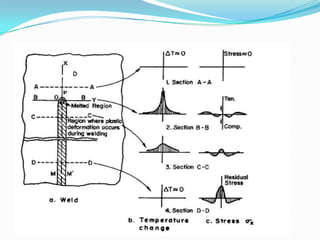
 Thermal stress and resulting residual stress
 Residual stress and reaction stress in weldment
Residual Stress in weld
 Heat flows from the weld area and causing the joint
  area to expand
 Thermal expansion and contraction due to welding
  can leave behind permanent stress
 Higher heat input welds are more prone to residual
  stress
 Increased restraint can decrease distortion but can
  result in higher residual stress
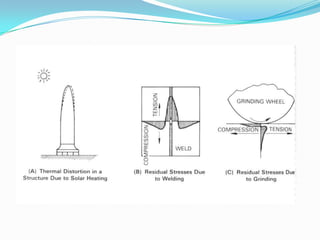
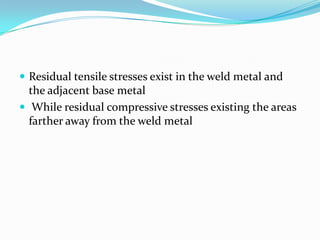
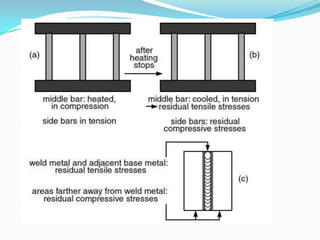
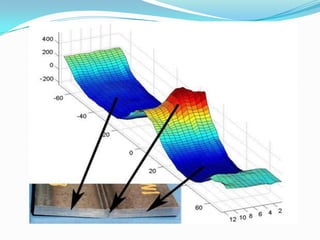
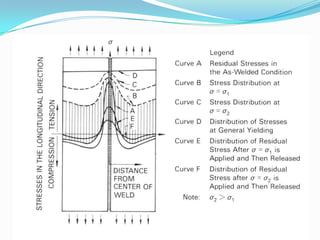
 Residual tensile stresses exist in the weld metal and
  the adjacent base metal
 While residual compressive stresses existing the areas
  farther away from the weld metal
Effect of residual stresses
 Decrease the fracture strength.
 Reduce buckling strength.
 Compressive residual stress increases fatigue strength
 In hostile environment residual stress can causes
 cracking in matel without any applied load.
Reducing residual stresses
 Selecting appropriate processes, procedures, welding
  sequence and fixturing.
 Selecting best method for stress reliving and
  removing distortion.
 Selecting design detail and materials to minimize the
  effect of residual stresses
Measurement of residual stresses
 Stress-relaxation techniques
 X-ray diffraction techniques
 Techniques using stress-sensitive properties
 Cracking techniques
THANK YOU…

residual stress in welding

  • 1.
  • 2.
    Residual Stresses  stressesthat would exist in a body if all external loads were removed.  They are sometimes called internal stresses  Caused by to non uniform temperature in welding
  • 3.
    Formation of Residualstresses  Resulting for mismatch .  Produced by unevenly distributed non elastic strain  Thermal stress and resulting residual stress  Residual stress and reaction stress in weldment
  • 5.
    Residual Stress inweld  Heat flows from the weld area and causing the joint area to expand  Thermal expansion and contraction due to welding can leave behind permanent stress  Higher heat input welds are more prone to residual stress  Increased restraint can decrease distortion but can result in higher residual stress
  • 6.
     Residual tensilestresses exist in the weld metal and the adjacent base metal  While residual compressive stresses existing the areas farther away from the weld metal
  • 10.
    Effect of residualstresses  Decrease the fracture strength.  Reduce buckling strength.  Compressive residual stress increases fatigue strength  In hostile environment residual stress can causes cracking in matel without any applied load.
  • 12.
    Reducing residual stresses Selecting appropriate processes, procedures, welding sequence and fixturing.  Selecting best method for stress reliving and removing distortion.  Selecting design detail and materials to minimize the effect of residual stresses
  • 13.
    Measurement of residualstresses  Stress-relaxation techniques  X-ray diffraction techniques  Techniques using stress-sensitive properties  Cracking techniques
  • 14.