By Ayuba Isaac
Introduction
 This is one the arc welding processes that is commonly
used in construction/fabrication processes. It is also known
with several names such as; MMA or MMAW, flux shielded
arc welding or informally known as stick welding.
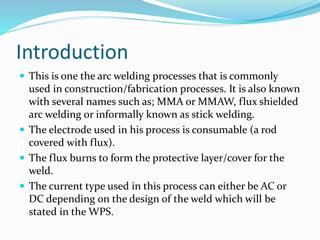
 The electrode used in his process is consumable (a rod
covered with flux).
 The flux burns to form the protective layer/cover for the
weld.
 The current type used in this process can either be AC or
DC depending on the design of the weld which will be
stated in the WPS.
 Because of the versatility and simplicity of this process,
it is most generally and widely used across the world, it
is mostly used for repair and maintenance in the heavy
steel industry.
Working principle
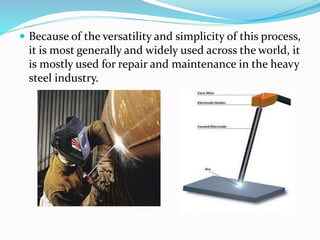
 Current flows in through the cables (ground cable and
the hot cable) from the power source (AC/DC) which
the circuit is completed when the electrode tip comes
in contact with the surface of the work piece as will be
seen in the diagram that will be displayed in later slide.
 The heat is simply generated at the meeting point
between the electrode an d the work pieces (arc).
 The heat input can however be calculated using the
formula H=[(60EI)/(1000S)] Kj/in
Working principle cont’d
 Shielded metal-arc welding with the transformer
welding machine depends upon this fundamental fact:
that when one side of the welding circuit is attached to
a piece of steel, a welding electrode connected to the
other side and the two brought into contact, an arc will
be established.
 If the arc is properly controlled, the metal from the
electrode will pass through the arc and be deposited
on the steel. When the electrode is moved along the
steel at the correct speed, the metal will deposit in a
uniform layer called a bead.
Working principle cont’d
 The arc is started by bringing the tip of the electrode into
contact with the base metal (work piece) by a very light
touch, hence this arc is maintained by keeping the
electrode at a relatively close distance from the base metal.
This arc length is usually 3mm - 4mm.
 Melting of the base metal and the core wire of the electrode
take place to form the weld pool. However, in some cases
an external filler rod could be where large weld deposit is
required.
Working principle cont’d
 The flux/coating of the electrode melts away to form
the shielding layer (slag) that protects the weld pool
from atmospheric contaminations as it solidifies. This
slag are later chipped off to reveal the actual weld.
 The penetration depth of the weld could either be a
full penetration or partial penetration (also referred to
as incomplete penetration).
 Incomplete penetration in most cases are considered
as defect but could be a requirement as stated in the
WPS base on the service condition of the welded joint.
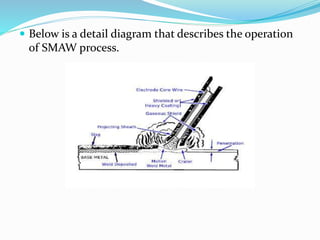
 Below is a detail diagram that describes the operation
of SMAW process.
 Shielded Metal Arc Welding
SOME FACTS ABOUT SMAW
 SMAW is considered as one of the least efficient
welding process because the operator’s factor of
chipping away slag and changing of worn-out
electrodes during the process.
 Actual welding technique utilized depends n the
electrode, composition of the work piece, and the
position of the joint to be welded.
 The choice of electrode and welding position also
determines the speed of the weld.
WELDING TECHNIQUES
 For the purpose of this presentation; we shall only
highlight the level of difficulties in carry out this
welding process in different positions;
 For plates
 1F 2F 3F 4F 5F
 1G 2G 3G 4G 5G
 For Pipes
Increasing order of difficulty....
NOTE: there are other varying welding positions in
addition to the above mentioned.
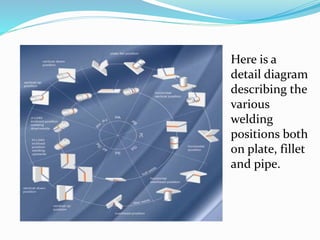
Here is a
detail diagram
describing the
various
welding
positions both
on plate, fillet
and pipe.
Defects associated with SMAW
 Below are some of the common defects that are
associated with the SMAW process;
A. Spatters
B. Porosity
C. Incomplete penetration
D. Cracks
E. Under cuts
F. Poor fusion
G. Poor weld profile, and so on...
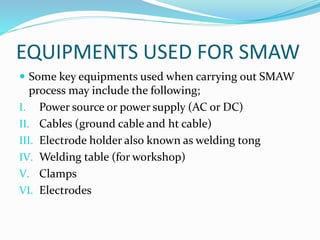
EQUIPMENTS USED FOR SMAW
 Some key equipments used when carrying out SMAW
process may include the following;
I. Power source or power supply (AC or DC)
II. Cables (ground cable and ht cable)
III. Electrode holder also known as welding tong
IV. Welding table (for workshop)
V. Clamps
VI. Electrodes
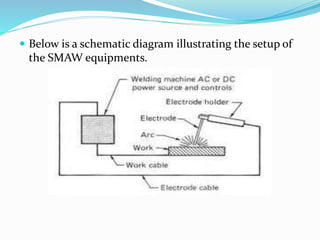
 Below is a schematic diagram illustrating the setup of
the SMAW equipments.
Other accessories in SMAW
 Leather gloves
 Face shield
 Chipping hammer
 Wire brush
 Cover all
 Safety boots/shoes
 Nose mask in the absence of fume extractor, and so on.
 However, all the above mentioned can simply be
referred to as personal protective equipment (PPE).
Process variation in SMAW
 Though SMAW is almost exclusively a manual arc
welding process, one notable process variation exists,
known as gravity welding or gravity arc welding. It
serves as an automated version of the traditional
shielded metal arc welding process, employing an
electrode holder attached to an inclined bar along the
length of the weld. Once started, the process continues
until the electrode is spent, allowing the operator to
manage multiple gravity welding systems.
Process variation in SMAW cont’d
 The electrodes employed (often E6027 or E7024) are
coated heavily in flux, and are typically 71 cm (28 in) in
length and about 6.35 mm (0.25 in) thick. As in
manual SMAW, a constant current welding power
supply is used, with either negative polarity direct
current or alternating current. Due to a rise in the use
of semiautomatic welding processes such as flux-cored
arc welding, the popularity of gravity welding has
fallen as its economic advantage over such methods is
often minimal.
Process variation in SMAW cont’d
 Other SMAW-related methods that are even less
frequently used include firecracker welding, an
automatic method for making butt and fillet welds,
and massive electrode welding, a process for welding
large components or structures that can deposit up to
27 kg (60 lb) of weld metal per hour.
Electrode
 The choice of electrode for SMAW depends on a
number of factors, including the weld material,
welding position and the desired weld properties. The
electrode is coated in a metal mixture called flux,
which gives off gases as it decomposes to prevent weld
contamination, introduces deoxidizers to purify the
weld, causes weld-protecting slag to form, improves
the arc stability, and provides alloying elements to
improve the weld quality.
 Electrodes can be divided into three groups—those
designed to melt quickly are called "fast-fill"
electrodes, those designed to solidify quickly are called
"fast-freeze" electrodes, and intermediate electrodes
go by the name "fill-freeze" or "fast-follow" electrodes.
Fast-fill electrodes are designed to melt quickly so that
the welding speed can be maximized, while fast-freeze
electrodes supply filler metal that solidifies quickly,
making welding in a variety of positions possible by
preventing the weld pool from shifting significantly
before solidifying.
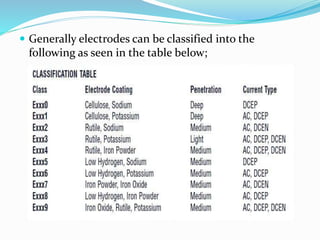
 Generally electrodes can be classified into the
following as seen in the table below;
 Common electrodes include the E6010, a fast-freeze,
all-position electrode with a minimum tensile strength
of 60 ksi (410 MPa) which is operated using DCEP.
E6011 is similar except its flux coating allows it to be
used with alternating current in addition to DCEP.
E7024 is a fast-fill electrode, used primarily to make
flat or horizontal welds using AC, DCEN, or DCEP.
Examples of fill-freeze electrodes are the E6012, E6013,
and E7014, all of which provide a compromise between
fast welding speeds and all-position welding.
Safety measures to be adhered to when
carrying out SMAW may include
 To prevent injury to personnel, extreme caution
should be exercised when using any types of welding
equipment. Injury can result from fire, explosions,
electric shock, or harmful agents. Both the general and
specific safety precautions listed below must be strictly
observed by workers who weld or cut metals.
 Do not permit unauthorized persons to use welding or
cutting equipment.
Safety measures to be adhered to when
carrying out SMAW may include cont’d
 Before welding or cutting, warm those in close
proximity who are not protected to wear proper
clothing or goggles.
 Remove any assembled parts from the component
being welded that may become warped or otherwise
damaged by the welding process.
 Do not leave hot rejected electrode stubs, steel scrap,
or tools on the floor or around the welding equipment.
Accidents and/or fires may occur.
 Keep a suitable fire extinguisher nearby at all times.
Ensure the fire extinguisher is in operable condition.
Safety measures to be adhered to when
carrying out SMAW may include cont’d
 Remove all flammable material, such as cotton, oil,
gasoline, etc., from the vicinity of welding. Do not
weld in a building with wooden floors, unless the
floors are protected from hot metal by means of fire
resistant fabric, sand, or other fireproof material. Be
sure that hot sparks or hot metal will not fall on the
operator or on any welding equipment components.
 Mark all hot metal after welding operations are
completed. Soapstone is commonly used for this
purpose.
Shielded Metal Arc Welding

Shielded Metal Arc Welding

  • 1.
  • 2.
    Introduction  This isone the arc welding processes that is commonly used in construction/fabrication processes. It is also known with several names such as; MMA or MMAW, flux shielded arc welding or informally known as stick welding.  The electrode used in his process is consumable (a rod covered with flux).  The flux burns to form the protective layer/cover for the weld.  The current type used in this process can either be AC or DC depending on the design of the weld which will be stated in the WPS.
  • 3.
     Because ofthe versatility and simplicity of this process, it is most generally and widely used across the world, it is mostly used for repair and maintenance in the heavy steel industry.
  • 4.
    Working principle  Currentflows in through the cables (ground cable and the hot cable) from the power source (AC/DC) which the circuit is completed when the electrode tip comes in contact with the surface of the work piece as will be seen in the diagram that will be displayed in later slide.  The heat is simply generated at the meeting point between the electrode an d the work pieces (arc).  The heat input can however be calculated using the formula H=[(60EI)/(1000S)] Kj/in
  • 5.
    Working principle cont’d Shielded metal-arc welding with the transformer welding machine depends upon this fundamental fact: that when one side of the welding circuit is attached to a piece of steel, a welding electrode connected to the other side and the two brought into contact, an arc will be established.  If the arc is properly controlled, the metal from the electrode will pass through the arc and be deposited on the steel. When the electrode is moved along the steel at the correct speed, the metal will deposit in a uniform layer called a bead.
  • 6.
    Working principle cont’d The arc is started by bringing the tip of the electrode into contact with the base metal (work piece) by a very light touch, hence this arc is maintained by keeping the electrode at a relatively close distance from the base metal. This arc length is usually 3mm - 4mm.  Melting of the base metal and the core wire of the electrode take place to form the weld pool. However, in some cases an external filler rod could be where large weld deposit is required.
  • 7.
    Working principle cont’d The flux/coating of the electrode melts away to form the shielding layer (slag) that protects the weld pool from atmospheric contaminations as it solidifies. This slag are later chipped off to reveal the actual weld.  The penetration depth of the weld could either be a full penetration or partial penetration (also referred to as incomplete penetration).  Incomplete penetration in most cases are considered as defect but could be a requirement as stated in the WPS base on the service condition of the welded joint.
  • 8.
     Below isa detail diagram that describes the operation of SMAW process.  Shielded Metal Arc Welding
  • 9.
    SOME FACTS ABOUTSMAW  SMAW is considered as one of the least efficient welding process because the operator’s factor of chipping away slag and changing of worn-out electrodes during the process.  Actual welding technique utilized depends n the electrode, composition of the work piece, and the position of the joint to be welded.  The choice of electrode and welding position also determines the speed of the weld.
  • 10.
    WELDING TECHNIQUES  Forthe purpose of this presentation; we shall only highlight the level of difficulties in carry out this welding process in different positions;  For plates  1F 2F 3F 4F 5F  1G 2G 3G 4G 5G  For Pipes Increasing order of difficulty.... NOTE: there are other varying welding positions in addition to the above mentioned.
  • 11.
    Here is a detaildiagram describing the various welding positions both on plate, fillet and pipe.
  • 12.
    Defects associated withSMAW  Below are some of the common defects that are associated with the SMAW process; A. Spatters B. Porosity C. Incomplete penetration D. Cracks E. Under cuts F. Poor fusion G. Poor weld profile, and so on...
  • 13.
    EQUIPMENTS USED FORSMAW  Some key equipments used when carrying out SMAW process may include the following; I. Power source or power supply (AC or DC) II. Cables (ground cable and ht cable) III. Electrode holder also known as welding tong IV. Welding table (for workshop) V. Clamps VI. Electrodes
  • 14.
     Below isa schematic diagram illustrating the setup of the SMAW equipments.
  • 15.
    Other accessories inSMAW  Leather gloves  Face shield  Chipping hammer  Wire brush  Cover all  Safety boots/shoes  Nose mask in the absence of fume extractor, and so on.  However, all the above mentioned can simply be referred to as personal protective equipment (PPE).
  • 16.
    Process variation inSMAW  Though SMAW is almost exclusively a manual arc welding process, one notable process variation exists, known as gravity welding or gravity arc welding. It serves as an automated version of the traditional shielded metal arc welding process, employing an electrode holder attached to an inclined bar along the length of the weld. Once started, the process continues until the electrode is spent, allowing the operator to manage multiple gravity welding systems.
  • 17.
    Process variation inSMAW cont’d  The electrodes employed (often E6027 or E7024) are coated heavily in flux, and are typically 71 cm (28 in) in length and about 6.35 mm (0.25 in) thick. As in manual SMAW, a constant current welding power supply is used, with either negative polarity direct current or alternating current. Due to a rise in the use of semiautomatic welding processes such as flux-cored arc welding, the popularity of gravity welding has fallen as its economic advantage over such methods is often minimal.
  • 18.
    Process variation inSMAW cont’d  Other SMAW-related methods that are even less frequently used include firecracker welding, an automatic method for making butt and fillet welds, and massive electrode welding, a process for welding large components or structures that can deposit up to 27 kg (60 lb) of weld metal per hour.
  • 19.
    Electrode  The choiceof electrode for SMAW depends on a number of factors, including the weld material, welding position and the desired weld properties. The electrode is coated in a metal mixture called flux, which gives off gases as it decomposes to prevent weld contamination, introduces deoxidizers to purify the weld, causes weld-protecting slag to form, improves the arc stability, and provides alloying elements to improve the weld quality.
  • 20.
     Electrodes canbe divided into three groups—those designed to melt quickly are called "fast-fill" electrodes, those designed to solidify quickly are called "fast-freeze" electrodes, and intermediate electrodes go by the name "fill-freeze" or "fast-follow" electrodes. Fast-fill electrodes are designed to melt quickly so that the welding speed can be maximized, while fast-freeze electrodes supply filler metal that solidifies quickly, making welding in a variety of positions possible by preventing the weld pool from shifting significantly before solidifying.
  • 21.
     Generally electrodescan be classified into the following as seen in the table below;
  • 22.
     Common electrodesinclude the E6010, a fast-freeze, all-position electrode with a minimum tensile strength of 60 ksi (410 MPa) which is operated using DCEP. E6011 is similar except its flux coating allows it to be used with alternating current in addition to DCEP. E7024 is a fast-fill electrode, used primarily to make flat or horizontal welds using AC, DCEN, or DCEP. Examples of fill-freeze electrodes are the E6012, E6013, and E7014, all of which provide a compromise between fast welding speeds and all-position welding.
  • 23.
    Safety measures tobe adhered to when carrying out SMAW may include  To prevent injury to personnel, extreme caution should be exercised when using any types of welding equipment. Injury can result from fire, explosions, electric shock, or harmful agents. Both the general and specific safety precautions listed below must be strictly observed by workers who weld or cut metals.  Do not permit unauthorized persons to use welding or cutting equipment.
  • 24.
    Safety measures tobe adhered to when carrying out SMAW may include cont’d  Before welding or cutting, warm those in close proximity who are not protected to wear proper clothing or goggles.  Remove any assembled parts from the component being welded that may become warped or otherwise damaged by the welding process.  Do not leave hot rejected electrode stubs, steel scrap, or tools on the floor or around the welding equipment. Accidents and/or fires may occur.  Keep a suitable fire extinguisher nearby at all times. Ensure the fire extinguisher is in operable condition.
  • 25.
    Safety measures tobe adhered to when carrying out SMAW may include cont’d  Remove all flammable material, such as cotton, oil, gasoline, etc., from the vicinity of welding. Do not weld in a building with wooden floors, unless the floors are protected from hot metal by means of fire resistant fabric, sand, or other fireproof material. Be sure that hot sparks or hot metal will not fall on the operator or on any welding equipment components.  Mark all hot metal after welding operations are completed. Soapstone is commonly used for this purpose.