Weld defects - Pressure vessel and Structurals.pptx
1.
Welding Defects
Irregularitiesformed in the given weld metal due to
wrong welding process or incorrect welding patterns, etc.
The defect may differ from the desired weld bead shape,
size, and intended quality.
Welding defects may occur either outside or inside the
weld metal.
Some of the defects may be allowed if the defects are
under permissible limits but other defects such as cracks
are never accepted.
Welding Defects – Types, Causes and Remedies
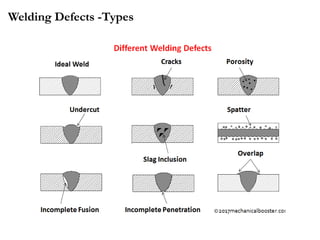
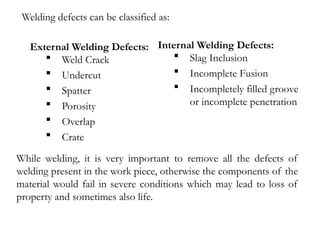
External Welding Defects:
Weld Crack
Undercut
Spatter
Porosity
Overlap
Crate
Internal Welding Defects:
Slag Inclusion
Incomplete Fusion
Incompletely filled groove
or incomplete penetration
While welding, it is very important to remove all the defects of
welding present in the work piece, otherwise the components of the
material would fail in severe conditions which may lead to loss of
property and sometimes also life.
Welding defects can be classified as:
4.
External Welding Defects
1.Weld Crack
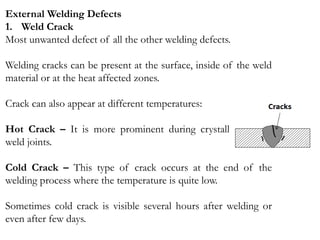
Most unwanted defect of all the other welding defects.
Welding cracks can be present at the surface, inside of the weld
material or at the heat affected zones.
Crack can also appear at different temperatures:
Hot Crack – It is more prominent during crystallization of
weld joints.
Cold Crack – This type of crack occurs at the end of the
welding process where the temperature is quite low.
Sometimes cold crack is visible several hours after welding or
even after few days.
5.
Causes of WeldCrack:
Poor ductility of the given base metal.
The presence of residual stress.
The rigidity of the joint.
If there is high content of sulfur and carbon then also the
cracks may appear.
Using hydrogen as a shielding gas while welding ferrous
materials.
Remedies for Weld crack:
Use of appropriate materials may decrease the chances of
crack.
Preheating the weld and reducing the cooling rate.
Reduce the gap between the weld joints.
6.
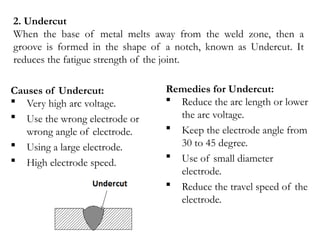
2. Undercut
When thebase of metal melts away from the weld zone, then a
groove is formed in the shape of a notch, known as Undercut. It
reduces the fatigue strength of the joint.
Causes of Undercut:
Very high arc voltage.
Use the wrong electrode or
wrong angle of electrode.
Using a large electrode.
High electrode speed.
Remedies for Undercut:
Reduce the arc length or lower
the arc voltage.
Keep the electrode angle from
30 to 45 degree.
Use of small diameter
electrode.
Reduce the travel speed of the
electrode.
7.
Remedies for Spatter:
Reducing the arc length and
welding current
Using the right polarity.
Increasing the plate angle and
using proper gas shielding.
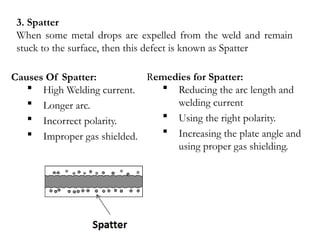
3. Spatter
When some metal drops are expelled from the weld and remain
stuck to the surface, then this defect is known as Spatter
Causes Of Spatter:
High Welding current.
Longer arc.
Incorrect polarity.
Improper gas shielded.
8.
Remedies for porosity:
Proper selection of the electrode.
Decreasing the welding current.
Using smaller arc and slowing the process to allow the gases
to escape.
Remove rust or oil from the surface and use a proper
technique.
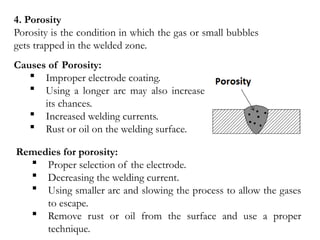
4. Porosity
Porosity is the condition in which the gas or small bubbles
gets trapped in the welded zone.
Causes of Porosity:
Improper electrode coating.
Using a longer arc may also increase
its chances.
Increased welding currents.
Rust or oil on the welding surface.
9.
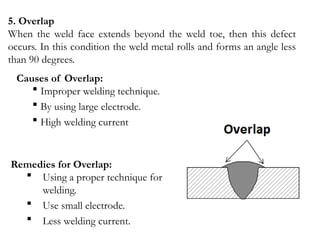
5. Overlap
When theweld face extends beyond the weld toe, then this defect
occurs. In this condition the weld metal rolls and forms an angle less
than 90 degrees.
Remedies for Overlap:
Using a proper technique for
welding.
Use small electrode.
Less welding current.
Causes of Overlap:
Improper welding technique.
By using large electrode.
High welding current
10.
Remedies for crater:
Using a proper torch angle may reduce the
stress on the metal
Using a small electrode.
Use a proper technique.
6. Crater
It occurs when the crater is not filled before the arc is broken,
which causes the outer edges to cool faster than the crater. This
causes a stress and then crack is formed.
Causes of the crater:
Incorrect torch angle.
Use of large electrode:
Improper welding technique
11.
Causes of Slag:
Slag is formed if the welding current density is very small, as
it does not provide the required amount of heat for melting
the metal surface.
High welding speed.
Improper cleaning of the weld surface.
Improper welding angle and travel rate of welding rod.
Remedies for Slag Inclusion:
Increase the current density
Adjusting the welding speed.
Clean the weld edges and remove the slag of previous weld.
Have a proper electrode angle and travel rate.
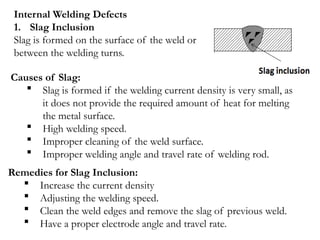
Internal Welding Defects
1. Slag Inclusion
Slag is formed on the surface of the weld or
between the welding turns.
12.
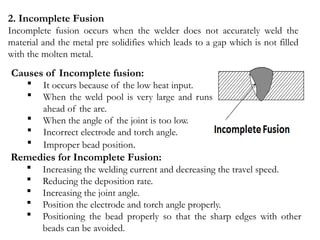
2. Incomplete Fusion
Incompletefusion occurs when the welder does not accurately weld the
material and the metal pre solidifies which leads to a gap which is not filled
with the molten metal.
Remedies for Incomplete Fusion:
Increasing the welding current and decreasing the travel speed.
Reducing the deposition rate.
Increasing the joint angle.
Position the electrode and torch angle properly.
Positioning the bead properly so that the sharp edges with other
beads can be avoided.
Causes of Incomplete fusion:
It occurs because of the low heat input.
When the weld pool is very large and runs
ahead of the arc.
When the angle of the joint is too low.
Incorrect electrode and torch angle.
Improper bead position.
13.
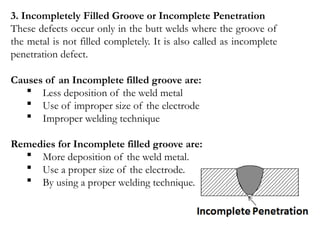
3. Incompletely FilledGroove or Incomplete Penetration
These defects occur only in the butt welds where the groove of
the metal is not filled completely. It is also called as incomplete
penetration defect.
Causes of an Incomplete filled groove are:
Less deposition of the weld metal
Use of improper size of the electrode
Improper welding technique
Remedies for Incomplete filled groove are:
More deposition of the weld metal.
Use a proper size of the electrode.
By using a proper welding technique.
14.
The easewith which welding of a given material can be
done without producing any defect is called Weldability.
Weldability can also be defined as the capability of metal to
be welded under the fabrication conditions imposed
satisfactorily on the intended surface.
The metal should not require expensive or complicated or
extracting procedures to produce a sound joint.
The American Welding Society defines weldability as, “the
capacity of a metal to be welded under the fabrication
conditions imposed into a specific, suitably designed
structure and to perform satisfactorily in the intended
service.”
Weldability
15.
When nearly anyprocess can be used on a metal and minimal effort
is necessary to produce a sound weld, the metal is said to have
“good weldability.”
In cases where a welder can choose from only a limited number of
processes and must carefully prepare the joint and execute the
welding procedure to create a strong weld, the metal is considered
to have “poor weldability.”
Weldability …..
16.
Factors affecting Weldability:
Melting point of metal: Materials with a medium melting
point can be welded very easily.
Thermal conductivity: Material with high thermal
conductivity (K) are treated as difficult to weld materials.
Reactivity: If the material reacts with air, water or
surroundings it becomes difficult to weld.
The coefficient of thermal expansion of metals:
Material with high thermal expansion coefficient, it becomes
difficult to weld.
Electrical resistance: Higher the electrical resistance of the
material, it becomes difficult because it requires a lot of heat
energy.
Surface condition: The material with the dirty surface it
becomes difficult to weld.
17.
How to ImproveWeldability
The heating and cooling cycles inherent to most forms of
welding can create strains and stresses in the weld.
They also affect physical, chemical, and metallurgical
changes in the metal.
When such changes make a metal prone to poor
weldability, adjustments can be made to improve the
quality of the weld.