Ms. Aixa Rodriguez Unit 1 ESL/Visual Arts High School of World Cultures Bronx, NY
Art  A visual statement that represents  the world around you, communicates an idea, expresses a feeling or present an interesting design.
Artist A person who uses imagination and skill to communicate ideas in visual form.
What is  fine art ? Fine art refers to art that is valued solely for its visual appeal or its success in communicating  ideas or feelings.
What is  applied art ? Applied art refers to art that is made to be functional as well as visually pleasing.
Visual Culture The visual statements you find in your environment every day.  Paintings , books, chairs, videogames advertisements everything one sees, has seen or may imagine. The internet, movies, toys, fashion and cars as well as fine arts are all part of one’s visual culture.
Perceive To be come aware through the senses fo the special nature of objects.  Using sight hearing touch smell and tast to pereceiv an object increases your understanding of it. Artists must strengthen their perception to interpret what they see in the world around them.
The fundamentals or vocabulary of the artist’s language.  The basic visual components that an artist uses to create visual art. Line, color, value, shape, form, space, and texture
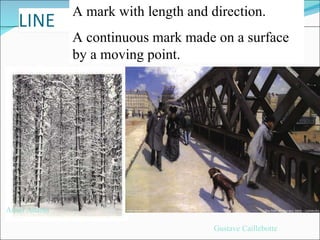
A mark with length and direction. A continuous mark made on a surface by a moving point. Ansel Adams Gustave Caillebotte
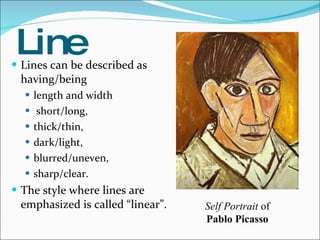
Line Lines can be described as having/being length and width short/long,  thick/thin,  dark/light,  blurred/uneven,  sharp/clear. The style where lines are emphasized is called “linear”. Self Portrait  of  Pablo Picasso
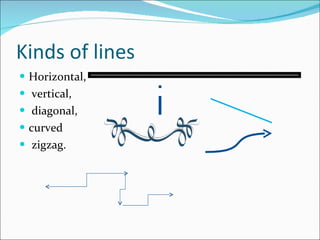
Kinds of lines Horizontal, vertical, diagonal,  curved  zigzag.
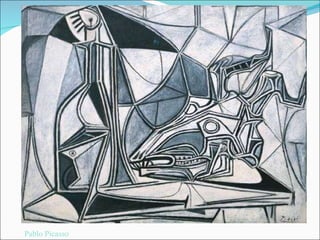
Pablo Picasso
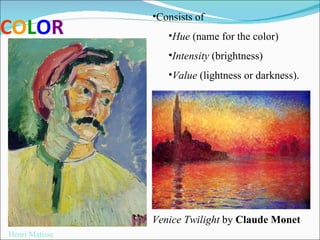
C O L O R Consists of   Hue  (name for the color) Intensity  (brightness)  Value  (lightness or darkness). Henri Matisse Venice Twilight  by  Claude Monet
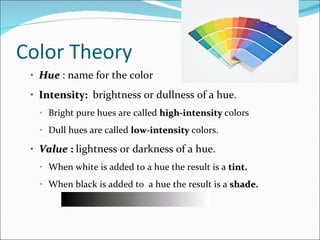
Color Theory Hue  : name for the color Intensity:  brightness or dullness of a hue.  Bright pure hues are called  high-intensity  colors Dull hues are called  low-intensity  colors. Value  :  lightness or darkness of a hue. When white is added to a hue the result is a  tint. When black is added to  a hue the result is a  shade.
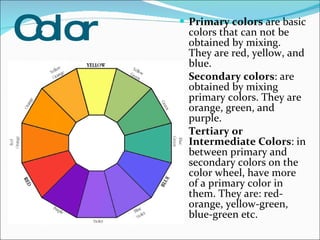
Color Primary colors  are basic colors that can not be obtained by mixing. They are red, yellow, and blue. Secondary colors : are obtained by mixing primary colors. They are orange, green, and purple. Tertiary or Intermediate Colors : in between primary and secondary colors on the color wheel, have more of a primary color in them. They are: red-orange, yellow-green, blue-green etc.
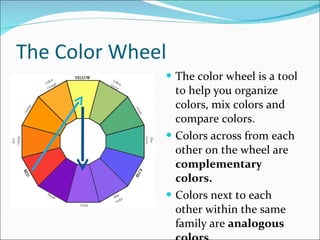
The Color Wheel The color wheel is a tool to help you organize colors, mix colors and compare colors.  Colors across from each other on the wheel are  complementary colors. Colors next to each other within the same family are  analogous colors.
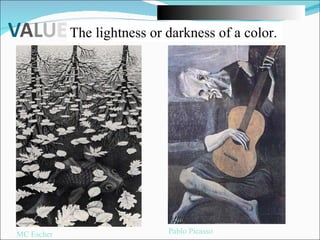
The lightness or darkness of a color. MC Escher Pablo Picasso
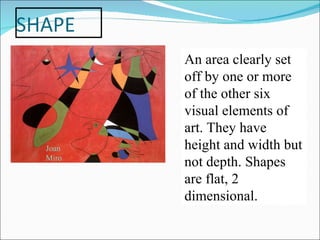
An area clearly set off by one or more of the other six visual elements of art. They have height and width but not depth. Shapes are flat, 2 dimensional. Joan Miro
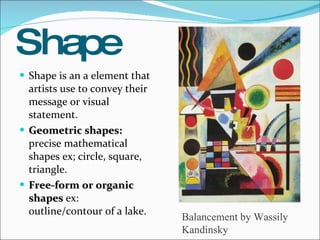
Shape Shape is an a element that artists use to convey their message or visual statement. Geometric shapes:  precise mathematical shapes ex; circle, square, triangle.  Free-form or organic shapes  ex: outline/contour of a lake. Balancement by Wassily Kandinsky
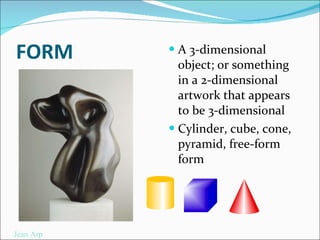
FORM A 3-dimensional object; or something in a 2-dimensional artwork that appears to be 3-dimensional  Cylinder, cube, cone, pyramid, free-form form Jean Arp
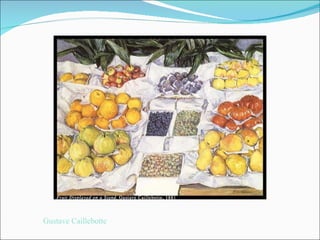
Gustave Caillebotte
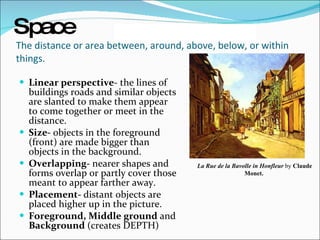
The distance or area between, around, above, below, or within things.  Linear perspective - the lines of buildings roads and similar objects are slanted to make them appear to come together or meet in the distance. Size-  objects in the foreground (front) are made bigger than objects in the background.  Overlapping-  nearer shapes and forms overlap or partly cover those meant to appear farther away. Placement-  distant objects are placed higher up in the picture. Foreground, Middle ground  and  Background  (creates DEPTH) La Rue de la Bavolle in Honfleur  by  Claude Monet.   Space
Space Positive  space filled with something Negative  empty spaces between the shapes or forms in two and three dimensional art. Intensity and value-  the colors of objects meant to appear in the distance are lower in intensity than those of objects meant to appear nearer. They are also lighter in value. Detail-  more detail is added to closer objects and less detail is added to those in the distance
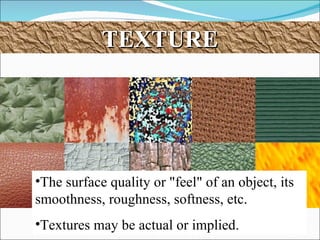
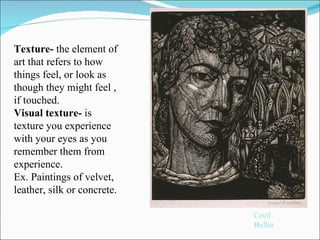
TEXTURE The surface quality or "feel" of an object, its smoothness, roughness, softness, etc.  Textures may be actual or implied.
Cecil Buller Texture-  the element of art that refers to how things feel, or look as though they might feel , if touched.  Visual texture-  is texture you experience with your eyes as you remember them from experience.  Ex. Paintings of velvet, leather, silk or concrete.
What we use to organize the Elements of Art, or  the tools to make art.
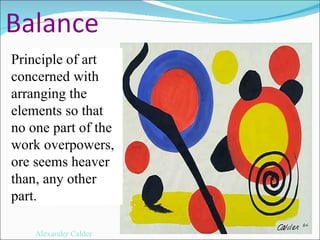
Principle of art concerned with arranging the elements so that no one part of the work overpowers, ore seems heaver than, any other part.  Alexander Calder
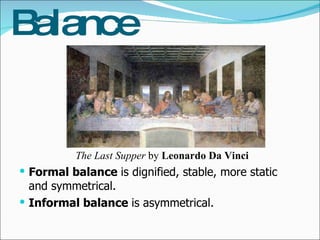
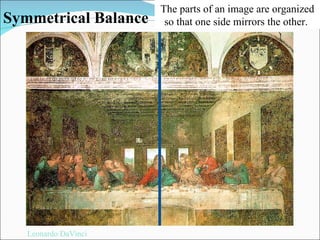
Balance Formal balance  is dignified, stable, more static and symmetrical. Informal balance  is asymmetrical. The Last Supper  by  Leonardo Da Vinci
Symmetrical Balance The parts of an image are organized so that one side mirrors the other.  Leonardo DaVinci
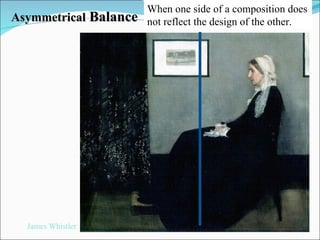
Asymmetrical  Balance When one side of a composition does not reflect the design of the other. James Whistler
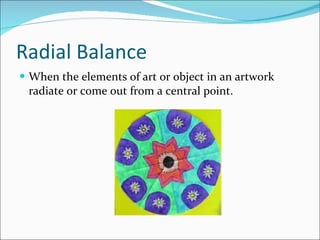
Radial Balance When the elements of art or object in an artwork radiate or come out from a central point.
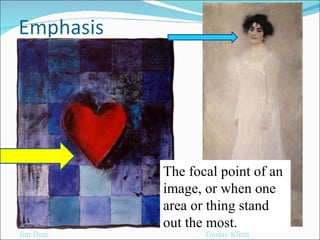
The focal point of an image, or when one area or thing stand out the most. Jim Dine Gustav Klimt
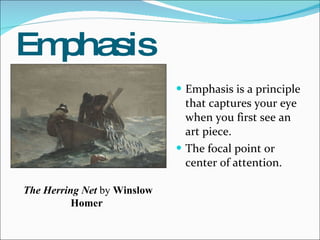
Emphasis Emphasis is a principle that captures your eye when you first see an art piece.  The focal point or center of attention. The Herring Net  by  Winslow Homer
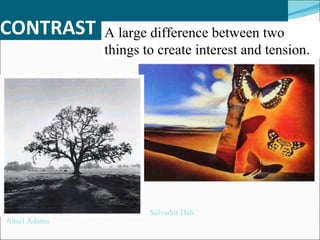
CONTRAST A large difference between two things to create interest and tension. Ansel Adams Salvador Dali
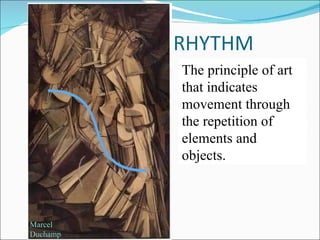
The principle of art that indicates movement through the repetition of elements and objects. Marcel Duchamp
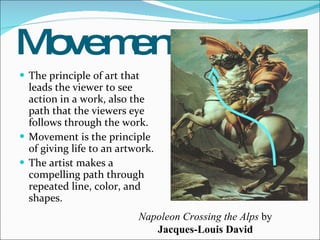
Movement The principle of art that leads the viewer to see action in a work, also the path that the viewers eye follows through the work. Movement is the principle of giving life to an artwork.  The artist makes a compelling path through repeated line, color, and shapes. Napoleon Crossing the Alps  by  Jacques-Louis David
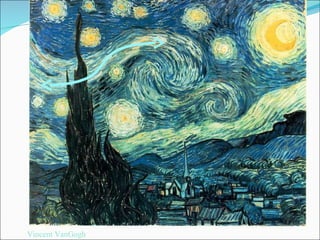
Vincent VanGogh
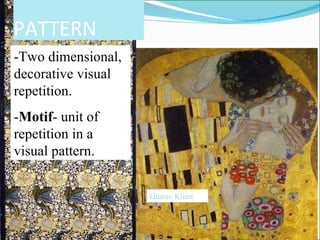
Gustav Klimt PATTERN -Two dimensional, decorative visual repetition. - Motif - unit of repetition in a visual pattern.
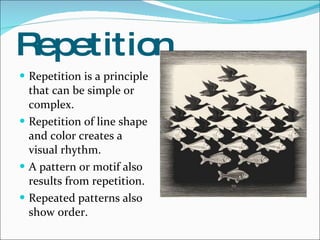
Repetition Repetition is a principle that can be simple or complex.  Repetition of line shape and color creates a visual rhythm.  A pattern or motif also results from repetition.  Repeated patterns also show order.
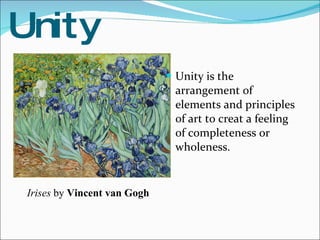
Unity Unity is the arrangement of elements and principles of art to creat a feeling of completeness or wholeness. Irises  by  Vincent van Gogh
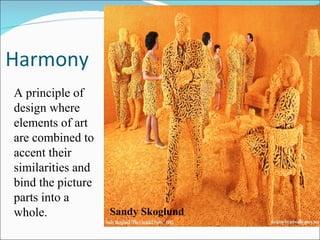
Harmony A principle of design where elements of art are combined to accent their similarities and bind the picture parts into a whole. Sandy Skoglund
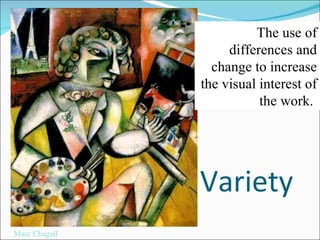
Variety The use of differences and change to increase the visual interest of the work.  Marc Chagall
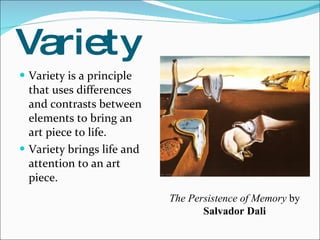
Variety Variety is a principle that uses differences and contrasts between elements to bring an art piece to life. Variety brings life and attention to an art piece. The Persistence of Memory  by  Salvador Dali
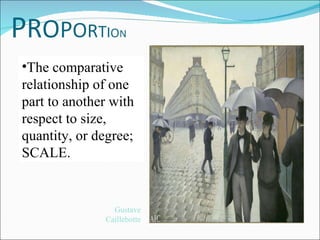
The comparative relationship of one part to another with respect to size, quantity, or degree; SCALE.  Gustave Caillebotte
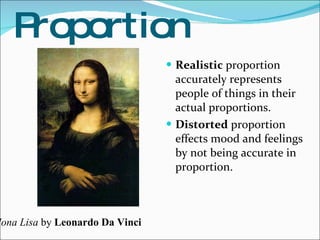
Proportion Realistic  proportion accurately represents people of things in their actual proportions.  Distorted  proportion effects mood and feelings by not being accurate in proportion. Mona Lisa  by  Leonardo Da Vinci

Arod elements of art

  • 1.
    Ms. Aixa RodriguezUnit 1 ESL/Visual Arts High School of World Cultures Bronx, NY
  • 2.
    Art Avisual statement that represents the world around you, communicates an idea, expresses a feeling or present an interesting design.
  • 3.
    Artist A personwho uses imagination and skill to communicate ideas in visual form.
  • 4.
    What is fine art ? Fine art refers to art that is valued solely for its visual appeal or its success in communicating ideas or feelings.
  • 5.
    What is applied art ? Applied art refers to art that is made to be functional as well as visually pleasing.
  • 6.
    Visual Culture Thevisual statements you find in your environment every day. Paintings , books, chairs, videogames advertisements everything one sees, has seen or may imagine. The internet, movies, toys, fashion and cars as well as fine arts are all part of one’s visual culture.
  • 7.
    Perceive To become aware through the senses fo the special nature of objects. Using sight hearing touch smell and tast to pereceiv an object increases your understanding of it. Artists must strengthen their perception to interpret what they see in the world around them.
  • 8.
    The fundamentals orvocabulary of the artist’s language. The basic visual components that an artist uses to create visual art. Line, color, value, shape, form, space, and texture
  • 9.
    A mark withlength and direction. A continuous mark made on a surface by a moving point. Ansel Adams Gustave Caillebotte
  • 10.
    Line Lines canbe described as having/being length and width short/long, thick/thin, dark/light, blurred/uneven, sharp/clear. The style where lines are emphasized is called “linear”. Self Portrait of Pablo Picasso
  • 11.
    Kinds of linesHorizontal, vertical, diagonal, curved zigzag.
  • 12.
  • 13.
    C O LO R Consists of Hue (name for the color) Intensity (brightness) Value (lightness or darkness). Henri Matisse Venice Twilight by Claude Monet
  • 14.
    Color Theory Hue : name for the color Intensity: brightness or dullness of a hue. Bright pure hues are called high-intensity colors Dull hues are called low-intensity colors. Value : lightness or darkness of a hue. When white is added to a hue the result is a tint. When black is added to a hue the result is a shade.
  • 15.
    Color Primary colors are basic colors that can not be obtained by mixing. They are red, yellow, and blue. Secondary colors : are obtained by mixing primary colors. They are orange, green, and purple. Tertiary or Intermediate Colors : in between primary and secondary colors on the color wheel, have more of a primary color in them. They are: red-orange, yellow-green, blue-green etc.
  • 16.
    The Color WheelThe color wheel is a tool to help you organize colors, mix colors and compare colors. Colors across from each other on the wheel are complementary colors. Colors next to each other within the same family are analogous colors.
  • 17.
    The lightness ordarkness of a color. MC Escher Pablo Picasso
  • 18.
    An area clearlyset off by one or more of the other six visual elements of art. They have height and width but not depth. Shapes are flat, 2 dimensional. Joan Miro
  • 19.
    Shape Shape isan a element that artists use to convey their message or visual statement. Geometric shapes: precise mathematical shapes ex; circle, square, triangle. Free-form or organic shapes ex: outline/contour of a lake. Balancement by Wassily Kandinsky
  • 20.
    FORM A 3-dimensionalobject; or something in a 2-dimensional artwork that appears to be 3-dimensional Cylinder, cube, cone, pyramid, free-form form Jean Arp
  • 21.
  • 22.
    The distance orarea between, around, above, below, or within things. Linear perspective - the lines of buildings roads and similar objects are slanted to make them appear to come together or meet in the distance. Size- objects in the foreground (front) are made bigger than objects in the background. Overlapping- nearer shapes and forms overlap or partly cover those meant to appear farther away. Placement- distant objects are placed higher up in the picture. Foreground, Middle ground and Background (creates DEPTH) La Rue de la Bavolle in Honfleur by Claude Monet. Space
  • 23.
    Space Positive space filled with something Negative empty spaces between the shapes or forms in two and three dimensional art. Intensity and value- the colors of objects meant to appear in the distance are lower in intensity than those of objects meant to appear nearer. They are also lighter in value. Detail- more detail is added to closer objects and less detail is added to those in the distance
  • 24.
    TEXTURE The surfacequality or "feel" of an object, its smoothness, roughness, softness, etc. Textures may be actual or implied.
  • 25.
    Cecil Buller Texture- the element of art that refers to how things feel, or look as though they might feel , if touched. Visual texture- is texture you experience with your eyes as you remember them from experience. Ex. Paintings of velvet, leather, silk or concrete.
  • 26.
    What we useto organize the Elements of Art, or the tools to make art.
  • 27.
    Principle of artconcerned with arranging the elements so that no one part of the work overpowers, ore seems heaver than, any other part. Alexander Calder
  • 28.
    Balance Formal balance is dignified, stable, more static and symmetrical. Informal balance is asymmetrical. The Last Supper by Leonardo Da Vinci
  • 29.
    Symmetrical Balance Theparts of an image are organized so that one side mirrors the other. Leonardo DaVinci
  • 30.
    Asymmetrical BalanceWhen one side of a composition does not reflect the design of the other. James Whistler
  • 31.
    Radial Balance Whenthe elements of art or object in an artwork radiate or come out from a central point.
  • 32.
    The focal pointof an image, or when one area or thing stand out the most. Jim Dine Gustav Klimt
  • 33.
    Emphasis Emphasis isa principle that captures your eye when you first see an art piece. The focal point or center of attention. The Herring Net by Winslow Homer
  • 34.
    CONTRAST A largedifference between two things to create interest and tension. Ansel Adams Salvador Dali
  • 35.
    The principle ofart that indicates movement through the repetition of elements and objects. Marcel Duchamp
  • 36.
    Movement The principleof art that leads the viewer to see action in a work, also the path that the viewers eye follows through the work. Movement is the principle of giving life to an artwork. The artist makes a compelling path through repeated line, color, and shapes. Napoleon Crossing the Alps by Jacques-Louis David
  • 37.
  • 38.
    Gustav Klimt PATTERN-Two dimensional, decorative visual repetition. - Motif - unit of repetition in a visual pattern.
  • 39.
    Repetition Repetition isa principle that can be simple or complex. Repetition of line shape and color creates a visual rhythm. A pattern or motif also results from repetition. Repeated patterns also show order.
  • 40.
    Unity Unity isthe arrangement of elements and principles of art to creat a feeling of completeness or wholeness. Irises by Vincent van Gogh
  • 41.
    Harmony A principleof design where elements of art are combined to accent their similarities and bind the picture parts into a whole. Sandy Skoglund
  • 42.
    Variety The useof differences and change to increase the visual interest of the work. Marc Chagall
  • 43.
    Variety Variety isa principle that uses differences and contrasts between elements to bring an art piece to life. Variety brings life and attention to an art piece. The Persistence of Memory by Salvador Dali
  • 44.
    The comparative relationshipof one part to another with respect to size, quantity, or degree; SCALE. Gustave Caillebotte
  • 45.
    Proportion Realistic proportion accurately represents people of things in their actual proportions. Distorted proportion effects mood and feelings by not being accurate in proportion. Mona Lisa by Leonardo Da Vinci