

PRINCIPLES OF COMPOSITION
By
Ar.Swetha.K
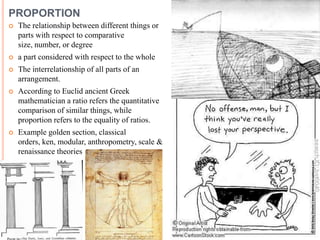
PROPORTION
 The relationship between different things or
parts with respect to comparative
size, number, or degree
 a part considered with respect to the whole
 The interrelationship of all parts of an
arrangement.
 According to Euclid ancient Greek
mathematician a ratio refers the quantitative
comparison of similar things, while
proportion refers to the equality of ratios.
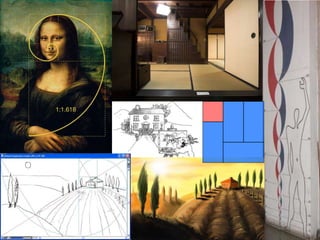
 Example golden section, classical
orders, ken, modular, anthropometry, scale &
renaissance theories
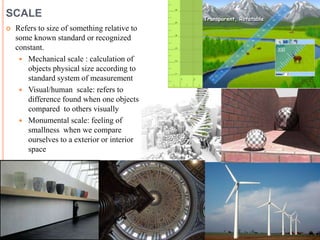
SCALE
 Refers to size of something relative to
some known standard or recognized
constant.
 Mechanical scale : calculation of
objects physical size according to
standard system of measurement
 Visual/human scale: refers to
difference found when one objects
compared to others visually
 Monumental scale: feeling of
smallness when we compare
ourselves to a exterior or interior
space
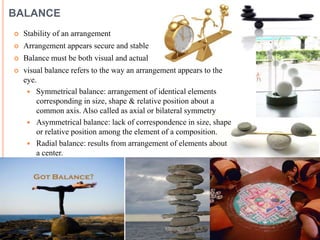
BALANCE
 Stability of an arrangement
 Arrangement appears secure and stable
 Balance must be both visual and actual
 visual balance refers to the way an arrangement appears to the
eye.
 Symmetrical balance: arrangement of identical elements
corresponding in size, shape & relative position about a
common axis. Also called as axial or bilateral symmetry
 Asymmetrical balance: lack of correspondence in size, shape
or relative position among the element of a composition.
 Radial balance: results from arrangement of elements about
a center.
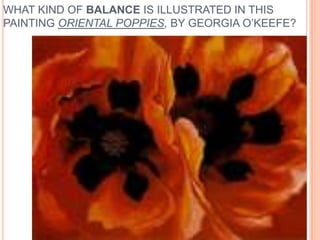
WHAT KIND OF BALANCE IS ILLUSTRATED IN THIS
PAINTING ORIENTAL POPPIES, BY GEORGIA O’KEEFE?
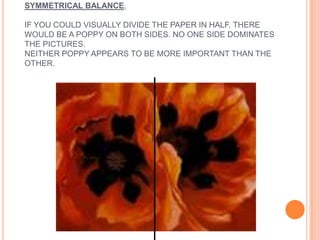
SYMMETRICAL BALANCE,
IF YOU COULD VISUALLY DIVIDE THE PAPER IN HALF. THERE
WOULD BE A POPPY ON BOTH SIDES. NO ONE SIDE DOMINATES
THE PICTURES.
NEITHER POPPY APPEARS TO BE MORE IMPORTANT THAN THE
OTHER.
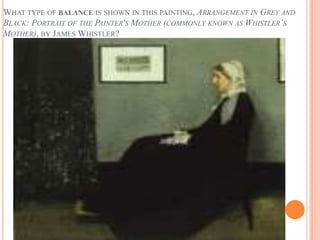
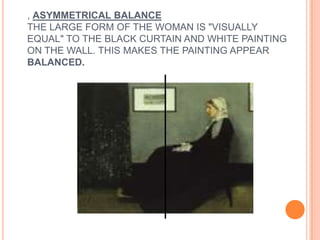
WHAT TYPE OF BALANCE IS SHOWN IN THIS PAINTING, ARRANGEMENT IN GREY AND
BLACK: PORTRAIT OF THE PAINTER'S MOTHER (COMMONLY KNOWN AS WHISTLER’S
MOTHER), BY JAMES WHISTLER?
, ASYMMETRICAL BALANCE
THE LARGE FORM OF THE WOMAN IS "VISUALLY
EQUAL" TO THE BLACK CURTAIN AND WHITE PAINTING
ON THE WALL. THIS MAKES THE PAINTING APPEAR
BALANCED.
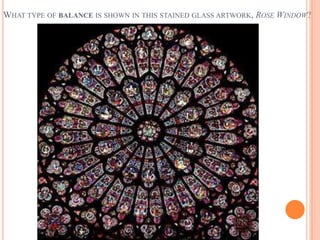
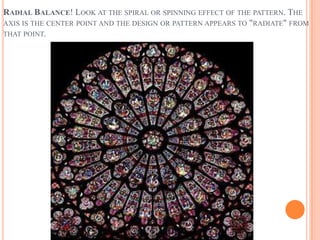
WHAT TYPE OF BALANCE IS SHOWN IN THIS STAINED GLASS ARTWORK, ROSE WINDOW?
RADIAL BALANCE! LOOK AT THE SPIRAL OR SPINNING EFFECT OF THE PATTERN. THE
AXIS IS THE CENTER POINT AND THE DESIGN OR PATTERN APPEARS TO "RADIATE" FROM
THAT POINT.
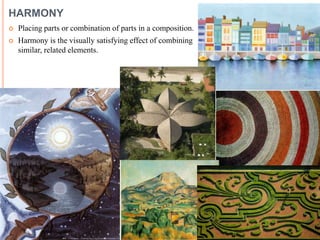
HARMONY
 Placing parts or combination of parts in a composition.
 Harmony is the visually satisfying effect of combining
similar, related elements.
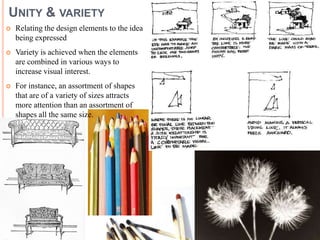
UNITY & VARIETY
 Relating the design elements to the idea
being expressed
 Variety is achieved when the elements
are combined in various ways to
increase visual interest.
 For instance, an assortment of shapes
that are of a variety of sizes attracts
more attention than an assortment of
shapes all the same size.
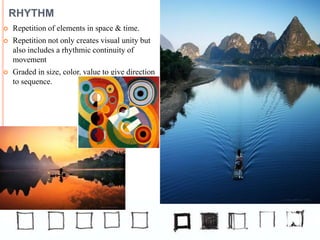
RHYTHM
 Repetition of elements in space & time.
 Repetition not only creates visual unity but
also includes a rhythmic continuity of
movement
 Graded in size, color, value to give direction
to sequence.
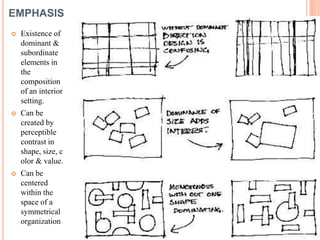
EMPHASIS
 Existence of
dominant &
subordinate
elements in
the
composition
of an interior
setting.
 Can be
created by
perceptible
contrast in
shape, size, c
olor & value.
 Can be
centered
within the
space of a
symmetrical
organization
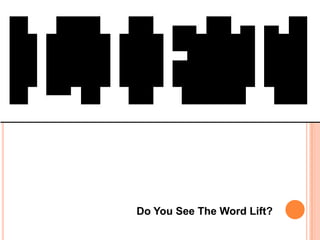
Do You See The Word Lift?
See More Than One Deer?
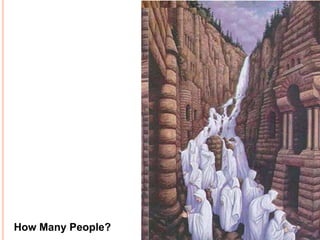
How Many People?
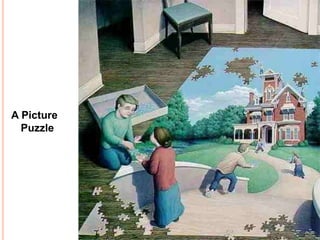
A Picture
Puzzle
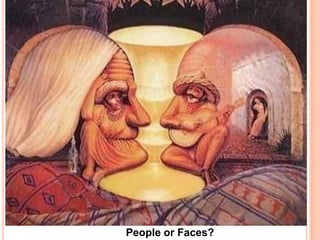
People or Faces?
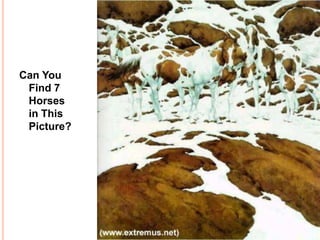
Can You
Find 7
Horses
in This
Picture?
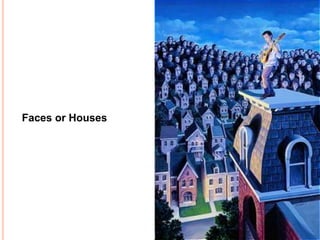
Faces or Houses
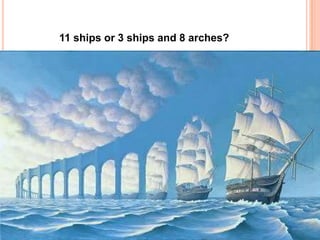
11 ships or 3 ships and 8 arches?

PRINCIPLES OF COMPOSITION

  • 1.
  • 2.
    PROPORTION  The relationshipbetween different things or parts with respect to comparative size, number, or degree  a part considered with respect to the whole  The interrelationship of all parts of an arrangement.  According to Euclid ancient Greek mathematician a ratio refers the quantitative comparison of similar things, while proportion refers to the equality of ratios.  Example golden section, classical orders, ken, modular, anthropometry, scale & renaissance theories
  • 4.
    SCALE  Refers tosize of something relative to some known standard or recognized constant.  Mechanical scale : calculation of objects physical size according to standard system of measurement  Visual/human scale: refers to difference found when one objects compared to others visually  Monumental scale: feeling of smallness when we compare ourselves to a exterior or interior space
  • 5.
    BALANCE  Stability ofan arrangement  Arrangement appears secure and stable  Balance must be both visual and actual  visual balance refers to the way an arrangement appears to the eye.  Symmetrical balance: arrangement of identical elements corresponding in size, shape & relative position about a common axis. Also called as axial or bilateral symmetry  Asymmetrical balance: lack of correspondence in size, shape or relative position among the element of a composition.  Radial balance: results from arrangement of elements about a center.
  • 6.
    WHAT KIND OFBALANCE IS ILLUSTRATED IN THIS PAINTING ORIENTAL POPPIES, BY GEORGIA O’KEEFE?
  • 7.
    SYMMETRICAL BALANCE, IF YOUCOULD VISUALLY DIVIDE THE PAPER IN HALF. THERE WOULD BE A POPPY ON BOTH SIDES. NO ONE SIDE DOMINATES THE PICTURES. NEITHER POPPY APPEARS TO BE MORE IMPORTANT THAN THE OTHER.
  • 8.
    WHAT TYPE OFBALANCE IS SHOWN IN THIS PAINTING, ARRANGEMENT IN GREY AND BLACK: PORTRAIT OF THE PAINTER'S MOTHER (COMMONLY KNOWN AS WHISTLER’S MOTHER), BY JAMES WHISTLER?
  • 9.
    , ASYMMETRICAL BALANCE THELARGE FORM OF THE WOMAN IS "VISUALLY EQUAL" TO THE BLACK CURTAIN AND WHITE PAINTING ON THE WALL. THIS MAKES THE PAINTING APPEAR BALANCED.
  • 10.
    WHAT TYPE OFBALANCE IS SHOWN IN THIS STAINED GLASS ARTWORK, ROSE WINDOW?
  • 11.
    RADIAL BALANCE! LOOKAT THE SPIRAL OR SPINNING EFFECT OF THE PATTERN. THE AXIS IS THE CENTER POINT AND THE DESIGN OR PATTERN APPEARS TO "RADIATE" FROM THAT POINT.
  • 12.
    HARMONY  Placing partsor combination of parts in a composition.  Harmony is the visually satisfying effect of combining similar, related elements.
  • 13.
    UNITY & VARIETY Relating the design elements to the idea being expressed  Variety is achieved when the elements are combined in various ways to increase visual interest.  For instance, an assortment of shapes that are of a variety of sizes attracts more attention than an assortment of shapes all the same size.
  • 14.
    RHYTHM  Repetition ofelements in space & time.  Repetition not only creates visual unity but also includes a rhythmic continuity of movement  Graded in size, color, value to give direction to sequence.
  • 15.
    EMPHASIS  Existence of dominant& subordinate elements in the composition of an interior setting.  Can be created by perceptible contrast in shape, size, c olor & value.  Can be centered within the space of a symmetrical organization
  • 17.
    Do You SeeThe Word Lift?
  • 18.
    See More ThanOne Deer?
  • 19.
  • 20.
  • 21.
  • 22.
  • 23.
  • 24.
    11 ships or3 ships and 8 arches?