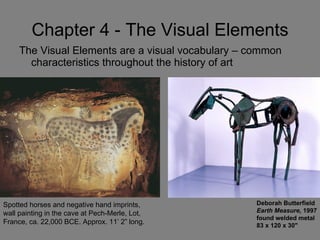
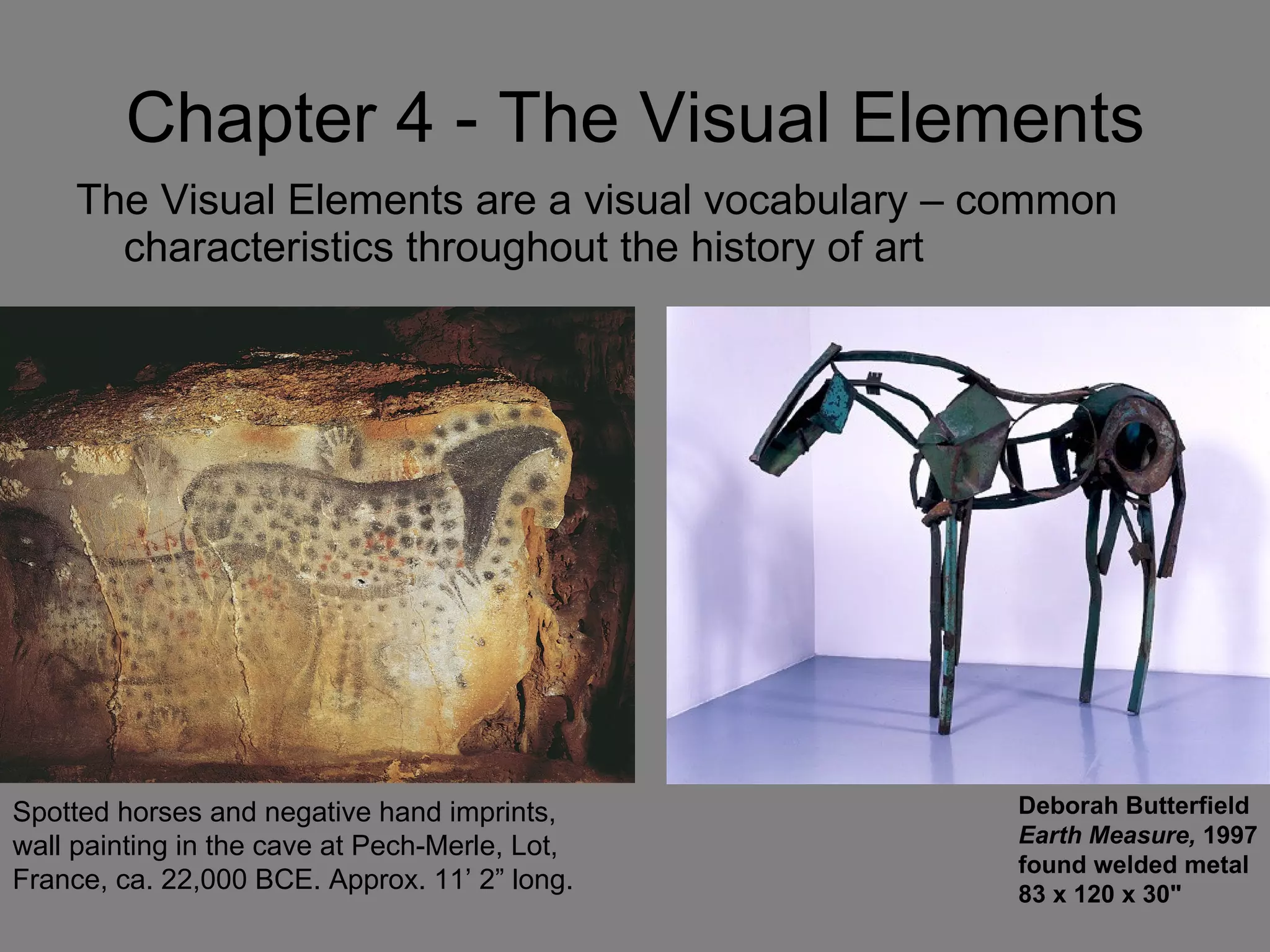
Chapter 4 - The Visual Elements The Visual Elements are a visual vocabulary – common characteristics throughout the history of art Spotted horses and negative hand imprints, wall painting in the cave at Pech-Merle, Lot, France, ca. 22,000 BCE. Approx. 11’ 2” long. Deborah Butterfield Earth Measure,  1997 found welded metal 83 x 120 x 30"
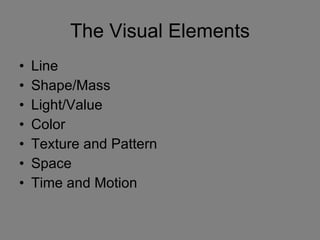
The Visual Elements Line Shape/Mass Light/Value Color Texture and Pattern Space  Time and Motion
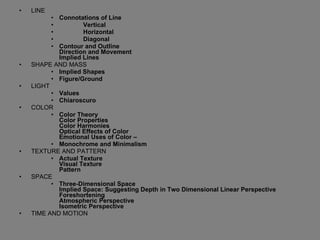
LINE Connotations of Line Vertical Horizontal Diagonal Contour and Outline Direction and Movement Implied Lines SHAPE AND MASS  Implied Shapes Figure/Ground LIGHT  Values Chiaroscuro COLOR  Color Theory Color Properties Color Harmonies Optical Effects of Color Emotional Uses of Color – Monochrome and Minimalism TEXTURE AND PATTERN  Actual Texture Visual Texture Pattern SPACE  Three-Dimensional Space Implied Space: Suggesting Depth in Two Dimensional Linear Perspective Foreshortening Atmospheric Perspective Isometric Perspective TIME AND MOTION
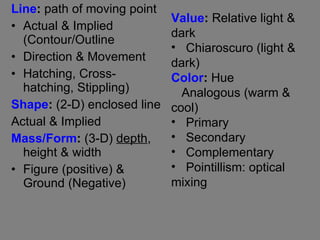
Line :  path of moving point Actual & Implied (Contour/Outline Direction & Movement Hatching, Cross-hatching, Stippling) Shape :  (2-D) enclosed line Actual & Implied  Mass/Form :  (3-D)  depth , height & width Figure (positive) & Ground (Negative) Value :  Relative light & dark Chiaroscuro (light & dark) Color :  Hue Analogous (warm & cool) Primary Secondary Complementary Pointillism: optical mixing
Draw a Non-objective design using line, and shape to convey meaning.  Anger Energy/Exuberance  Love
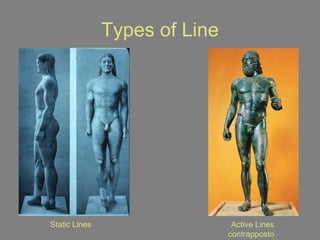
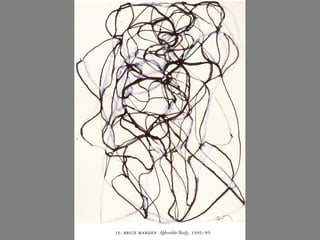
Types of Line Active Lines contrapposto Static Lines
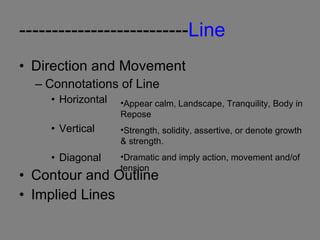
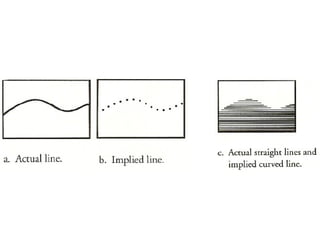
-------------------------- Line Direction and Movement Connotations of Line Horizontal Vertical Diagonal Contour and Outline Implied Lines Appear calm,   Landscape, Tranquility, Body in Repose Strength, solidity, assertive, or denote growth & strength. Dramatic and imply action, movement and/of tension


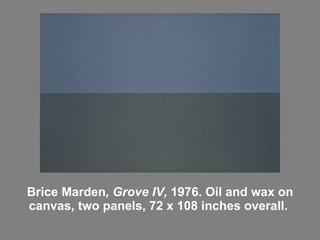
Brice Marden , Grove IV,  1976. Oil and wax on canvas, two panels, 72 x 108 inches overall.
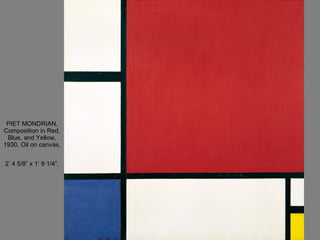
PIET MONDRIAN, Composition in Red, Blue, and Yellow, 1930. Oil on canvas, 2’ 4 5/8” x 1’ 9 1/4”.
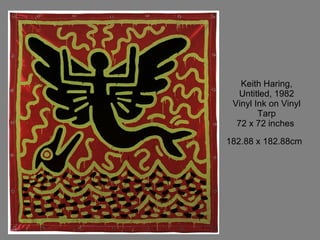
Keith Haring, Untitled, 1982 Vinyl Ink on Vinyl Tarp 72 x 72 inches  182.88 x 182.88cm
 
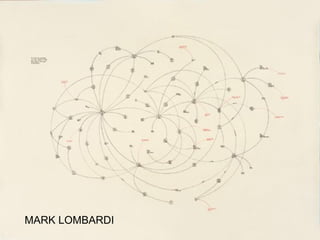
MARK LOMBARDI
 
 
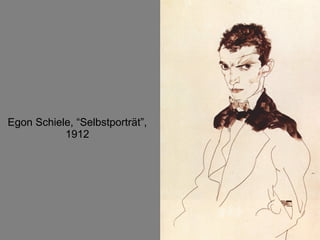
Egon Schiele, “Selbstporträt”, 1912
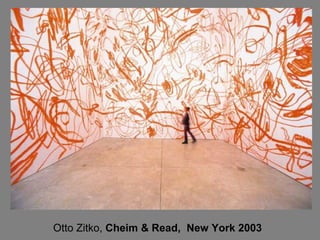
Otto Zitko,  Cheim & Read,  New York 2003
 
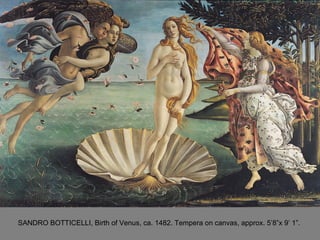
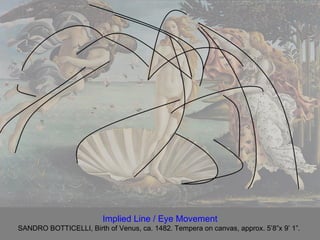
SANDRO BOTTICELLI, Birth of Venus, ca. 1482. Tempera on canvas, approx. 5’8”x 9’ 1”.
Implied Line / Eye Movement SANDRO BOTTICELLI, Birth of Venus, ca. 1482. Tempera on canvas, approx. 5’8”x 9’ 1”.
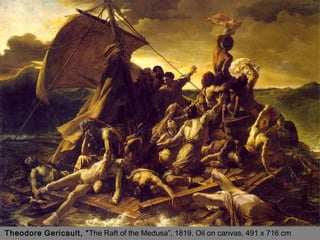
Theodore   Gericault, “ The Raft of the Medusa”, 1819, Oil on canvas, 491 x 716 cm
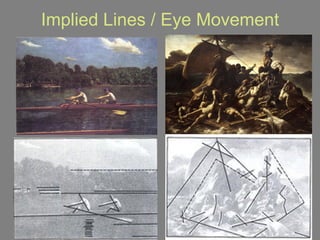
Implied Lines / Eye Movement
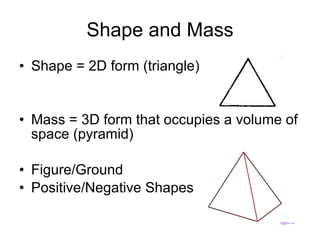
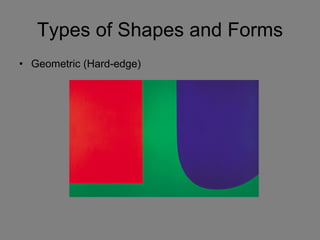
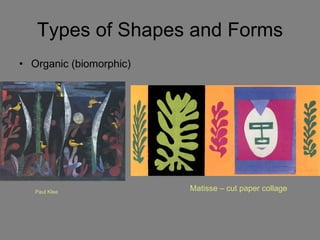
Shape and Mass Shape = 2D form (triangle) Mass = 3D form that occupies a volume of space (pyramid) Figure/Ground Positive/Negative Shapes
Types of Shapes and Forms Geometric (Hard-edge)
Types of Shapes and Forms Organic (biomorphic) Paul Klee Matisse – cut paper collage
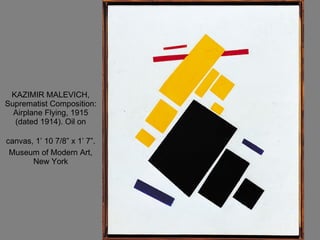
KAZIMIR MALEVICH, Suprematist Composition: Airplane Flying, 1915 (dated 1914). Oil on canvas, 1’ 10 7/8” x 1’ 7”.   Museum of Modern Art, New York
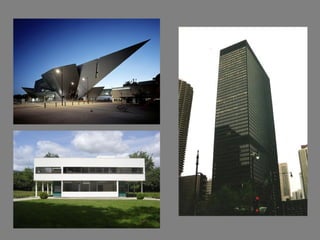
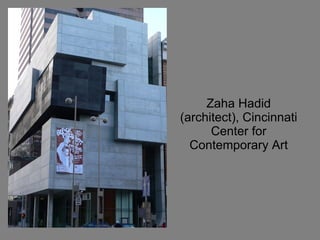
Zaha Hadid (architect), Cincinnati Center for Contemporary Art
 
 
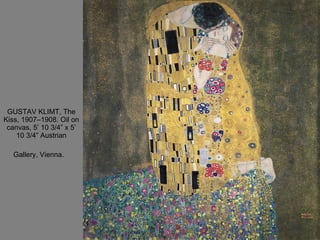
GUSTAV KLIMT, The Kiss, 1907–1908. Oil on canvas, 5’ 10 3/4” x 5’ 10 3/4” Austrian Gallery, Vienna.
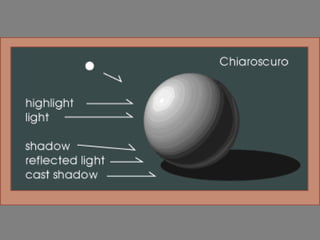
Values (the Effects of Light) Chiaroscuro The term "chiaroscuro" comes from Italian, and literally means  A)  organic shape.  B)  a sense of movement.  C)  outlined form.  D)  rough texture.  E)  light/dark.
Values (the Effects of Light) Chiaroscuro The term "chiaroscuro" comes from Italian, and literally means  A)  organic shape.  B)  a sense of movement.  C)  outlined form.  D)  rough texture.  E)   light/dark.
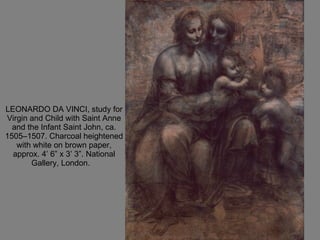
 
LEONARDO DA VINCI, study for Virgin and Child with Saint Anne and the Infant Saint John, ca. 1505–1507. Charcoal heightened with white on brown paper, approx. 4’ 6” x 3’ 3”. National Gallery, London.
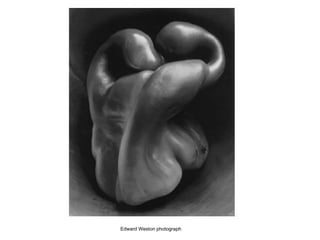
Edward Weston photograph
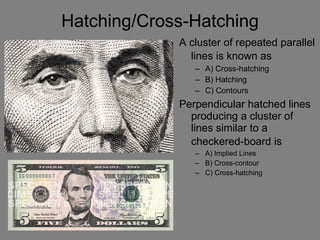
A cluster of repeated parallel lines is known as   A) Cross-hatching  B) Hatching  C) Contours Perpendicular hatched lines producing a cluster of lines similar to a checkered-board is   A) Implied Lines  B) Cross-contour  C) Cross-hatching Hatching/Cross-Hatching
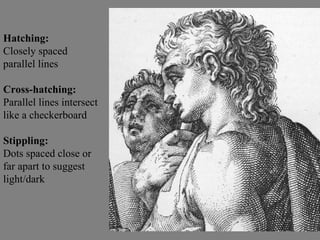
Hatching: Closely spaced parallel lines Cross-hatching: Parallel lines intersect like a checkerboard Stippling:  Dots spaced close or far apart to suggest light/dark


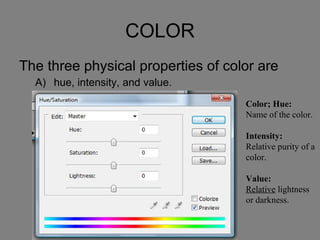
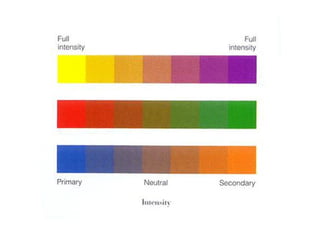
COLOR The three physical properties of color are  hue, intensity, and value.  primary, secondary, and intermediate.  warm, cool, and neutral.  tint, tone, and shade.  None of the answers are correct. Color; Hue: Name of the color. Intensity: Relative purity of a color. Value: Relative  lightness or darkness.
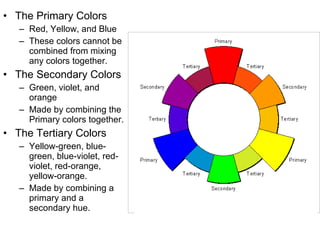
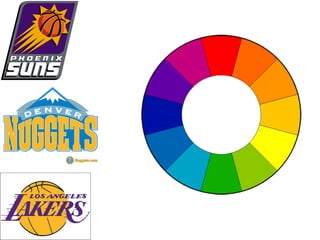
The Primary Colors Red, Yellow, and Blue These colors cannot be combined from mixing any colors together. The Secondary Colors  Green, violet, and orange Made by combining the Primary colors together. The Tertiary Colors  Yellow-green, blue-green, blue-violet, red-violet, red-orange, yellow-orange. Made by combining a primary and a secondary hue.
 
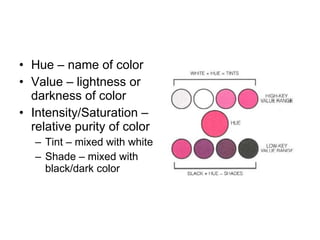
Hue – name of color Value – lightness or darkness of color Intensity/Saturation – relative purity of color Tint – mixed with white Shade – mixed with black/dark color
 
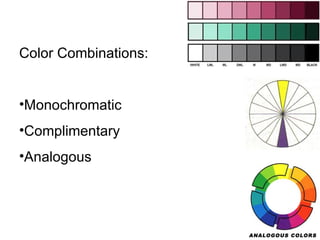
Color Combinations: Monochromatic Complimentary  Analogous
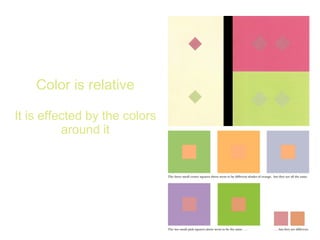
Color is relative It is effected by the colors around it
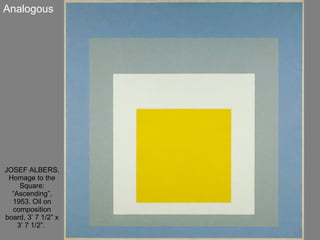
JOSEF ALBERS, Homage to the Square: “Ascending”, 1953. Oil on composition board, 3’ 7 1/2” x 3’ 7 1/2”.  Analogous
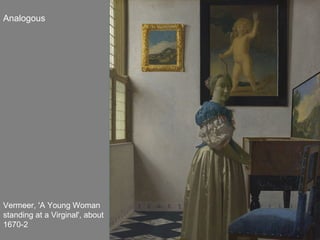
Vermeer, 'A Young Woman standing at a Virginal', about 1670-2 Analogous
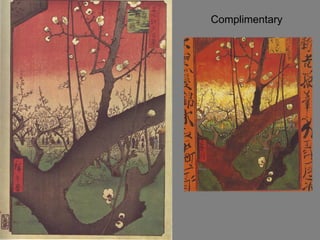
Complimentary
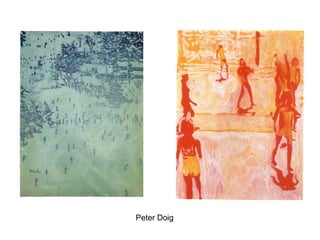
Peter Doig
 
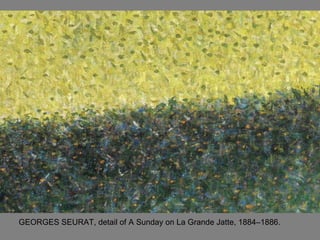
GEORGES SEURAT, detail of A Sunday on La Grande Jatte, 1884–1886.
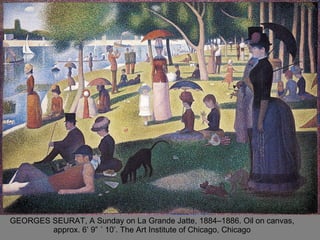
GEORGES SEURAT, A Sunday on La Grande Jatte, 1884–1886. Oil on canvas, approx. 6’ 9” ´ 10’. The Art Institute of Chicago, Chicago
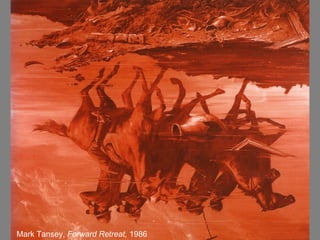
Mark Tansey,  Forward Retreat,  1986
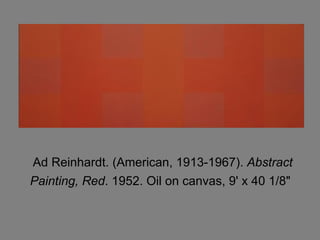
Ad Reinhardt. (American, 1913-1967).  Abstract Painting, Red . 1952. Oil on canvas, 9' x 40 1/8"
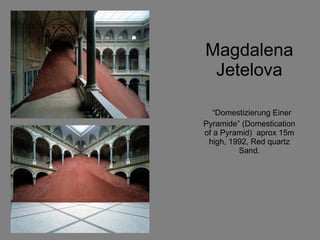
Magdalena Jetelova   “Domestizierung Einer Pyramide” (Domestication of a Pyramid)  aprox 15m high, 1992, Red quartz Sand.
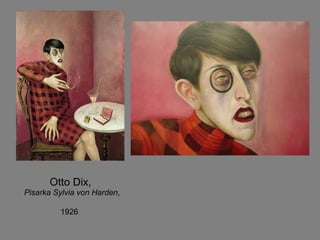
Otto Dix,  Pisarka Sylvia von Harden , 1926
Subjective Color That which is derived from the mind reflecting a personal viewpoint, bias, or emotion.  A subjective color tends to be intuitive, inventive, or creative.
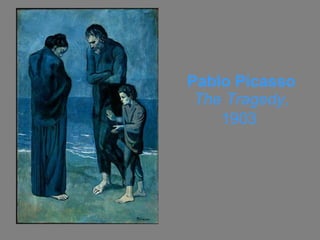
Pablo Picasso The Tragedy , 1903
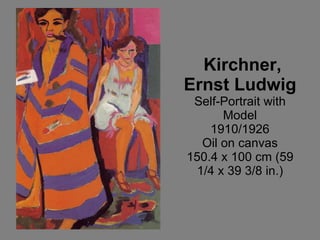
  Kirchner, Ernst Ludwig Self-Portrait with Model 1910/1926 Oil on canvas 150.4 x 100 cm (59 1/4 x 39 3/8 in.)
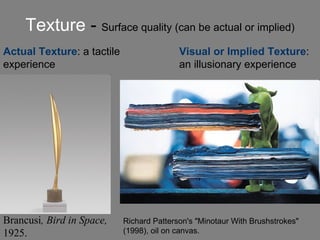
Texture  -  Surface quality (can be actual or implied) Actual Texture : a tactile experience Visual or Implied Texture :  an illusionary experience Brancusi , Bird in Space,  1925. Richard Patterson's "Minotaur With Brushstrokes" (1998), oil on canvas.
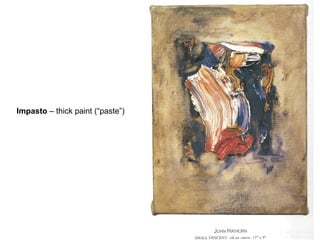
Impasto  – thick paint (“paste”)
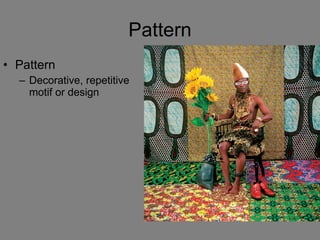
Pattern Pattern Decorative, repetitive motif or design
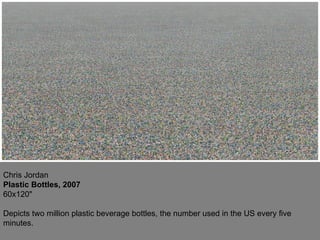
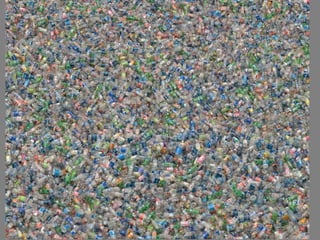
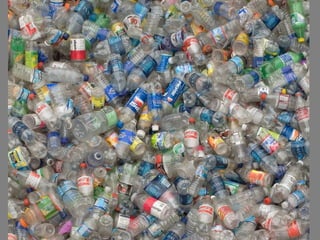
Chris Jordan Plastic Bottles, 2007 60x120" Depicts two million plastic beverage bottles, the number used in the US every five minutes.
 
 
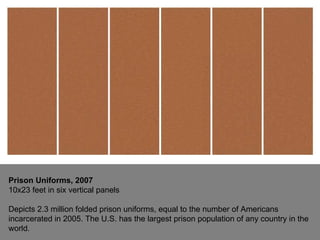
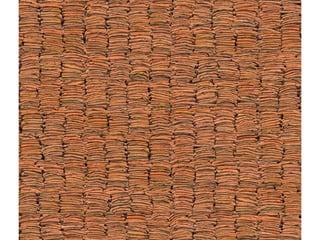
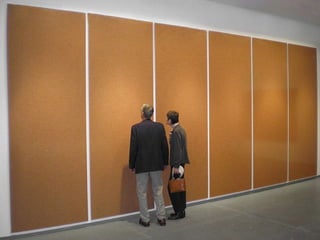
Prison Uniforms, 2007 10x23 feet in six vertical panels Depicts 2.3 million folded prison uniforms, equal to the number of Americans incarcerated in 2005. The U.S. has the largest prison population of any country in the world.


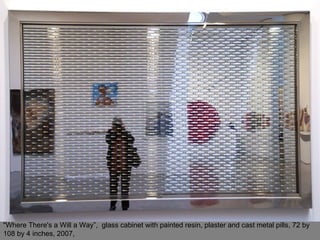
"Where There's a Will a Way”,  glass cabinet with painted resin, plaster and cast metal pills, 72 by 108 by 4 inches, 2007,
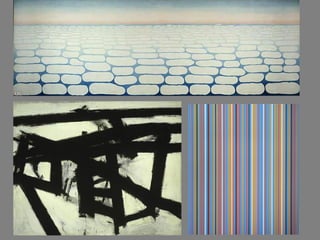
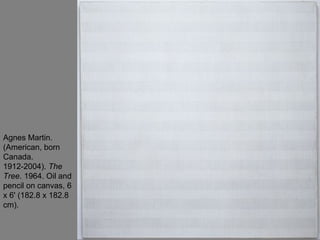
Agnes Martin. (American, born Canada. 1912-2004).  The Tree . 1964. Oil and pencil on canvas, 6 x 6' (182.8 x 182.8 cm).
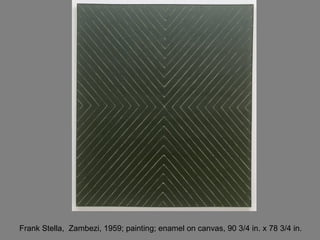
Frank Stella,  Zambezi, 1959; painting; enamel on canvas, 90 3/4 in. x 78 3/4 in.
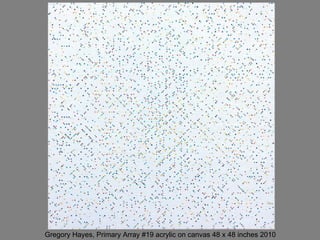
Gregory Hayes, Primary Array #19 acrylic on canvas 48 x 48 inches 2010

Week2 Visual Elements Part1

  • 1.
    Chapter 4 -The Visual Elements The Visual Elements are a visual vocabulary – common characteristics throughout the history of art Spotted horses and negative hand imprints, wall painting in the cave at Pech-Merle, Lot, France, ca. 22,000 BCE. Approx. 11’ 2” long. Deborah Butterfield Earth Measure, 1997 found welded metal 83 x 120 x 30"
  • 2.
    The Visual ElementsLine Shape/Mass Light/Value Color Texture and Pattern Space Time and Motion
  • 3.
    LINE Connotations ofLine Vertical Horizontal Diagonal Contour and Outline Direction and Movement Implied Lines SHAPE AND MASS Implied Shapes Figure/Ground LIGHT Values Chiaroscuro COLOR Color Theory Color Properties Color Harmonies Optical Effects of Color Emotional Uses of Color – Monochrome and Minimalism TEXTURE AND PATTERN Actual Texture Visual Texture Pattern SPACE Three-Dimensional Space Implied Space: Suggesting Depth in Two Dimensional Linear Perspective Foreshortening Atmospheric Perspective Isometric Perspective TIME AND MOTION
  • 4.
    Line : path of moving point Actual & Implied (Contour/Outline Direction & Movement Hatching, Cross-hatching, Stippling) Shape : (2-D) enclosed line Actual & Implied Mass/Form : (3-D) depth , height & width Figure (positive) & Ground (Negative) Value : Relative light & dark Chiaroscuro (light & dark) Color : Hue Analogous (warm & cool) Primary Secondary Complementary Pointillism: optical mixing
  • 5.
    Draw a Non-objectivedesign using line, and shape to convey meaning. Anger Energy/Exuberance Love
  • 6.
    Types of LineActive Lines contrapposto Static Lines
  • 7.
    -------------------------- Line Directionand Movement Connotations of Line Horizontal Vertical Diagonal Contour and Outline Implied Lines Appear calm, Landscape, Tranquility, Body in Repose Strength, solidity, assertive, or denote growth & strength. Dramatic and imply action, movement and/of tension
  • 8.
  • 9.
  • 10.
  • 11.
  • 12.
  • 13.
    Brice Marden ,Grove IV, 1976. Oil and wax on canvas, two panels, 72 x 108 inches overall.
  • 14.
    PIET MONDRIAN, Compositionin Red, Blue, and Yellow, 1930. Oil on canvas, 2’ 4 5/8” x 1’ 9 1/4”.
  • 15.
    Keith Haring, Untitled,1982 Vinyl Ink on Vinyl Tarp 72 x 72 inches 182.88 x 182.88cm
  • 16.
  • 17.
  • 18.
  • 19.
  • 20.
  • 21.
    Otto Zitko, Cheim & Read, New York 2003
  • 22.
  • 23.
    SANDRO BOTTICELLI, Birthof Venus, ca. 1482. Tempera on canvas, approx. 5’8”x 9’ 1”.
  • 24.
    Implied Line /Eye Movement SANDRO BOTTICELLI, Birth of Venus, ca. 1482. Tempera on canvas, approx. 5’8”x 9’ 1”.
  • 25.
    Theodore Gericault, “ The Raft of the Medusa”, 1819, Oil on canvas, 491 x 716 cm
  • 26.
    Implied Lines /Eye Movement
  • 27.
    Shape and MassShape = 2D form (triangle) Mass = 3D form that occupies a volume of space (pyramid) Figure/Ground Positive/Negative Shapes
  • 28.
    Types of Shapesand Forms Geometric (Hard-edge)
  • 29.
    Types of Shapesand Forms Organic (biomorphic) Paul Klee Matisse – cut paper collage
  • 30.
    KAZIMIR MALEVICH, SuprematistComposition: Airplane Flying, 1915 (dated 1914). Oil on canvas, 1’ 10 7/8” x 1’ 7”. Museum of Modern Art, New York
  • 31.
    Zaha Hadid (architect),Cincinnati Center for Contemporary Art
  • 32.
  • 33.
  • 34.
    GUSTAV KLIMT, TheKiss, 1907–1908. Oil on canvas, 5’ 10 3/4” x 5’ 10 3/4” Austrian Gallery, Vienna.
  • 35.
    Values (the Effectsof Light) Chiaroscuro The term "chiaroscuro" comes from Italian, and literally means A) organic shape. B) a sense of movement. C) outlined form. D) rough texture. E) light/dark.
  • 36.
    Values (the Effectsof Light) Chiaroscuro The term "chiaroscuro" comes from Italian, and literally means A) organic shape. B) a sense of movement. C) outlined form. D) rough texture. E) light/dark.
  • 37.
  • 38.
    LEONARDO DA VINCI,study for Virgin and Child with Saint Anne and the Infant Saint John, ca. 1505–1507. Charcoal heightened with white on brown paper, approx. 4’ 6” x 3’ 3”. National Gallery, London.
  • 39.
  • 40.
    A cluster ofrepeated parallel lines is known as A) Cross-hatching B) Hatching C) Contours Perpendicular hatched lines producing a cluster of lines similar to a checkered-board is A) Implied Lines B) Cross-contour C) Cross-hatching Hatching/Cross-Hatching
  • 41.
    Hatching: Closely spacedparallel lines Cross-hatching: Parallel lines intersect like a checkerboard Stippling: Dots spaced close or far apart to suggest light/dark
  • 42.
  • 43.
  • 44.
  • 45.
    COLOR The threephysical properties of color are hue, intensity, and value. primary, secondary, and intermediate. warm, cool, and neutral. tint, tone, and shade. None of the answers are correct. Color; Hue: Name of the color. Intensity: Relative purity of a color. Value: Relative lightness or darkness.
  • 46.
    The Primary ColorsRed, Yellow, and Blue These colors cannot be combined from mixing any colors together. The Secondary Colors Green, violet, and orange Made by combining the Primary colors together. The Tertiary Colors Yellow-green, blue-green, blue-violet, red-violet, red-orange, yellow-orange. Made by combining a primary and a secondary hue.
  • 47.
  • 48.
    Hue – nameof color Value – lightness or darkness of color Intensity/Saturation – relative purity of color Tint – mixed with white Shade – mixed with black/dark color
  • 49.
  • 50.
    Color Combinations: MonochromaticComplimentary Analogous
  • 51.
    Color is relativeIt is effected by the colors around it
  • 52.
    JOSEF ALBERS, Homageto the Square: “Ascending”, 1953. Oil on composition board, 3’ 7 1/2” x 3’ 7 1/2”. Analogous
  • 53.
    Vermeer, 'A YoungWoman standing at a Virginal', about 1670-2 Analogous
  • 54.
  • 55.
  • 56.
  • 57.
    GEORGES SEURAT, detailof A Sunday on La Grande Jatte, 1884–1886.
  • 58.
    GEORGES SEURAT, ASunday on La Grande Jatte, 1884–1886. Oil on canvas, approx. 6’ 9” ´ 10’. The Art Institute of Chicago, Chicago
  • 59.
    Mark Tansey, Forward Retreat, 1986
  • 60.
    Ad Reinhardt. (American,1913-1967). Abstract Painting, Red . 1952. Oil on canvas, 9' x 40 1/8"
  • 61.
    Magdalena Jetelova “Domestizierung Einer Pyramide” (Domestication of a Pyramid) aprox 15m high, 1992, Red quartz Sand.
  • 62.
    Otto Dix, Pisarka Sylvia von Harden , 1926
  • 63.
    Subjective Color Thatwhich is derived from the mind reflecting a personal viewpoint, bias, or emotion. A subjective color tends to be intuitive, inventive, or creative.
  • 64.
    Pablo Picasso TheTragedy , 1903
  • 65.
    Kirchner,Ernst Ludwig Self-Portrait with Model 1910/1926 Oil on canvas 150.4 x 100 cm (59 1/4 x 39 3/8 in.)
  • 66.
    Texture - Surface quality (can be actual or implied) Actual Texture : a tactile experience Visual or Implied Texture : an illusionary experience Brancusi , Bird in Space, 1925. Richard Patterson's "Minotaur With Brushstrokes" (1998), oil on canvas.
  • 67.
    Impasto –thick paint (“paste”)
  • 68.
    Pattern Pattern Decorative,repetitive motif or design
  • 69.
    Chris Jordan PlasticBottles, 2007 60x120" Depicts two million plastic beverage bottles, the number used in the US every five minutes.
  • 70.
  • 71.
  • 72.
    Prison Uniforms, 200710x23 feet in six vertical panels Depicts 2.3 million folded prison uniforms, equal to the number of Americans incarcerated in 2005. The U.S. has the largest prison population of any country in the world.
  • 73.
  • 74.
  • 75.
  • 76.
    "Where There's aWill a Way”, glass cabinet with painted resin, plaster and cast metal pills, 72 by 108 by 4 inches, 2007,
  • 77.
    Agnes Martin. (American,born Canada. 1912-2004). The Tree . 1964. Oil and pencil on canvas, 6 x 6' (182.8 x 182.8 cm).
  • 78.
    Frank Stella, Zambezi, 1959; painting; enamel on canvas, 90 3/4 in. x 78 3/4 in.
  • 79.
    Gregory Hayes, PrimaryArray #19 acrylic on canvas 48 x 48 inches 2010

Editor's Notes

  • #5 This chapter is divided into 2 parts, as there are a lot of terms. This also allows lecture time to be divided by an activity. Students will find the need to take notes on individual slides, so they should save more room beneath each term. Activity: Non-objective design using line, shape, and color to convey meaning. Write several adjectives on the board (Anger, Exuberance, Alienation, Passion). Students must use Nonobjective lines, shapes, and colors to convey the meaning. Remind students to bring supplies (paper, pencils, range of color media). There are excellent interactive study activities, Web links and videos related to this chapter available at www.mhhe.com/lwa8.
  • #67 Texture can be described as a perception of smooth or rough, fine or coarse. This sculpture could be experienced through touch (if we were allowed). Some museums have had to set up detection alarms due to our need to touch. Brancusi included three different textures, which grow more refined as our eyes move upward. This contributes to the sense of movement, as if the material world were falling away. The rough, wooden pedestal exerts an upward thrust; the small limestone base acts as a compression zone for gathering energy; the smooth marble bird makes a leap into space. Paint applied thickly creates an actual texture, called Impasto, that we could feel (again, if we were allowed). Dufy’s painting is on a flat canvas, but he creates a visual illusion or an implied texture through his brushstrokes. They create “rough patches.” The water does not have a representational illusion, but still conveys choppiness. Artists can create convincing illusions of actual texture created through ranges of VALUE and use of LINE. The mask is an example of actual textures which are tactile (can be felt), and create a dynamic visual PATTERN.