Basic Elements and
Principles of Art
With an emphasis on sculpture and three dimensional art
Line:
An element of art defined
by a point moving in
space. Line may be two-or
three-dimensional,
descriptive, implied, or
abstract.
Definitions:
Descriptive – describing or classifying in
an objective and nonjudgmental way.
Describing accents, forms, structures,
and usage without making value
judgments.
Implied – suggested but not directly
expressed
Abstract -art that does not attempt to
represent external reality, but seeks to
achieve its effect using shapes, forms,
colors, and textures.
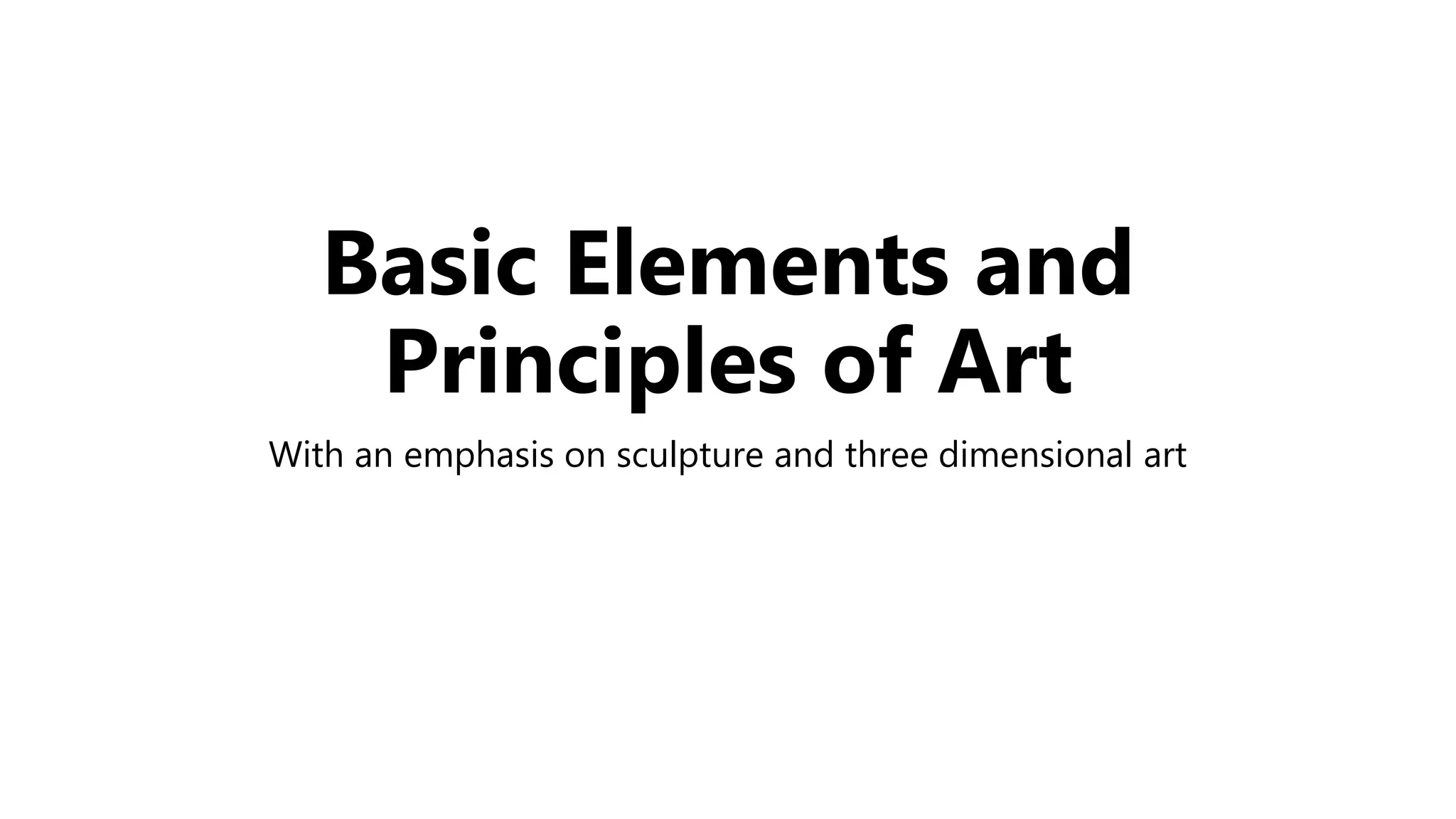
Claes Oldenburg (Sweden, 1922–
2022) and Coosje van Bruggen
(Netherlands, 1942-2009)
Spoonbridge and Cherry, 1985-1988
aluminum, stainless steel, paint, 354 x
618 x 162 inches.
Shape / Form:
3D shapes or forms
are shapes with three
dimensions, such as width,
height, and depth. An
example of a 3D shape is a
prism or a sphere. 3D
shapes are
multidimensional and can
be physically held.
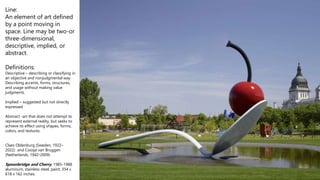
Two types of shape –
organic and geometric.
Yayoi Kusama, (Japan, 1929)
Narcissus Garden, 2018, 1500 mirrored
plastic balls, dimensions vary.
Space:
Real space is three-
dimensional. The
dimensions of height,
depth, and width within
which all things exist and
move.
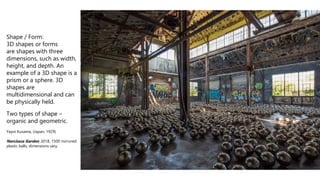
It can also refer to the
artist's use of the area
within the sculpture. In
sculpture, the positive
space is solid (the
sculpture itself) and the
negative space is the area
around it.
Damián Ortega, (Mexico, 1967)
Controller of the Universe , 2007,
Found tools and wire, 110 x 160 x 180
inches
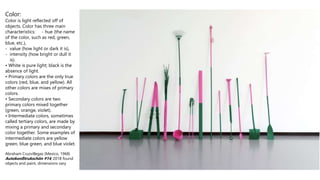
Color:
Color is light reflected off of
objects. Color has three main
characteristics: - hue (the name
of the color, such as red, green,
blue, etc.),
- value (how light or dark it is),
- intensity (how bright or dull it
is).
• White is pure light; black is the
absence of light.
• Primary colors are the only true
colors (red, blue, and yellow). All
other colors are mixes of primary
colors.
• Secondary colors are two
primary colors mixed together
(green, orange, violet).
• Intermediate colors, sometimes
called tertiary colors, are made by
mixing a primary and secondary
color together. Some examples of
intermediate colors are yellow
green, blue green, and blue violet.
Abraham Cruzvillegas (Mexico, 1968)
Autokonßtrukschön #14, 2018 found
objects and paint, dimensions vary
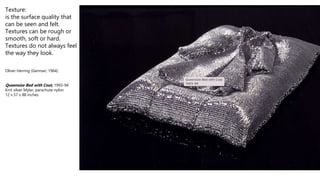
Texture:
is the surface quality that
can be seen and felt.
Textures can be rough or
smooth, soft or hard.
Textures do not always feel
the way they look.
Oliver Herring (German, 1964)
Queensize Bed with Coat, 1993-94
Knit silver Mylar, parachute nylon
12 x 57 x 88 inches
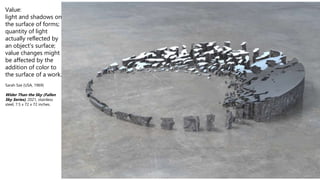
Value:
light and shadows on
the surface of forms;
quantity of light
actually reflected by
an object's surface;
value changes might
be affected by the
addition of color to
the surface of a work.
Sarah Sze (USA, 1969)
Wider Than the Sky (Fallen
Sky Series), 2021, stainless
steel, 7.5 x 72 x 72 inches.
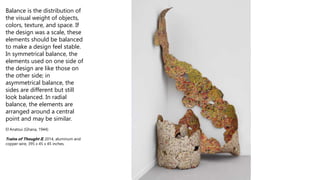
Balance is the distribution of
the visual weight of objects,
colors, texture, and space. If
the design was a scale, these
elements should be balanced
to make a design feel stable.
In symmetrical balance, the
elements used on one side of
the design are like those on
the other side; in
asymmetrical balance, the
sides are different but still
look balanced. In radial
balance, the elements are
arranged around a central
point and may be similar.
El Anatsui (Ghana, 1944)
Trains of Thought II, 2014, aluminum and
copper wire, 395 x 45 x 45 inches.
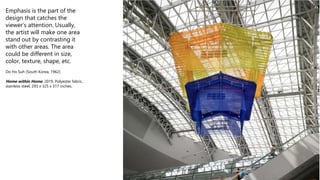
Emphasis is the part of the
design that catches the
viewer’s attention. Usually,
the artist will make one area
stand out by contrasting it
with other areas. The area
could be different in size,
color, texture, shape, etc.
Do Ho Suh (South Korea, 1962)
Home within Home, 2019, Polyester fabric,
stainless steel, 293 x 325 x 317 inches.
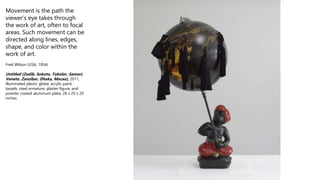
Movement is the path the
viewer’s eye takes through
the work of art, often to focal
areas. Such movement can be
directed along lines, edges,
shape, and color within the
work of art.
Fred Wilson (USA, 1954)
Untitled (Zadib, Sokoto, Tokolor, Samori,
Veneto, Zanzibar, Dhaka, Macao), 2011,
illuminated plastic globe, acrylic paint,
tassels, steel armature, plaster figure, and
powder coated aluminum plate, 28 x 20 x 20
inches
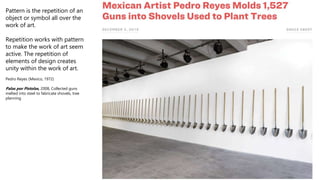
Pattern is the repetition of an
object or symbol all over the
work of art.
Repetition works with pattern
to make the work of art seem
active. The repetition of
elements of design creates
unity within the work of art.
Pedro Reyes (Mexico, 1972)
Palas por Pistolas, 2008, Collected guns
melted into steel to fabricate shovels, tree
planning
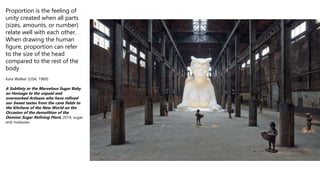
Proportion is the feeling of
unity created when all parts
(sizes, amounts, or number)
relate well with each other.
When drawing the human
figure, proportion can refer
to the size of the head
compared to the rest of the
body
Kara Walker (USA, 1969)
A Subtlety or the Marvelous Sugar Baby
an Homage to the unpaid and
overworked Artisans who have refined
our Sweet tastes from the cane fields to
the Kitchens of the New World on the
Occasion of the demolition of the
Domino Sugar Refining Plant, 2014, sugar
and molasses.
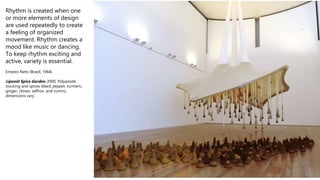
Rhythm is created when one
or more elements of design
are used repeatedly to create
a feeling of organized
movement. Rhythm creates a
mood like music or dancing.
To keep rhythm exciting and
active, variety is essential.
Ernesto Neto (Brazil, 1964)
Lipzoid Spice Garden, 2000, Polyamide
stocking and spices (black pepper, turmeric,
ginger, cloves, saffron, and cumin),
dimensions vary
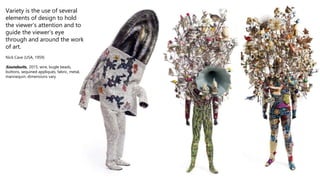
Variety is the use of several
elements of design to hold
the viewer’s attention and to
guide the viewer’s eye
through and around the work
of art.
Nick Cave (USA, 1959)
Soundsuits,, 2015, wire, bugle beads,
buttons, sequined appliqués, fabric, metal,
mannequin, dimensions vary
Unity is the feeling of harmony between all parts of the work of art, which creates a sense of completeness.

elements+principles.pptx

  • 1.
    Basic Elements and Principlesof Art With an emphasis on sculpture and three dimensional art
  • 2.
    Line: An element ofart defined by a point moving in space. Line may be two-or three-dimensional, descriptive, implied, or abstract. Definitions: Descriptive – describing or classifying in an objective and nonjudgmental way. Describing accents, forms, structures, and usage without making value judgments. Implied – suggested but not directly expressed Abstract -art that does not attempt to represent external reality, but seeks to achieve its effect using shapes, forms, colors, and textures. Claes Oldenburg (Sweden, 1922– 2022) and Coosje van Bruggen (Netherlands, 1942-2009) Spoonbridge and Cherry, 1985-1988 aluminum, stainless steel, paint, 354 x 618 x 162 inches.
  • 3.
    Shape / Form: 3Dshapes or forms are shapes with three dimensions, such as width, height, and depth. An example of a 3D shape is a prism or a sphere. 3D shapes are multidimensional and can be physically held. Two types of shape – organic and geometric. Yayoi Kusama, (Japan, 1929) Narcissus Garden, 2018, 1500 mirrored plastic balls, dimensions vary.
  • 4.
    Space: Real space isthree- dimensional. The dimensions of height, depth, and width within which all things exist and move. It can also refer to the artist's use of the area within the sculpture. In sculpture, the positive space is solid (the sculpture itself) and the negative space is the area around it. Damián Ortega, (Mexico, 1967) Controller of the Universe , 2007, Found tools and wire, 110 x 160 x 180 inches
  • 5.
    Color: Color is lightreflected off of objects. Color has three main characteristics: - hue (the name of the color, such as red, green, blue, etc.), - value (how light or dark it is), - intensity (how bright or dull it is). • White is pure light; black is the absence of light. • Primary colors are the only true colors (red, blue, and yellow). All other colors are mixes of primary colors. • Secondary colors are two primary colors mixed together (green, orange, violet). • Intermediate colors, sometimes called tertiary colors, are made by mixing a primary and secondary color together. Some examples of intermediate colors are yellow green, blue green, and blue violet. Abraham Cruzvillegas (Mexico, 1968) Autokonßtrukschön #14, 2018 found objects and paint, dimensions vary
  • 6.
    Texture: is the surfacequality that can be seen and felt. Textures can be rough or smooth, soft or hard. Textures do not always feel the way they look. Oliver Herring (German, 1964) Queensize Bed with Coat, 1993-94 Knit silver Mylar, parachute nylon 12 x 57 x 88 inches
  • 7.
    Value: light and shadowson the surface of forms; quantity of light actually reflected by an object's surface; value changes might be affected by the addition of color to the surface of a work. Sarah Sze (USA, 1969) Wider Than the Sky (Fallen Sky Series), 2021, stainless steel, 7.5 x 72 x 72 inches.
  • 9.
    Balance is thedistribution of the visual weight of objects, colors, texture, and space. If the design was a scale, these elements should be balanced to make a design feel stable. In symmetrical balance, the elements used on one side of the design are like those on the other side; in asymmetrical balance, the sides are different but still look balanced. In radial balance, the elements are arranged around a central point and may be similar. El Anatsui (Ghana, 1944) Trains of Thought II, 2014, aluminum and copper wire, 395 x 45 x 45 inches.
  • 10.
    Emphasis is thepart of the design that catches the viewer’s attention. Usually, the artist will make one area stand out by contrasting it with other areas. The area could be different in size, color, texture, shape, etc. Do Ho Suh (South Korea, 1962) Home within Home, 2019, Polyester fabric, stainless steel, 293 x 325 x 317 inches.
  • 11.
    Movement is thepath the viewer’s eye takes through the work of art, often to focal areas. Such movement can be directed along lines, edges, shape, and color within the work of art. Fred Wilson (USA, 1954) Untitled (Zadib, Sokoto, Tokolor, Samori, Veneto, Zanzibar, Dhaka, Macao), 2011, illuminated plastic globe, acrylic paint, tassels, steel armature, plaster figure, and powder coated aluminum plate, 28 x 20 x 20 inches
  • 12.
    Pattern is therepetition of an object or symbol all over the work of art. Repetition works with pattern to make the work of art seem active. The repetition of elements of design creates unity within the work of art. Pedro Reyes (Mexico, 1972) Palas por Pistolas, 2008, Collected guns melted into steel to fabricate shovels, tree planning
  • 13.
    Proportion is thefeeling of unity created when all parts (sizes, amounts, or number) relate well with each other. When drawing the human figure, proportion can refer to the size of the head compared to the rest of the body Kara Walker (USA, 1969) A Subtlety or the Marvelous Sugar Baby an Homage to the unpaid and overworked Artisans who have refined our Sweet tastes from the cane fields to the Kitchens of the New World on the Occasion of the demolition of the Domino Sugar Refining Plant, 2014, sugar and molasses.
  • 14.
    Rhythm is createdwhen one or more elements of design are used repeatedly to create a feeling of organized movement. Rhythm creates a mood like music or dancing. To keep rhythm exciting and active, variety is essential. Ernesto Neto (Brazil, 1964) Lipzoid Spice Garden, 2000, Polyamide stocking and spices (black pepper, turmeric, ginger, cloves, saffron, and cumin), dimensions vary
  • 15.
    Variety is theuse of several elements of design to hold the viewer’s attention and to guide the viewer’s eye through and around the work of art. Nick Cave (USA, 1959) Soundsuits,, 2015, wire, bugle beads, buttons, sequined appliqués, fabric, metal, mannequin, dimensions vary
  • 16.
    Unity is thefeeling of harmony between all parts of the work of art, which creates a sense of completeness.