Principles of Design
What are principles of design?
The guidelines for        Harmony
organizing the            Variety
elements in order to
satisfy the artist’s      Balance
expressive intent.        Proportion and Scale
They describe             Dominance
relationships of          Rhythm/Movement
elements to one
another.                  Economy
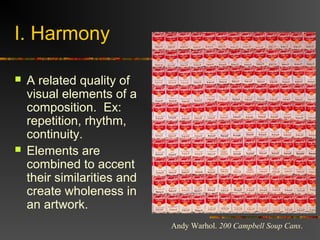
I. Harmony

   A related quality of
    visual elements of a
    composition. Ex:
    repetition, rhythm,
    continuity.
   Elements are
    combined to accent
    their similarities and
    create wholeness in
    an artwork.
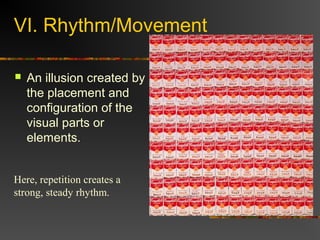
                             Andy Warhol. 200 Campbell Soup Cans.
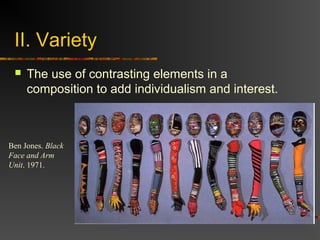
II. Variety
    The use of contrasting elements in a
     composition to add individualism and interest.


Ben Jones. Black
Face and Arm
Unit. 1971.
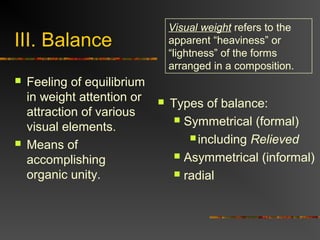
Visual weight refers to the
III. Balance                     apparent “heaviness” or
                                 “lightness” of the forms
                                 arranged in a composition.
   Feeling of equilibrium
    in weight attention or      Types of balance:
    attraction of various
                                   Symmetrical (formal)
    visual elements.
                                      including Relieved
   Means of
                                   Asymmetrical (informal)
    accomplishing
    organic unity.                 radial
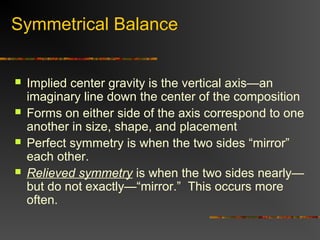
Symmetrical Balance


   Implied center gravity is the vertical axis—an
    imaginary line down the center of the composition
   Forms on either side of the axis correspond to one
    another in size, shape, and placement
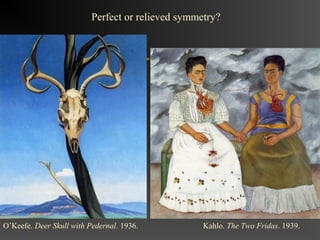
   Perfect symmetry is when the two sides “mirror”
    each other.
   Relieved symmetry is when the two sides nearly—
    but do not exactly—“mirror.” This occurs more
    often.
Perfect or relieved symmetry?


O’Keefe. Deer Skull with Pedernal. 1936.           Kahlo. The Two Fridas. 1939.
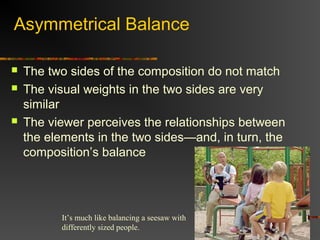
Asymmetrical Balance

   The two sides of the composition do not match
   The visual weights in the two sides are very
    similar
   The viewer perceives the relationships between
    the elements in the two sides—and, in turn, the
    composition’s balance


          It’s much like balancing a seesaw with
          differently sized people.
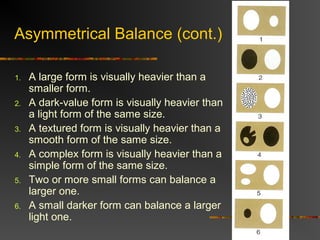
Asymmetrical Balance (cont.)

1.   A large form is visually heavier than a
     smaller form.
2.   A dark-value form is visually heavier than
     a light form of the same size.
3.   A textured form is visually heavier than a
     smooth form of the same size.
4.   A complex form is visually heavier than a
     simple form of the same size.
5.   Two or more small forms can balance a
     larger one.
6.   A small darker form can balance a larger
     light one.
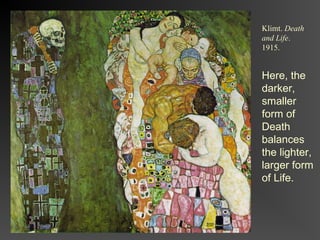
Klimt. Death
and Life.
1915.


Here, the
darker,
smaller
form of
Death
balances
the lighter,
larger form
of Life.
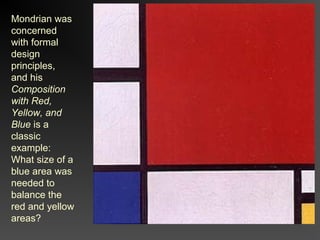
Mondrian was
concerned
with formal
design
principles,
and his
Composition
with Red,
Yellow, and
Blue is a
classic
example:
What size of a
blue area was
needed to
balance the
red and yellow
areas?
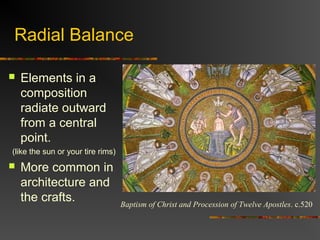
Radial Balance

   Elements in a
    composition
    radiate outward
    from a central
    point.
(like the sun or your tire rims)
   More common in
    architecture and
    the crafts.                    Baptism of Christ and Procession of Twelve Apostles. c.520
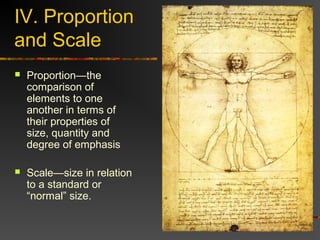
IV. Proportion
and Scale
   Proportion—the
    comparison of
    elements to one
    another in terms of
    their properties of
    size, quantity and
    degree of emphasis

   Scale—size in relation
    to a standard or
    “normal” size.
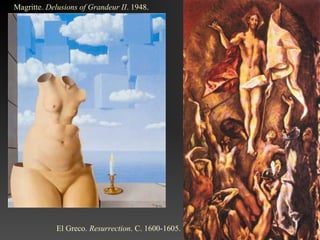
Magritte. Delusions of Grandeur II. 1948.


            El Greco. Resurrection. C. 1600-1605.
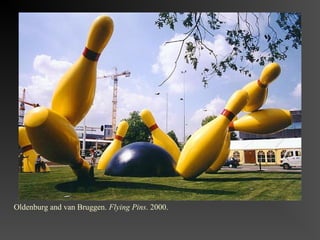
Oldenburg and van Bruggen. Flying Pins. 2000.
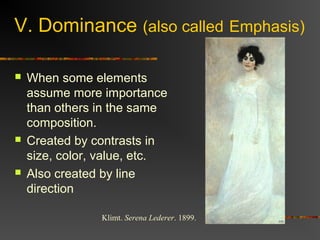
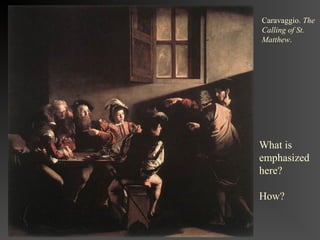
V. Dominance (also called Emphasis)

   When some elements
    assume more importance
    than others in the same
    composition.
   Created by contrasts in
    size, color, value, etc.
   Also created by line
    direction

                Klimt. Serena Lederer. 1899.
Caravaggio. The
Calling of St.
Matthew.


What is
emphasized
here?

How?
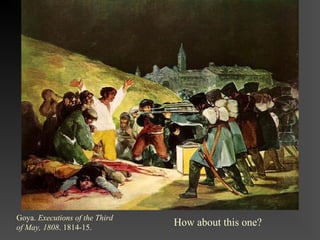
Goya. Executions of the Third
of May, 1808. 1814-15.
                                How about this one?
VI. Rhythm/Movement

   An illusion created by
    the placement and
    configuration of the
    visual parts or
    elements.


Here, repetition creates a
strong, steady rhythm.
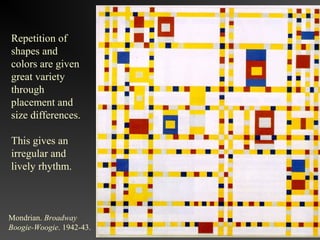
Repetition of
shapes and
colors are given
great variety
through
placement and
size differences.

This gives an
irregular and
lively rhythm.


Mondrian. Broadway
Boogie-Woogie. 1942-43.
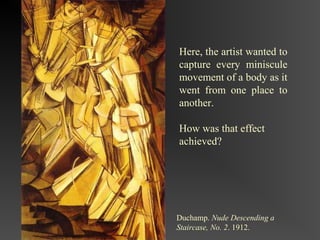
Here, the artist wanted to
capture every miniscule
movement of a body as it
went from one place to
another.

How was that effect
achieved?


Duchamp. Nude Descending a
Staircase, No. 2. 1912.
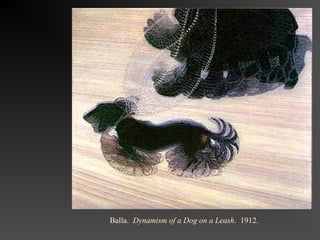
Balla. Dynamism of a Dog on a Leash. 1912.
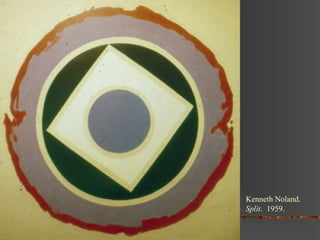
VII. Economy

    Process of breaking a composition down into
     it’s most significant essentials: eliminating
     elaborate details to provide greater legibility;
     often a component of abstraction.
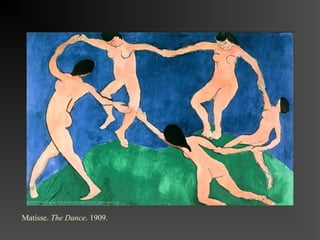
Matisse. The Dance. 1909.
Kenneth Noland.
Split. 1959.
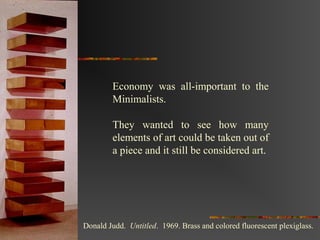
Economy was all-important to the
        Minimalists.

        They wanted to see how many
        elements of art could be taken out of
        a piece and it still be considered art.


Donald Judd. Untitled. 1969. Brass and colored fluorescent plexiglass.
Information and images for this presentation were provided by:
Getlein, Mark. Gilbert’s Living with Art, 6th ed. New York: McGraw-Hill, Inc., 2002.
Gilbert, Rita. Living with Art, 4th ed. New York: McGraw-Hill, Inc., 1995.
Harden, Mark. Artchive. http://artchive.com/core.html 2005.
Hext, Bob and Kristi Hext. Lecture notes 2004-2005.

Principles of-design

  • 1.
  • 2.
    What are principlesof design? The guidelines for  Harmony organizing the  Variety elements in order to satisfy the artist’s  Balance expressive intent.  Proportion and Scale They describe  Dominance relationships of  Rhythm/Movement elements to one another.  Economy
  • 3.
    I. Harmony  A related quality of visual elements of a composition. Ex: repetition, rhythm, continuity.  Elements are combined to accent their similarities and create wholeness in an artwork. Andy Warhol. 200 Campbell Soup Cans.
  • 4.
    II. Variety  The use of contrasting elements in a composition to add individualism and interest. Ben Jones. Black Face and Arm Unit. 1971.
  • 5.
    Visual weight refersto the III. Balance apparent “heaviness” or “lightness” of the forms arranged in a composition.  Feeling of equilibrium in weight attention or  Types of balance: attraction of various  Symmetrical (formal) visual elements.  including Relieved  Means of  Asymmetrical (informal) accomplishing organic unity.  radial
  • 6.
    Symmetrical Balance  Implied center gravity is the vertical axis—an imaginary line down the center of the composition  Forms on either side of the axis correspond to one another in size, shape, and placement  Perfect symmetry is when the two sides “mirror” each other.  Relieved symmetry is when the two sides nearly— but do not exactly—“mirror.” This occurs more often.
  • 7.
    Perfect or relievedsymmetry? O’Keefe. Deer Skull with Pedernal. 1936. Kahlo. The Two Fridas. 1939.
  • 8.
    Asymmetrical Balance  The two sides of the composition do not match  The visual weights in the two sides are very similar  The viewer perceives the relationships between the elements in the two sides—and, in turn, the composition’s balance It’s much like balancing a seesaw with differently sized people.
  • 9.
    Asymmetrical Balance (cont.) 1. A large form is visually heavier than a smaller form. 2. A dark-value form is visually heavier than a light form of the same size. 3. A textured form is visually heavier than a smooth form of the same size. 4. A complex form is visually heavier than a simple form of the same size. 5. Two or more small forms can balance a larger one. 6. A small darker form can balance a larger light one.
  • 10.
    Klimt. Death and Life. 1915. Here,the darker, smaller form of Death balances the lighter, larger form of Life.
  • 11.
    Mondrian was concerned with formal design principles, andhis Composition with Red, Yellow, and Blue is a classic example: What size of a blue area was needed to balance the red and yellow areas?
  • 12.
    Radial Balance  Elements in a composition radiate outward from a central point. (like the sun or your tire rims)  More common in architecture and the crafts. Baptism of Christ and Procession of Twelve Apostles. c.520
  • 13.
    IV. Proportion and Scale  Proportion—the comparison of elements to one another in terms of their properties of size, quantity and degree of emphasis  Scale—size in relation to a standard or “normal” size.
  • 14.
    Magritte. Delusions ofGrandeur II. 1948. El Greco. Resurrection. C. 1600-1605.
  • 15.
    Oldenburg and vanBruggen. Flying Pins. 2000.
  • 16.
    V. Dominance (alsocalled Emphasis)  When some elements assume more importance than others in the same composition.  Created by contrasts in size, color, value, etc.  Also created by line direction Klimt. Serena Lederer. 1899.
  • 17.
    Caravaggio. The Calling ofSt. Matthew. What is emphasized here? How?
  • 18.
    Goya. Executions ofthe Third of May, 1808. 1814-15. How about this one?
  • 19.
    VI. Rhythm/Movement  An illusion created by the placement and configuration of the visual parts or elements. Here, repetition creates a strong, steady rhythm.
  • 20.
    Repetition of shapes and colorsare given great variety through placement and size differences. This gives an irregular and lively rhythm. Mondrian. Broadway Boogie-Woogie. 1942-43.
  • 21.
    Here, the artistwanted to capture every miniscule movement of a body as it went from one place to another. How was that effect achieved? Duchamp. Nude Descending a Staircase, No. 2. 1912.
  • 22.
    Balla. Dynamism ofa Dog on a Leash. 1912.
  • 23.
    VII. Economy  Process of breaking a composition down into it’s most significant essentials: eliminating elaborate details to provide greater legibility; often a component of abstraction.
  • 24.
  • 25.
  • 26.
    Economy was all-importantto the Minimalists. They wanted to see how many elements of art could be taken out of a piece and it still be considered art. Donald Judd. Untitled. 1969. Brass and colored fluorescent plexiglass.
  • 27.
    Information and imagesfor this presentation were provided by: Getlein, Mark. Gilbert’s Living with Art, 6th ed. New York: McGraw-Hill, Inc., 2002. Gilbert, Rita. Living with Art, 4th ed. New York: McGraw-Hill, Inc., 1995. Harden, Mark. Artchive. http://artchive.com/core.html 2005. Hext, Bob and Kristi Hext. Lecture notes 2004-2005.