Presenting and Discussing
Data in Charts, Graphs and
Tables
 By the end of this unit you should be able
to:
 list the variables for analysing surveillance data
 identify the types of charts and graphs and when
the use of each is appropriate
#1-8-3
 Person: Who develops a disease (for example, by
age group or sex)? Are the distributions changing
over time?
 Place: Where are cases occurring? Is the
geographical distribution changing over time?
 Time: Is the number of reported cases changing
over time?
#1-8-4
 The purpose of developing clearly
understandable tables, charts and graphs
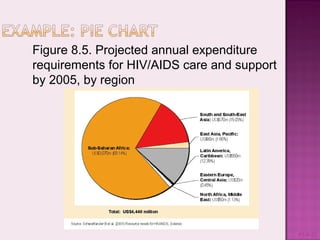
is to facilitate:
 analysis of data
 interpretation of data
 effective, rapid communication on complex
issues and situations
#1-8-5
 Categorical variables refer to items that
can be grouped into categories.
Ordinal variables are those that have a natural
order.
Nominal variables represent discrete
categories without a natural order.
 Dichotomous variables have only two categories
 Continuous variables are items that occur
in numerical order.
#1-8-6
 Simpler is better.
 Graphs, tables and charts can be used together.
 Use clear descriptive titles and labels.
 Provide a narrative description of the highlights.
 Don’t compare variables with different scales of
magnitude. #1-8-7
 A diagram shown as a series of one or more
points, lines, line segments, curves or areas
 Represents variation of a variable in comparison
with that of one or more other variables
#1-8-8
 Scale line graph: represents frequency
distributions over time
 Y-axis represents frequency.
 X-axis represents time.
#1-8-9
#1-8-10
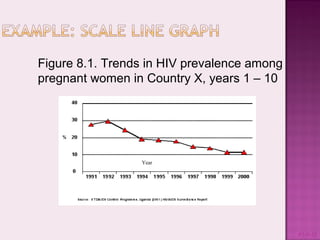
Year
Figure 8.1. Trends in HIV prevalence among
pregnant women in Country X, years 1 – 10
 Y-axis should be shorter than X-axis
 Start the Y-axis with zero
 Determine the range of values needed
 Select an interval size
#1-8-11
 Uses differently coloured or patterned bars
to represent different classes
 Y-axis represents frequency
 X-axis may represent time or different
classes
#1-8-12
0
5
10
15
20
25
30
Female sex
workers
Men who
have sex
with men
Injecting drug
users
Prisoners Refugees
Population
%HIVprevalence
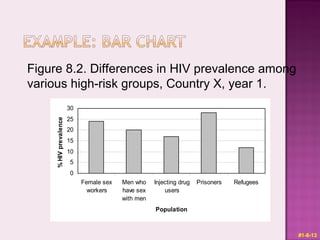
Figure 8.2. Differences in HIV prevalence among
various high-risk groups, Country X, year 1.
#1-8-13
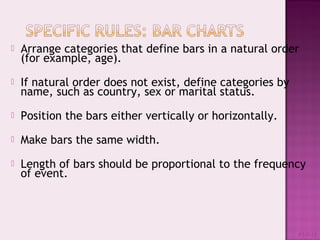
 Arrange categories that define bars in a natural order
(for example, age).
 If natural order does not exist, define categories by
name, such as country, sex or marital status.
 Position the bars either vertically or horizontally.
 Make bars the same width.
 Length of bars should be proportional to the frequency
of event.
#1-8-14
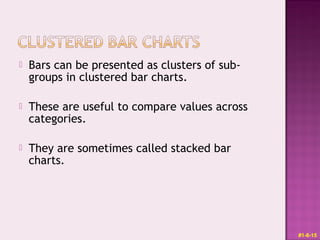
 Bars can be presented as clusters of sub-
groups in clustered bar charts.
 These are useful to compare values across
categories.
 They are sometimes called stacked bar
charts.
#1-8-15
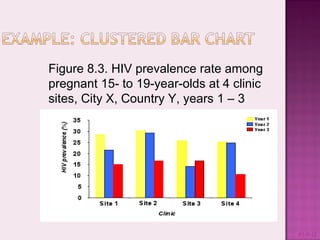
Figure 8.3. HIV prevalence rate among
pregnant 15- to 19-year-olds at 4 clinic
sites, City X, Country Y, years 1 – 3
#1-8-16
 Show no more than three sub-bars within a
group of bars.
 Leave a space between adjacent groups of bars.
 Use different colours or patterns to show
different sub-groups for the variables being
shown.
 Include a legend that interprets the different
colours and patterns.
#1-8-17
 A representation of a frequency distribution
by means of rectangles
 Width of bars represents class intervals and
height represents corresponding frequency
#1-8-18
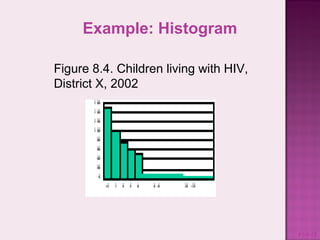
Example: Histogram
#1-8-19
Figure 8.4. Children living with HIV,
District X, 2002
 A circular (360 degree) graphic
representation
 Compares subclasses or categories to the
whole class or category using differently
coloured or patterned segments
#1-8-20
#1-8-21
Figure 8.5. Projected annual expenditure
requirements for HIV/AIDS care and support
by 2005, by region
 A graph used to plot variables by
geographic locations
#1-8-22
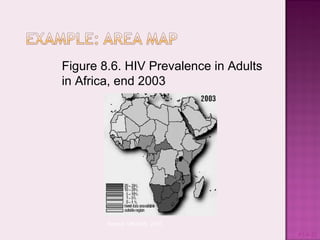
Figure 8.6. HIV Prevalence in Adults
in Africa, end 2003
#1-8-23
Source: UNAIDS, 2003
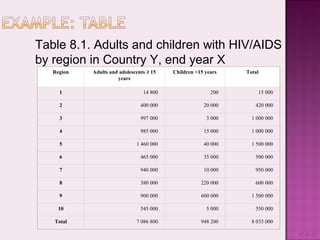
 A rectangular arrangement of data in
which the data are positioned in rows and
columns.
 Each row and column should be labelled.
 Rows and columns with totals should be
shown in the last row or in the right-hand
column.
#1-8-24
#1-8-25
Table 8.1. Adults and children with HIV/AIDS
by region in Country Y, end year X
Region Adults and adolescents 15≥
years
Children <15 years Total
1 14 800 200 15 000
2 400 000 20 000 420 000
3 997 000 3 000 1 000 000
4 985 000 15 000 1 000 000
5 1 460 000 40 000 1 500 000
6 465 000 35 000 500 000
7 940 000 10 000 950 000
8 380 000 220 000 600 000
9 900 000 600 000 1 500 000
10 545 000 5 000 550 000
Total 7 086 800 948 200 8 035 000
 Surveillance data can be analysed by
person, place or time.
 Depending on your data, you can choose
from a variety of chart and graph formats,
including pie charts, histograms, tables,
etc.
 Using several simpler graphics is more
effective than attempting to combine all
of the information into one figure.
#1-8-26

Week 8 presenting data in charts, graphs, and tables 2

  • 1.
    Presenting and Discussing Datain Charts, Graphs and Tables
  • 2.
     By theend of this unit you should be able to:  list the variables for analysing surveillance data  identify the types of charts and graphs and when the use of each is appropriate #1-8-3
  • 3.
     Person: Whodevelops a disease (for example, by age group or sex)? Are the distributions changing over time?  Place: Where are cases occurring? Is the geographical distribution changing over time?  Time: Is the number of reported cases changing over time? #1-8-4
  • 4.
     The purposeof developing clearly understandable tables, charts and graphs is to facilitate:  analysis of data  interpretation of data  effective, rapid communication on complex issues and situations #1-8-5
  • 5.
     Categorical variablesrefer to items that can be grouped into categories. Ordinal variables are those that have a natural order. Nominal variables represent discrete categories without a natural order.  Dichotomous variables have only two categories  Continuous variables are items that occur in numerical order. #1-8-6
  • 6.
     Simpler isbetter.  Graphs, tables and charts can be used together.  Use clear descriptive titles and labels.  Provide a narrative description of the highlights.  Don’t compare variables with different scales of magnitude. #1-8-7
  • 7.
     A diagramshown as a series of one or more points, lines, line segments, curves or areas  Represents variation of a variable in comparison with that of one or more other variables #1-8-8
  • 8.
     Scale linegraph: represents frequency distributions over time  Y-axis represents frequency.  X-axis represents time. #1-8-9
  • 9.
    #1-8-10 Year Figure 8.1. Trendsin HIV prevalence among pregnant women in Country X, years 1 – 10
  • 10.
     Y-axis shouldbe shorter than X-axis  Start the Y-axis with zero  Determine the range of values needed  Select an interval size #1-8-11
  • 11.
     Uses differentlycoloured or patterned bars to represent different classes  Y-axis represents frequency  X-axis may represent time or different classes #1-8-12
  • 12.
    0 5 10 15 20 25 30 Female sex workers Men who havesex with men Injecting drug users Prisoners Refugees Population %HIVprevalence Figure 8.2. Differences in HIV prevalence among various high-risk groups, Country X, year 1. #1-8-13
  • 13.
     Arrange categoriesthat define bars in a natural order (for example, age).  If natural order does not exist, define categories by name, such as country, sex or marital status.  Position the bars either vertically or horizontally.  Make bars the same width.  Length of bars should be proportional to the frequency of event. #1-8-14
  • 14.
     Bars canbe presented as clusters of sub- groups in clustered bar charts.  These are useful to compare values across categories.  They are sometimes called stacked bar charts. #1-8-15
  • 15.
    Figure 8.3. HIVprevalence rate among pregnant 15- to 19-year-olds at 4 clinic sites, City X, Country Y, years 1 – 3 #1-8-16
  • 16.
     Show nomore than three sub-bars within a group of bars.  Leave a space between adjacent groups of bars.  Use different colours or patterns to show different sub-groups for the variables being shown.  Include a legend that interprets the different colours and patterns. #1-8-17
  • 17.
     A representationof a frequency distribution by means of rectangles  Width of bars represents class intervals and height represents corresponding frequency #1-8-18
  • 18.
    Example: Histogram #1-8-19 Figure 8.4.Children living with HIV, District X, 2002
  • 19.
     A circular(360 degree) graphic representation  Compares subclasses or categories to the whole class or category using differently coloured or patterned segments #1-8-20
  • 20.
    #1-8-21 Figure 8.5. Projectedannual expenditure requirements for HIV/AIDS care and support by 2005, by region
  • 21.
     A graphused to plot variables by geographic locations #1-8-22
  • 22.
    Figure 8.6. HIVPrevalence in Adults in Africa, end 2003 #1-8-23 Source: UNAIDS, 2003
  • 23.
     A rectangulararrangement of data in which the data are positioned in rows and columns.  Each row and column should be labelled.  Rows and columns with totals should be shown in the last row or in the right-hand column. #1-8-24
  • 24.
    #1-8-25 Table 8.1. Adultsand children with HIV/AIDS by region in Country Y, end year X Region Adults and adolescents 15≥ years Children <15 years Total 1 14 800 200 15 000 2 400 000 20 000 420 000 3 997 000 3 000 1 000 000 4 985 000 15 000 1 000 000 5 1 460 000 40 000 1 500 000 6 465 000 35 000 500 000 7 940 000 10 000 950 000 8 380 000 220 000 600 000 9 900 000 600 000 1 500 000 10 545 000 5 000 550 000 Total 7 086 800 948 200 8 035 000
  • 25.
     Surveillance datacan be analysed by person, place or time.  Depending on your data, you can choose from a variety of chart and graph formats, including pie charts, histograms, tables, etc.  Using several simpler graphics is more effective than attempting to combine all of the information into one figure. #1-8-26