

WEEK 5
STATEMENT of the PROBLEM,
GENERAL PURPOSE AND
RESEARCH QUESTIONS
At the end of the lecture, students should be
able to
1.discuss and demonstrate understanding on
the meaning of statement of problem, research
purpose and research questions.
2. identify the language forms used in
expressing statement of problem and research
purpose.
3. formulate some statements of problems.
4. formulate some sentences reflecting
research purpose.
The number ONE Requirement
in
coming up with the Statement of
the Problem
• You need to have an inquisitive and
imaginative mind
• You need a Questioning attitude
• You need to be critical –’Wonder
why?’
Answer the following
preliminary questions…
• Are the topics reviewed significant enough?
• What are the questions in my mind that have
not been answered by the literature
reviewed?
• Is it feasible (practical/possible for me
to do a research on them)?
Note:
There are times when it is appropriate to
replicate (repeat) a study to verify its
conclusions or to extend the validity of its
findings to a different situation or
population
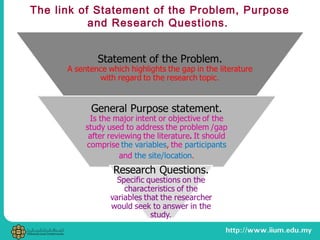
The link of Statement of the Problem, Purpose
and Research Questions.
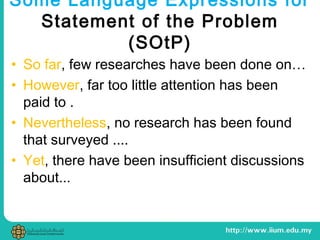
Some Language Expressions for
Statement of the Problem
(SOtP)
• So far, few researches have been done on…
• However, far too little attention has been
paid to .
• Nevertheless, no research has been found
that surveyed ....
• Yet, there have been insufficient discussions
about...
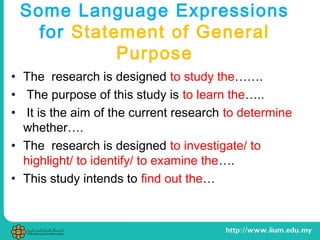
Some Language Expressions
for Statement of General
Purpose
• The research is designed to study the…….
• The purpose of this study is to learn the…..
• It is the aim of the current research to determine
whether….
• The research is designed to investigate/ to
highlight/ to identify/ to examine the….
• This study intends to find out the…
Example 1
An example adapted from:
Teh, B. H., Ong, T. S & Loh, Y. L. (2011). The acceptance and effectiveness of telecommuting
(working from home) in Malaysia. Global Conference on Innovations in Management. Retrieved from
http://www.cibmp.org/Papers/Paper%20648.pdf
Statement of the
problem
Gap (in red)
Under Economic Transformation Programme, Malaysia aims to become a developed
nation by 2020. During the period, Malaysia will transform from middle income of
RM23,700 to high nation income of RM48,000. Critically, retaining and attracting
talent and expert is crucial for the success of the Economic Transformation
Programme. In conjunction with it, Talent Corporation had been set up not only to
attain the abovementioned goals but also to resolve the severe brain drain faced by
Malaysia. Indeed, at present, many Malaysian experts work or serve abroad such as
in Singapore, Australia and the United Kingdom. Obviously, we are under uphill
situation to generate a competitive, flexible and good working environment in order to
lure back Malaysian expertise and retain the existing talent from moving abroad.
According to Muhammad (2000), one of the major advantages of telecommuting is the
ability of corporations to employ and retain key employees. Since telecommuting
program is getting popular in Malaysia, there is a need to conduct this research in
order to understand the factors which are critical in acceptance of Telecommuting
program. However, a thorough review of related literature has shown that very little
research has been done with regard to these critical factors.
An example adapted from:
Teh, B. H., Ong, T. S & Loh, Y. L. (2011). The acceptance and effectiveness of telecommuting
(working from home) in Malaysia. Global Conference on Innovations in Management. Retrieved from
http://www.cibmp.org/Papers/Paper%20648.pdf
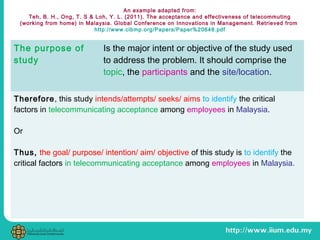
The purpose of
study
Is the major intent or objective of the study used
to address the problem. It should comprise the
topic, the participants and the site/location.
Therefore, this study intends/attempts/ seeks/ aims to identify the critical
factors in telecommunicating acceptance among employees in Malaysia.
Or
Thus, the goal/ purpose/ intention/ aim/ objective of this study is to identify the
critical factors in telecommunicating acceptance among employees in Malaysia.
An example adapted from:
Teh, B. H., Ong, T. S & Loh, Y. L. (2011). The acceptance and effectiveness of telecommuting
(working from home) in Malaysia. Global Conference on Innovations in Management. Retrieved from
http://www.cibmp.org/Papers/Paper%20648.pdf
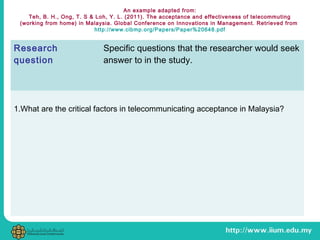
Research
question
Specific questions that the researcher would seek
answer to in the study.
1.What are the critical factors in telecommunicating acceptance in Malaysia?
Example 2
An example adapted from:
Baker, E., Aver, C. G. & Crawford J. (2007). Satisfaction and perceived productivity when
professionals work from home. Research and Practice in Human Resource Management, Curtin
University of Technology. Retrieved from http://rphrm.curtin.edu.au/2007/issue1/satisfaction.html
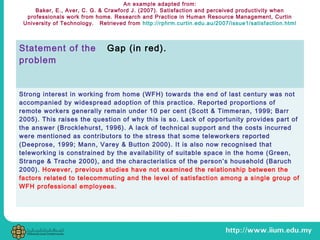
Statement of the
problem
Gap (in red).
Strong interest in working from home (WFH) towards the end of last century was not
accompanied by widespread adoption of this practice. Reported proportions of
remote workers generally remain under 10 per cent (Scott & Timmeran, 1999; Barr
2005). This raises the question of why this is so. Lack of opportunity provides part of
the answer (Brocklehurst, 1996). A lack of technical support and the costs incurred
were mentioned as contributors to the stress that some teleworkers reported
(Deeprose, 1999; Mann, Varey & Button 2000). It is also now recognised that
teleworking is constrained by the availability of suitable space in the home (Green,
Strange & Trache 2000), and the characteristics of the person’s household (Baruch
2000). However, previous studies have not examined the relationship between the
factors related to telecommuting and the level of satisfaction among a single group of
WFH professional employees.
An example adapted from:
Baker, E., Aver, C. G. & Crawford J. (2007). Satisfaction and perceived productivity when
professionals work from home. Research and Practice in Human Resource Management, Curtin
University of Technology. Retrieved from http://rphrm.curtin.edu.au/2007/issue1/satisfaction.html
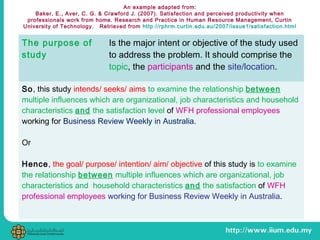
The purpose of
study
Is the major intent or objective of the study used
to address the problem. It should comprise the
topic, the participants and the site/location.
So, this study intends/ seeks/ aims to examine the relationship between
multiple influences which are organizational, job characteristics and household
characteristics and the satisfaction level of WFH professional employees
working for Business Review Weekly in Australia.
Or
Hence, the goal/ purpose/ intention/ aim/ objective of this study is to examine
the relationship between multiple influences which are organizational, job
characteristics and household characteristics and the satisfaction of WFH
professional employees working for Business Review Weekly in Australia.
An example adapted from:
Baker, E., Aver, C. G. & Crawford J. (2007). Satisfaction and perceived productivity when
professionals work from home. Research and Practice in Human Resource Management, Curtin
University of Technology. Retrieved from http://rphrm.curtin.edu.au/2007/issue1/satisfaction.html
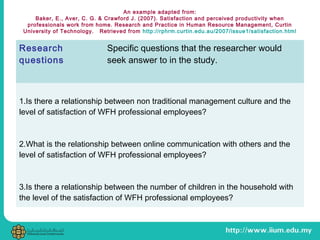
Research
questions
Specific questions that the researcher would
seek answer to in the study.
1.Is there a relationship between non traditional management culture and the
level of satisfaction of WFH professional employees?
2.What is the relationship between online communication with others and the
level of satisfaction of WFH professional employees?
3.Is there a relationship between the number of children in the household with
the level of the satisfaction of WFH professional employees?
Tasks
• Evaluate the SOtP and the General
Purpose Statement of Sample 1 & 2
• With your partner, draft the statement of
the problem and the research purpose for
your own study.
References:
Creswell, J. W. (2008). Educational research : Planning,
conducting, and evaluating quantitative and qualitative
research (3rd ed.). New Jersey: Prentice hall.
http://www.phrasebank.manchester.ac.uk/introductions.htm
Norazman Abd Majid, Masdinah Alawiyah Md Yusoff, Tina
Abdullah, Sahirah Marzuki, Zanariah Md Salleh,
Faruk Muhammad et al. (2007). Academic report
writing (2nd
edition). Petaling Jaya: Pearson Prentice
Hall Malaysia .

Week5a writing statement of the problem & general purpose 2

  • 1.
    WEEK 5 STATEMENT ofthe PROBLEM, GENERAL PURPOSE AND RESEARCH QUESTIONS
  • 2.
    At the endof the lecture, students should be able to 1.discuss and demonstrate understanding on the meaning of statement of problem, research purpose and research questions. 2. identify the language forms used in expressing statement of problem and research purpose. 3. formulate some statements of problems. 4. formulate some sentences reflecting research purpose.
  • 3.
    The number ONERequirement in coming up with the Statement of the Problem • You need to have an inquisitive and imaginative mind • You need a Questioning attitude • You need to be critical –’Wonder why?’
  • 4.
    Answer the following preliminaryquestions… • Are the topics reviewed significant enough? • What are the questions in my mind that have not been answered by the literature reviewed? • Is it feasible (practical/possible for me to do a research on them)?
  • 5.
    Note: There are timeswhen it is appropriate to replicate (repeat) a study to verify its conclusions or to extend the validity of its findings to a different situation or population
  • 6.
    The link ofStatement of the Problem, Purpose and Research Questions.
  • 7.
    Some Language Expressionsfor Statement of the Problem (SOtP) • So far, few researches have been done on… • However, far too little attention has been paid to . • Nevertheless, no research has been found that surveyed .... • Yet, there have been insufficient discussions about...
  • 8.
    Some Language Expressions forStatement of General Purpose • The research is designed to study the……. • The purpose of this study is to learn the….. • It is the aim of the current research to determine whether…. • The research is designed to investigate/ to highlight/ to identify/ to examine the…. • This study intends to find out the…
  • 9.
  • 10.
    An example adaptedfrom: Teh, B. H., Ong, T. S & Loh, Y. L. (2011). The acceptance and effectiveness of telecommuting (working from home) in Malaysia. Global Conference on Innovations in Management. Retrieved from http://www.cibmp.org/Papers/Paper%20648.pdf Statement of the problem Gap (in red) Under Economic Transformation Programme, Malaysia aims to become a developed nation by 2020. During the period, Malaysia will transform from middle income of RM23,700 to high nation income of RM48,000. Critically, retaining and attracting talent and expert is crucial for the success of the Economic Transformation Programme. In conjunction with it, Talent Corporation had been set up not only to attain the abovementioned goals but also to resolve the severe brain drain faced by Malaysia. Indeed, at present, many Malaysian experts work or serve abroad such as in Singapore, Australia and the United Kingdom. Obviously, we are under uphill situation to generate a competitive, flexible and good working environment in order to lure back Malaysian expertise and retain the existing talent from moving abroad. According to Muhammad (2000), one of the major advantages of telecommuting is the ability of corporations to employ and retain key employees. Since telecommuting program is getting popular in Malaysia, there is a need to conduct this research in order to understand the factors which are critical in acceptance of Telecommuting program. However, a thorough review of related literature has shown that very little research has been done with regard to these critical factors.
  • 11.
    An example adaptedfrom: Teh, B. H., Ong, T. S & Loh, Y. L. (2011). The acceptance and effectiveness of telecommuting (working from home) in Malaysia. Global Conference on Innovations in Management. Retrieved from http://www.cibmp.org/Papers/Paper%20648.pdf The purpose of study Is the major intent or objective of the study used to address the problem. It should comprise the topic, the participants and the site/location. Therefore, this study intends/attempts/ seeks/ aims to identify the critical factors in telecommunicating acceptance among employees in Malaysia. Or Thus, the goal/ purpose/ intention/ aim/ objective of this study is to identify the critical factors in telecommunicating acceptance among employees in Malaysia.
  • 12.
    An example adaptedfrom: Teh, B. H., Ong, T. S & Loh, Y. L. (2011). The acceptance and effectiveness of telecommuting (working from home) in Malaysia. Global Conference on Innovations in Management. Retrieved from http://www.cibmp.org/Papers/Paper%20648.pdf Research question Specific questions that the researcher would seek answer to in the study. 1.What are the critical factors in telecommunicating acceptance in Malaysia?
  • 13.
  • 14.
    An example adaptedfrom: Baker, E., Aver, C. G. & Crawford J. (2007). Satisfaction and perceived productivity when professionals work from home. Research and Practice in Human Resource Management, Curtin University of Technology. Retrieved from http://rphrm.curtin.edu.au/2007/issue1/satisfaction.html Statement of the problem Gap (in red). Strong interest in working from home (WFH) towards the end of last century was not accompanied by widespread adoption of this practice. Reported proportions of remote workers generally remain under 10 per cent (Scott & Timmeran, 1999; Barr 2005). This raises the question of why this is so. Lack of opportunity provides part of the answer (Brocklehurst, 1996). A lack of technical support and the costs incurred were mentioned as contributors to the stress that some teleworkers reported (Deeprose, 1999; Mann, Varey & Button 2000). It is also now recognised that teleworking is constrained by the availability of suitable space in the home (Green, Strange & Trache 2000), and the characteristics of the person’s household (Baruch 2000). However, previous studies have not examined the relationship between the factors related to telecommuting and the level of satisfaction among a single group of WFH professional employees.
  • 15.
    An example adaptedfrom: Baker, E., Aver, C. G. & Crawford J. (2007). Satisfaction and perceived productivity when professionals work from home. Research and Practice in Human Resource Management, Curtin University of Technology. Retrieved from http://rphrm.curtin.edu.au/2007/issue1/satisfaction.html The purpose of study Is the major intent or objective of the study used to address the problem. It should comprise the topic, the participants and the site/location. So, this study intends/ seeks/ aims to examine the relationship between multiple influences which are organizational, job characteristics and household characteristics and the satisfaction level of WFH professional employees working for Business Review Weekly in Australia. Or Hence, the goal/ purpose/ intention/ aim/ objective of this study is to examine the relationship between multiple influences which are organizational, job characteristics and household characteristics and the satisfaction of WFH professional employees working for Business Review Weekly in Australia.
  • 16.
    An example adaptedfrom: Baker, E., Aver, C. G. & Crawford J. (2007). Satisfaction and perceived productivity when professionals work from home. Research and Practice in Human Resource Management, Curtin University of Technology. Retrieved from http://rphrm.curtin.edu.au/2007/issue1/satisfaction.html Research questions Specific questions that the researcher would seek answer to in the study. 1.Is there a relationship between non traditional management culture and the level of satisfaction of WFH professional employees? 2.What is the relationship between online communication with others and the level of satisfaction of WFH professional employees? 3.Is there a relationship between the number of children in the household with the level of the satisfaction of WFH professional employees?
  • 17.
    Tasks • Evaluate theSOtP and the General Purpose Statement of Sample 1 & 2 • With your partner, draft the statement of the problem and the research purpose for your own study.
  • 18.
    References: Creswell, J. W.(2008). Educational research : Planning, conducting, and evaluating quantitative and qualitative research (3rd ed.). New Jersey: Prentice hall. http://www.phrasebank.manchester.ac.uk/introductions.htm Norazman Abd Majid, Masdinah Alawiyah Md Yusoff, Tina Abdullah, Sahirah Marzuki, Zanariah Md Salleh, Faruk Muhammad et al. (2007). Academic report writing (2nd edition). Petaling Jaya: Pearson Prentice Hall Malaysia .