SUMMARISING
Summarising is an essential skill. It is something
that we do everyday. We are summarising
when: we tell our friend briefly what a movie▪
is about,
▪ we give someone a gist of what we did that
day,
▪ we inform someone of how we come to a
decision about something, etc.
SUMMARISING
• The ability to summarise information is one of the
most important critical thinking skills you can
develop.
• Taking large quantities of information, understanding
what that information means, and condensing it into
a shorter version of the original allows you to have
important information on hand for easy reference
without having to memorise long passages or
complex statistics.
SUMMARISING
What is a summary in the academic
context?
• A brief restatement in your own words of a
text's main ideas.
• A condensation of "an extended idea or
argument into a sentence or more in your
own words“.
SUMMARISING
Why Summarise?
• to represent the gist of an author's work .
• to avoid unnecessary details when the main
point is all you need.
• to use own words (unless the text includes
technical terms or words in common usage)
and sum up the main point of a text.
SUMMARISING
• Deciding on the main point of an essay can be
difficult, since authors frequently make
several points in one text.
• While all the points made might be important
to demonstrate why the author believes what
he does, they can usually be subsumed into a
more general point that the entire article
makes.
SUMMARISING
The following steps help ensure that you find
the main point rather than only the first point
that the author makes.
SUMMARISING
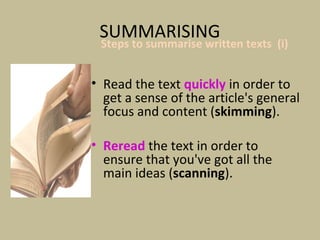
Steps to summarise written texts (i)
• Read the text quickly in order to
get a sense of the article's general
focus and content (skimming).
• Reread the text in order to
ensure that you've got all the
main ideas (scanning).
SUMMARISING
Steps to summarise
written texts (ii)
•Underline the important words
(marking).
•Write down key-words, i.e.
words that sum up the meaning
of the text, but which needn't
necessarily occur in the text
(making notes).
SUMMARISING
Steps to summarise written texts (iii)
•Sum up the key-words in simple
sentences (summing up in simple
form).
•Combine the simple sentences by
using conjunctions like "as, though,
because, since" etc or participle
constructions or infinitives (summing
up in complex form).
SUMMARISING
Steps to summarise written texts (iv)
•Compare the original text with your text to find
out that you've got the essential information
(check).
•Edit very carefully for neatness and
correctness.
SUMMARISING
The following slides will guide you on the
characteristics of a good summary.
SUMMARISING
The characteristics of a summary (i)
• It contains all the main points of the original.
• It maintains and communicate the meaning
of the original.
• It does not contain your own opinion or views
on the original.
• It does not include examples or supporting
points.
SUMMARISING
The characteristics of a summary (ii)
•It attributes the original author.
• It focuses exclusively on the presentation of
the writer's main ideas.
•It contains the main ideas presented in more
than one paragraph, in a chapter or a text.
SUMMARISING
The characteristics of a summary (iii)
• It combines specific statements into general
statements.
• It changes speeches into statements.
• It demonstrates the writer’s understanding
on a text's subject matter.
SUMMARISING
The characteristics of a summary (iv)
• It tends to be 60% shorter than the original
text i.e. the original is cut to about one third.
• It omits the original text's examples,
analogies, and details.
SUMMARISING
• Read the following paragraphs.
• See what makes a good summary (Article 1).
•
• See what other phrases can be used in citing a text
SUMMARISING
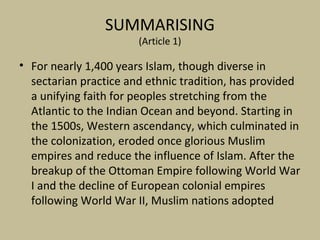
(Article 1)
• For nearly 1,400 years Islam, though diverse in
sectarian practice and ethnic tradition, has provided
a unifying faith for peoples stretching from the
Atlantic to the Indian Ocean and beyond. Starting in
the 1500s, Western ascendancy, which culminated in
the colonization, eroded once glorious Muslim
empires and reduce the influence of Islam. After the
breakup of the Ottoman Empire following World War
I and the decline of European colonial empires
following World War II, Muslim nations adopted
SUMMARISING
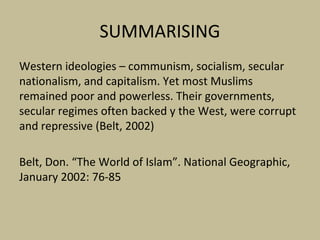
Western ideologies – communism, socialism, secular
nationalism, and capitalism. Yet most Muslims
remained poor and powerless. Their governments,
secular regimes often backed y the West, were corrupt
and repressive (Belt, 2002)
Belt, Don. “The World of Islam”. National Geographic,
January 2002: 76-85
SUMMARISING
(Article 1)
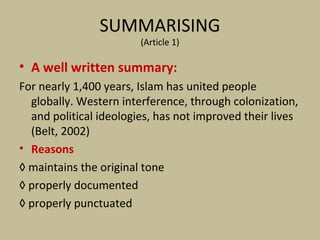
• A well written summary:
For nearly 1,400 years, Islam has united people
globally. Western interference, through colonization,
and political ideologies, has not improved their lives
(Belt, 2002)
• Reasons
◊ maintains the original tone
◊ properly documented
◊ properly punctuated
SUMMARISING
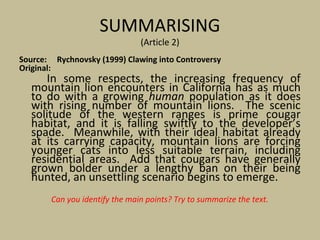
(Article 2)
Source: Rychnovsky (1999) Clawing into Controversy
Original:
In some respects, the increasing frequency of
mountain lion encounters in California has as much
to do with a growing human population as it does
with rising number of mountain lions. The scenic
solitude of the western ranges is prime cougar
habitat, and it is falling swiftly to the developer’s
spade. Meanwhile, with their ideal habitat already
at its carrying capacity, mountain lions are forcing
younger cats into less suitable terrain, including
residential areas. Add that cougars have generally
grown bolder under a lengthy ban on their being
hunted, an unsettling scenario begins to emerge.
Can you identify the main points? Try to summarize the text.
SUMMARISING
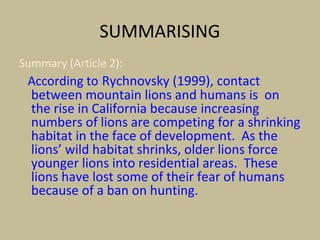
Summary (Article 2):
According to Rychnovsky (1999), contact
between mountain lions and humans is on
the rise in California because increasing
numbers of lions are competing for a shrinking
habitat in the face of development. As the
lions’ wild habitat shrinks, older lions force
younger lions into residential areas. These
lions have lost some of their fear of humans
because of a ban on hunting.
SUMMARISING
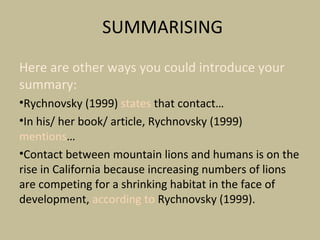
Here are other ways you could introduce your
summary:
•Rychnovsky (1999) states that contact…
•In his/ her book/ article, Rychnovsky (1999)
mentions…
•Contact between mountain lions and humans is on the
rise in California because increasing numbers of lions
are competing for a shrinking habitat in the face of
development, according to Rychnovsky (1999).
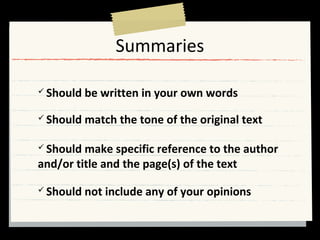
Summaries
 Should be written in your own words
 Should match the tone of the original text
 Should not include any of your opinions
 Should make specific reference to the author
and/or title and the page(s) of the text
SUMMARISING
FOR CLASS:
Bring articles you might want to use in your
term paper.
Sources
• Summary Skills DLA by Chaffey College Writing Center
• Wisc-online (adapted)
• http://www3.surrey.ac.uk/Skills/pack/suggest.html
• EAP LMS notes

Week4f pptslides in text citation - summarising

  • 1.
    SUMMARISING Summarising is anessential skill. It is something that we do everyday. We are summarising when: we tell our friend briefly what a movie▪ is about, ▪ we give someone a gist of what we did that day, ▪ we inform someone of how we come to a decision about something, etc.
  • 2.
    SUMMARISING • The abilityto summarise information is one of the most important critical thinking skills you can develop. • Taking large quantities of information, understanding what that information means, and condensing it into a shorter version of the original allows you to have important information on hand for easy reference without having to memorise long passages or complex statistics.
  • 3.
    SUMMARISING What is asummary in the academic context? • A brief restatement in your own words of a text's main ideas. • A condensation of "an extended idea or argument into a sentence or more in your own words“.
  • 4.
    SUMMARISING Why Summarise? • torepresent the gist of an author's work . • to avoid unnecessary details when the main point is all you need. • to use own words (unless the text includes technical terms or words in common usage) and sum up the main point of a text.
  • 5.
    SUMMARISING • Deciding onthe main point of an essay can be difficult, since authors frequently make several points in one text. • While all the points made might be important to demonstrate why the author believes what he does, they can usually be subsumed into a more general point that the entire article makes.
  • 6.
    SUMMARISING The following stepshelp ensure that you find the main point rather than only the first point that the author makes.
  • 7.
    SUMMARISING Steps to summarisewritten texts (i) • Read the text quickly in order to get a sense of the article's general focus and content (skimming). • Reread the text in order to ensure that you've got all the main ideas (scanning).
  • 8.
    SUMMARISING Steps to summarise writtentexts (ii) •Underline the important words (marking). •Write down key-words, i.e. words that sum up the meaning of the text, but which needn't necessarily occur in the text (making notes).
  • 9.
    SUMMARISING Steps to summarisewritten texts (iii) •Sum up the key-words in simple sentences (summing up in simple form). •Combine the simple sentences by using conjunctions like "as, though, because, since" etc or participle constructions or infinitives (summing up in complex form).
  • 10.
    SUMMARISING Steps to summarisewritten texts (iv) •Compare the original text with your text to find out that you've got the essential information (check). •Edit very carefully for neatness and correctness.
  • 11.
    SUMMARISING The following slideswill guide you on the characteristics of a good summary.
  • 12.
    SUMMARISING The characteristics ofa summary (i) • It contains all the main points of the original. • It maintains and communicate the meaning of the original. • It does not contain your own opinion or views on the original. • It does not include examples or supporting points.
  • 13.
    SUMMARISING The characteristics ofa summary (ii) •It attributes the original author. • It focuses exclusively on the presentation of the writer's main ideas. •It contains the main ideas presented in more than one paragraph, in a chapter or a text.
  • 14.
    SUMMARISING The characteristics ofa summary (iii) • It combines specific statements into general statements. • It changes speeches into statements. • It demonstrates the writer’s understanding on a text's subject matter.
  • 15.
    SUMMARISING The characteristics ofa summary (iv) • It tends to be 60% shorter than the original text i.e. the original is cut to about one third. • It omits the original text's examples, analogies, and details.
  • 16.
    SUMMARISING • Read thefollowing paragraphs. • See what makes a good summary (Article 1). • • See what other phrases can be used in citing a text
  • 17.
    SUMMARISING (Article 1) • Fornearly 1,400 years Islam, though diverse in sectarian practice and ethnic tradition, has provided a unifying faith for peoples stretching from the Atlantic to the Indian Ocean and beyond. Starting in the 1500s, Western ascendancy, which culminated in the colonization, eroded once glorious Muslim empires and reduce the influence of Islam. After the breakup of the Ottoman Empire following World War I and the decline of European colonial empires following World War II, Muslim nations adopted
  • 18.
    SUMMARISING Western ideologies –communism, socialism, secular nationalism, and capitalism. Yet most Muslims remained poor and powerless. Their governments, secular regimes often backed y the West, were corrupt and repressive (Belt, 2002) Belt, Don. “The World of Islam”. National Geographic, January 2002: 76-85
  • 19.
    SUMMARISING (Article 1) • Awell written summary: For nearly 1,400 years, Islam has united people globally. Western interference, through colonization, and political ideologies, has not improved their lives (Belt, 2002) • Reasons ◊ maintains the original tone ◊ properly documented ◊ properly punctuated
  • 20.
    SUMMARISING (Article 2) Source: Rychnovsky(1999) Clawing into Controversy Original: In some respects, the increasing frequency of mountain lion encounters in California has as much to do with a growing human population as it does with rising number of mountain lions. The scenic solitude of the western ranges is prime cougar habitat, and it is falling swiftly to the developer’s spade. Meanwhile, with their ideal habitat already at its carrying capacity, mountain lions are forcing younger cats into less suitable terrain, including residential areas. Add that cougars have generally grown bolder under a lengthy ban on their being hunted, an unsettling scenario begins to emerge. Can you identify the main points? Try to summarize the text.
  • 21.
    SUMMARISING Summary (Article 2): Accordingto Rychnovsky (1999), contact between mountain lions and humans is on the rise in California because increasing numbers of lions are competing for a shrinking habitat in the face of development. As the lions’ wild habitat shrinks, older lions force younger lions into residential areas. These lions have lost some of their fear of humans because of a ban on hunting.
  • 22.
    SUMMARISING Here are otherways you could introduce your summary: •Rychnovsky (1999) states that contact… •In his/ her book/ article, Rychnovsky (1999) mentions… •Contact between mountain lions and humans is on the rise in California because increasing numbers of lions are competing for a shrinking habitat in the face of development, according to Rychnovsky (1999).
  • 23.
    Summaries  Should bewritten in your own words  Should match the tone of the original text  Should not include any of your opinions  Should make specific reference to the author and/or title and the page(s) of the text
  • 24.
    SUMMARISING FOR CLASS: Bring articlesyou might want to use in your term paper.
  • 25.
    Sources • Summary SkillsDLA by Chaffey College Writing Center • Wisc-online (adapted) • http://www3.surrey.ac.uk/Skills/pack/suggest.html • EAP LMS notes