USES OF TABLES &
CHARTS
Teacher: Ibironke Sonuga
 Define Tables
 Enumerate the characteristics of a good table
 Explain the importance of tables
 Construct a pie chart from a given data
 Construct a simple, component and multiple bar
chart from a given data
 Construct a line graph from a given data
 Choose an appropriate chart to use for different data
Lesson objectives
21/10/2014Ibironke Sonuga 2
 Tables and charts, are frequently used
to visually communicate data
 The goal in creating tables, charts or
graphs is to present data in a clear and
accurate format which is easily
interpreted.
Introduction
21/10/2014Ibironke Sonuga 3
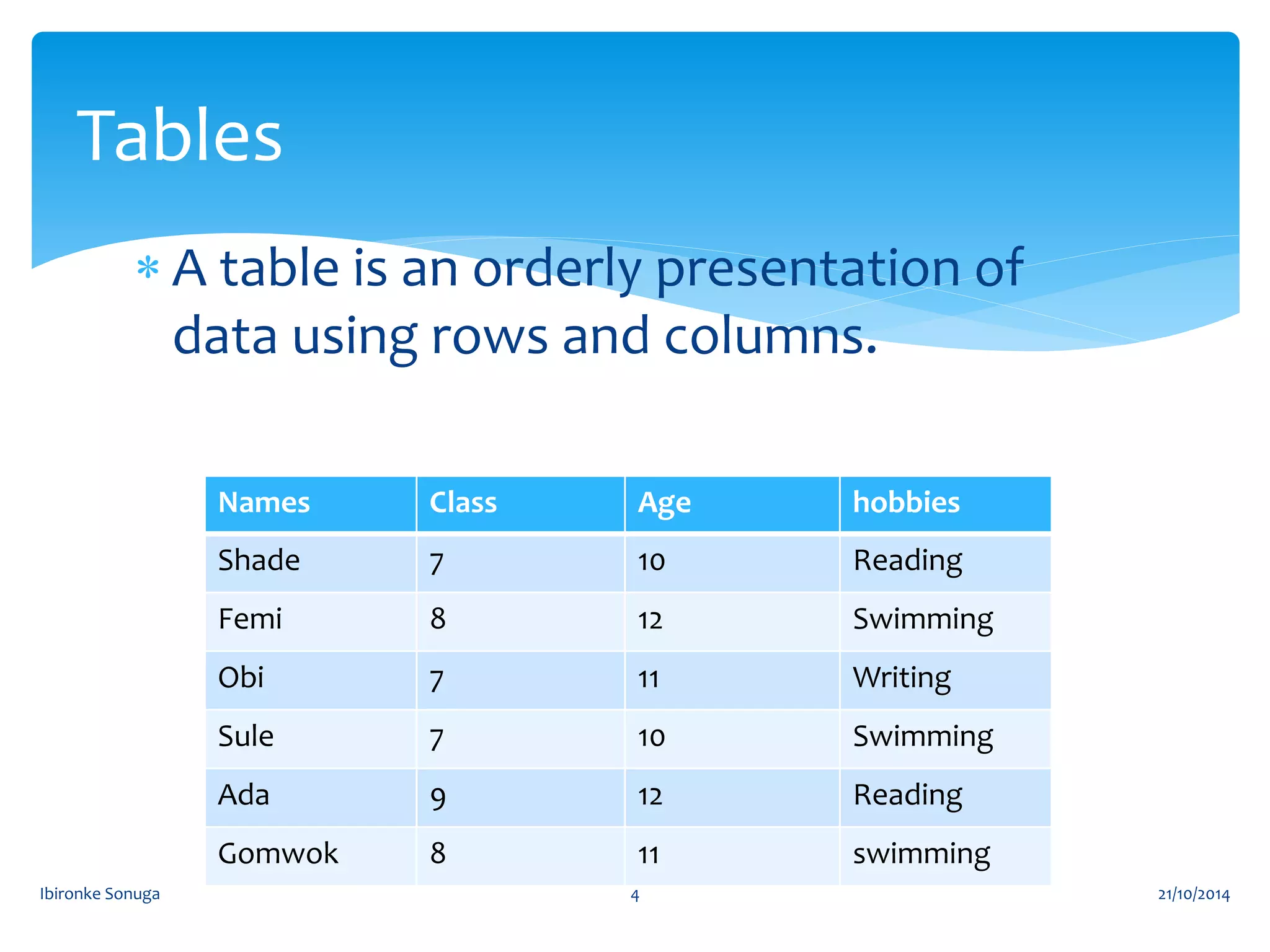
 A table is an orderly presentation of
data using rows and columns.
Tables
Names Class Age hobbies
Shade 7 10 Reading
Femi 8 12 Swimming
Obi 7 11 Writing
Sule 7 10 Swimming
Ada 9 12 Reading
Gomwok 8 11 swimming
21/10/2014Ibironke Sonuga 4
 It must have a title
 The sub-heading of the columns and rows must be stated
 The units of measurement used in the table must be
stated
 The source of information should be stated
 Number your tables
 It must be easy to understand. Organize your tables
neatly so that the meaning of the table is obvious at first
glance
Characteristics of Good Tables
21/10/2014Ibironke Sonuga 5
 It explains more information in less time than
pages of an explanatory essay
 Makes comparison easier
 Highlights the important information
 Easier and faster decision making
Importance of Good Tables
21/10/2014Ibironke Sonuga 6
 A diagram that shows functional relationship
between two variables
 Graphs are used in economics and statistics for
analysis. Examples are:
 Pictogram
 Pie charts
 Bar chart: single bar chart, multiple bar chart,
component bar chart.
 Histogram
 Line graph
Graphs
21/10/2014Ibironke Sonuga 7
These are charts in which
pictures or drawing of
objects are used to represent
data
Pictogram
21/10/2014Ibironke Sonuga 8
Pictogram
21/10/2014Ibironke Sonuga 9
 This is a circle divided into sectors, each sector
representing the relative size of different variables of
the population or objects
Pie Chart
21/10/2014Ibironke Sonuga 10
 How to construct a pie chart:
 Add up total figures
 Calculate the angle of each sector
 Draw a circle of convenient size
 Divide the circle into sectors using the angles
calculated above
 Write the degree of each sector in in it.
 Don’t forget your title
Pie Chart
21/10/2014Ibironke Sonuga 11
 This is a representation of data by scaled
lengths of bars. These bars are equal in
width, and the lengths are proportional to
the quantities they represent. The body of
the bars must not touch each other.
 There are:
Bar Chart
21/10/2014Ibironke Sonuga 12
 Simple Bar Charts – One variable in. The bars
are of equal widths and lengths proportional
to the values they represent in the data
Bar Chart
21/10/2014Ibironke Sonuga 13
Component Bar Charts – each bar is divided
into two or more sections, proportional in size
to the component parts of a total being
displayed by each bar
Bar Chart
21/10/2014Ibironke Sonuga 14
 Multiple Bar Charts – component values are
drawn as different bars adjoining each other.
Bar Chart
21/10/2014Ibironke Sonuga 15
 The histogram is similar to the simple bar chart but the bars
are connected together. There are no spaces between
them.
21/10/2014Ibironke Sonuga 16
Histogram
Line Graph
21/10/2014Ibironke Sonuga 17
 The line graphs make use
of lines for data
representation.
 The line graphs are very
useful in economics.
 Examples are the demand
and supply curve, costs
curve, etc.
s
s
P
Q
 Define Tables
 Enumerate the characteristics of a good table
 Explain the importance of tables
 Construct a pie chart from a given data
 Construct a simple, component and multiple bar
chart from a given data
 Construct a line graph from a given data
 Choose an appropriate chart to use for different data
21/10/2014Ibironke Sonuga 18
Can you now….

Tables and charts

  • 1.
    USES OF TABLES& CHARTS Teacher: Ibironke Sonuga
  • 2.
     Define Tables Enumerate the characteristics of a good table  Explain the importance of tables  Construct a pie chart from a given data  Construct a simple, component and multiple bar chart from a given data  Construct a line graph from a given data  Choose an appropriate chart to use for different data Lesson objectives 21/10/2014Ibironke Sonuga 2
  • 3.
     Tables andcharts, are frequently used to visually communicate data  The goal in creating tables, charts or graphs is to present data in a clear and accurate format which is easily interpreted. Introduction 21/10/2014Ibironke Sonuga 3
  • 4.
     A tableis an orderly presentation of data using rows and columns. Tables Names Class Age hobbies Shade 7 10 Reading Femi 8 12 Swimming Obi 7 11 Writing Sule 7 10 Swimming Ada 9 12 Reading Gomwok 8 11 swimming 21/10/2014Ibironke Sonuga 4
  • 5.
     It musthave a title  The sub-heading of the columns and rows must be stated  The units of measurement used in the table must be stated  The source of information should be stated  Number your tables  It must be easy to understand. Organize your tables neatly so that the meaning of the table is obvious at first glance Characteristics of Good Tables 21/10/2014Ibironke Sonuga 5
  • 6.
     It explainsmore information in less time than pages of an explanatory essay  Makes comparison easier  Highlights the important information  Easier and faster decision making Importance of Good Tables 21/10/2014Ibironke Sonuga 6
  • 7.
     A diagramthat shows functional relationship between two variables  Graphs are used in economics and statistics for analysis. Examples are:  Pictogram  Pie charts  Bar chart: single bar chart, multiple bar chart, component bar chart.  Histogram  Line graph Graphs 21/10/2014Ibironke Sonuga 7
  • 8.
    These are chartsin which pictures or drawing of objects are used to represent data Pictogram 21/10/2014Ibironke Sonuga 8
  • 9.
  • 10.
     This isa circle divided into sectors, each sector representing the relative size of different variables of the population or objects Pie Chart 21/10/2014Ibironke Sonuga 10
  • 11.
     How toconstruct a pie chart:  Add up total figures  Calculate the angle of each sector  Draw a circle of convenient size  Divide the circle into sectors using the angles calculated above  Write the degree of each sector in in it.  Don’t forget your title Pie Chart 21/10/2014Ibironke Sonuga 11
  • 12.
     This isa representation of data by scaled lengths of bars. These bars are equal in width, and the lengths are proportional to the quantities they represent. The body of the bars must not touch each other.  There are: Bar Chart 21/10/2014Ibironke Sonuga 12
  • 13.
     Simple BarCharts – One variable in. The bars are of equal widths and lengths proportional to the values they represent in the data Bar Chart 21/10/2014Ibironke Sonuga 13
  • 14.
    Component Bar Charts– each bar is divided into two or more sections, proportional in size to the component parts of a total being displayed by each bar Bar Chart 21/10/2014Ibironke Sonuga 14
  • 15.
     Multiple BarCharts – component values are drawn as different bars adjoining each other. Bar Chart 21/10/2014Ibironke Sonuga 15
  • 16.
     The histogramis similar to the simple bar chart but the bars are connected together. There are no spaces between them. 21/10/2014Ibironke Sonuga 16 Histogram
  • 17.
    Line Graph 21/10/2014Ibironke Sonuga17  The line graphs make use of lines for data representation.  The line graphs are very useful in economics.  Examples are the demand and supply curve, costs curve, etc. s s P Q
  • 18.
     Define Tables Enumerate the characteristics of a good table  Explain the importance of tables  Construct a pie chart from a given data  Construct a simple, component and multiple bar chart from a given data  Construct a line graph from a given data  Choose an appropriate chart to use for different data 21/10/2014Ibironke Sonuga 18 Can you now….