Paraline Drawings
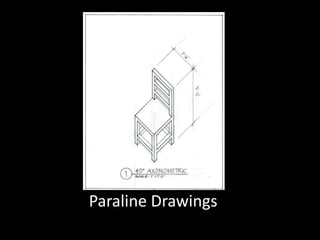
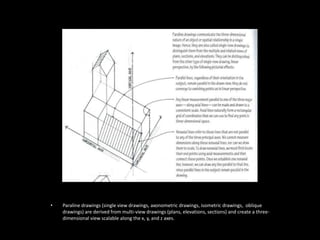
• Paraline drawings (single view drawings, axonometric drawings, isometric drawings, oblique 
drawings) are derived from multi-view drawings (plans, elevations, sections) and create a three-dimensional 
view scalable along the x, y, and z axes.
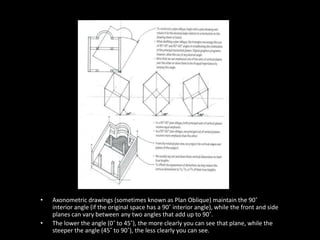
• Axonometric drawings (sometimes known as Plan Oblique) maintain the 90˚ 
interior angle (if the original space has a 90˚ interior angle), while the front and side 
planes can vary between any two angles that add up to 90˚. 
• The lower the angle (0˚ to 45˚), the more clearly you can see that plane, while the 
steeper the angle (45˚ to 90˚), the less clearly you can see.
• Here you can see how changing the angle of projection along the X or Y axis 
changes the view of the associated plane. The 60˚ angle seems steep, 
while the 30˚ angle feels more relaxed (at 0˚, it’s an elevation).
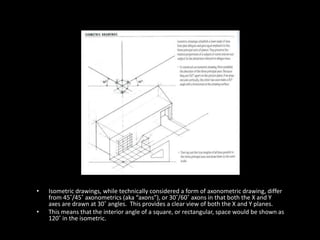
• Isometric drawings, while technically considered a form of axonometric drawing, differ 
from 45˚/45˚ axonometrics (aka “axons”), or 30˚/60˚ axons in that both the X and Y 
axes are drawn at 30˚ angles. This provides a clear view of both the X and Y planes. 
• This means that the interior angle of a square, or rectangular, space would be shown as 
120˚ in the isometric.
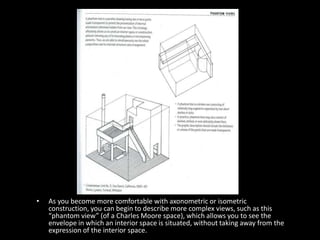
• As you become more comfortable with axonometric or isometric 
construction, you can begin to describe more complex views, such as this 
“phantom view” (of a Charles Moore space), which allows you to see the 
envelope in which an interior space is situated, without taking away from the 
expression of the interior space.
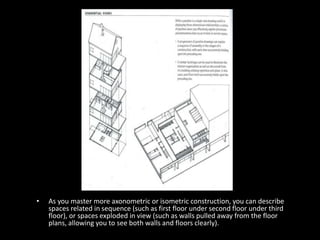
• As you master more axonometric or isometric construction, you can describe 
spaces related in sequence (such as first floor under second floor under third 
floor), or spaces exploded in view (such as walls pulled away from the floor 
plans, allowing you to see both walls and floors clearly).

Basic Drafting Week 8 powerpoint paraline drawing

  • 1.
  • 2.
    • Paraline drawings(single view drawings, axonometric drawings, isometric drawings, oblique drawings) are derived from multi-view drawings (plans, elevations, sections) and create a three-dimensional view scalable along the x, y, and z axes.
  • 3.
    • Axonometric drawings(sometimes known as Plan Oblique) maintain the 90˚ interior angle (if the original space has a 90˚ interior angle), while the front and side planes can vary between any two angles that add up to 90˚. • The lower the angle (0˚ to 45˚), the more clearly you can see that plane, while the steeper the angle (45˚ to 90˚), the less clearly you can see.
  • 4.
    • Here youcan see how changing the angle of projection along the X or Y axis changes the view of the associated plane. The 60˚ angle seems steep, while the 30˚ angle feels more relaxed (at 0˚, it’s an elevation).
  • 5.
    • Isometric drawings,while technically considered a form of axonometric drawing, differ from 45˚/45˚ axonometrics (aka “axons”), or 30˚/60˚ axons in that both the X and Y axes are drawn at 30˚ angles. This provides a clear view of both the X and Y planes. • This means that the interior angle of a square, or rectangular, space would be shown as 120˚ in the isometric.
  • 6.
    • As youbecome more comfortable with axonometric or isometric construction, you can begin to describe more complex views, such as this “phantom view” (of a Charles Moore space), which allows you to see the envelope in which an interior space is situated, without taking away from the expression of the interior space.
  • 7.
    • As youmaster more axonometric or isometric construction, you can describe spaces related in sequence (such as first floor under second floor under third floor), or spaces exploded in view (such as walls pulled away from the floor plans, allowing you to see both walls and floors clearly).