Drafting the Furniture Plan
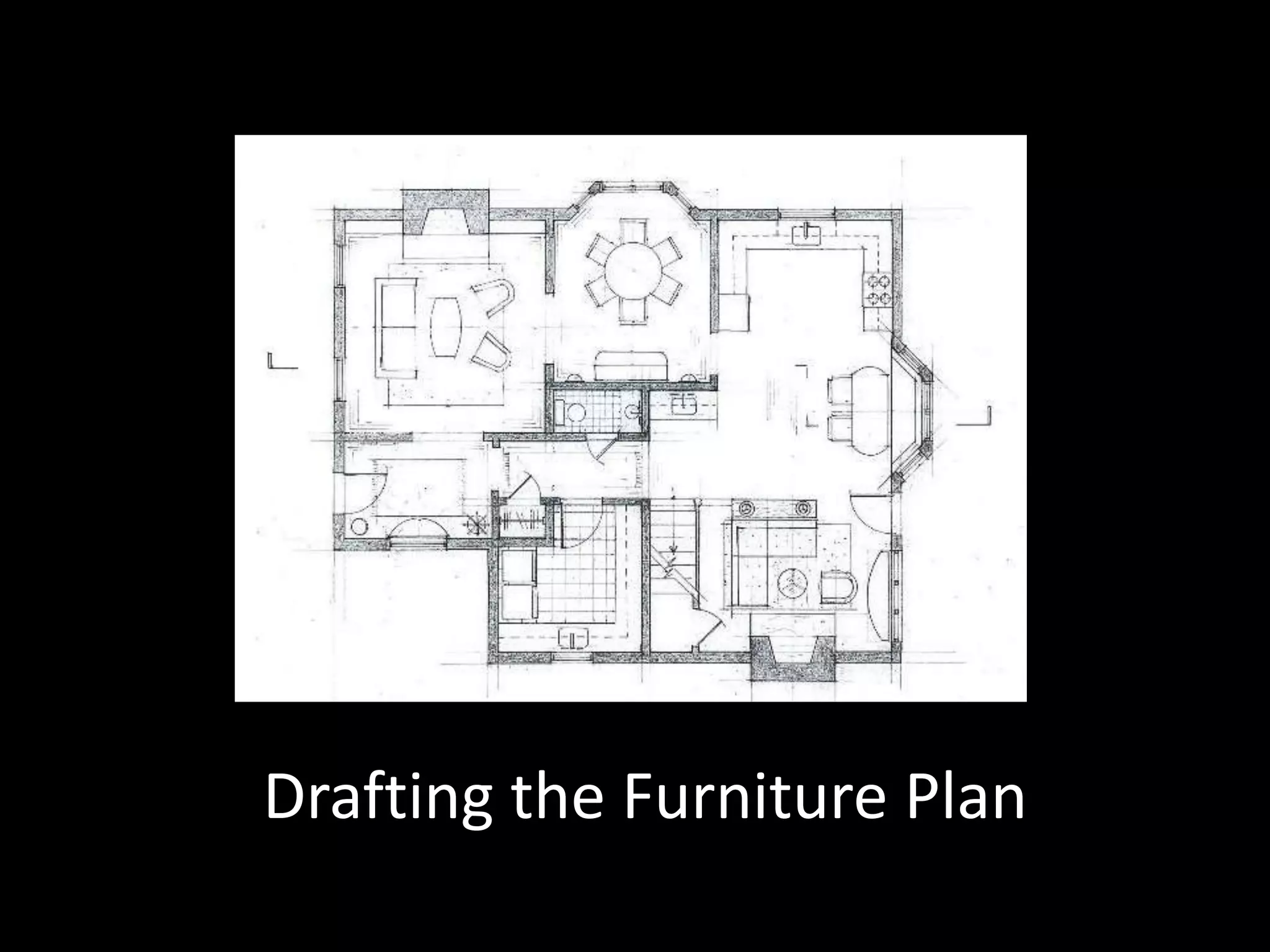
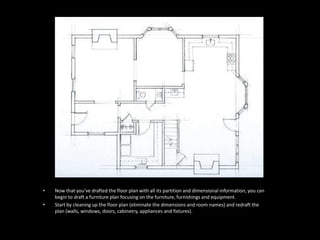
• Now that you’ve drafted the floor plan with all its partition and dimensional information, you can
begin to draft a furniture plan focusing on the furniture, furnishings and equipment.
• Start by cleaning up the floor plan (eliminate the dimensions and room names) and redraft the
plan (walls, windows, doors, cabinetry, appliances and fixtures).
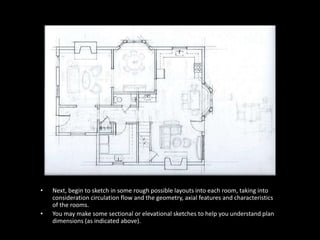
• Next, begin to sketch in some rough possible layouts into each room, taking into
consideration circulation flow and the geometry, axial features and characteristics
of the rooms.
• You may make some sectional or elevational sketches to help you understand plan
dimensions (as indicated above).
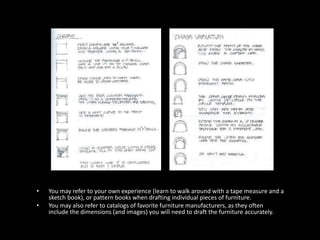
• You may refer to your own experience (learn to walk around with a tape measure and a
sketch book), or pattern books when drafting individual pieces of furniture.
• You may also refer to catalogs of favorite furniture manufacturers, as they often
include the dimensions (and images) you will need to draft the furniture accurately.
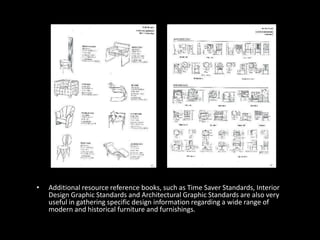
• Additional resource reference books, such as Time Saver Standards, Interior
Design Graphic Standards and Architectural Graphic Standards are also very
useful in gathering specific design information regarding a wide range of
modern and historical furniture and furnishings.
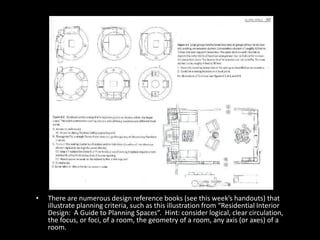
• There are numerous design reference books (see this week’s handouts) that
illustrate planning criteria, such as this illustration from “Residential Interior
Design: A Guide to Planning Spaces”. Hint: consider logical, clear circulation,
the focus, or foci, of a room, the geometry of a room, any axis (or axes) of a
room.
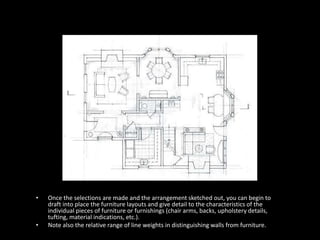
• Once the selections are made and the arrangement sketched out, you can begin to
draft into place the furniture layouts and give detail to the characteristics of the
individual pieces of furniture or furnishings (chair arms, backs, upholstery details,
tufting, material indications, etc.).
• Note also the relative range of line weights in distinguishing walls from furniture.
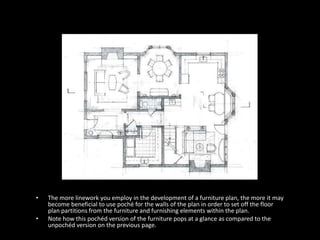
• The more linework you employ in the development of a furniture plan, the more it may
become beneficial to use poché for the walls of the plan in order to set off the floor
plan partitions from the furniture and furnishing elements within the plan.
• Note how this pochéd version of the furniture pops at a glance as compared to the
unpochéd version on the previous page.
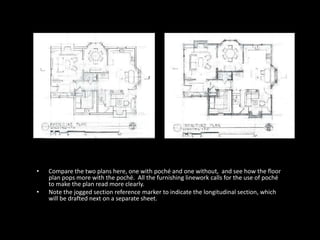
• Compare the two plans here, one with poché and one without, and see how the floor
plan pops more with the poché. All the furnishing linework calls for the use of poché
to make the plan read more clearly.
• Note the jogged section reference marker to indicate the longitudinal section, which
will be drafted next on a separate sheet.

Basic drafting week 11 powerpoint drafting the house furniture plan

  • 1.
  • 2.
    • Now thatyou’ve drafted the floor plan with all its partition and dimensional information, you can begin to draft a furniture plan focusing on the furniture, furnishings and equipment. • Start by cleaning up the floor plan (eliminate the dimensions and room names) and redraft the plan (walls, windows, doors, cabinetry, appliances and fixtures).
  • 3.
    • Next, beginto sketch in some rough possible layouts into each room, taking into consideration circulation flow and the geometry, axial features and characteristics of the rooms. • You may make some sectional or elevational sketches to help you understand plan dimensions (as indicated above).
  • 4.
    • You mayrefer to your own experience (learn to walk around with a tape measure and a sketch book), or pattern books when drafting individual pieces of furniture. • You may also refer to catalogs of favorite furniture manufacturers, as they often include the dimensions (and images) you will need to draft the furniture accurately.
  • 5.
    • Additional resourcereference books, such as Time Saver Standards, Interior Design Graphic Standards and Architectural Graphic Standards are also very useful in gathering specific design information regarding a wide range of modern and historical furniture and furnishings.
  • 6.
    • There arenumerous design reference books (see this week’s handouts) that illustrate planning criteria, such as this illustration from “Residential Interior Design: A Guide to Planning Spaces”. Hint: consider logical, clear circulation, the focus, or foci, of a room, the geometry of a room, any axis (or axes) of a room.
  • 7.
    • Once theselections are made and the arrangement sketched out, you can begin to draft into place the furniture layouts and give detail to the characteristics of the individual pieces of furniture or furnishings (chair arms, backs, upholstery details, tufting, material indications, etc.). • Note also the relative range of line weights in distinguishing walls from furniture.
  • 8.
    • The morelinework you employ in the development of a furniture plan, the more it may become beneficial to use poché for the walls of the plan in order to set off the floor plan partitions from the furniture and furnishing elements within the plan. • Note how this pochéd version of the furniture pops at a glance as compared to the unpochéd version on the previous page.
  • 9.
    • Compare thetwo plans here, one with poché and one without, and see how the floor plan pops more with the poché. All the furnishing linework calls for the use of poché to make the plan read more clearly. • Note the jogged section reference marker to indicate the longitudinal section, which will be drafted next on a separate sheet.