ORGANIZATIONAL JUSTICE
Bahadir Beadin
OVERVIEW
 Organizational justice is conceptualized as a
multidimensional construct.
 The four proposed components are distributive,
procedural, interpersonal, and informational justice.
 Research also suggests the importance of affect
and emotion in the appraisal of the fairness of a
situation as well as one’s behavioral and attitudinal
reactions to the situation.
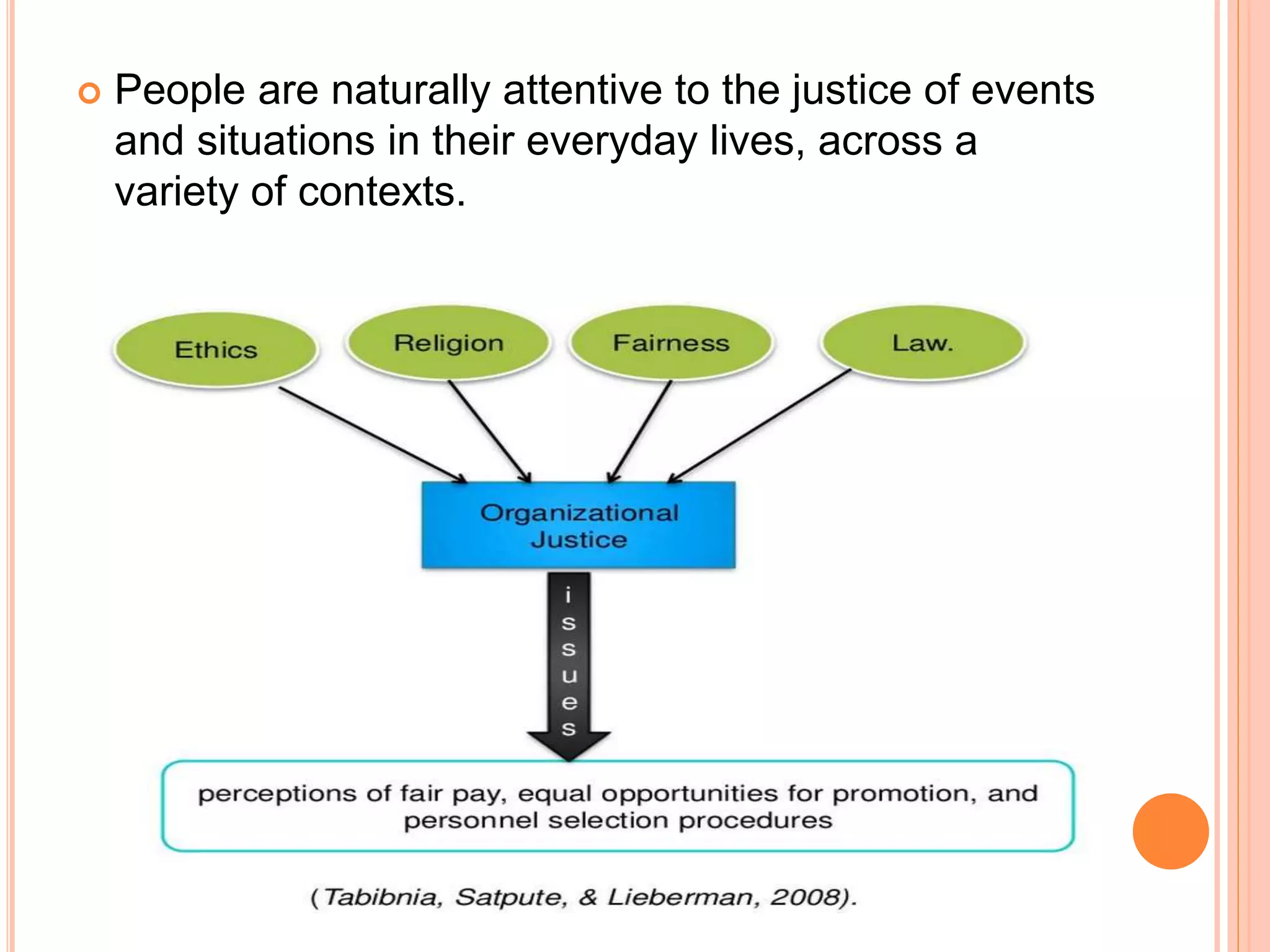
 Justice or fairness refers to the idea that an action
or decision is morally right, which may be defined
according to ethics, religion, fairness, equity, or law.
 People are naturally attentive to the justice of events
and situations in their everyday lives, across a
variety of contexts.
ORGANIZATIONAL JUSTICE
 Organizational justice theory, developed from
applied research in organizational settings, focuses
on how individuals socially construct incidents of
justice and injustice.
 Justice in organizational justice research is
examined through the perceptions of employees in
organizations who make judgments about the
actions of organizational leaders.
 Organizational justice generally refers to perceptions
of fairness in treatment of individuals internal to that
organization while corporate social responsibility
focuses on the fairness of treatment of entities
external to the organization.
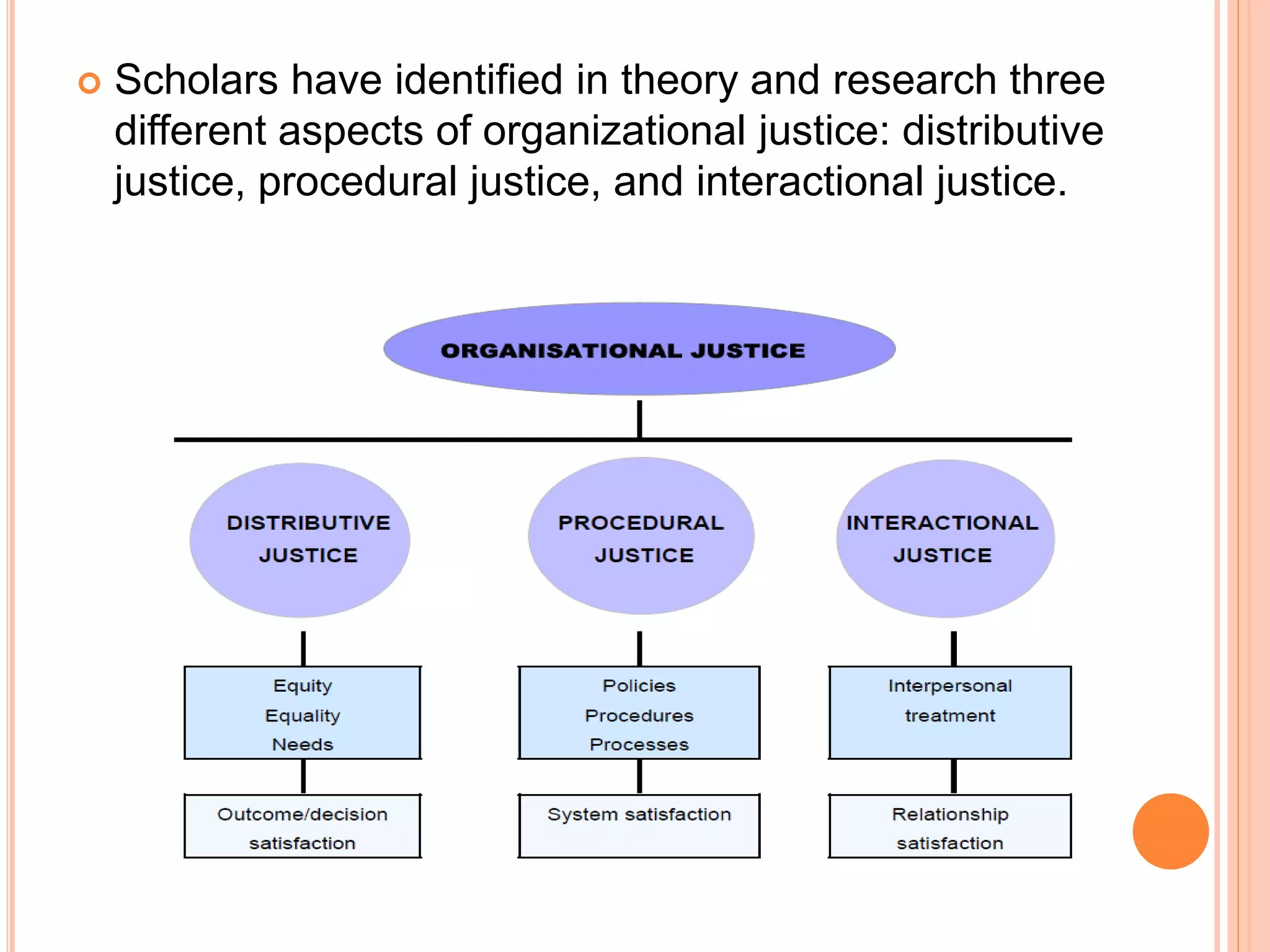
 Scholars have identified in theory and research three
different aspects of organizational justice: distributive
justice, procedural justice, and interactional justice.
DISTRIBUTIVE JUSTICE
 is conceptualized as the fairness associated with
decision outcomes and distribution of resources.
 The outcomes or resources distributed may be
tangible or intangible. Perceptions of distributive
justice can be fostered when outcomes are
perceived to be equally applied.
 Employees, in this view, have a transactional
relationship with their employers – at its simplest
level, employees provide their knowledge,
intelligence, skills, and labor in return for wages or
salaries and benefits.
PROCEDURAL JUSTICE
 Procedural justice research has resulted in
overwhelming evidence that decision control is an
important contributor to perceptions of justice.
 When individuals feel that they have a voice in the
process or that the process involves characteristics
such as consistency, accuracy, ethicality,
correctability, representativness, and lack of
prejudice then procedural justice is enhanced.
 Consistency: Applying standards uniformly over
time and across persons.
 Bias suppression: Minimizing personal self‐interest
and narrow preconceptions.
 Accuracy: Relying on high‐quality information and
wellinformed opinions.
 Correctability: Allowing decisions to be reviewed
and revised or reversed.
 Representativeness Taking into account various
interests.
 Ethicality Taking into account prevalent standards of
moral conduct.
FAIR PROCEDURAL EFFEECT
INTERACTIONAL JUSTICE
 refers to the treatment that an individual receives as
decisions are made and can be promoted by
providing explanations for decisions and delivering
the news with sensitivity and respect
 A construct validation study by Colquitt (2001)
suggests that interactional justice should be broken
into two components: interpersonal and informational
justice.
 Interpersonal justice refers to perceptions of
respect and propriety in one’s treatment
while informational justice relates to the adequacy
of the explanations given in terms of their timeliness,
specificity, and truthfulness
RESPONSES TO INJUSTICE
 It is most commonly a person or group of people
that comes under attack, as employees may not
feel inclined or qualified to question underlying
organisational systems.
 A number of factors can influence the decision to
act on a perceived injustice, including the extent of
its impact, perceptions of past and likely future
injustices, and personal dispositions such as a
desire for retribution and the tendency to confront
or avoid problem situations.
HANDLING RESPONSES TO INJUSTICE
 Revise systems and procedures to eliminate the
potential for gross injustices altogether. Many
organisations will already have a basic set of HR
policies in place that are intended to promote
fairness: for example, the standardised salary scales
and development programmes mentioned previously.
 Provide a controlled, accessible, responsive,
nonretributlve means for employees to access help
and support to tackle unforeseen or one-off instances
of injustice.
ANTECEDENTS OF ORGANİZATİONAL
JUSTİCE PERCEPTİONS
 Employee participation
 One antecedent to perceptions of organizational
justice is the extent to which employees feel that
they are involved in decision-making or other
organizational procedures.
 In addition, other studies have shown that
employee input is related to both procedural and
interpersonal justice perceptions.
 Communication
 The quality of communication by an organization or
manager can improve justice perceptions by
improving employee perceptions of manager
trustworthiness and also by reducing feelings of
uncertainty.
 It is important that the information provided be
accurate, timely, and helpful in order for the impact
on justice perceptions to be positive.
 Justice climate
 Recent research suggests that team level
perceptions of justice form what is called a ‘justice
climate’ which can impact individuals’ own views of
justice.
 Research findings show that individuals can “learn”
justice evaluations from team members and these
can lead to homogeneity of justice perceptions
within teams, creating a strong justice climate
OUTCOMES OF ORGANİZATİONAL JUSTİCE
PERCEPTİONS
 Employees’ perceptions of injustice within the
organization can result in a myriad of outcomes
both positive and negative.
 Trust: A positive relationship between an employee
and supervisor can lead to trust in the organization.
 Performance: Procedural justice affects
performance as a result of its impact on employee
attitudes. Distributive justice affects performance
when efficiency and productivity are involved.
Improving justice perceptions improves productivity
and performance
 Job satisfaction and organizational commitment:
Job satisfaction was found to be positively associated
with overall perceptions of organizational justice such
that greater perceived injustice results in lower levels
of job satisfaction and greater perceptions of justice
result in higher levels of job satisfaction.
 Organizational citizenship behavior:
Organizational citizenship behaviors are actions that
employees take to support the organization that go
above and beyond the scope of their job description.
 Counterproductive work behaviors: Increased
judgments of procedural injustice, for instance, can
lead to employee unwillingness to comply with an
organization’s rules.
 Absenteeism and withdrawal: Failure to receive a
promotion is an example of a situation in which
feelings of injustice may result in an employee being
absent from work without reason.
 Emotional exhaustion:Which related to employee
health and burnout, is related to overall
organizational justice perceptions. As perceptions of
justice increase employee health increases and
burnout decreases.
PROCESS TO CREATE PERCEPTIONS OF
ORGANIZATIONAL JUSTICE
WAYS TO PROMOTE ORGANIZATIONAL JUSTICE
 Pay workers what they deserve.
 Follow open and fair procedures.
 Offer workers a voice.
 Meet regularly and invite input.
 Conduct employee surveys.
 Keep an ‘Open Door Polıcy’
 Use suggestioı system.
THANK YOU
 As a conclusion we can say that organizational
justice has a huge effect working life. In any
industries every company should consider justice to
have more efficient employees, wich effects also
company's future to succeed in business.

Organizational Justice

  • 1.
  • 2.
    OVERVIEW  Organizational justiceis conceptualized as a multidimensional construct.  The four proposed components are distributive, procedural, interpersonal, and informational justice.  Research also suggests the importance of affect and emotion in the appraisal of the fairness of a situation as well as one’s behavioral and attitudinal reactions to the situation.  Justice or fairness refers to the idea that an action or decision is morally right, which may be defined according to ethics, religion, fairness, equity, or law.
  • 3.
     People arenaturally attentive to the justice of events and situations in their everyday lives, across a variety of contexts.
  • 4.
    ORGANIZATIONAL JUSTICE  Organizationaljustice theory, developed from applied research in organizational settings, focuses on how individuals socially construct incidents of justice and injustice.  Justice in organizational justice research is examined through the perceptions of employees in organizations who make judgments about the actions of organizational leaders.  Organizational justice generally refers to perceptions of fairness in treatment of individuals internal to that organization while corporate social responsibility focuses on the fairness of treatment of entities external to the organization.
  • 5.
     Scholars haveidentified in theory and research three different aspects of organizational justice: distributive justice, procedural justice, and interactional justice.
  • 6.
    DISTRIBUTIVE JUSTICE  isconceptualized as the fairness associated with decision outcomes and distribution of resources.  The outcomes or resources distributed may be tangible or intangible. Perceptions of distributive justice can be fostered when outcomes are perceived to be equally applied.  Employees, in this view, have a transactional relationship with their employers – at its simplest level, employees provide their knowledge, intelligence, skills, and labor in return for wages or salaries and benefits.
  • 7.
    PROCEDURAL JUSTICE  Proceduraljustice research has resulted in overwhelming evidence that decision control is an important contributor to perceptions of justice.  When individuals feel that they have a voice in the process or that the process involves characteristics such as consistency, accuracy, ethicality, correctability, representativness, and lack of prejudice then procedural justice is enhanced.  Consistency: Applying standards uniformly over time and across persons.  Bias suppression: Minimizing personal self‐interest and narrow preconceptions.
  • 8.
     Accuracy: Relyingon high‐quality information and wellinformed opinions.  Correctability: Allowing decisions to be reviewed and revised or reversed.  Representativeness Taking into account various interests.  Ethicality Taking into account prevalent standards of moral conduct.
  • 9.
  • 10.
    INTERACTIONAL JUSTICE  refersto the treatment that an individual receives as decisions are made and can be promoted by providing explanations for decisions and delivering the news with sensitivity and respect  A construct validation study by Colquitt (2001) suggests that interactional justice should be broken into two components: interpersonal and informational justice.  Interpersonal justice refers to perceptions of respect and propriety in one’s treatment while informational justice relates to the adequacy of the explanations given in terms of their timeliness, specificity, and truthfulness
  • 11.
    RESPONSES TO INJUSTICE It is most commonly a person or group of people that comes under attack, as employees may not feel inclined or qualified to question underlying organisational systems.  A number of factors can influence the decision to act on a perceived injustice, including the extent of its impact, perceptions of past and likely future injustices, and personal dispositions such as a desire for retribution and the tendency to confront or avoid problem situations.
  • 12.
    HANDLING RESPONSES TOINJUSTICE  Revise systems and procedures to eliminate the potential for gross injustices altogether. Many organisations will already have a basic set of HR policies in place that are intended to promote fairness: for example, the standardised salary scales and development programmes mentioned previously.  Provide a controlled, accessible, responsive, nonretributlve means for employees to access help and support to tackle unforeseen or one-off instances of injustice.
  • 13.
    ANTECEDENTS OF ORGANİZATİONAL JUSTİCEPERCEPTİONS  Employee participation  One antecedent to perceptions of organizational justice is the extent to which employees feel that they are involved in decision-making or other organizational procedures.  In addition, other studies have shown that employee input is related to both procedural and interpersonal justice perceptions.
  • 14.
     Communication  Thequality of communication by an organization or manager can improve justice perceptions by improving employee perceptions of manager trustworthiness and also by reducing feelings of uncertainty.  It is important that the information provided be accurate, timely, and helpful in order for the impact on justice perceptions to be positive.
  • 15.
     Justice climate Recent research suggests that team level perceptions of justice form what is called a ‘justice climate’ which can impact individuals’ own views of justice.  Research findings show that individuals can “learn” justice evaluations from team members and these can lead to homogeneity of justice perceptions within teams, creating a strong justice climate
  • 16.
    OUTCOMES OF ORGANİZATİONALJUSTİCE PERCEPTİONS  Employees’ perceptions of injustice within the organization can result in a myriad of outcomes both positive and negative.  Trust: A positive relationship between an employee and supervisor can lead to trust in the organization.  Performance: Procedural justice affects performance as a result of its impact on employee attitudes. Distributive justice affects performance when efficiency and productivity are involved. Improving justice perceptions improves productivity and performance
  • 17.
     Job satisfactionand organizational commitment: Job satisfaction was found to be positively associated with overall perceptions of organizational justice such that greater perceived injustice results in lower levels of job satisfaction and greater perceptions of justice result in higher levels of job satisfaction.  Organizational citizenship behavior: Organizational citizenship behaviors are actions that employees take to support the organization that go above and beyond the scope of their job description.
  • 18.
     Counterproductive workbehaviors: Increased judgments of procedural injustice, for instance, can lead to employee unwillingness to comply with an organization’s rules.  Absenteeism and withdrawal: Failure to receive a promotion is an example of a situation in which feelings of injustice may result in an employee being absent from work without reason.  Emotional exhaustion:Which related to employee health and burnout, is related to overall organizational justice perceptions. As perceptions of justice increase employee health increases and burnout decreases.
  • 19.
    PROCESS TO CREATEPERCEPTIONS OF ORGANIZATIONAL JUSTICE
  • 20.
    WAYS TO PROMOTEORGANIZATIONAL JUSTICE  Pay workers what they deserve.  Follow open and fair procedures.  Offer workers a voice.  Meet regularly and invite input.  Conduct employee surveys.  Keep an ‘Open Door Polıcy’  Use suggestioı system.
  • 21.
    THANK YOU  Asa conclusion we can say that organizational justice has a huge effect working life. In any industries every company should consider justice to have more efficient employees, wich effects also company's future to succeed in business.