Heat and Mass Transfer - Syllabus
Course Outcome : Unit 1
Apply heat conduction equations to different surface configurations under steady
state and transient conditions and solve problems
Heat and Mass Transfer Data Book by C.P.Kothandaraman (Ninth Edition)
What is Heat Transfer
• Heat, which is the form of energy that can be transferred from one system to
another as a result of temperature difference. The science that deals with the
determination of the rates of such energy transfers is heat transfer.
• The basic requirement for heat transfer is the presence of a temperature difference.
There can be no net heat transfer between two mediums that are at the same
temperature. The temperature difference is the driving force for heat transfer, just
as the voltage difference is the driving force for electric current flow and pressure
difference is the driving force for fluid flow.
• The rate of heat transfer in a certain direction depends on the magnitude of the
temperature gradient (the temperature difference per unit length or the rate of
change of temperature) in that direction. The larger the temperature gradient, the
higher the rate of heat transfer.
• Heat can be transferred in three different modes: conduction, convection and
radiation. All modes of heat transfer require the existence of a temperature
difference, and all modes are from the high-temperature medium to a lower-
temperature one.
Application Areas of Heat Transfer
Conduction
• Conduction is the transfer of energy from the more energetic particles of
a substance to the adjacent less energetic ones as a result of interactions
between the particles. Conduction can take place in solids, liquids, or
gases.
• In gases and liquids, conduction is due to the collisions and diffusion of the
molecules during their random motion. In solids, it is due to the
combination of vibrations of the molecules in a lattice and the energy
transport by free electrons.
• A cold canned drink in a warm room, for example, eventually warms up to
the room temperature as a result of heat transfer from the room to the
drink through the aluminum can by conduction.
• The rate of heat conduction through a medium depends on the
geometry of the medium, its thickness, and the material of the
medium, as well as the temperature difference across the medium.
• Experiments have shown that the rate of heat transfer Q ·through the
wall is doubled when the temperature difference T across the wall or
the area A normal to the direction of heat transfer is doubled, but is
halved when the wall thickness L is doubled.
• Thus we conclude that the rate of heat conduction through a plane
Conduction
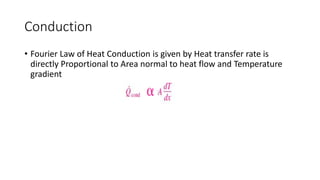
• Fourier Law of Heat Conduction is given by Heat transfer rate is
directly Proportional to Area normal to heat flow and Temperature
gradient
Conduction
• Thermal Conductivity
• Thus the thermal conductivity of a material can be
defined as the rate of heat transfer through a unit
thickness of the material per unit area per unit
temperature difference.
• The thermal conductivity of a material is a measure of the
ability of the material to conduct heat.
• A high value for thermal conductivity indicates that the
material is a good heat conductor, and a low value indicates
that the material is a poor heat conductor or insulator.
• Unit for Thermal Conductivity
Conduction
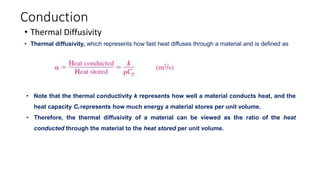
• Thermal Diffusivity
• Thermal diffusivity, which represents how fast heat diffuses through a material and is defined as
• Note that the thermal conductivity k represents how well a material conducts heat, and the
heat capacity Cp represents how much energy a material stores per unit volume.
• Therefore, the thermal diffusivity of a material can be viewed as the ratio of the heat
conducted through the material to the heat stored per unit volume.
Convection
• Convection is the mode of energy transfer between a solid surface and the
adjacent liquid or gas that is in motion.. The faster the fluid motion, the
greater the convection heat transfer.
• Convection is called forced convection if the fluid is forced to flow over the
surface by external means such as a fan, pump, or the wind.
• convection is called natural (or free) convection if the fluid motion is
caused by buoyancy forces that are induced by density differences due to
the variation of temperature in the fluid.
• The rate of convection heat transfer is observed to be proportional to the
temperature difference, and is conveniently expressed by Newton’s law of
cooling as
where h is the convection heat transfer coefficient in W/m2· °C
As is the surface area through which convection heat transfer takes place,
Ts is the surface temperature, and Ts is the temperature of the fluid sufficiently
far
from the surface. Note
Convection
• The convection heat transfer coefficient h is not a property of the fluid. It is an
experimentally determined parameter whose value depends on all the variables influencing
convection such as the surface geometry, the nature of fluid motion, the properties of the
fluid, and the bulk fluid velocity.
• The Unit for convection heat transfer coefficient h =
• Newton’s law of Convection is given by Rate of heat Conduction is
directly Proportional to area and Temperature difference
Radiation
• Radiation is the energy emitted by matter in the form of electromagnetic waves (or photons) as a
result of the changes in the electronic configurations of the atoms or molecules. Unlike
conduction and convection, the transfer of energy by radiation does not require the presence of
an intervening medium.
• The maximum rate of radiation that can be emitted from a surface at an absolute temperature
Ts (in K) is given by the Stefan–Boltzmann law as
• where = 5.67 x 10⁻⁸ W/m2 K4 is the Stefan–Boltzmann constant.
• Radiation heat transfer from sun to earth
• Stefan Boltzmann law states that the heat transfer rate is directly proportional to Area and fourth
power of Absolute temperature.
• Q A T4
Multiply by r
• The Copper wire 0.1 cm in diameter is insulated with plastic to an
outer diameter of 0.3 cm and it is exposed to an environment at 40 oC.
The Heat transfer coefficient from outer surface of plastic to the
surrounding is 8.75 W/m2K. What is the maximum steady current in
amperes that this wire can carry with heating any part of plastic above
95oC. The Thermal Conductivities of Plastic and Copper are 0.35 and
384 W/mK respectively. The Electrical Resistivity of the copper is
0.196 x 10⁻⁵ Ωcm
FINS or Extended Surfaces
Refer to Page 50 from Data book
NOTE : If the Length of the Fin is
given it is Short Fin.
If Length of the Fin is not given
then Assume it is as Long Fin
Refer to Page 50 from Data book
NOTE : If the Length of the Fin is
given it is Short Fin.
If Length of the Fin is not given
then Assume it is as Long Fin
Pg No -58 from HMT Data
book
Pg No -58 from
HMT Data book
Pg No -2
Pg No -58
Refer to Pg No -58 from HMT Data
book
Pg No -69
Pg No -70
Pg No -71
Refer to Pg No -66 from Data
Book
Refer to Pg No -67
from Data Book
Pg No -66
Pg No -67
Refer to Pg No -66 from Data
Book
Refer to Pg No -67 from Data
Book
Pg No -66
Pg No -67
Refer to Pg No -68 from Data
Book
Pg No -68

HMT-Conduction1.pptx

  • 1.
    Heat and MassTransfer - Syllabus
  • 2.
    Course Outcome :Unit 1 Apply heat conduction equations to different surface configurations under steady state and transient conditions and solve problems
  • 3.
    Heat and MassTransfer Data Book by C.P.Kothandaraman (Ninth Edition)
  • 4.
    What is HeatTransfer • Heat, which is the form of energy that can be transferred from one system to another as a result of temperature difference. The science that deals with the determination of the rates of such energy transfers is heat transfer. • The basic requirement for heat transfer is the presence of a temperature difference. There can be no net heat transfer between two mediums that are at the same temperature. The temperature difference is the driving force for heat transfer, just as the voltage difference is the driving force for electric current flow and pressure difference is the driving force for fluid flow. • The rate of heat transfer in a certain direction depends on the magnitude of the temperature gradient (the temperature difference per unit length or the rate of change of temperature) in that direction. The larger the temperature gradient, the higher the rate of heat transfer. • Heat can be transferred in three different modes: conduction, convection and radiation. All modes of heat transfer require the existence of a temperature difference, and all modes are from the high-temperature medium to a lower- temperature one.
  • 6.
    Application Areas ofHeat Transfer
  • 7.
    Conduction • Conduction isthe transfer of energy from the more energetic particles of a substance to the adjacent less energetic ones as a result of interactions between the particles. Conduction can take place in solids, liquids, or gases. • In gases and liquids, conduction is due to the collisions and diffusion of the molecules during their random motion. In solids, it is due to the combination of vibrations of the molecules in a lattice and the energy transport by free electrons. • A cold canned drink in a warm room, for example, eventually warms up to the room temperature as a result of heat transfer from the room to the drink through the aluminum can by conduction. • The rate of heat conduction through a medium depends on the geometry of the medium, its thickness, and the material of the medium, as well as the temperature difference across the medium. • Experiments have shown that the rate of heat transfer Q ·through the wall is doubled when the temperature difference T across the wall or the area A normal to the direction of heat transfer is doubled, but is halved when the wall thickness L is doubled. • Thus we conclude that the rate of heat conduction through a plane
  • 9.
    Conduction • Fourier Lawof Heat Conduction is given by Heat transfer rate is directly Proportional to Area normal to heat flow and Temperature gradient
  • 10.
    Conduction • Thermal Conductivity •Thus the thermal conductivity of a material can be defined as the rate of heat transfer through a unit thickness of the material per unit area per unit temperature difference. • The thermal conductivity of a material is a measure of the ability of the material to conduct heat. • A high value for thermal conductivity indicates that the material is a good heat conductor, and a low value indicates that the material is a poor heat conductor or insulator. • Unit for Thermal Conductivity
  • 11.
    Conduction • Thermal Diffusivity •Thermal diffusivity, which represents how fast heat diffuses through a material and is defined as • Note that the thermal conductivity k represents how well a material conducts heat, and the heat capacity Cp represents how much energy a material stores per unit volume. • Therefore, the thermal diffusivity of a material can be viewed as the ratio of the heat conducted through the material to the heat stored per unit volume.
  • 12.
    Convection • Convection isthe mode of energy transfer between a solid surface and the adjacent liquid or gas that is in motion.. The faster the fluid motion, the greater the convection heat transfer. • Convection is called forced convection if the fluid is forced to flow over the surface by external means such as a fan, pump, or the wind. • convection is called natural (or free) convection if the fluid motion is caused by buoyancy forces that are induced by density differences due to the variation of temperature in the fluid. • The rate of convection heat transfer is observed to be proportional to the temperature difference, and is conveniently expressed by Newton’s law of cooling as where h is the convection heat transfer coefficient in W/m2· °C As is the surface area through which convection heat transfer takes place, Ts is the surface temperature, and Ts is the temperature of the fluid sufficiently far from the surface. Note
  • 13.
    Convection • The convectionheat transfer coefficient h is not a property of the fluid. It is an experimentally determined parameter whose value depends on all the variables influencing convection such as the surface geometry, the nature of fluid motion, the properties of the fluid, and the bulk fluid velocity. • The Unit for convection heat transfer coefficient h = • Newton’s law of Convection is given by Rate of heat Conduction is directly Proportional to area and Temperature difference
  • 14.
    Radiation • Radiation isthe energy emitted by matter in the form of electromagnetic waves (or photons) as a result of the changes in the electronic configurations of the atoms or molecules. Unlike conduction and convection, the transfer of energy by radiation does not require the presence of an intervening medium. • The maximum rate of radiation that can be emitted from a surface at an absolute temperature Ts (in K) is given by the Stefan–Boltzmann law as • where = 5.67 x 10⁻⁸ W/m2 K4 is the Stefan–Boltzmann constant. • Radiation heat transfer from sun to earth • Stefan Boltzmann law states that the heat transfer rate is directly proportional to Area and fourth power of Absolute temperature. • Q A T4
  • 49.
  • 65.
    • The Copperwire 0.1 cm in diameter is insulated with plastic to an outer diameter of 0.3 cm and it is exposed to an environment at 40 oC. The Heat transfer coefficient from outer surface of plastic to the surrounding is 8.75 W/m2K. What is the maximum steady current in amperes that this wire can carry with heating any part of plastic above 95oC. The Thermal Conductivities of Plastic and Copper are 0.35 and 384 W/mK respectively. The Electrical Resistivity of the copper is 0.196 x 10⁻⁵ Ωcm
  • 106.
  • 108.
    Refer to Page50 from Data book
  • 109.
    NOTE : Ifthe Length of the Fin is given it is Short Fin. If Length of the Fin is not given then Assume it is as Long Fin
  • 111.
    Refer to Page50 from Data book
  • 135.
    NOTE : Ifthe Length of the Fin is given it is Short Fin. If Length of the Fin is not given then Assume it is as Long Fin
  • 139.
    Pg No -58from HMT Data book
  • 140.
    Pg No -58from HMT Data book
  • 141.
  • 142.
  • 143.
    Refer to PgNo -58 from HMT Data book
  • 151.
  • 153.
  • 154.
  • 156.
    Refer to PgNo -66 from Data Book Refer to Pg No -67 from Data Book
  • 157.
  • 158.
  • 159.
    Refer to PgNo -66 from Data Book Refer to Pg No -67 from Data Book
  • 160.
  • 161.
  • 162.
    Refer to PgNo -68 from Data Book
  • 163.