What is Task Analysis?


Methods of analysing people's jobs:
  what people do
  what things they work with
  what they must know
An Example


in order to clean the house
     get the vacuum cleaner out
     fix the appropriate attachments
     clean the rooms
     when the dust bag gets full, empty it
     put the vacuum cleaner and tools away


must know about:
     vacuum cleaners, their attachments, dust bags,
     cupboards, rooms etc.
Approaches to task analysis

Task decomposition
    splitting task into (ordered) subtasks

Knowledge based techniques
    what the user knows about the task and how it is organized

Entity-relation based analysis
      relationships between objects, actions
                    and the people who perform them
General method:
      observe
      collect unstructured lists of words and actions
      organize using notation or diagrams
Differences from other techniques


   Systems analysis        vs.       Task analysis
       system design - focus - the user


   Cognitive models        vs.       Task analysis
  internal mental state - focus -    external actions
   practiced `unit' task - focus -   whole job
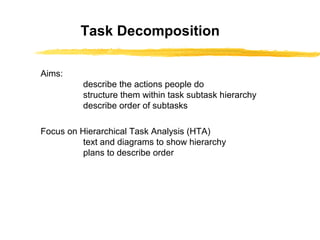
Task Decomposition

Aims:
          describe the actions people do
          structure them within task subtask hierarchy
          describe order of subtasks

Focus on Hierarchical Task Analysis (HTA)
          text and diagrams to show hierarchy
          plans to describe order
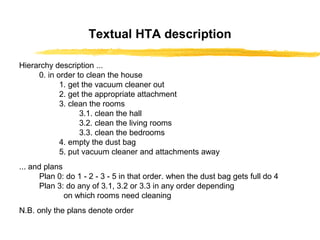
Textual HTA description

Hierarchy description ...
     0. in order to clean the house
            1. get the vacuum cleaner out
            2. get the appropriate attachment
            3. clean the rooms
                  3.1. clean the hall
                  3.2. clean the living rooms
                  3.3. clean the bedrooms
            4. empty the dust bag
            5. put vacuum cleaner and attachments away
... and plans
      Plan 0: do 1 - 2 - 3 - 5 in that order. when the dust bag gets full do 4
      Plan 3: do any of 3.1, 3.2 or 3.3 in any order depending
              on which rooms need cleaning
N.B. only the plans denote order
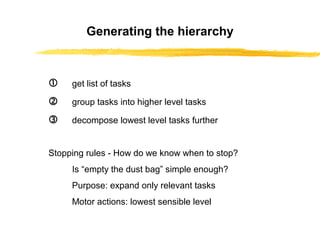
Generating the hierarchy


    get list of tasks

    group tasks into higher level tasks

    decompose lowest level tasks further


Stopping rules - How do we know when to stop?
     Is “empty the dust bag” simple enough?
     Purpose: expand only relevant tasks
     Motor actions: lowest sensible level
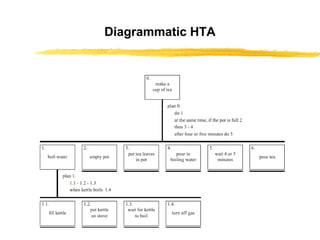
Diagrammatic HTA
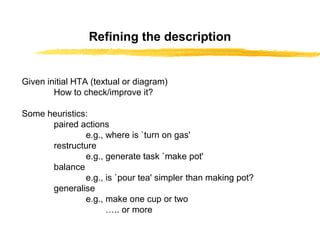
Refining the description


Given initial HTA (textual or diagram)
        How to check/improve it?

Some heuristics:
      paired actions
               e.g., where is `turn on gas'
      restructure
               e.g., generate task `make pot'
      balance
               e.g., is `pour tea' simpler than making pot?
      generalise
               e.g., make one cup or two
                     ….. or more
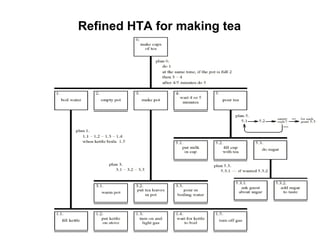
Refined HTA for making tea
You’re Turn!


•Think of an example (like making tea) of
when you would use task analysis to break
down a job.

•In the blog, write some simple tasks you
might used to accomplish this job.

Task analysis

  • 1.
    What is TaskAnalysis? Methods of analysing people's jobs: what people do what things they work with what they must know
  • 2.
    An Example in orderto clean the house get the vacuum cleaner out fix the appropriate attachments clean the rooms when the dust bag gets full, empty it put the vacuum cleaner and tools away must know about: vacuum cleaners, their attachments, dust bags, cupboards, rooms etc.
  • 3.
    Approaches to taskanalysis Task decomposition splitting task into (ordered) subtasks Knowledge based techniques what the user knows about the task and how it is organized Entity-relation based analysis relationships between objects, actions and the people who perform them General method: observe collect unstructured lists of words and actions organize using notation or diagrams
  • 4.
    Differences from othertechniques Systems analysis vs. Task analysis system design - focus - the user Cognitive models vs. Task analysis internal mental state - focus - external actions practiced `unit' task - focus - whole job
  • 5.
    Task Decomposition Aims: describe the actions people do structure them within task subtask hierarchy describe order of subtasks Focus on Hierarchical Task Analysis (HTA) text and diagrams to show hierarchy plans to describe order
  • 6.
    Textual HTA description Hierarchydescription ... 0. in order to clean the house 1. get the vacuum cleaner out 2. get the appropriate attachment 3. clean the rooms 3.1. clean the hall 3.2. clean the living rooms 3.3. clean the bedrooms 4. empty the dust bag 5. put vacuum cleaner and attachments away ... and plans Plan 0: do 1 - 2 - 3 - 5 in that order. when the dust bag gets full do 4 Plan 3: do any of 3.1, 3.2 or 3.3 in any order depending on which rooms need cleaning N.B. only the plans denote order
  • 7.
    Generating the hierarchy  get list of tasks  group tasks into higher level tasks  decompose lowest level tasks further Stopping rules - How do we know when to stop? Is “empty the dust bag” simple enough? Purpose: expand only relevant tasks Motor actions: lowest sensible level
  • 8.
  • 9.
    Refining the description Giveninitial HTA (textual or diagram) How to check/improve it? Some heuristics: paired actions e.g., where is `turn on gas' restructure e.g., generate task `make pot' balance e.g., is `pour tea' simpler than making pot? generalise e.g., make one cup or two ….. or more
  • 10.
    Refined HTA formaking tea
  • 11.
    You’re Turn! •Think ofan example (like making tea) of when you would use task analysis to break down a job. •In the blog, write some simple tasks you might used to accomplish this job.