Chapter-4 
Failure Modes and Effect Analysis 
1
4.1 FAILURE MODES AND EFFECT ANALYSIS 
• Failure modes and effect analysis (FMEA) is a powerful design tool 
to analyze engineering systems and it may simply be described as 
an approach to perform analysis of each potential failure mode in 
the system to examine the results or effects of such failure modes 
on the system. When FMEA is extended to classify each potential 
failure effect according to its severity (this incorporates 
documenting catastrophic (an event causing great damage or 
suffering) and critical failures), the method is known as failure mode 
effects and criticality analysis (FMECA). 
• The history of FMEA goes back to the early 1950s with the 
development of flight control systems when the U.S. Navy’s Bureau 
of Aeronautics, in order to establish a mechanism for reliability 
control over the detail design effort, developed a requirement 
called “Failure Analysis”. 
2
Subsequently, J.S. Coutinho (1963-64) coined the term “Failure Effect 
Analysis” and the Bureau of Naval Weapons (i.e., successor to the 
Bureau of Aeronautics) introduced it into its new specification on 
flight controls. However, FMECA was developed by the National 
Aeronautics and Astronautics Administration (NASA) to assure the 
desired reliability of space systems. 
In the 1970s, the U.S. Department of Defense directed its effort to 
develop a military standard entitled “Procedures for Performing a 
Failure Mode, Effects, and Criticality Analysis”. 
Today FMEA/FMECA methods are widely used in the industry to 
conduct analysis of systems, particularly for use in aerospace, 
defense, and nuclear power generation. 
4.2 TERMS AND DEFINITIONS 
There are many terms used in performing FMEA/FMECA and some of 
them are as follows: 
• Failure cause: The factors such as design defects, quality defects, 
physical or chemical processes, or part misapplication are the 
primary reason for failure or they start the physical process through 
which deterioration progresses to failure. 3
• Failure mode: The notion or manner through which a failure is 
perceived. 
• Failure effect: The consequence or consequences a failure mode has 
on an item’s function, operation, or status. 
• Single failure point: An item’s malfunction that would lead to 
system failure and is not compensated through redundancy or 
through other operational mechanisms. 
• Criticality: A relative measure of a failure mode’s consequences and 
its occurrence frequency. 
• Severity: A failure mode’s consequences, taking into consideration 
the worst case scenario of a failure, determined by factors such as 
damage to property, the degree of injury, or ultimate system 
damage. 
• Corrective action: A change such as design, process, procedure, or 
materials implemented and validated to rectify failure cause/design 
deficiency. 
4
• Criticality analysis: An approach through which each possible failure 
mode is ranked with respect to the combined influence of 
occurrence probability and severity. 
• Undetectable failure: A postulated failure mode in the FMEA for 
which no failure detection approach is available through which the 
concerned operator can be alerted of the failure. 
• Local effect: The consequence or conseqences a failure mode has on 
the function, operation, or status of the item currently being 
analyzed. 
4.3 TYPES OF FMEA AND THEIR ASSOCIATED BENEFITS 
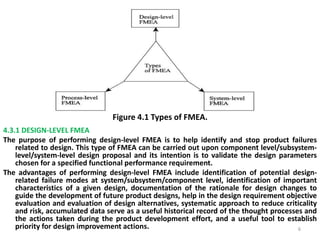
• FMEA may be grouped under three distinct classifications as shown 
in Figure 4.1. These are design-level FMEA, system-level FMEA, and 
process-level FMEA. Each of these categories is described as 
follows: 
5
Figure 4.1 Types of FMEA. 
4.3.1 DESIGN-LEVEL FMEA 
The purpose of performing design-level FMEA is to help identify and stop product failures 
related to design. This type of FMEA can be carried out upon component level/subsystem-level/ 
system-level design proposal and its intention is to validate the design parameters 
chosen for a specified functional performance requirement. 
The advantages of performing design-level FMEA include identification of potential design-related 
failure modes at system/subsystem/component level, identification of important 
characteristics of a given design, documentation of the rationale for design changes to 
guide the development of future product designs, help in the design requirement objective 
evaluation and evaluation of design alternatives, systematic approach to reduce criticality 
and risk, accumulated data serve as a useful historical record of the thought processes and 
the actions taken during the product development effort, and a useful tool to establish 
priority for design improvement actions. 6
4.3.2 SYSTEM-LEVEL FMEA 
• This is the highest-level FMEA that can be performed and its 
purpose is to identify and prevent failures related to 
system/subsystems during the early conceptual design. 
Furthermore, this type of FMEA is carried out to validate that the 
system design specifications reduce the risk of functional failure to 
the lowest level during the operational period. 
• Some benefits of the system-level FMEA are identification of 
potential systemic failure modes due to system interaction with 
other systems and/or by subsystem interactions, selection of the 
optimum system design alternative, identification of potential 
system design parameters that may incorporate deficiencies prior to 
releasing hardware/software to production, a systematic approach 
to identify all potential effects of subsystem/assembly part failure 
modes for incorporation into design-level FMEA, and a useful data 
bank of historical records of the thought processes as well as of 
actions taken during product development efforts. 
7
4.3.3 PROCESS-LEVEL FMEA 
This identifies and prevents failures related to the 
manufacturing/assembly process for a certain item. The benefits of 
the process-level FMEA include identification of potential process-level 
failure modes at system/subsystem/operation level, 
identification of important characteristics associated with the 
process, identification of potential process shortcomings early in 
the process planning cycle, development of priorities for process 
improvement actions, and documentation of rationale for process 
changes to help guide the establishment of potential manufacturing 
processes. 
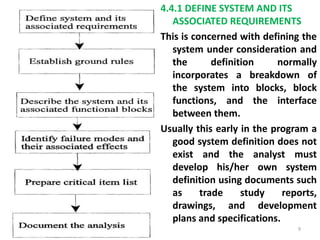
4.4 STEPS FOR PERFORMING FMEA 
FMEA can be performed in six steps as shown in Figure 4.2. 
• Define system and its associated requirements, 
• Establish ground rules, 
• Describe the system and its associated functional blocks, 
• Identify failure modes and their associated effects, 
• Prepare critical items list, 
• Document the analysis. 
8
4.4.1 DEFINE SYSTEM AND ITS 
ASSOCIATED REQUIREMENTS 
This is concerned with defining the 
system under consideration and 
the definition normally 
incorporates a breakdown of 
the system into blocks, block 
functions, and the interface 
between them. 
Usually this early in the program a 
good system definition does not 
exist and the analyst must 
develop his/her own system 
definition using documents such 
as trade study reports, 
drawings, and development 
plans and specifications. 
9
4.4.2 ESTABLISH GROUND RULES 
These are established as to which the FMEA is conducted. Usually, 
developing the ground rules is a quite straightforward process when 
the system definition and mission requirements are reasonably 
complete. 
Nonetheless, examples of the ground rules include primary and 
secondary mission objectives statement, limits of environmental 
and operational stresses, statement of analysis level, delineation of 
mission phases, definition of what constitutes failure of system 
hardware parts, and the detail of the coding system used. 
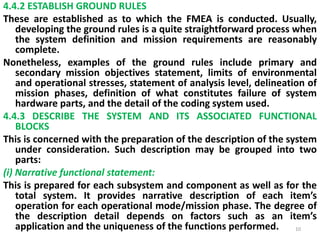
4.4.3 DESCRIBE THE SYSTEM AND ITS ASSOCIATED FUNCTIONAL 
BLOCKS 
This is concerned with the preparation of the description of the system 
under consideration. Such description may be grouped into two 
parts: 
(i) Narrative functional statement: 
This is prepared for each subsystem and component as well as for the 
total system. It provides narrative description of each item’s 
operation for each operational mode/mission phase. The degree of 
the description detail depends on factors such as an item’s 
application and the uniqueness of the functions performed. 10
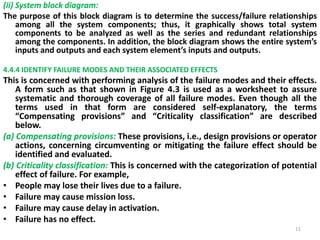
(ii) System block diagram: 
The purpose of this block diagram is to determine the success/failure relationships 
among all the system components; thus, it graphically shows total system 
components to be analyzed as well as the series and redundant relationships 
among the components. In addition, the block diagram shows the entire system’s 
inputs and outputs and each system element’s inputs and outputs. 
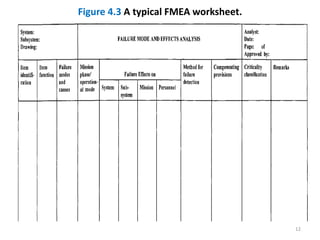
4.4.4 IDENTIFY FAILURE MODES AND THEIR ASSOCIATED EFFECTS 
This is concerned with performing analysis of the failure modes and their effects. 
A form such as that shown in Figure 4.3 is used as a worksheet to assure 
systematic and thorough coverage of all failure modes. Even though all the 
terms used in that form are considered self-explanatory, the terms 
“Compensating provisions” and “Criticality classification” are described 
below. 
(a) Compensating provisions: These provisions, i.e., design provisions or operator 
actions, concerning circumventing or mitigating the failure effect should be 
identified and evaluated. 
(b) Criticality classification: This is concerned with the categorization of potential 
effect of failure. For example, 
• People may lose their lives due to a failure. 
• Failure may cause mission loss. 
• Failure may cause delay in activation. 
• Failure has no effect. 
11
Figure 4.3 A typical FMEA worksheet. 
12
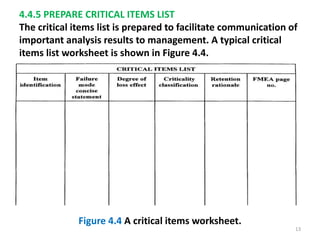
4.4.5 PREPARE CRITICAL ITEMS LIST 
The critical items list is prepared to facilitate communication of 
important analysis results to management. A typical critical 
items list worksheet is shown in Figure 4.4. 
13 
Figure 4.4 A critical items worksheet.
4.4.6 DOCUMENT THE ANALYSIS 
• This is the final step of the FMEA performing process and is 
concerned with the documentation of analysis. This step is at least 
as important as the other previous five steps because poor 
documentation can lead to ineffectiveness of the FMEA process. 
Nonetheless, the FMEA report incorporates items such as system 
definition, FMEA associated ground rules, failure modes and their 
effects, description of the system (i.e., including functional 
descriptions and block diagrams), and critical items list. 
4.5 CRITICALITY ASSESSMENT 
The objective of the criticality assessment is to prioritize the 
failure modes discovered during the system analysis on the 
basis of their effects and occurrence likelihood. Thus, for 
making an assessment of the severity of an item failure, two 
commonly used methods are Risk Priority Number (RPN) 
Technique and Military Standard Technique. The former is 
widely used in the automotive industrial sector and the latter 
in defense, nuclear, and aerospace industries. Both 
approaches are described as follows. 14
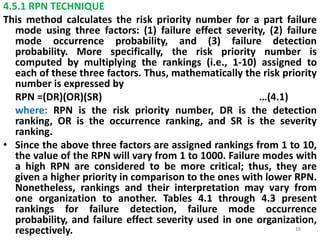
4.5.1 RPN TECHNIQUE 
This method calculates the risk priority number for a part failure 
mode using three factors: (1) failure effect severity, (2) failure 
mode occurrence probability, and (3) failure detection 
probability. More specifically, the risk priority number is 
computed by multiplying the rankings (i.e., 1-10) assigned to 
each of these three factors. Thus, mathematically the risk priority 
number is expressed by 
RPN =(DR)(OR)(SR) …(4.1) 
where: RPN is the risk priority number, DR is the detection 
ranking, OR is the occurrence ranking, and SR is the severity 
ranking. 
• Since the above three factors are assigned rankings from 1 to 10, 
the value of the RPN will vary from 1 to 1000. Failure modes with 
a high RPN are considered to be more critical; thus, they are 
given a higher priority in comparison to the ones with lower RPN. 
Nonetheless, rankings and their interpretation may vary from 
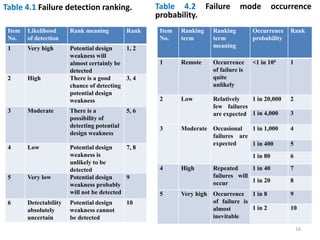
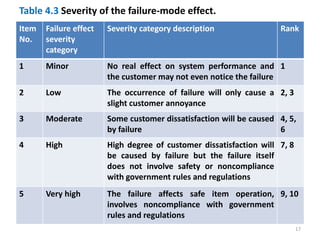
one organization to another. Tables 4.1 through 4.3 present 
rankings for failure detection, failure mode occurrence 
probability, and failure effect severity used in one organization, 
respectively. 15
Table 4.1 Failure detection ranking. 
Item 
No. 
Likelihood 
of detection 
Rank meaning Rank 
1 Very high Potential design 
weakness will 
almost certainly be 
detected 
1, 2 
2 High There is a good 
chance of detecting 
potential design 
weakness 
3, 4 
3 Moderate There is a 
possibility of 
detecting potential 
design weakness 
5, 6 
4 Low Potential design 
weakness is 
unlikely to be 
detected 
7, 8 
5 Very low Potential design 
weakness probably 
will not be detected 
9 
6 Detectability 
absolutely 
uncertain 
Potential design 
weakness cannot 
be detected 
10 
Table 4.2 Failure mode occurrence 
probability. 
Item 
No. 
Ranking 
term 
Ranking 
term 
meaning 
Occurrence 
probability 
Rank 
1 Remote Occurrence 
of failure is 
quite 
unlikely 
<1 in 106 1 
2 Low Relatively 
few failures 
are expected 
1 in 20,000 2 
1 in 4,000 3 
3 Moderate Occasional 
failures are 
expected 
1 in 1,000 4 
1 in 400 5 
1 in 80 6 
4 High Repeated 
failures will 
occur 
1 in 40 7 
1 in 20 8 
5 Very high Occurrence 
of failure is 
almost 
inevitable 
1 in 8 9 
1 in 2 10 
16
Table 4.3 Severity of the failure-mode effect. 
Item 
No. 
Failure effect 
severity 
category 
Severity category description Rank 
1 Minor No real effect on system performance and 
the customer may not even notice the failure 
1 
2 Low The occurrence of failure will only cause a 
slight customer annoyance 
2, 3 
3 Moderate Some customer dissatisfaction will be caused 
by failure 
4, 5, 
6 
4 High High degree of customer dissatisfaction will 
be caused by failure but the failure itself 
does not involve safety or noncompliance 
with government rules and regulations 
7, 8 
5 Very high The failure affects safe item operation, 
involves noncompliance with government 
rules and regulations 
9, 10 
17
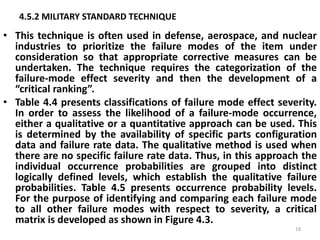
4.5.2 MILITARY STANDARD TECHNIQUE 
• This technique is often used in defense, aerospace, and nuclear 
industries to prioritize the failure modes of the item under 
consideration so that appropriate corrective measures can be 
undertaken. The technique requires the categorization of the 
failure-mode effect severity and then the development of a 
“critical ranking”. 
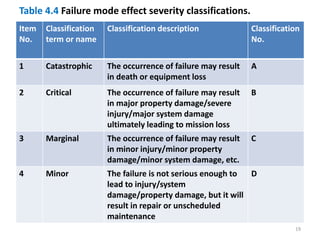
• Table 4.4 presents classifications of failure mode effect severity. 
In order to assess the likelihood of a failure-mode occurrence, 
either a qualitative or a quantitative approach can be used. This 
is determined by the availability of specific parts configuration 
data and failure rate data. The qualitative method is used when 
there are no specific failure rate data. Thus, in this approach the 
individual occurrence probabilities are grouped into distinct 
logically defined levels, which establish the qualitative failure 
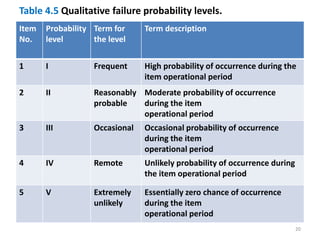
probabilities. Table 4.5 presents occurrence probability levels. 
For the purpose of identifying and comparing each failure mode 
to all other failure modes with respect to severity, a critical 
matrix is developed as shown in Figure 4.3. 
18
Table 4.4 Failure mode effect severity classifications. 
Item 
Classification 
No. 
term or name 
Classification description Classification 
No. 
1 Catastrophic The occurrence of failure may result 
in death or equipment loss 
A 
2 Critical The occurrence of failure may result 
in major property damage/severe 
injury/major system damage 
ultimately leading to mission loss 
B 
3 Marginal The occurrence of failure may result 
in minor injury/minor property 
damage/minor system damage, etc. 
C 
4 Minor The failure is not serious enough to 
lead to injury/system 
damage/property damage, but it will 
result in repair or unscheduled 
maintenance 
D 
19
Table 4.5 Qualitative failure probability levels. 
Item 
Probability 
Term for 
Term description 
No. 
level 
the level 
1 I Frequent High probability of occurrence during the 
item operational period 
2 II Reasonably 
probable 
Moderate probability of occurrence 
during the item 
operational period 
3 III Occasional Occasional probability of occurrence 
during the item 
operational period 
4 IV Remote Unlikely probability of occurrence during 
the item operational period 
5 V Extremely 
unlikely 
Essentially zero chance of occurrence 
during the item 
operational period 
20
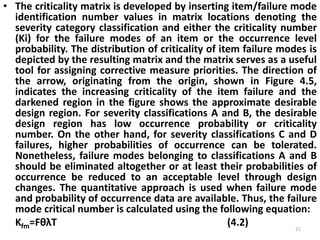
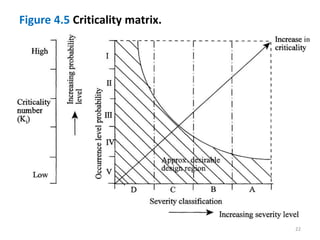
• The criticality matrix is developed by inserting item/failure mode 
identification number values in matrix locations denoting the 
severity category classification and either the criticality number 
(Ki) for the failure modes of an item or the occurrence level 
probability. The distribution of criticality of item failure modes is 
depicted by the resulting matrix and the matrix serves as a useful 
tool for assigning corrective measure priorities. The direction of 
the arrow, originating from the origin, shown in Figure 4.5, 
indicates the increasing criticality of the item failure and the 
darkened region in the figure shows the approximate desirable 
design region. For severity classifications A and B, the desirable 
design region has low occurrence probability or criticality 
number. On the other hand, for severity classifications C and D 
failures, higher probabilities of occurrence can be tolerated. 
Nonetheless, failure modes belonging to classifications A and B 
should be eliminated altogether or at least their probabilities of 
occurrence be reduced to an acceptable level through design 
changes. The quantitative approach is used when failure mode 
and probability of occurrence data are available. Thus, the failure 
mode critical number is calculated using the following equation: 
Kfm=FθλT (4.2) 
21
Figure 4.5 Criticality matrix. 
22
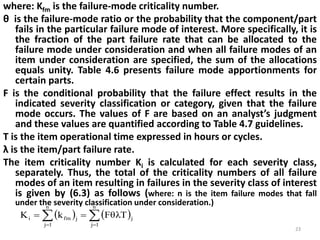
where: Kfm is the failure-mode criticality number. 
θ is the failure-mode ratio or the probability that the component/part 
fails in the particular failure mode of interest. More specifically, it is 
the fraction of the part failure rate that can be allocated to the 
failure mode under consideration and when all failure modes of an 
item under consideration are specified, the sum of the allocations 
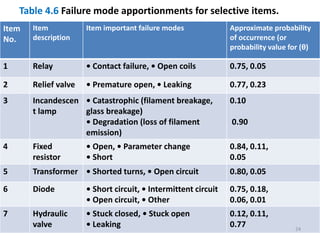
equals unity. Table 4.6 presents failure mode apportionments for 
certain parts. 
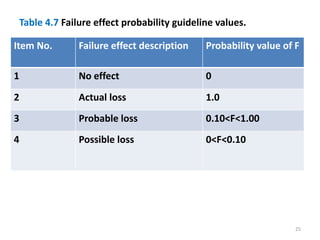
F is the conditional probability that the failure effect results in the 
indicated severity classification or category, given that the failure 
mode occurs. The values of F are based on an analyst’s judgment 
and these values are quantified according to Table 4.7 guidelines. 
T is the item operational time expressed in hours or cycles. 
λ is the item/part failure rate. 
The item criticality number Ki is calculated for each severity class, 
separately. Thus, the total of the criticality numbers of all failure 
modes of an item resulting in failures in the severity class of interest 
is given by (6.3) as follows (where: n is the item failure modes that fall 
under the severity classification under consideration.) 
23 
    
  
K  k  
FθλT 
i fm j n 
j 1 
j 
n 
j 1
Table 4.6 Failure mode apportionments for selective items. 
Item 
No. 
Item 
description 
Item important failure modes Approximate probability 
of occurrence (or 
probability value for (θ) 
1 Relay • Contact failure, • Open coils 0.75, 0.05 
2 Relief valve • Premature open, • Leaking 0.77, 0.23 
3 Incandescen 
t lamp 
• Catastrophic (filament breakage, 
glass breakage) 
• Degradation (loss of filament 
emission) 
0.10 
0.90 
4 Fixed 
resistor 
• Open, • Parameter change 
• Short 
0.84, 0.11, 
0.05 
5 Transformer • Shorted turns, • Open circuit 0.80, 0.05 
6 Diode • Short circuit, • Intermittent circuit 
• Open circuit, • Other 
0.75, 0.18, 
0.06, 0.01 
7 Hydraulic 
valve 
• Stuck closed, • Stuck open 
• Leaking 
0.12, 0.11, 
0.77 
24
Table 4.7 Failure effect probability guideline values. 
Item No. Failure effect description Probability value of F 
1 No effect 0 
2 Actual loss 1.0 
3 Probable loss 0.10<F<1.00 
4 Possible loss 0<F<0.10 
25
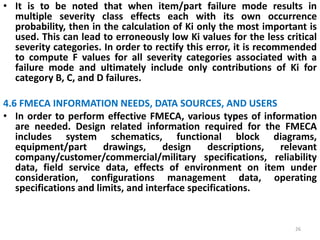
• It is to be noted that when item/part failure mode results in 
multiple severity class effects each with its own occurrence 
probability, then in the calculation of Ki only the most important is 
used. This can lead to erroneously low Ki values for the less critical 
severity categories. In order to rectify this error, it is recommended 
to compute F values for all severity categories associated with a 
failure mode and ultimately include only contributions of Ki for 
category B, C, and D failures. 
4.6 FMECA INFORMATION NEEDS, DATA SOURCES, AND USERS 
• In order to perform effective FMECA, various types of information 
are needed. Design related information required for the FMECA 
includes system schematics, functional block diagrams, 
equipment/part drawings, design descriptions, relevant 
company/customer/commercial/military specifications, reliability 
data, field service data, effects of environment on item under 
consideration, configurations management data, operating 
specifications and limits, and interface specifications. 
26
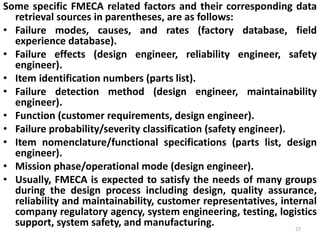
Some specific FMECA related factors and their corresponding data 
retrieval sources in parentheses, are as follows: 
• Failure modes, causes, and rates (factory database, field 
experience database). 
• Failure effects (design engineer, reliability engineer, safety 
engineer). 
• Item identification numbers (parts list). 
• Failure detection method (design engineer, maintainability 
engineer). 
• Function (customer requirements, design engineer). 
• Failure probability/severity classification (safety engineer). 
• Item nomenclature/functional specifications (parts list, design 
engineer). 
• Mission phase/operational mode (design engineer). 
• Usually, FMECA is expected to satisfy the needs of many groups 
during the design process including design, quality assurance, 
reliability and maintainability, customer representatives, internal 
company regulatory agency, system engineering, testing, logistics 
support, system safety, and manufacturing. 
27
4.7 FMEA IMPLEMENTATION RELATED FACTORS AND GENERAL GUIDELINES 
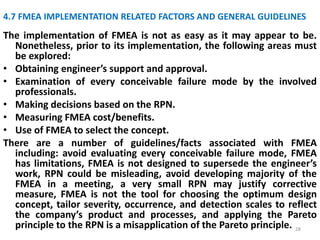
The implementation of FMEA is not as easy as it may appear to be. 
Nonetheless, prior to its implementation, the following areas must 
be explored: 
• Obtaining engineer’s support and approval. 
• Examination of every conceivable failure mode by the involved 
professionals. 
• Making decisions based on the RPN. 
• Measuring FMEA cost/benefits. 
• Use of FMEA to select the concept. 
There are a number of guidelines/facts associated with FMEA 
including: avoid evaluating every conceivable failure mode, FMEA 
has limitations, FMEA is not designed to supersede the engineer’s 
work, RPN could be misleading, avoid developing majority of the 
FMEA in a meeting, a very small RPN may justify corrective 
measure, FMEA is not the tool for choosing the optimum design 
concept, tailor severity, occurrence, and detection scales to reflect 
the company’s product and processes, and applying the Pareto 
principle to the RPN is a misapplication of the Pareto principle. 28
Advantages 
• Improve the quality, reliability and safety of a product/process. 
• Improve company image and competitiveness. 
• Increase user satisfaction. 
• Reduce system development time and cost. 
• Collect information to reduce future failures, capture engineering 
knowledge. 
• Reduce the potential for warranty concerns. 
• Early identification and elimination of potential failure modes. 
• Emphasize problem prevention. 
• Minimize late changes and associated cost. 
• Catalyst for teamwork and idea exchange between functions. 
• Reduce the possibility of same kind of failure in future. 
• Reduce impact on company profit margin. 
• Improve production yield. 
29
Uses of FMEA 
• Development of system requirements that minimize the 
likelihood of failures. 
• Development of methods to design and test systems to 
ensure that the failures have been eliminated. 
• Evaluation of the requirements of the customer to ensure 
that those do not give rise to potential failures. 
• Identification of certain design characteristics that 
contribute to failures, and minimize or eliminate those 
effects. 
• Tracking and managing potential risks in the design. This 
helps avoid the same failures in future projects. 
• Ensuring that any failure that could occur will not injure 
the customer or seriously impact a system. 
• To produce world class quality products. 
30
4.9 Review Questions 
1. Write a short essay on the history of FMEA. 
2. Define the following terms: Failure mode, Single point 
failure, Severity. 
3. Discuss design-level FMEA and its associated benefits. 
4. Describe the FMEA process. 
5. Discuss the elements of a typical critical items list 
worksheet. 
6. Describe the RPN method. 
7. Identify sources for obtaining data for the following 
factors: Item identification numbers, Failure effects and 
Failure probability/severity classification. 
8. List at least ten advantages of performing FMEA. 
9. What is the difference between FMEA and FMECA? 
10. Who are the users of FMEA/FMECA? 
31

Reliability engineering chapter-4 fmea

  • 1.
    Chapter-4 Failure Modesand Effect Analysis 1
  • 2.
    4.1 FAILURE MODESAND EFFECT ANALYSIS • Failure modes and effect analysis (FMEA) is a powerful design tool to analyze engineering systems and it may simply be described as an approach to perform analysis of each potential failure mode in the system to examine the results or effects of such failure modes on the system. When FMEA is extended to classify each potential failure effect according to its severity (this incorporates documenting catastrophic (an event causing great damage or suffering) and critical failures), the method is known as failure mode effects and criticality analysis (FMECA). • The history of FMEA goes back to the early 1950s with the development of flight control systems when the U.S. Navy’s Bureau of Aeronautics, in order to establish a mechanism for reliability control over the detail design effort, developed a requirement called “Failure Analysis”. 2
  • 3.
    Subsequently, J.S. Coutinho(1963-64) coined the term “Failure Effect Analysis” and the Bureau of Naval Weapons (i.e., successor to the Bureau of Aeronautics) introduced it into its new specification on flight controls. However, FMECA was developed by the National Aeronautics and Astronautics Administration (NASA) to assure the desired reliability of space systems. In the 1970s, the U.S. Department of Defense directed its effort to develop a military standard entitled “Procedures for Performing a Failure Mode, Effects, and Criticality Analysis”. Today FMEA/FMECA methods are widely used in the industry to conduct analysis of systems, particularly for use in aerospace, defense, and nuclear power generation. 4.2 TERMS AND DEFINITIONS There are many terms used in performing FMEA/FMECA and some of them are as follows: • Failure cause: The factors such as design defects, quality defects, physical or chemical processes, or part misapplication are the primary reason for failure or they start the physical process through which deterioration progresses to failure. 3
  • 4.
    • Failure mode:The notion or manner through which a failure is perceived. • Failure effect: The consequence or consequences a failure mode has on an item’s function, operation, or status. • Single failure point: An item’s malfunction that would lead to system failure and is not compensated through redundancy or through other operational mechanisms. • Criticality: A relative measure of a failure mode’s consequences and its occurrence frequency. • Severity: A failure mode’s consequences, taking into consideration the worst case scenario of a failure, determined by factors such as damage to property, the degree of injury, or ultimate system damage. • Corrective action: A change such as design, process, procedure, or materials implemented and validated to rectify failure cause/design deficiency. 4
  • 5.
    • Criticality analysis:An approach through which each possible failure mode is ranked with respect to the combined influence of occurrence probability and severity. • Undetectable failure: A postulated failure mode in the FMEA for which no failure detection approach is available through which the concerned operator can be alerted of the failure. • Local effect: The consequence or conseqences a failure mode has on the function, operation, or status of the item currently being analyzed. 4.3 TYPES OF FMEA AND THEIR ASSOCIATED BENEFITS • FMEA may be grouped under three distinct classifications as shown in Figure 4.1. These are design-level FMEA, system-level FMEA, and process-level FMEA. Each of these categories is described as follows: 5
  • 6.
    Figure 4.1 Typesof FMEA. 4.3.1 DESIGN-LEVEL FMEA The purpose of performing design-level FMEA is to help identify and stop product failures related to design. This type of FMEA can be carried out upon component level/subsystem-level/ system-level design proposal and its intention is to validate the design parameters chosen for a specified functional performance requirement. The advantages of performing design-level FMEA include identification of potential design-related failure modes at system/subsystem/component level, identification of important characteristics of a given design, documentation of the rationale for design changes to guide the development of future product designs, help in the design requirement objective evaluation and evaluation of design alternatives, systematic approach to reduce criticality and risk, accumulated data serve as a useful historical record of the thought processes and the actions taken during the product development effort, and a useful tool to establish priority for design improvement actions. 6
  • 7.
    4.3.2 SYSTEM-LEVEL FMEA • This is the highest-level FMEA that can be performed and its purpose is to identify and prevent failures related to system/subsystems during the early conceptual design. Furthermore, this type of FMEA is carried out to validate that the system design specifications reduce the risk of functional failure to the lowest level during the operational period. • Some benefits of the system-level FMEA are identification of potential systemic failure modes due to system interaction with other systems and/or by subsystem interactions, selection of the optimum system design alternative, identification of potential system design parameters that may incorporate deficiencies prior to releasing hardware/software to production, a systematic approach to identify all potential effects of subsystem/assembly part failure modes for incorporation into design-level FMEA, and a useful data bank of historical records of the thought processes as well as of actions taken during product development efforts. 7
  • 8.
    4.3.3 PROCESS-LEVEL FMEA This identifies and prevents failures related to the manufacturing/assembly process for a certain item. The benefits of the process-level FMEA include identification of potential process-level failure modes at system/subsystem/operation level, identification of important characteristics associated with the process, identification of potential process shortcomings early in the process planning cycle, development of priorities for process improvement actions, and documentation of rationale for process changes to help guide the establishment of potential manufacturing processes. 4.4 STEPS FOR PERFORMING FMEA FMEA can be performed in six steps as shown in Figure 4.2. • Define system and its associated requirements, • Establish ground rules, • Describe the system and its associated functional blocks, • Identify failure modes and their associated effects, • Prepare critical items list, • Document the analysis. 8
  • 9.
    4.4.1 DEFINE SYSTEMAND ITS ASSOCIATED REQUIREMENTS This is concerned with defining the system under consideration and the definition normally incorporates a breakdown of the system into blocks, block functions, and the interface between them. Usually this early in the program a good system definition does not exist and the analyst must develop his/her own system definition using documents such as trade study reports, drawings, and development plans and specifications. 9
  • 10.
    4.4.2 ESTABLISH GROUNDRULES These are established as to which the FMEA is conducted. Usually, developing the ground rules is a quite straightforward process when the system definition and mission requirements are reasonably complete. Nonetheless, examples of the ground rules include primary and secondary mission objectives statement, limits of environmental and operational stresses, statement of analysis level, delineation of mission phases, definition of what constitutes failure of system hardware parts, and the detail of the coding system used. 4.4.3 DESCRIBE THE SYSTEM AND ITS ASSOCIATED FUNCTIONAL BLOCKS This is concerned with the preparation of the description of the system under consideration. Such description may be grouped into two parts: (i) Narrative functional statement: This is prepared for each subsystem and component as well as for the total system. It provides narrative description of each item’s operation for each operational mode/mission phase. The degree of the description detail depends on factors such as an item’s application and the uniqueness of the functions performed. 10
  • 11.
    (ii) System blockdiagram: The purpose of this block diagram is to determine the success/failure relationships among all the system components; thus, it graphically shows total system components to be analyzed as well as the series and redundant relationships among the components. In addition, the block diagram shows the entire system’s inputs and outputs and each system element’s inputs and outputs. 4.4.4 IDENTIFY FAILURE MODES AND THEIR ASSOCIATED EFFECTS This is concerned with performing analysis of the failure modes and their effects. A form such as that shown in Figure 4.3 is used as a worksheet to assure systematic and thorough coverage of all failure modes. Even though all the terms used in that form are considered self-explanatory, the terms “Compensating provisions” and “Criticality classification” are described below. (a) Compensating provisions: These provisions, i.e., design provisions or operator actions, concerning circumventing or mitigating the failure effect should be identified and evaluated. (b) Criticality classification: This is concerned with the categorization of potential effect of failure. For example, • People may lose their lives due to a failure. • Failure may cause mission loss. • Failure may cause delay in activation. • Failure has no effect. 11
  • 12.
    Figure 4.3 Atypical FMEA worksheet. 12
  • 13.
    4.4.5 PREPARE CRITICALITEMS LIST The critical items list is prepared to facilitate communication of important analysis results to management. A typical critical items list worksheet is shown in Figure 4.4. 13 Figure 4.4 A critical items worksheet.
  • 14.
    4.4.6 DOCUMENT THEANALYSIS • This is the final step of the FMEA performing process and is concerned with the documentation of analysis. This step is at least as important as the other previous five steps because poor documentation can lead to ineffectiveness of the FMEA process. Nonetheless, the FMEA report incorporates items such as system definition, FMEA associated ground rules, failure modes and their effects, description of the system (i.e., including functional descriptions and block diagrams), and critical items list. 4.5 CRITICALITY ASSESSMENT The objective of the criticality assessment is to prioritize the failure modes discovered during the system analysis on the basis of their effects and occurrence likelihood. Thus, for making an assessment of the severity of an item failure, two commonly used methods are Risk Priority Number (RPN) Technique and Military Standard Technique. The former is widely used in the automotive industrial sector and the latter in defense, nuclear, and aerospace industries. Both approaches are described as follows. 14
  • 15.
    4.5.1 RPN TECHNIQUE This method calculates the risk priority number for a part failure mode using three factors: (1) failure effect severity, (2) failure mode occurrence probability, and (3) failure detection probability. More specifically, the risk priority number is computed by multiplying the rankings (i.e., 1-10) assigned to each of these three factors. Thus, mathematically the risk priority number is expressed by RPN =(DR)(OR)(SR) …(4.1) where: RPN is the risk priority number, DR is the detection ranking, OR is the occurrence ranking, and SR is the severity ranking. • Since the above three factors are assigned rankings from 1 to 10, the value of the RPN will vary from 1 to 1000. Failure modes with a high RPN are considered to be more critical; thus, they are given a higher priority in comparison to the ones with lower RPN. Nonetheless, rankings and their interpretation may vary from one organization to another. Tables 4.1 through 4.3 present rankings for failure detection, failure mode occurrence probability, and failure effect severity used in one organization, respectively. 15
  • 16.
    Table 4.1 Failuredetection ranking. Item No. Likelihood of detection Rank meaning Rank 1 Very high Potential design weakness will almost certainly be detected 1, 2 2 High There is a good chance of detecting potential design weakness 3, 4 3 Moderate There is a possibility of detecting potential design weakness 5, 6 4 Low Potential design weakness is unlikely to be detected 7, 8 5 Very low Potential design weakness probably will not be detected 9 6 Detectability absolutely uncertain Potential design weakness cannot be detected 10 Table 4.2 Failure mode occurrence probability. Item No. Ranking term Ranking term meaning Occurrence probability Rank 1 Remote Occurrence of failure is quite unlikely <1 in 106 1 2 Low Relatively few failures are expected 1 in 20,000 2 1 in 4,000 3 3 Moderate Occasional failures are expected 1 in 1,000 4 1 in 400 5 1 in 80 6 4 High Repeated failures will occur 1 in 40 7 1 in 20 8 5 Very high Occurrence of failure is almost inevitable 1 in 8 9 1 in 2 10 16
  • 17.
    Table 4.3 Severityof the failure-mode effect. Item No. Failure effect severity category Severity category description Rank 1 Minor No real effect on system performance and the customer may not even notice the failure 1 2 Low The occurrence of failure will only cause a slight customer annoyance 2, 3 3 Moderate Some customer dissatisfaction will be caused by failure 4, 5, 6 4 High High degree of customer dissatisfaction will be caused by failure but the failure itself does not involve safety or noncompliance with government rules and regulations 7, 8 5 Very high The failure affects safe item operation, involves noncompliance with government rules and regulations 9, 10 17
  • 18.
    4.5.2 MILITARY STANDARDTECHNIQUE • This technique is often used in defense, aerospace, and nuclear industries to prioritize the failure modes of the item under consideration so that appropriate corrective measures can be undertaken. The technique requires the categorization of the failure-mode effect severity and then the development of a “critical ranking”. • Table 4.4 presents classifications of failure mode effect severity. In order to assess the likelihood of a failure-mode occurrence, either a qualitative or a quantitative approach can be used. This is determined by the availability of specific parts configuration data and failure rate data. The qualitative method is used when there are no specific failure rate data. Thus, in this approach the individual occurrence probabilities are grouped into distinct logically defined levels, which establish the qualitative failure probabilities. Table 4.5 presents occurrence probability levels. For the purpose of identifying and comparing each failure mode to all other failure modes with respect to severity, a critical matrix is developed as shown in Figure 4.3. 18
  • 19.
    Table 4.4 Failuremode effect severity classifications. Item Classification No. term or name Classification description Classification No. 1 Catastrophic The occurrence of failure may result in death or equipment loss A 2 Critical The occurrence of failure may result in major property damage/severe injury/major system damage ultimately leading to mission loss B 3 Marginal The occurrence of failure may result in minor injury/minor property damage/minor system damage, etc. C 4 Minor The failure is not serious enough to lead to injury/system damage/property damage, but it will result in repair or unscheduled maintenance D 19
  • 20.
    Table 4.5 Qualitativefailure probability levels. Item Probability Term for Term description No. level the level 1 I Frequent High probability of occurrence during the item operational period 2 II Reasonably probable Moderate probability of occurrence during the item operational period 3 III Occasional Occasional probability of occurrence during the item operational period 4 IV Remote Unlikely probability of occurrence during the item operational period 5 V Extremely unlikely Essentially zero chance of occurrence during the item operational period 20
  • 21.
    • The criticalitymatrix is developed by inserting item/failure mode identification number values in matrix locations denoting the severity category classification and either the criticality number (Ki) for the failure modes of an item or the occurrence level probability. The distribution of criticality of item failure modes is depicted by the resulting matrix and the matrix serves as a useful tool for assigning corrective measure priorities. The direction of the arrow, originating from the origin, shown in Figure 4.5, indicates the increasing criticality of the item failure and the darkened region in the figure shows the approximate desirable design region. For severity classifications A and B, the desirable design region has low occurrence probability or criticality number. On the other hand, for severity classifications C and D failures, higher probabilities of occurrence can be tolerated. Nonetheless, failure modes belonging to classifications A and B should be eliminated altogether or at least their probabilities of occurrence be reduced to an acceptable level through design changes. The quantitative approach is used when failure mode and probability of occurrence data are available. Thus, the failure mode critical number is calculated using the following equation: Kfm=FθλT (4.2) 21
  • 22.
  • 23.
    where: Kfm isthe failure-mode criticality number. θ is the failure-mode ratio or the probability that the component/part fails in the particular failure mode of interest. More specifically, it is the fraction of the part failure rate that can be allocated to the failure mode under consideration and when all failure modes of an item under consideration are specified, the sum of the allocations equals unity. Table 4.6 presents failure mode apportionments for certain parts. F is the conditional probability that the failure effect results in the indicated severity classification or category, given that the failure mode occurs. The values of F are based on an analyst’s judgment and these values are quantified according to Table 4.7 guidelines. T is the item operational time expressed in hours or cycles. λ is the item/part failure rate. The item criticality number Ki is calculated for each severity class, separately. Thus, the total of the criticality numbers of all failure modes of an item resulting in failures in the severity class of interest is given by (6.3) as follows (where: n is the item failure modes that fall under the severity classification under consideration.) 23       K  k  FθλT i fm j n j 1 j n j 1
  • 24.
    Table 4.6 Failuremode apportionments for selective items. Item No. Item description Item important failure modes Approximate probability of occurrence (or probability value for (θ) 1 Relay • Contact failure, • Open coils 0.75, 0.05 2 Relief valve • Premature open, • Leaking 0.77, 0.23 3 Incandescen t lamp • Catastrophic (filament breakage, glass breakage) • Degradation (loss of filament emission) 0.10 0.90 4 Fixed resistor • Open, • Parameter change • Short 0.84, 0.11, 0.05 5 Transformer • Shorted turns, • Open circuit 0.80, 0.05 6 Diode • Short circuit, • Intermittent circuit • Open circuit, • Other 0.75, 0.18, 0.06, 0.01 7 Hydraulic valve • Stuck closed, • Stuck open • Leaking 0.12, 0.11, 0.77 24
  • 25.
    Table 4.7 Failureeffect probability guideline values. Item No. Failure effect description Probability value of F 1 No effect 0 2 Actual loss 1.0 3 Probable loss 0.10<F<1.00 4 Possible loss 0<F<0.10 25
  • 26.
    • It isto be noted that when item/part failure mode results in multiple severity class effects each with its own occurrence probability, then in the calculation of Ki only the most important is used. This can lead to erroneously low Ki values for the less critical severity categories. In order to rectify this error, it is recommended to compute F values for all severity categories associated with a failure mode and ultimately include only contributions of Ki for category B, C, and D failures. 4.6 FMECA INFORMATION NEEDS, DATA SOURCES, AND USERS • In order to perform effective FMECA, various types of information are needed. Design related information required for the FMECA includes system schematics, functional block diagrams, equipment/part drawings, design descriptions, relevant company/customer/commercial/military specifications, reliability data, field service data, effects of environment on item under consideration, configurations management data, operating specifications and limits, and interface specifications. 26
  • 27.
    Some specific FMECArelated factors and their corresponding data retrieval sources in parentheses, are as follows: • Failure modes, causes, and rates (factory database, field experience database). • Failure effects (design engineer, reliability engineer, safety engineer). • Item identification numbers (parts list). • Failure detection method (design engineer, maintainability engineer). • Function (customer requirements, design engineer). • Failure probability/severity classification (safety engineer). • Item nomenclature/functional specifications (parts list, design engineer). • Mission phase/operational mode (design engineer). • Usually, FMECA is expected to satisfy the needs of many groups during the design process including design, quality assurance, reliability and maintainability, customer representatives, internal company regulatory agency, system engineering, testing, logistics support, system safety, and manufacturing. 27
  • 28.
    4.7 FMEA IMPLEMENTATIONRELATED FACTORS AND GENERAL GUIDELINES The implementation of FMEA is not as easy as it may appear to be. Nonetheless, prior to its implementation, the following areas must be explored: • Obtaining engineer’s support and approval. • Examination of every conceivable failure mode by the involved professionals. • Making decisions based on the RPN. • Measuring FMEA cost/benefits. • Use of FMEA to select the concept. There are a number of guidelines/facts associated with FMEA including: avoid evaluating every conceivable failure mode, FMEA has limitations, FMEA is not designed to supersede the engineer’s work, RPN could be misleading, avoid developing majority of the FMEA in a meeting, a very small RPN may justify corrective measure, FMEA is not the tool for choosing the optimum design concept, tailor severity, occurrence, and detection scales to reflect the company’s product and processes, and applying the Pareto principle to the RPN is a misapplication of the Pareto principle. 28
  • 29.
    Advantages • Improvethe quality, reliability and safety of a product/process. • Improve company image and competitiveness. • Increase user satisfaction. • Reduce system development time and cost. • Collect information to reduce future failures, capture engineering knowledge. • Reduce the potential for warranty concerns. • Early identification and elimination of potential failure modes. • Emphasize problem prevention. • Minimize late changes and associated cost. • Catalyst for teamwork and idea exchange between functions. • Reduce the possibility of same kind of failure in future. • Reduce impact on company profit margin. • Improve production yield. 29
  • 30.
    Uses of FMEA • Development of system requirements that minimize the likelihood of failures. • Development of methods to design and test systems to ensure that the failures have been eliminated. • Evaluation of the requirements of the customer to ensure that those do not give rise to potential failures. • Identification of certain design characteristics that contribute to failures, and minimize or eliminate those effects. • Tracking and managing potential risks in the design. This helps avoid the same failures in future projects. • Ensuring that any failure that could occur will not injure the customer or seriously impact a system. • To produce world class quality products. 30
  • 31.
    4.9 Review Questions 1. Write a short essay on the history of FMEA. 2. Define the following terms: Failure mode, Single point failure, Severity. 3. Discuss design-level FMEA and its associated benefits. 4. Describe the FMEA process. 5. Discuss the elements of a typical critical items list worksheet. 6. Describe the RPN method. 7. Identify sources for obtaining data for the following factors: Item identification numbers, Failure effects and Failure probability/severity classification. 8. List at least ten advantages of performing FMEA. 9. What is the difference between FMEA and FMECA? 10. Who are the users of FMEA/FMECA? 31