Heat Conduction, Thermal
Resistance, Overall Heat Transfer
Coefficient, and Mass Transfer
An Overview
Presented by: Md. Helal Hossain
Department: Mechanical
Engineering, World University of
Bangladesh
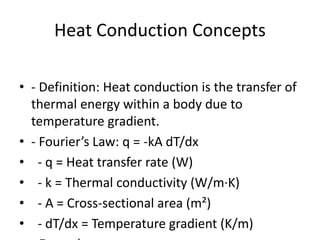
Heat Conduction Concepts
• - Definition: Heat conduction is the transfer of
thermal energy within a body due to
temperature gradient.
• - Fourier’s Law: q = -kA dT/dx
• - q = Heat transfer rate (W)
• - k = Thermal conductivity (W/m·K)
• - A = Cross-sectional area (m²)
• - dT/dx = Temperature gradient (K/m)
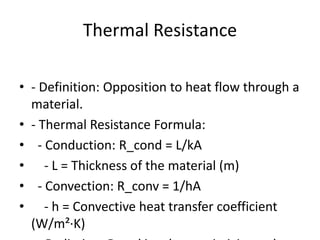
Thermal Resistance
• - Definition: Opposition to heat flow through a
material.
• - Thermal Resistance Formula:
• - Conduction: R_cond = L/kA
• - L = Thickness of the material (m)
• - Convection: R_conv = 1/hA
• - h = Convective heat transfer coefficient
(W/m²·K)
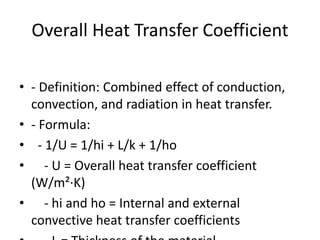
Overall Heat Transfer Coefficient
• - Definition: Combined effect of conduction,
convection, and radiation in heat transfer.
• - Formula:
• - 1/U = 1/hi + L/k + 1/ho
• - U = Overall heat transfer coefficient
(W/m²·K)
• - hi and ho = Internal and external
convective heat transfer coefficients
Mass Transfer
• - Definition: Movement of mass from one
location to another, often occurring in gases
or liquids.
• - Driving Forces: Concentration gradients,
pressure gradients, temperature gradients.
• - Modes of Mass Transfer:
• - Diffusion: Movement from high to low
concentration.
Applications and Examples
• - Heat Conduction:
• - Thermal insulation in buildings
• - Cooling of electronic devices
• - Thermal Resistance:
• - Design of thermal insulators
• - Heat sinks in electronics
• - Overall Heat Transfer Coefficient:
• - Designing efficient heat exchangers
Summary
• - Key Concepts:
• - Heat conduction is driven by temperature
gradients.
• - Thermal resistance is the opposition to heat
flow.
• - Overall heat transfer coefficient accounts
for combined modes of heat transfer.
• - Mass transfer involves movement due to
Q&A
• - Questions and Discussion
• - Encourage audience to ask questions and
discuss real-world applications.
• - Provide further explanations on complex
topics as needed.
References
• - Books and Articles:
• - Incropera, F.P., DeWitt, D.P., "Fundamentals
of Heat and Mass Transfer"
• - Cengel, Y.A., "Heat and Mass Transfer:
Fundamentals and Applications"
• - Relevant research papers and articles

3.Heat_Transfer_Presentation for WUB.pptx

  • 1.
    Heat Conduction, Thermal Resistance,Overall Heat Transfer Coefficient, and Mass Transfer An Overview Presented by: Md. Helal Hossain Department: Mechanical Engineering, World University of Bangladesh
  • 2.
    Heat Conduction Concepts •- Definition: Heat conduction is the transfer of thermal energy within a body due to temperature gradient. • - Fourier’s Law: q = -kA dT/dx • - q = Heat transfer rate (W) • - k = Thermal conductivity (W/m·K) • - A = Cross-sectional area (m²) • - dT/dx = Temperature gradient (K/m)
  • 3.
    Thermal Resistance • -Definition: Opposition to heat flow through a material. • - Thermal Resistance Formula: • - Conduction: R_cond = L/kA • - L = Thickness of the material (m) • - Convection: R_conv = 1/hA • - h = Convective heat transfer coefficient (W/m²·K)
  • 4.
    Overall Heat TransferCoefficient • - Definition: Combined effect of conduction, convection, and radiation in heat transfer. • - Formula: • - 1/U = 1/hi + L/k + 1/ho • - U = Overall heat transfer coefficient (W/m²·K) • - hi and ho = Internal and external convective heat transfer coefficients
  • 5.
    Mass Transfer • -Definition: Movement of mass from one location to another, often occurring in gases or liquids. • - Driving Forces: Concentration gradients, pressure gradients, temperature gradients. • - Modes of Mass Transfer: • - Diffusion: Movement from high to low concentration.
  • 6.
    Applications and Examples •- Heat Conduction: • - Thermal insulation in buildings • - Cooling of electronic devices • - Thermal Resistance: • - Design of thermal insulators • - Heat sinks in electronics • - Overall Heat Transfer Coefficient: • - Designing efficient heat exchangers
  • 7.
    Summary • - KeyConcepts: • - Heat conduction is driven by temperature gradients. • - Thermal resistance is the opposition to heat flow. • - Overall heat transfer coefficient accounts for combined modes of heat transfer. • - Mass transfer involves movement due to
  • 8.
    Q&A • - Questionsand Discussion • - Encourage audience to ask questions and discuss real-world applications. • - Provide further explanations on complex topics as needed.
  • 9.
    References • - Booksand Articles: • - Incropera, F.P., DeWitt, D.P., "Fundamentals of Heat and Mass Transfer" • - Cengel, Y.A., "Heat and Mass Transfer: Fundamentals and Applications" • - Relevant research papers and articles