


ENTROPY & LAW OF
INCREASE OF ENTROPY
        Khemendra Shukla
           MSc. II Semester
            Applied Physics
           B.B.A. University
                   Lucknow
Contents :

 Entropy : Statistical Interpretation

 Principle Of Entropy Increase.

 Equilibrium Conditions

  i) Thermal Equilibrium, ii) Mechanical
  Equilibrium iii)concentration Equilibrium

 Gibbs Paradox

                                           2
Entropy :

• Physically Entropy of a system is a measure of
  disorder of its molecular motion.

• Greater is disorder of molecular motion greater is the
  entropy.

• The connection between statistical mechanics is
  provided by entropy.

• Natural processes tend to move toward a state
  of greater disorder.

                                                       3
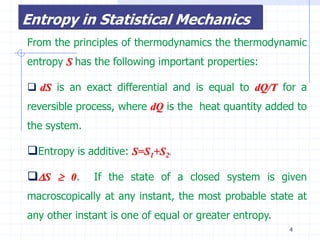
Entropy in Statistical Mechanics
From the principles of thermodynamics the thermodynamic
entropy S has the following important properties:

 dS is an exact differential and is equal to dQ/T for a
reversible process, where dQ is the heat quantity added to
the system.

Entropy is additive: S=S1+S2.

S  0.      If the state of a closed system is given
macroscopically at any instant, the most probable state at
any other instant is one of equal or greater entropy.
                                                        4
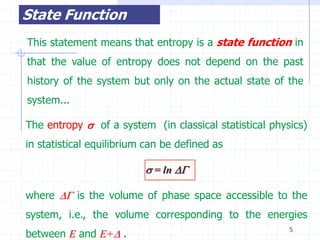
State Function
This statement means that entropy is a state function in
that the value of entropy does not depend on the past
history of the system but only on the actual state of the
system...

The entropy  of a system (in classical statistical physics)
in statistical equilibrium can be defined as

                           = ln 

where  is the volume of phase space accessible to the
system, i.e., the volume corresponding to the energies
                                                        5
between E and E+ .
Change in entropy
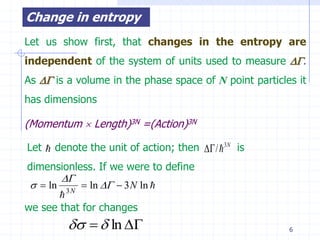
Let us show first, that changes in the entropy are
independent of the system of units used to measure .
As  is a volume in the phase space of N point particles it
has dimensions

(Momentum  Length)3N =(Action)3N

Let  denote the unit of action; then  /  3N is
dimensionless. If we were to define
        
   ln 3 N  ln   3 N ln 
       
we see that for changes
            ln                                    6
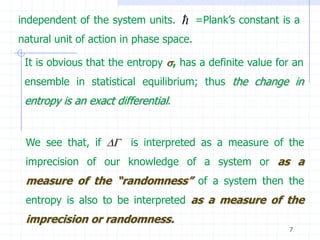
independent of the system units.        =Plank’s constant is a
natural unit of action in phase space.

 It is obvious that the entropy , has a definite value for an
 ensemble in statistical equilibrium; thus the change in
 entropy is an exact differential.


 We see that, if      is interpreted as a measure of the
 imprecision of our knowledge of a system or as a
 measure of the “randomness” of a system then the
 entropy is also to be interpreted as a measure of the
 imprecision or randomness.
                                                            7
Entropy is an additive
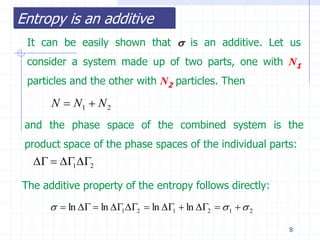
 It can be easily shown that  is an additive. Let us
 consider a system made up of two parts, one with N1
 particles and the other with N2 particles. Then

      N  N1  N 2
 and the phase space of the combined system is the
 product space of the phase spaces of the individual parts:
    12

The additive property of the entropy follows directly:
        ln   ln 12  ln 1  ln 2   1   2

                                                            8
Principle Of Entropy Increase
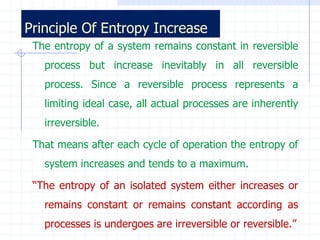
 The entropy of a system remains constant in reversible
   process but increase inevitably in all reversible
   process. Since a reversible process represents a
   limiting ideal case, all actual processes are inherently
   irreversible.

 That means after each cycle of operation the entropy of
   system increases and tends to a maximum.

 “The entropy of an isolated system either increases or
   remains constant or remains constant according as
   processes is undergoes are irreversible or reversible.”
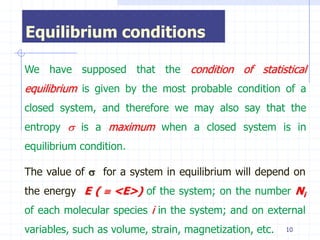
Equilibrium conditions

We have supposed that the condition of statistical
equilibrium is given by the most probable condition of a
closed system, and therefore we may also say that the
entropy  is a maximum when a closed system is in
equilibrium condition.

The value of  for a system in equilibrium will depend on
the energy E (  <E>) of the system; on the number Ni
of each molecular species i in the system; and on external
variables, such as volume, strain, magnetization, etc.   10
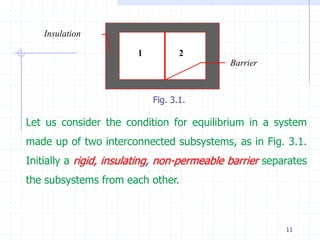
Insulation

                        1          2
                                             Barrier


                            Fig. 3.1.

Let us consider the condition for equilibrium in a system
made up of two interconnected subsystems, as in Fig. 3.1.
Initially a rigid, insulating, non-permeable barrier separates
the subsystems from each other.


                                                         11
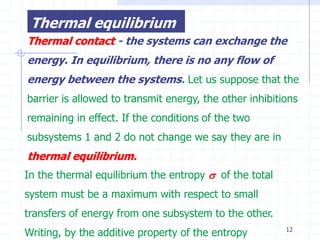
Thermal equilibrium
Thermal contact - the systems can exchange the
energy. In equilibrium, there is no any flow of
energy between the systems. Let us suppose that the
barrier is allowed to transmit energy, the other inhibitions
remaining in effect. If the conditions of the two
subsystems 1 and 2 do not change we say they are in
thermal equilibrium.
In the thermal equilibrium the entropy  of the total
system must be a maximum with respect to small
transfers of energy from one subsystem to the other.
Writing, by the additive property of the entropy         12
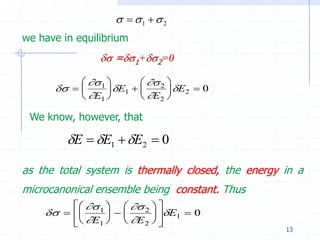
  1   2
we have in equilibrium
                 =1+2=0

             1          2 
               E1         E2  0
            E1          E2 

 We know, however, that

         E  E1  E2  0

as the total system is thermally closed, the energy in a
microcanonical ensemble being constant. Thus
           1    2  
                   E1  0
          E1   E2  
                                                    13
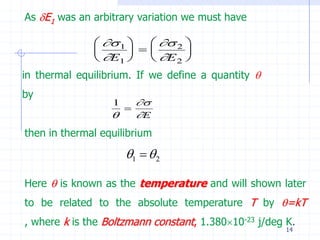
As E1 was an arbitrary variation we must have

                1     2 
                           
               E1     E 2 
in thermal equilibrium. If we define a quantity 
by
                  1       
                      
                         E
then in thermal equilibrium

                      1   2

Here  is known as the temperature and will shown later
to be related to the absolute temperature T by =kT
, where k is the Boltzmann constant, 1.38010-23 j/deg K.
                                                       14
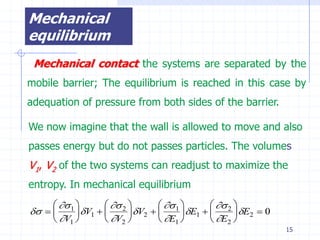
Mechanical
equilibrium
 Mechanical contact the systems are separated by the
mobile barrier; The equilibrium is reached in this case by
adequation of pressure from both sides of the barrier.

We now imagine that the wall is allowed to move and also
passes energy but do not passes particles. The volumes
V1, V2 of the two systems can readjust to maximize the
entropy. In mechanical equilibrium
       1          2          1          2 
         V1         V2         E1         E2  0
      V1          V2          E1          E2 
                                                                     15
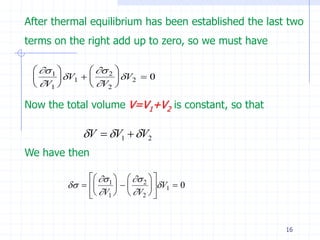
After thermal equilibrium has been established the last two
terms on the right add up to zero, so we must have

   1          2 
        V1         V2  0
  V1          V2 

Now the total volume V=V1+V2 is constant, so that

             V  V1  V2
We have then

                1    2  
                        V1  0
               V1   V2  


                                                       16
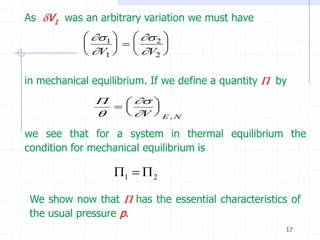
As V1 was an arbitrary variation we must have
              1     2 
                         
             V1     V2 

in mechanical equilibrium. If we define a quantity  by
                  
                    
                 V  E , N

we see that for a system in thermal equilibrium the
condition for mechanical equilibrium is

                  1   2

 We show now that  has the essential characteristics of
 the usual pressure p.
                                                      17
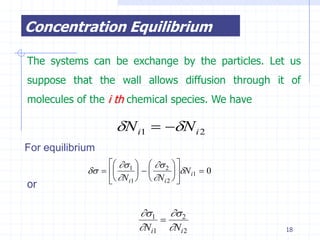
Concentration Equilibrium

The systems can be exchange by the particles. Let us
suppose that the wall allows diffusion through it of
molecules of the i th chemical species. We have

                     N i1  N i 2
For equilibrium
                    1    2  
                               N i1  0
or                 N i1   N i 2  


                            1  2
                                
                            Ni1 Ni 2               18
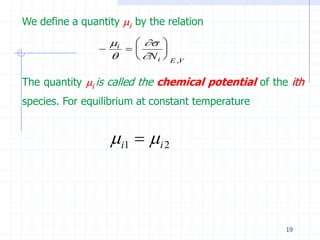
We define a quantity i by the relation
                  i    
                          
                      N i  E ,V

The quantity i is called the chemical potential of the ith
species. For equilibrium at constant temperature


                   i1   i 2


                                                       19
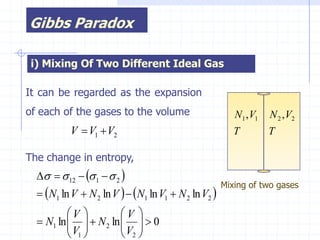
Gibbs Paradox

 i) Mixing Of Two Different Ideal Gas

It can be regarded as the expansion
of each of the gases to the volume                       N1 , V1   N 2 , V2
           V  V1  V2                                   T         T

The change in entropy,
     12   1   2 
                                                      Mixing of two gases
   N1 ln V  N 2 ln V   N1 ln V1  N 2 ln V2 
          V          V 
   N1 ln    N 2 ln    0
          V          V 
           1          2
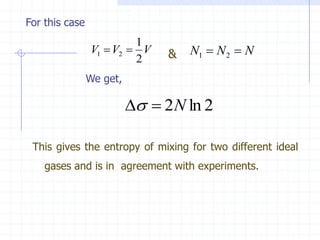
For this case
                         1
                V1  V2  V    &   N1  N 2  N
                         2
                We get,

                            2N ln 2

 This gives the entropy of mixing for two different ideal
    gases and is in agreement with experiments.
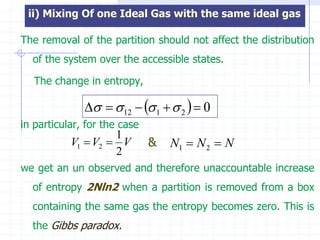
ii) Mixing Of one Ideal Gas with the same ideal gas

The removal of the partition should not affect the distribution
  of the system over the accessible states.

   The change in entropy,

                 12   1   2   0
in particular, for the case
                    1
           V1  V2  V        &   N1  N 2  N
                    2
we get an un observed and therefore unaccountable increase
  of entropy 2Nln2 when a partition is removed from a box
  containing the same gas the entropy becomes zero. This is
  the Gibbs paradox.
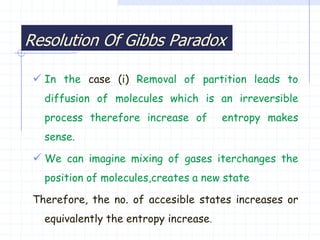
Resolution Of Gibbs Paradox

  In the case (i) Removal of partition leads to
   diffusion of molecules which is an irreversible
   process therefore increase of        entropy makes
   sense.

  We can imagine mixing of gases iterchanges the
   position of molecules,creates a new state

 Therefore, the no. of accesible states increases or
   equivalently the entropy increase.
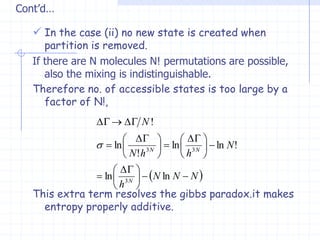
Cont’d…

    In the case (ii) no new state is created when
      partition is removed.
   If there are N molecules N! permutations are possible,
      also the mixing is indistinguishable.
   Therefore no. of accessible states is too large by a
      factor of N!,
                   N !
                                       
                 ln        3N 
                                     ln  3 N   ln N !
                        N !h           h 
                       
                 ln  3 N    N ln N  N 
                     h 
   This extra term resolves the gibbs paradox.it makes
     entropy properly additive.
Entropy : statistical approach

Entropy : statistical approach

  • 1.
    ENTROPY & LAWOF INCREASE OF ENTROPY Khemendra Shukla MSc. II Semester Applied Physics B.B.A. University Lucknow
  • 2.
    Contents :  Entropy: Statistical Interpretation  Principle Of Entropy Increase.  Equilibrium Conditions i) Thermal Equilibrium, ii) Mechanical Equilibrium iii)concentration Equilibrium  Gibbs Paradox 2
  • 3.
    Entropy : • PhysicallyEntropy of a system is a measure of disorder of its molecular motion. • Greater is disorder of molecular motion greater is the entropy. • The connection between statistical mechanics is provided by entropy. • Natural processes tend to move toward a state of greater disorder. 3
  • 4.
    Entropy in StatisticalMechanics From the principles of thermodynamics the thermodynamic entropy S has the following important properties:  dS is an exact differential and is equal to dQ/T for a reversible process, where dQ is the heat quantity added to the system. Entropy is additive: S=S1+S2. S  0. If the state of a closed system is given macroscopically at any instant, the most probable state at any other instant is one of equal or greater entropy. 4
  • 5.
    State Function This statementmeans that entropy is a state function in that the value of entropy does not depend on the past history of the system but only on the actual state of the system... The entropy  of a system (in classical statistical physics) in statistical equilibrium can be defined as  = ln  where  is the volume of phase space accessible to the system, i.e., the volume corresponding to the energies 5 between E and E+ .
  • 6.
    Change in entropy Letus show first, that changes in the entropy are independent of the system of units used to measure . As  is a volume in the phase space of N point particles it has dimensions (Momentum  Length)3N =(Action)3N Let  denote the unit of action; then  /  3N is dimensionless. If we were to define    ln 3 N  ln   3 N ln   we see that for changes    ln  6
  • 7.
    independent of thesystem units.  =Plank’s constant is a natural unit of action in phase space. It is obvious that the entropy , has a definite value for an ensemble in statistical equilibrium; thus the change in entropy is an exact differential. We see that, if  is interpreted as a measure of the imprecision of our knowledge of a system or as a measure of the “randomness” of a system then the entropy is also to be interpreted as a measure of the imprecision or randomness. 7
  • 8.
    Entropy is anadditive It can be easily shown that  is an additive. Let us consider a system made up of two parts, one with N1 particles and the other with N2 particles. Then N  N1  N 2 and the phase space of the combined system is the product space of the phase spaces of the individual parts:   12 The additive property of the entropy follows directly:   ln   ln 12  ln 1  ln 2   1   2 8
  • 9.
    Principle Of EntropyIncrease The entropy of a system remains constant in reversible process but increase inevitably in all reversible process. Since a reversible process represents a limiting ideal case, all actual processes are inherently irreversible. That means after each cycle of operation the entropy of system increases and tends to a maximum. “The entropy of an isolated system either increases or remains constant or remains constant according as processes is undergoes are irreversible or reversible.”
  • 10.
    Equilibrium conditions We havesupposed that the condition of statistical equilibrium is given by the most probable condition of a closed system, and therefore we may also say that the entropy  is a maximum when a closed system is in equilibrium condition. The value of  for a system in equilibrium will depend on the energy E (  <E>) of the system; on the number Ni of each molecular species i in the system; and on external variables, such as volume, strain, magnetization, etc. 10
  • 11.
    Insulation 1 2 Barrier Fig. 3.1. Let us consider the condition for equilibrium in a system made up of two interconnected subsystems, as in Fig. 3.1. Initially a rigid, insulating, non-permeable barrier separates the subsystems from each other. 11
  • 12.
    Thermal equilibrium Thermal contact- the systems can exchange the energy. In equilibrium, there is no any flow of energy between the systems. Let us suppose that the barrier is allowed to transmit energy, the other inhibitions remaining in effect. If the conditions of the two subsystems 1 and 2 do not change we say they are in thermal equilibrium. In the thermal equilibrium the entropy  of the total system must be a maximum with respect to small transfers of energy from one subsystem to the other. Writing, by the additive property of the entropy 12
  • 13.
      1  2 we have in equilibrium  =1+2=0   1    2      E1    E2  0  E1   E2  We know, however, that E  E1  E2  0 as the total system is thermally closed, the energy in a microcanonical ensemble being constant. Thus   1    2         E1  0  E1   E2   13
  • 14.
    As E1 wasan arbitrary variation we must have   1    2       E1   E 2  in thermal equilibrium. If we define a quantity  by 1    E then in thermal equilibrium 1   2 Here  is known as the temperature and will shown later to be related to the absolute temperature T by =kT , where k is the Boltzmann constant, 1.38010-23 j/deg K. 14
  • 15.
    Mechanical equilibrium Mechanical contactthe systems are separated by the mobile barrier; The equilibrium is reached in this case by adequation of pressure from both sides of the barrier. We now imagine that the wall is allowed to move and also passes energy but do not passes particles. The volumes V1, V2 of the two systems can readjust to maximize the entropy. In mechanical equilibrium   1    2    1    2      V1    V2    E1    E2  0  V1   V2   E1   E2  15
  • 16.
    After thermal equilibriumhas been established the last two terms on the right add up to zero, so we must have   1    2    V1    V2  0  V1   V2  Now the total volume V=V1+V2 is constant, so that V  V1  V2 We have then   1    2         V1  0  V1   V2   16
  • 17.
    As V1 wasan arbitrary variation we must have   1    2       V1   V2  in mechanical equilibrium. If we define a quantity  by         V  E , N we see that for a system in thermal equilibrium the condition for mechanical equilibrium is 1   2 We show now that  has the essential characteristics of the usual pressure p. 17
  • 18.
    Concentration Equilibrium The systemscan be exchange by the particles. Let us suppose that the wall allows diffusion through it of molecules of the i th chemical species. We have N i1  N i 2 For equilibrium   1    2         N i1  0 or  N i1   N i 2   1  2  Ni1 Ni 2 18
  • 19.
    We define aquantity i by the relation i         N i  E ,V The quantity i is called the chemical potential of the ith species. For equilibrium at constant temperature  i1   i 2 19
  • 20.
    Gibbs Paradox i)Mixing Of Two Different Ideal Gas It can be regarded as the expansion of each of the gases to the volume N1 , V1 N 2 , V2 V  V1  V2 T T The change in entropy,    12   1   2  Mixing of two gases  N1 ln V  N 2 ln V   N1 ln V1  N 2 ln V2  V  V   N1 ln    N 2 ln    0 V  V   1  2
  • 21.
    For this case 1 V1  V2  V & N1  N 2  N 2 We get,   2N ln 2 This gives the entropy of mixing for two different ideal gases and is in agreement with experiments.
  • 22.
    ii) Mixing Ofone Ideal Gas with the same ideal gas The removal of the partition should not affect the distribution of the system over the accessible states. The change in entropy,    12   1   2   0 in particular, for the case 1 V1  V2  V & N1  N 2  N 2 we get an un observed and therefore unaccountable increase of entropy 2Nln2 when a partition is removed from a box containing the same gas the entropy becomes zero. This is the Gibbs paradox.
  • 23.
    Resolution Of GibbsParadox  In the case (i) Removal of partition leads to diffusion of molecules which is an irreversible process therefore increase of entropy makes sense.  We can imagine mixing of gases iterchanges the position of molecules,creates a new state Therefore, the no. of accesible states increases or equivalently the entropy increase.
  • 24.
    Cont’d…  In the case (ii) no new state is created when partition is removed. If there are N molecules N! permutations are possible, also the mixing is indistinguishable. Therefore no. of accessible states is too large by a factor of N!,    N !         ln  3N   ln  3 N   ln N !  N !h  h      ln  3 N    N ln N  N  h  This extra term resolves the gibbs paradox.it makes entropy properly additive.

Editor's Notes

  • #9 Extensive property of entropy