Prepared by: Cherrylyn T. Magano, LPT
Objectives:
At the end of this lesson, the students should be able to:
1. Define power;
2. Identify the nature, types, and consequences of power;
3. Explain the nature, dimensions, types, and consequences of
power; and
4. Explain how power is exercised in different situations.
A Glimpse Back
Answer the following:
1. What political ideology in your society(or in general) do you like most?
2. In one sentence, describe that ideology.
3. Why do you like this certain ideology?
4. What political ideology (or in general) do you like?
5. Why do you not like this certain ideology? What aspect of this ideology
do you dislike?
Test Your Stock Knowledge
Determine the situations where there is a clear use of power as
defined in political science. Check those statements that present a
clear use of power and put an X mark on those that do not present
a clear use of power.
____1. Your mother asks you to buy flour in the bakery.
____2. Agnes tries to escape a building on fire by breaking the
windows using her ukulele.
____3. The teacher asks the class to return immediately the
classroom globe to its proper scale.
• Power is the capability to control and influence
people’s behavior as well as the capability to direct
the paths and result of events (Oxford University
Press, 2015)
• It can be perceived as good or bad, just or unjust,
and its exercise is accepted and acknowledged since
the beginning of time.
• Power may be expressed as Upward, where the
leader or superior influences the members or
subordinates; or it may be expressed as Downward,
where the members or subordinates influence the
decisions of their leader or superior (Bukowski and
Rajagopalan, 2000)
POWER MAY BE USED THROUGH:
1. INFLUENCE -the power to change or affect someone or
something;
-the power to cause changes without directly forcing them
to happen; and
-a person or thing that affects someone or something in an
important way.
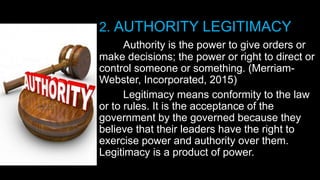
2. AUTHORITY LEGITIMACY
Authority is the power to give orders or
make decisions; the power or right to direct or
control someone or something. (Merriam-
Webster, Incorporated, 2015)
Legitimacy means conformity to the law
or to rules. It is the acceptance of the
government by the governed because they
believe that their leaders have the right to
exercise power and authority over them.
Legitimacy is a product of power.
2. SOVEREIGNTY
Sovereignty is the highest
exercise of political power; it is the
supreme (and possibly unlimited
power) and ultimate authority that
cannot be overruled by a higher
power.
Sovereignty is exercised by
government (Waluchow, 2014)
Dimensions of Power
1. ONE-DIMENSIONAL VIEW OF POWER
-the issue method.
- focuses only on behavior in decision making
which are apparent in observable situations like in
making decisions on issues over which there are
conflicting interests of the parties involved.
- Often, these can be observed through political
participation and action.
2. TWO-DIMENSIONAL VIEW OF POWER
-Setting the agenda.
-A person or group has power when that
person or group consciously or unconsciously
creates or reinforces barriers to the public
airing of policy conflict.
-Determining the agenda is an important
source of power
3. THREE-DIMENSIONAL VIEW OF POWER
-manipulating the view of others.
-It is the set of ways in which the powerful
transforms the powerless in such a way that
the latter behaves as the former wishes, even
without coerced.
-This is what Lukes termed as “power of
domination.”
TYPES OF POWER
REWARD POWER
Persons who are in power are able to give out
rewards.
Often, these rewards are in the form of
promotions, added benefits, salary increase,
training opportunities, or compliments.
This form of power is based on the thought that
people are more inclined to do things well when
they are getting something in return.
COERCIVE POWER
This form of power is based upon the idea of
compulsion, which means that someone is forced
to do something against their will.
Coercion is applied when the boss (for example)
wants his/her employee to comply
This form of power leads to problems because
this is often abused. Moreover, it can lead to
unhealthy behavior and dissatisfaction at work.
LEGITIMATE POWER
This power gives the elected, selected, or appointed
position of authority the ability to administer to other
people a certain feeling of obligation or notion of
responsibility.
Leaders can reward or punish their subordinates
based on their actions.
Disadvantage: Whenever the leaders lose their title,
they also lose their power to persuade or influence their
subordinates.
INFORMATIONAL POWER
Power that comes from access to and control over
information.
Information is a form of influence and social power by
providing information to a person resulting them to think
and act in different way.
Individual Power
EXPERT POWER
Influence based on special skills or knowledge.
Referent Power influenced based on possession
by an individual of desirable resources or
personal traits.
The fact is that, if someone has particular
expertise within an organization, they can often
persuade employees, who trust and respect them,
to do things for them.
REFERENT POWER
Leaders in this form of power are often seen as
role models and their power is often treated with
admiration or charm.
They are highly liked and people identify strongly
with them in some way
Analysis Guide
1. How will you use different types of power to affect the behaviour of other people.
(e.g., your classmates or group mates during debates , group projects, school
program)?
2. Power can corrupt an individual. How can a person avoid being corrupted by
power or abuse of power given to him/her?
3. Explain the quotation by Lord Acton “ Power tends to corrupt and absolute power
absolutely”
4. Explain the quotation by William Gaddis “ Power doesn’t corrupt people, people
corrupt power”
5. 5. Explain the quotation from Eric Hoffer “ The only way to predict the future is to
have the power to shape the future”

Lesson 3.-power

  • 1.
    Prepared by: CherrylynT. Magano, LPT
  • 2.
    Objectives: At the endof this lesson, the students should be able to: 1. Define power; 2. Identify the nature, types, and consequences of power; 3. Explain the nature, dimensions, types, and consequences of power; and 4. Explain how power is exercised in different situations.
  • 3.
    A Glimpse Back Answerthe following: 1. What political ideology in your society(or in general) do you like most? 2. In one sentence, describe that ideology. 3. Why do you like this certain ideology? 4. What political ideology (or in general) do you like? 5. Why do you not like this certain ideology? What aspect of this ideology do you dislike?
  • 4.
    Test Your StockKnowledge Determine the situations where there is a clear use of power as defined in political science. Check those statements that present a clear use of power and put an X mark on those that do not present a clear use of power. ____1. Your mother asks you to buy flour in the bakery. ____2. Agnes tries to escape a building on fire by breaking the windows using her ukulele. ____3. The teacher asks the class to return immediately the classroom globe to its proper scale.
  • 5.
    • Power isthe capability to control and influence people’s behavior as well as the capability to direct the paths and result of events (Oxford University Press, 2015) • It can be perceived as good or bad, just or unjust, and its exercise is accepted and acknowledged since the beginning of time. • Power may be expressed as Upward, where the leader or superior influences the members or subordinates; or it may be expressed as Downward, where the members or subordinates influence the decisions of their leader or superior (Bukowski and Rajagopalan, 2000)
  • 6.
    POWER MAY BEUSED THROUGH: 1. INFLUENCE -the power to change or affect someone or something; -the power to cause changes without directly forcing them to happen; and -a person or thing that affects someone or something in an important way.
  • 7.
    2. AUTHORITY LEGITIMACY Authorityis the power to give orders or make decisions; the power or right to direct or control someone or something. (Merriam- Webster, Incorporated, 2015) Legitimacy means conformity to the law or to rules. It is the acceptance of the government by the governed because they believe that their leaders have the right to exercise power and authority over them. Legitimacy is a product of power.
  • 8.
    2. SOVEREIGNTY Sovereignty isthe highest exercise of political power; it is the supreme (and possibly unlimited power) and ultimate authority that cannot be overruled by a higher power. Sovereignty is exercised by government (Waluchow, 2014)
  • 9.
  • 10.
    1. ONE-DIMENSIONAL VIEWOF POWER -the issue method. - focuses only on behavior in decision making which are apparent in observable situations like in making decisions on issues over which there are conflicting interests of the parties involved. - Often, these can be observed through political participation and action.
  • 11.
    2. TWO-DIMENSIONAL VIEWOF POWER -Setting the agenda. -A person or group has power when that person or group consciously or unconsciously creates or reinforces barriers to the public airing of policy conflict. -Determining the agenda is an important source of power
  • 12.
    3. THREE-DIMENSIONAL VIEWOF POWER -manipulating the view of others. -It is the set of ways in which the powerful transforms the powerless in such a way that the latter behaves as the former wishes, even without coerced. -This is what Lukes termed as “power of domination.”
  • 13.
  • 14.
    REWARD POWER Persons whoare in power are able to give out rewards. Often, these rewards are in the form of promotions, added benefits, salary increase, training opportunities, or compliments. This form of power is based on the thought that people are more inclined to do things well when they are getting something in return.
  • 15.
    COERCIVE POWER This formof power is based upon the idea of compulsion, which means that someone is forced to do something against their will. Coercion is applied when the boss (for example) wants his/her employee to comply This form of power leads to problems because this is often abused. Moreover, it can lead to unhealthy behavior and dissatisfaction at work.
  • 16.
    LEGITIMATE POWER This powergives the elected, selected, or appointed position of authority the ability to administer to other people a certain feeling of obligation or notion of responsibility. Leaders can reward or punish their subordinates based on their actions. Disadvantage: Whenever the leaders lose their title, they also lose their power to persuade or influence their subordinates.
  • 17.
    INFORMATIONAL POWER Power thatcomes from access to and control over information. Information is a form of influence and social power by providing information to a person resulting them to think and act in different way.
  • 18.
  • 19.
    EXPERT POWER Influence basedon special skills or knowledge. Referent Power influenced based on possession by an individual of desirable resources or personal traits. The fact is that, if someone has particular expertise within an organization, they can often persuade employees, who trust and respect them, to do things for them.
  • 20.
    REFERENT POWER Leaders inthis form of power are often seen as role models and their power is often treated with admiration or charm. They are highly liked and people identify strongly with them in some way
  • 21.
    Analysis Guide 1. Howwill you use different types of power to affect the behaviour of other people. (e.g., your classmates or group mates during debates , group projects, school program)? 2. Power can corrupt an individual. How can a person avoid being corrupted by power or abuse of power given to him/her? 3. Explain the quotation by Lord Acton “ Power tends to corrupt and absolute power absolutely” 4. Explain the quotation by William Gaddis “ Power doesn’t corrupt people, people corrupt power” 5. 5. Explain the quotation from Eric Hoffer “ The only way to predict the future is to have the power to shape the future”