Theme 1
Politics and Governance
01
Theme 1 Section A:
DEMOCRACY, STATE AND SOVEREIGNTY
01
A1
Introduction to
Global Citizenship
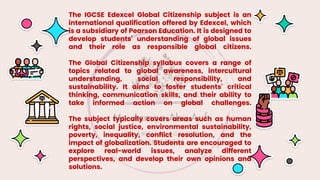
The IGCSE Edexcel Global Citizenship subject is an
international qualification offered by Edexcel, which
is a subsidiary of Pearson Education. It is designed to
develop students' understanding of global issues
and their role as responsible global citizens.
The Global Citizenship syllabus covers a range of
topics related to global awareness, intercultural
understanding, social responsibility, and
sustainability. It aims to foster students' critical
thinking, communication skills, and their ability to
take informed action on global challenges.
The subject typically covers areas such as human
rights, social justice, environmental sustainability,
poverty, inequality, conflict resolution, and the
impact of globalization. Students are encouraged to
explore real-world issues, analyze different
perspectives, and develop their own opinions and
solutions.
Starter
2 min task
What values and traits
might someone need to
be a good global citizen?
Try to list 4!
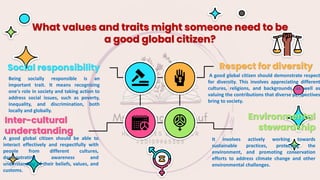
Environmental
stewardship
It involves actively working towards
sustainable practices, protecting the
environment, and promoting conservation
efforts to address climate change and other
environmental challenges.
Inter-cultural
understanding
A good global citizen should be able to
interact effectively and respectfully with
people from different cultures,
demonstrating awareness and
understanding of their beliefs, values, and
customs.
Respect for diversity
A good global citizen should demonstrate respect
for diversity. This involves appreciating different
cultures, religions, and backgrounds, as well as
valuing the contributions that diverse perspectives
bring to society.
Social responsibility
Being socially responsible is an
important trait. It means recognizing
one's role in society and taking action to
address social issues, such as poverty,
inequality, and discrimination, both
locally and globally.
What values and traits might someone need to be
a good global citizen?
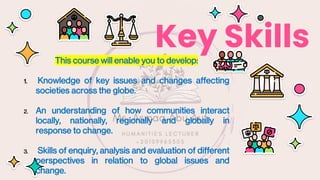
Key Skills
This course will enable you to develop:
1. Knowledge of key issues and changes affecting
societies across the globe.
2. An understanding of how communities interact
locally, nationally, regionally and globally in
response to change.
3. Skills of enquiry, analysis and evaluation of different
perspectives in relation to global issues and
change.
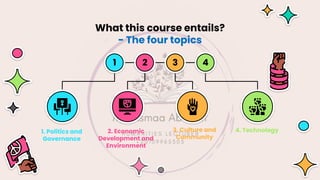
What this course entails?
- The four topics
1. Politics and
Governance
2. Economic
Development and
Environment
3. Culture and
Community
4. Technology
1 2 3 4
After learning the 4 themes we
should be able to identify global
issues around the world and we
as a group get to pick one, we
would like to start an extended
project on. Including research,
reports, campaigning, fundraising
all for a global cause.
+ 5. Citizen and
Community Project .
Are there any global issues
that you can think of that
effects everybody?
2min to think!!
Are there any global issues
that you can think of that
effects everybody?
1. Water Scarcity .
2. Use of nonrenewable energies.
3. Slavery.
4. Climate Change.
5. Pollution – plastic, air, water.
6. Access to education (war and poverty).
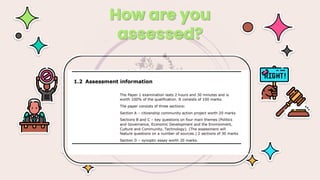
How are you
assessed?
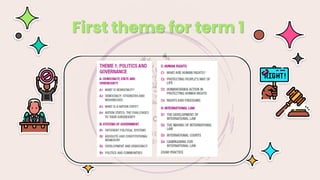
First theme for term 1
A2
Democracy,
What is it?
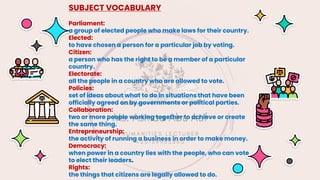
SUBJECT VOCABULARY
Parliament:
a group of elected people who make laws for their country.
Elected:
to have chosen a person for a particular job by voting.
Citizen:
a person who has the right to be a member of a particular
country.
Electorate:
all the people in a country who are allowed to vote.
Policies:
set of ideas about what to do in situations that have been
officially agreed on by governments or political parties.
Collaboration:
two or more people working together to achieve or create
the same thing.
Entrepreneurship:
the activity of running a business in order to make money.
Democracy:
when power in a country lies with the people, who can vote
to elect their leaders.
Rights:
the things that citizens are legally allowed to do.
Keywords
Members of the UK Parliament (MPs):
Successful candidates who represent their
constituency in Parliament
Candidate:
A person who asks people to vote for him/her as their
representative.
Political Party:
A group of people with similar ideas who campaign
together to win elections.
Constituency:
An area of the country with around 60,000 voters.
Each of the UK constituencies elects one
representative to Parliament.
THE WORLD’S MODEL OF DEMOCRACY
Norway is known as a democratic country. Its parliament is elected every four years
and has 169 members. All citizens over 18 are automatically registered to vote. Voting is
not compulsory, but nearly 80% of the electorate usually vote. In the UK, this figure is less
than 70%, and in the USA, it is often below 60% of the electorate vote.
In Norway, there are several political parties who compete for people’s votes. However,
the parties are not focused on getting power for themselves, but instead work together
to create policies that help the Norwegian people. This collaboration gives the people
more power in the running of their country.
The population of Norway is almost 5.5 million, compared with almost 68 million in the
UK. It is a rich country because it uses the profits from its offshore oil to help the
country’s finances. There is more financial equality in Norway than in most other
countries due to a strong welfare state, higher taxes and entrepreneurship.
Norwegians feel a part of democracy because their voices are heard. They think of
politicians as ordinary people who earn fair salaries and care about what happens to
the country.
1. Who can vote in Norway?
2. What percentage of the
electorate usually votes?
3. Discuss why you think Norway
is a good model of
democracy.
4. compared to other countries.
What unique features does it
have?
Recall Quiz
THE ORIGINS OF DEMOCRACY
A democratic country gives power to the people. Democracies come in many
forms around the world, as people in some countries have more power than
others.
The word ‘democracy’ first appeared in Ancient Greece around 500 BCE.
However, there is some evidence from pre-history that suggests that groups
of
people who lived and worked together made decisions together.
In Athens in Ancient Greece, citizens could vote on decisions in public
meetings. However, only a limited number of people were classed as full
citizens with voting rights. The electorate was made up of only men over the
age of 18. Women, slaves, foreign nationals and children were all excluded.
Direct
Democracy
SUBJECT VOCABULARY
Direct democracy:
All citizens vote directly on every decision about the
running of the country.
Referendum:
A vote by all citizens on a specific topic.
Issues:
Topics or problems that people are thinking and talking about.
Legally-binding:
An agreement, contract, decision etc. that the law
says must be obeyed.
Government:
The group of people who officially control a country.
Election:
The process in which citizens vote to choose a person to
represent them in managing the country.
Ballot:
A system or occasion of secret voting.
Representative democracy:
Citizens vote for people to represent them in making decisions
about the running of the country.
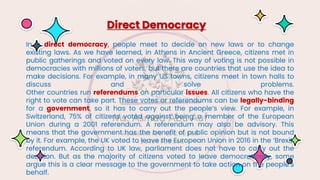
In a direct democracy, people meet to decide on new laws or to change
existing laws. As we have learned, in Athens in Ancient Greece, citizens met in
public gatherings and voted on every law. This way of voting is not possible in
democracies with millions of voters, but there are countries that use the idea to
make decisions. For example, in many US towns, citizens meet in town halls to
discuss and solve problems.
Other countries run referendums on particular issues. All citizens who have the
right to vote can take part. These votes or referendums can be legally-binding
for a government, so it has to carry out the people’s view. For example, in
Switzerland, 75% of citizens voted against being a member of the European
Union during a 2001 referendum. A referendum may also be advisory. This
means that the government has the benefit of public opinion but is not bound
by it. For example, the UK voted to leave the European Union in 2016 in the ‘Brexit’
referendum. According to UK law, parliament does not have to carry out the
decision. But as the majority of citizens voted to leave democratically, some
argue this is a clear message to the government to take action on the people’s
behalf.
Direct Democracy
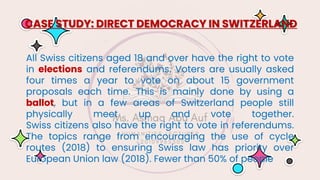
All Swiss citizens aged 18 and over have the right to vote
in elections and referendums. Voters are usually asked
four times a year to vote on about 15 government
proposals each time. This is mainly done by using a
ballot, but in a few areas of Switzerland people still
physically meet up and vote together.
Swiss citizens also have the right to vote in referendums.
The topics range from encouraging the use of cycle
routes (2018) to ensuring Swiss law has priority over
European Union law (2018). Fewer than 50% of people
CASE STUDY: DIRECT DEMOCRACY IN SWITZERLAND
Take down 3 bullet
points from the video
Democracy
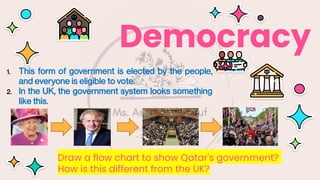
1. This form of government is elected by the people,
and everyone is eligible to vote.
2. In the UK, the government system looks something
like this.
Draw a flow chart to show Qatar's government?
How is this different from the UK?
• Where does the word Democracy
come from?
• When did it first start?
• Name some of the key principles.
• How does a democracy represent its
citizens?
Plenary: What have
you learnt?
Plenary: What have
you learnt?
• Where does the word Democracy
come from?
The word "Democracy" originated from
ancient Greece. It comes from the
Greek words "demos" meaning "people"
and "kratos" meaning "rule" or "power,"
thus signifying "rule by the people."
Plenary: What have
you learnt?
• When did it first start?
Democracy first started in ancient
Athens, Greece around the 5th century
BCE. This form of government allowed
eligible citizens to participate in
decision-making and had elements of
direct democracy.
Plenary: What have
you learnt?
• Name some of the key principles.
Political equality: All citizens have an
equal opportunity to participate in the
political process, express their views, and
have their voices heard.
Rule of law: The principle that all
individuals, including those in power, are
subject to and must abide by the law. This
ensures fairness, accountability, and
protection of individual rights.
Plenary: What have
you learnt?
• Name some of the key principles.
Human rights: Democracy upholds the protection of
fundamental human rights, such as freedom of speech,
assembly, and expression.
Popular sovereignty: The power and authority of the
government are derived from the consent and will of the
people.
Pluralism: Democracy embraces and respects diverse
opinions, values, and interests, allowing for a range of
perspectives to be represented and considered.
Plenary: What have
you learnt?
• How does a democracy represent its citizens?
Elections: Citizens have the opportunity to elect their
representatives through free and fair elections. These
representatives then make decisions on behalf of the
citizens.
Political parties: Political parties provide platforms for
citizens to participate in the political process and
compete for government positions. They represent
different ideologies and policy proposals.
Plenary: What have
you learnt?
• How does a democracy represent its citizens?
Public participation: Democracies encourage citizen
engagement and participation through mechanisms
such as public consultations, referendums, and town hall
meetings. These allow citizens to express their opinions
and influence decision-making processes.
Freedom of expression: Democracies protect freedom of
speech and the media, allowing citizens to voice their
opinions, criticize the government, and contribute to
public debates.
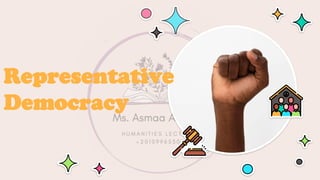
Representative
Democracy
To differentiate between a
representative and a
direct democracy.
Learner Objective
1. Who is the Head of the UK?
2. What is the name of the
Prime Minister in the UK?
3. Name 2 values of a global
citizen?
4. Name 1 Global Issue that
affects everybody?
Recall Quiz
The Romans believed that direct democracy was not effective
because of the large numbers of people involved in the decision-
making process. Therefore, they decided that fewer people with
more knowledge on how to govern would work better. This led to
representative democracy, where many people vote for a smaller
number of people to represent them. These elected
representatives then make decisions for an entire group, such as a
country. If the people do not like the decisions made by their
representatives, the representatives can be voted out at the next
election.
Many countries use this system. The UK, India, the USA, Australia
and much of the European Union are all representative
democracies.
Representative Democracy
1. What is democracy?
2. What is the difference between
direct and representative
democracy?
3. How do the European countries of
Norway and Switzerland promote
the key features of democracy?
4. Do you think that direct
democracy would work well in all
countries? Explain your answer.
Recall Quiz
‘Direct democracy is much more
effective than representative
democracy.’
Do you agree with this statement?
Give reasons for your opinion, showing
that you have considered different
points of view.
Discussion
Representative
and Direct
Democracy
What is Representative
Democracy?
Representative democracies now use elections to choose those men
and women who will represent all citizens.
Representatives in the UK Parliament are known as Members of
Parliament (MPs.) They are elected by those UK citizens who have the
right to vote.
At first most candidates were popular or important people in their
communities. As populations grew and communications improved,
candidates with similar views formed political parties.
This made it easier for voters to decide who to vote for. Voters may
not have met the parliamentary candidates standing for election in
their constituency, but they can decide which political party they
prefer and vote for the candidate representing that party.
A system of decision-making in which all electors have the right to
vote on the most important issues.
A form of government in which policies and laws are decided by a
majority of all those eligible rather than by a body of elected
representatives.
What is Direct Democracy?
5 min to think and write your answers.
What is the difference between
a representative and a direct
democracy?
Representative Democracy: In a representative democracy, also
known as an indirect democracy, citizens elect representatives who
make decisions on their behalf. These elected officials, such as
members of parliament or congress, represent the interests and
viewpoints of the citizens in the decision-making process. The
representatives are responsible for enacting laws, formulating
policies, and representing the concerns of their constituents. The
citizens exercise their democratic rights through voting in elections to
choose their representatives.
What is the difference between
a representative and a direct
democracy?
Direct Democracy: In a direct democracy, individuals participate
directly in decision-making processes and policy formulation. This
form of democracy allows citizens to have a direct say in the
governance and legislation of the country. In a direct democracy,
citizens are actively involved in voting on laws, policies, and other
important matters. This can be done through referendums, public
assemblies, or town hall meetings. Direct democracies aim to involve
as many citizens as possible in decision-making and prioritize the
participation and engagement of the people.
What is the difference between
a representative and a direct
democracy?
In summary, the key difference between representative democracy
and direct democracy lies in the level of citizen involvement in
decision-making processes. Representative democracy relies on
elected officials who act on behalf of the citizens, while direct
democracy involves direct participation of citizens in making
decisions.
What is the difference between
a representative and a direct
democracy?
. To establish the different
forms of Democracy and
to understand the
strengths and
weaknesses
Learner Objective
1. What is a constituency?
2. What does the terms Demos
and Kratos mean?
3. What year did democracy
start?
Recall Quiz
Democracy:
Strengths and
weaknesses
SUBJECT VOCABULARY
Bill:
suggestion for a new law. Bills are discussed before being
voted on and either passed into law or rejected.
Sovereignty:
to have supreme power or authority.
Justice system:
a system of laws to judge people accused of crimes in
court.
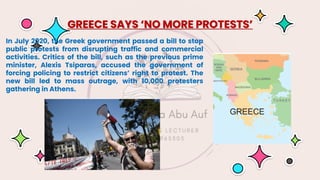
In July 2020, the Greek government passed a bill to stop
public protests from disrupting traffic and commercial
activities. Critics of the bill, such as the previous prime
minister, Alexis Tsiparas, accused the government of
forcing policing to restrict citizens’ right to protest. The
new bill led to mass outrage, with 10,000 protesters
gathering in Athens.
GREECE SAYS ‘NO MORE PROTESTS’
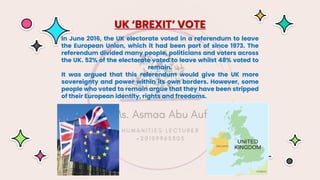
In June 2016, the UK electorate voted in a referendum to leave
the European Union, which it had been part of since 1973. The
referendum divided many people, politicians and voters across
the UK. 52% of the electorate voted to leave whilst 48% voted to
remain.
It was argued that this referendum would give the UK more
sovereignty and power within its own borders. However, some
people who voted to remain argue that they have been stripped
of their European identity, rights and freedoms.
UK ‘BREXIT’ VOTE
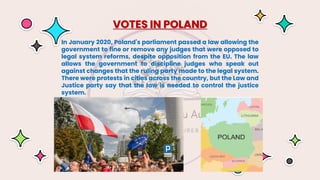
In January 2020, Poland's parliament passed a law allowing the
government to fine or remove any judges that were opposed to
legal system reforms, despite opposition from the EU. The law
allows the government to discipline judges who speak out
against changes that the ruling party made to the legal system.
There were protests in cities across the country, but the Law and
Justice party say that the law is needed to control the justice
system.
VOTES IN POLAND
Comparing these examples from Greece, the
UK and Poland, answer the following
questions.
1. To what extent do a government’s actions impact
on citizens’ rights?
2. What impacts do minorities face when the
majority always wins? Are minority views always
taken into account during law-making?
3. Do you think democracy is always effective?
Why/Why not? ‘Direct democracy is much more
effective than representative democracy.’
Discussion
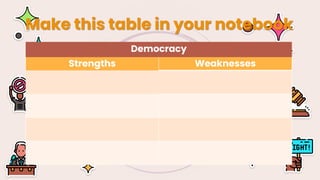
Strengths Weaknesses
Make this table in your notebook
Democracy
Organize these boxes into your
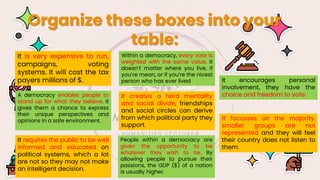
table:
It is very expensive to run,
campaigns, voting
systems. It will cost the tax
payers millions of $.
A democracy enables people to
stand up for what they believe. It
gives them a chance to express
their unique perspectives and
opinions in a safe environment.
It requires the public to be well
informed and educated on
political systems, which a lot
are not so they may not make
an intelligent decision.
Within a democracy, every vote is
weighted with the same value. It
doesn’t matter where you live, if
you’re mean, or if you’re the nicest
person who has ever lived
It creates a herd mentality
and social divide, friendships
and social circles can derive
from which political party they
support.
People within a democracy are
given the opportunity to be
whatever they wish to be. By
allowing people to pursue their
passions, the GDP ($) of a nation
is usually higher.
It encourages personal
involvement, they have the
choice and freedom to vote.
It focusses on the majority,
smaller groups are not
represented and they will feel
their country does not listen to
them.
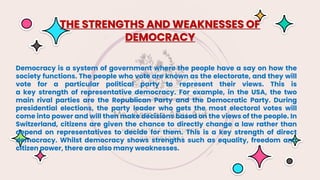
Democracy is a system of government where the people have a say on how the
society functions. The people who vote are known as the electorate, and they will
vote for a particular political party to represent their views. This is
a key strength of representative democracy. For example, in the USA, the two
main rival parties are the Republican Party and the Democratic Party. During
presidential elections, the party leader who gets the most electoral votes will
come into power and will then make decisions based on the views of the people. In
Switzerland, citizens are given the chance to directly change a law rather than
depend on representatives to decide for them. This is a key strength of direct
democracy. Whilst democracy shows strengths such as equality, freedom and
citizen power, there are also many weaknesses.
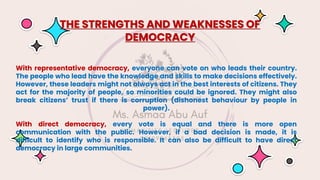
THE STRENGTHS AND WEAKNESSES OF
DEMOCRACY
THE STRENGTHS AND WEAKNESSES OF
DEMOCRACY
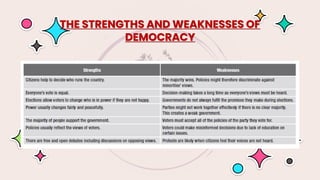
With representative democracy, everyone can vote on who leads their country.
The people who lead have the knowledge and skills to make decisions effectively.
However, these leaders might not always act in the best interests of citizens. They
act for the majority of people, so minorities could be ignored. They might also
break citizens’ trust if there is corruption (dishonest behaviour by people in
power).
With direct democracy, every vote is equal and there is more open
communication with the public. However, if a bad decision is made, it is
difficult to identify who is responsible. It can also be difficult to have direct
democracy in large communities.
THE STRENGTHS AND WEAKNESSES OF
DEMOCRACY
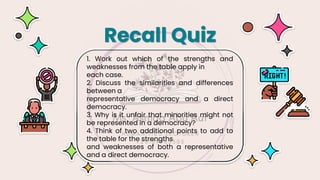
1. Work out which of the strengths and
weaknesses from the table apply in
each case.
2. Discuss the similarities and differences
between a
representative democracy and a direct
democracy.
3. Why is it unfair that minorities might not
be represented in a democracy?
4. Think of two additional points to add to
the table for the strengths
and weaknesses of both a representative
and a direct democracy.
Recall Quiz
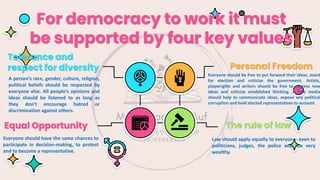
The rule of law
Law should apply equally to everyone- even to
politicians, judges, the police and the very
wealthy.
Equal Opportunity
Everyone should have the same chances to
participate in decision-making, to protest
and to become a representative.
Personal Freedom
Everyone should be free to put forward their ideas, stand
for election and criticize the government. Artists,
playwrights and writers should be free to express new
ideas and criticize established thinking. A free media
should help to communicate ideas, expose any political
corruption and hold elected representatives to account.
Tolerance and
respect for diversity
A person’s race, gender, culture, religion,
political beliefs should be respected by
everyone else. All people’s opinions and
ideas should be listened to as long as
they don’t encourage hatred or
discrimination against others.
For democracy to work it must
be supported by four key values
‘The disadvantages of
democracy are so great we
should avoid using it.’
How far do you agree with this statement?
Give reasons for your opinion, showing you
have considered different points of view.
Discussion
• Note down 3 things you have
learned today.
• Note down your questions.
What have you
learned today?
Our class material and HW files
are going to be sent today on
Google Classroom.
Remember: They are not for
sharing.
Have a nice day.
See you in the next session.

IGCSE - Global Citizenship - Democracy.pdf

  • 2.
    Theme 1 Politics andGovernance 01
  • 3.
    Theme 1 SectionA: DEMOCRACY, STATE AND SOVEREIGNTY 01
  • 4.
  • 5.
    The IGCSE EdexcelGlobal Citizenship subject is an international qualification offered by Edexcel, which is a subsidiary of Pearson Education. It is designed to develop students' understanding of global issues and their role as responsible global citizens. The Global Citizenship syllabus covers a range of topics related to global awareness, intercultural understanding, social responsibility, and sustainability. It aims to foster students' critical thinking, communication skills, and their ability to take informed action on global challenges. The subject typically covers areas such as human rights, social justice, environmental sustainability, poverty, inequality, conflict resolution, and the impact of globalization. Students are encouraged to explore real-world issues, analyze different perspectives, and develop their own opinions and solutions.
  • 6.
    Starter 2 min task Whatvalues and traits might someone need to be a good global citizen? Try to list 4!
  • 7.
    Environmental stewardship It involves activelyworking towards sustainable practices, protecting the environment, and promoting conservation efforts to address climate change and other environmental challenges. Inter-cultural understanding A good global citizen should be able to interact effectively and respectfully with people from different cultures, demonstrating awareness and understanding of their beliefs, values, and customs. Respect for diversity A good global citizen should demonstrate respect for diversity. This involves appreciating different cultures, religions, and backgrounds, as well as valuing the contributions that diverse perspectives bring to society. Social responsibility Being socially responsible is an important trait. It means recognizing one's role in society and taking action to address social issues, such as poverty, inequality, and discrimination, both locally and globally. What values and traits might someone need to be a good global citizen?

  • 8.
    Key Skills This coursewill enable you to develop: 1. Knowledge of key issues and changes affecting societies across the globe. 2. An understanding of how communities interact locally, nationally, regionally and globally in response to change. 3. Skills of enquiry, analysis and evaluation of different perspectives in relation to global issues and change.
  • 9.
    What this courseentails? - The four topics 1. Politics and Governance 2. Economic Development and Environment 3. Culture and Community 4. Technology 1 2 3 4
  • 10.
    After learning the4 themes we should be able to identify global issues around the world and we as a group get to pick one, we would like to start an extended project on. Including research, reports, campaigning, fundraising all for a global cause. + 5. Citizen and Community Project .
  • 11.
    Are there anyglobal issues that you can think of that effects everybody? 2min to think!!
  • 12.
    Are there anyglobal issues that you can think of that effects everybody? 1. Water Scarcity . 2. Use of nonrenewable energies. 3. Slavery. 4. Climate Change. 5. Pollution – plastic, air, water. 6. Access to education (war and poverty).
  • 13.
  • 14.
  • 15.
  • 16.
    SUBJECT VOCABULARY Parliament: a groupof elected people who make laws for their country. Elected: to have chosen a person for a particular job by voting. Citizen: a person who has the right to be a member of a particular country. Electorate: all the people in a country who are allowed to vote. Policies: set of ideas about what to do in situations that have been officially agreed on by governments or political parties. Collaboration: two or more people working together to achieve or create the same thing. Entrepreneurship: the activity of running a business in order to make money. Democracy: when power in a country lies with the people, who can vote to elect their leaders. Rights: the things that citizens are legally allowed to do.
  • 17.
    Keywords Members of theUK Parliament (MPs): Successful candidates who represent their constituency in Parliament Candidate: A person who asks people to vote for him/her as their representative. Political Party: A group of people with similar ideas who campaign together to win elections. Constituency: An area of the country with around 60,000 voters. Each of the UK constituencies elects one representative to Parliament.
  • 18.
    THE WORLD’S MODELOF DEMOCRACY Norway is known as a democratic country. Its parliament is elected every four years and has 169 members. All citizens over 18 are automatically registered to vote. Voting is not compulsory, but nearly 80% of the electorate usually vote. In the UK, this figure is less than 70%, and in the USA, it is often below 60% of the electorate vote. In Norway, there are several political parties who compete for people’s votes. However, the parties are not focused on getting power for themselves, but instead work together to create policies that help the Norwegian people. This collaboration gives the people more power in the running of their country. The population of Norway is almost 5.5 million, compared with almost 68 million in the UK. It is a rich country because it uses the profits from its offshore oil to help the country’s finances. There is more financial equality in Norway than in most other countries due to a strong welfare state, higher taxes and entrepreneurship. Norwegians feel a part of democracy because their voices are heard. They think of politicians as ordinary people who earn fair salaries and care about what happens to the country.
  • 19.
    1. Who canvote in Norway? 2. What percentage of the electorate usually votes? 3. Discuss why you think Norway is a good model of democracy. 4. compared to other countries. What unique features does it have? Recall Quiz
  • 20.
    THE ORIGINS OFDEMOCRACY A democratic country gives power to the people. Democracies come in many forms around the world, as people in some countries have more power than others. The word ‘democracy’ first appeared in Ancient Greece around 500 BCE. However, there is some evidence from pre-history that suggests that groups of people who lived and worked together made decisions together. In Athens in Ancient Greece, citizens could vote on decisions in public meetings. However, only a limited number of people were classed as full citizens with voting rights. The electorate was made up of only men over the age of 18. Women, slaves, foreign nationals and children were all excluded.
  • 21.
  • 22.
    SUBJECT VOCABULARY Direct democracy: Allcitizens vote directly on every decision about the running of the country. Referendum: A vote by all citizens on a specific topic. Issues: Topics or problems that people are thinking and talking about. Legally-binding: An agreement, contract, decision etc. that the law says must be obeyed. Government: The group of people who officially control a country. Election: The process in which citizens vote to choose a person to represent them in managing the country. Ballot: A system or occasion of secret voting. Representative democracy: Citizens vote for people to represent them in making decisions about the running of the country.
  • 23.
    In a directdemocracy, people meet to decide on new laws or to change existing laws. As we have learned, in Athens in Ancient Greece, citizens met in public gatherings and voted on every law. This way of voting is not possible in democracies with millions of voters, but there are countries that use the idea to make decisions. For example, in many US towns, citizens meet in town halls to discuss and solve problems. Other countries run referendums on particular issues. All citizens who have the right to vote can take part. These votes or referendums can be legally-binding for a government, so it has to carry out the people’s view. For example, in Switzerland, 75% of citizens voted against being a member of the European Union during a 2001 referendum. A referendum may also be advisory. This means that the government has the benefit of public opinion but is not bound by it. For example, the UK voted to leave the European Union in 2016 in the ‘Brexit’ referendum. According to UK law, parliament does not have to carry out the decision. But as the majority of citizens voted to leave democratically, some argue this is a clear message to the government to take action on the people’s behalf. Direct Democracy
  • 24.
    All Swiss citizensaged 18 and over have the right to vote in elections and referendums. Voters are usually asked four times a year to vote on about 15 government proposals each time. This is mainly done by using a ballot, but in a few areas of Switzerland people still physically meet up and vote together. Swiss citizens also have the right to vote in referendums. The topics range from encouraging the use of cycle routes (2018) to ensuring Swiss law has priority over European Union law (2018). Fewer than 50% of people CASE STUDY: DIRECT DEMOCRACY IN SWITZERLAND
  • 25.
    Take down 3bullet points from the video
  • 26.
    Democracy 1. This formof government is elected by the people, and everyone is eligible to vote. 2. In the UK, the government system looks something like this. Draw a flow chart to show Qatar's government? How is this different from the UK?
  • 27.
    • Where doesthe word Democracy come from? • When did it first start? • Name some of the key principles. • How does a democracy represent its citizens? Plenary: What have you learnt?
  • 28.
    Plenary: What have youlearnt? • Where does the word Democracy come from? The word "Democracy" originated from ancient Greece. It comes from the Greek words "demos" meaning "people" and "kratos" meaning "rule" or "power," thus signifying "rule by the people."
  • 29.
    Plenary: What have youlearnt? • When did it first start? Democracy first started in ancient Athens, Greece around the 5th century BCE. This form of government allowed eligible citizens to participate in decision-making and had elements of direct democracy.
  • 30.
    Plenary: What have youlearnt? • Name some of the key principles. Political equality: All citizens have an equal opportunity to participate in the political process, express their views, and have their voices heard. Rule of law: The principle that all individuals, including those in power, are subject to and must abide by the law. This ensures fairness, accountability, and protection of individual rights.
  • 31.
    Plenary: What have youlearnt? • Name some of the key principles. Human rights: Democracy upholds the protection of fundamental human rights, such as freedom of speech, assembly, and expression. Popular sovereignty: The power and authority of the government are derived from the consent and will of the people. Pluralism: Democracy embraces and respects diverse opinions, values, and interests, allowing for a range of perspectives to be represented and considered.
  • 32.
    Plenary: What have youlearnt? • How does a democracy represent its citizens? Elections: Citizens have the opportunity to elect their representatives through free and fair elections. These representatives then make decisions on behalf of the citizens. Political parties: Political parties provide platforms for citizens to participate in the political process and compete for government positions. They represent different ideologies and policy proposals.
  • 33.
    Plenary: What have youlearnt? • How does a democracy represent its citizens? Public participation: Democracies encourage citizen engagement and participation through mechanisms such as public consultations, referendums, and town hall meetings. These allow citizens to express their opinions and influence decision-making processes. Freedom of expression: Democracies protect freedom of speech and the media, allowing citizens to voice their opinions, criticize the government, and contribute to public debates.
  • 34.
  • 35.
    To differentiate betweena representative and a direct democracy. Learner Objective
  • 36.
    1. Who isthe Head of the UK? 2. What is the name of the Prime Minister in the UK? 3. Name 2 values of a global citizen? 4. Name 1 Global Issue that affects everybody? Recall Quiz
  • 37.
    The Romans believedthat direct democracy was not effective because of the large numbers of people involved in the decision- making process. Therefore, they decided that fewer people with more knowledge on how to govern would work better. This led to representative democracy, where many people vote for a smaller number of people to represent them. These elected representatives then make decisions for an entire group, such as a country. If the people do not like the decisions made by their representatives, the representatives can be voted out at the next election. Many countries use this system. The UK, India, the USA, Australia and much of the European Union are all representative democracies. Representative Democracy
  • 38.
    1. What isdemocracy? 2. What is the difference between direct and representative democracy? 3. How do the European countries of Norway and Switzerland promote the key features of democracy? 4. Do you think that direct democracy would work well in all countries? Explain your answer. Recall Quiz
  • 39.
    ‘Direct democracy ismuch more effective than representative democracy.’ Do you agree with this statement? Give reasons for your opinion, showing that you have considered different points of view. Discussion
  • 40.
  • 41.
    What is Representative Democracy? Representativedemocracies now use elections to choose those men and women who will represent all citizens. Representatives in the UK Parliament are known as Members of Parliament (MPs.) They are elected by those UK citizens who have the right to vote. At first most candidates were popular or important people in their communities. As populations grew and communications improved, candidates with similar views formed political parties. This made it easier for voters to decide who to vote for. Voters may not have met the parliamentary candidates standing for election in their constituency, but they can decide which political party they prefer and vote for the candidate representing that party.
  • 42.
    A system ofdecision-making in which all electors have the right to vote on the most important issues. A form of government in which policies and laws are decided by a majority of all those eligible rather than by a body of elected representatives. What is Direct Democracy?
  • 43.
    5 min tothink and write your answers. What is the difference between a representative and a direct democracy?
  • 44.
    Representative Democracy: Ina representative democracy, also known as an indirect democracy, citizens elect representatives who make decisions on their behalf. These elected officials, such as members of parliament or congress, represent the interests and viewpoints of the citizens in the decision-making process. The representatives are responsible for enacting laws, formulating policies, and representing the concerns of their constituents. The citizens exercise their democratic rights through voting in elections to choose their representatives. What is the difference between a representative and a direct democracy?
  • 45.
    Direct Democracy: Ina direct democracy, individuals participate directly in decision-making processes and policy formulation. This form of democracy allows citizens to have a direct say in the governance and legislation of the country. In a direct democracy, citizens are actively involved in voting on laws, policies, and other important matters. This can be done through referendums, public assemblies, or town hall meetings. Direct democracies aim to involve as many citizens as possible in decision-making and prioritize the participation and engagement of the people. What is the difference between a representative and a direct democracy?
  • 46.
    In summary, thekey difference between representative democracy and direct democracy lies in the level of citizen involvement in decision-making processes. Representative democracy relies on elected officials who act on behalf of the citizens, while direct democracy involves direct participation of citizens in making decisions. What is the difference between a representative and a direct democracy?
  • 47.
    . To establishthe different forms of Democracy and to understand the strengths and weaknesses Learner Objective
  • 48.
    1. What isa constituency? 2. What does the terms Demos and Kratos mean? 3. What year did democracy start? Recall Quiz
  • 49.
  • 50.
    SUBJECT VOCABULARY Bill: suggestion fora new law. Bills are discussed before being voted on and either passed into law or rejected. Sovereignty: to have supreme power or authority. Justice system: a system of laws to judge people accused of crimes in court.
  • 51.
    In July 2020,the Greek government passed a bill to stop public protests from disrupting traffic and commercial activities. Critics of the bill, such as the previous prime minister, Alexis Tsiparas, accused the government of forcing policing to restrict citizens’ right to protest. The new bill led to mass outrage, with 10,000 protesters gathering in Athens. GREECE SAYS ‘NO MORE PROTESTS’
  • 52.
    In June 2016,the UK electorate voted in a referendum to leave the European Union, which it had been part of since 1973. The referendum divided many people, politicians and voters across the UK. 52% of the electorate voted to leave whilst 48% voted to remain. It was argued that this referendum would give the UK more sovereignty and power within its own borders. However, some people who voted to remain argue that they have been stripped of their European identity, rights and freedoms. UK ‘BREXIT’ VOTE
  • 53.
    In January 2020,Poland's parliament passed a law allowing the government to fine or remove any judges that were opposed to legal system reforms, despite opposition from the EU. The law allows the government to discipline judges who speak out against changes that the ruling party made to the legal system. There were protests in cities across the country, but the Law and Justice party say that the law is needed to control the justice system. VOTES IN POLAND
  • 54.
    Comparing these examplesfrom Greece, the UK and Poland, answer the following questions. 1. To what extent do a government’s actions impact on citizens’ rights? 2. What impacts do minorities face when the majority always wins? Are minority views always taken into account during law-making? 3. Do you think democracy is always effective? Why/Why not? ‘Direct democracy is much more effective than representative democracy.’ Discussion
  • 55.
    Strengths Weaknesses Make thistable in your notebook Democracy
  • 56.
    Organize these boxesinto your table: It is very expensive to run, campaigns, voting systems. It will cost the tax payers millions of $. A democracy enables people to stand up for what they believe. It gives them a chance to express their unique perspectives and opinions in a safe environment. It requires the public to be well informed and educated on political systems, which a lot are not so they may not make an intelligent decision. Within a democracy, every vote is weighted with the same value. It doesn’t matter where you live, if you’re mean, or if you’re the nicest person who has ever lived It creates a herd mentality and social divide, friendships and social circles can derive from which political party they support. People within a democracy are given the opportunity to be whatever they wish to be. By allowing people to pursue their passions, the GDP ($) of a nation is usually higher. It encourages personal involvement, they have the choice and freedom to vote. It focusses on the majority, smaller groups are not represented and they will feel their country does not listen to them.
  • 57.
    Democracy is asystem of government where the people have a say on how the society functions. The people who vote are known as the electorate, and they will vote for a particular political party to represent their views. This is a key strength of representative democracy. For example, in the USA, the two main rival parties are the Republican Party and the Democratic Party. During presidential elections, the party leader who gets the most electoral votes will come into power and will then make decisions based on the views of the people. In Switzerland, citizens are given the chance to directly change a law rather than depend on representatives to decide for them. This is a key strength of direct democracy. Whilst democracy shows strengths such as equality, freedom and citizen power, there are also many weaknesses. THE STRENGTHS AND WEAKNESSES OF DEMOCRACY
  • 58.
    THE STRENGTHS ANDWEAKNESSES OF DEMOCRACY
  • 59.
    With representative democracy,everyone can vote on who leads their country. The people who lead have the knowledge and skills to make decisions effectively. However, these leaders might not always act in the best interests of citizens. They act for the majority of people, so minorities could be ignored. They might also break citizens’ trust if there is corruption (dishonest behaviour by people in power). With direct democracy, every vote is equal and there is more open communication with the public. However, if a bad decision is made, it is difficult to identify who is responsible. It can also be difficult to have direct democracy in large communities. THE STRENGTHS AND WEAKNESSES OF DEMOCRACY
  • 60.
    1. Work outwhich of the strengths and weaknesses from the table apply in each case. 2. Discuss the similarities and differences between a representative democracy and a direct democracy. 3. Why is it unfair that minorities might not be represented in a democracy? 4. Think of two additional points to add to the table for the strengths and weaknesses of both a representative and a direct democracy. Recall Quiz
  • 61.
    The rule oflaw Law should apply equally to everyone- even to politicians, judges, the police and the very wealthy. Equal Opportunity Everyone should have the same chances to participate in decision-making, to protest and to become a representative. Personal Freedom Everyone should be free to put forward their ideas, stand for election and criticize the government. Artists, playwrights and writers should be free to express new ideas and criticize established thinking. A free media should help to communicate ideas, expose any political corruption and hold elected representatives to account. Tolerance and respect for diversity A person’s race, gender, culture, religion, political beliefs should be respected by everyone else. All people’s opinions and ideas should be listened to as long as they don’t encourage hatred or discrimination against others. For democracy to work it must be supported by four key values
  • 62.
    ‘The disadvantages of democracyare so great we should avoid using it.’ How far do you agree with this statement? Give reasons for your opinion, showing you have considered different points of view. Discussion
  • 63.
    • Note down3 things you have learned today. • Note down your questions. What have you learned today?
  • 64.
    Our class materialand HW files are going to be sent today on Google Classroom. Remember: They are not for sharing. Have a nice day. See you in the next session.