Power Factor & APFCPower Factor & APFC
1
By: Ravi Shankar Singh
What is power factor…?What is power factor…?
2
Power Factor = Active Power (kW)/Apparent Power (kVA)
PF≤1.0
Usually P.F is always “Lag” (Inductive)
Some time P.F can be “Lead” (Capacitive).
Origin of Low Power FactorOrigin of Low Power Factor
3
 Electrical Equipment need Reactive Power
 Inductive loads draw Reactive Power
 Phase difference between current & Voltage
reduces “Displacement PF”.
 Reactive Power to maintain magnetic fields
in Motors.
 Non-Linear loads reduces “Distortion PF”.
 True PF, being product of displacement and
distortion PF is lower than both.
Capacitors can only improve displacement PF.
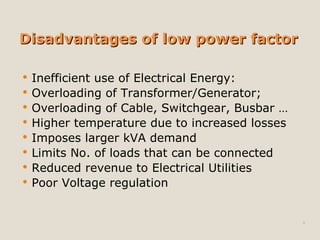
Disadvantages of low power factorDisadvantages of low power factor
 Inefficient use of Electrical Energy:
 Overloading of Transformer/Generator;
 Overloading of Cable, Switchgear, Busbar …
 Higher temperature due to increased losses
 Imposes larger kVA demand
 Limits No. of loads that can be connected
 Reduced revenue to Electrical Utilities
 Poor Voltage regulation
4
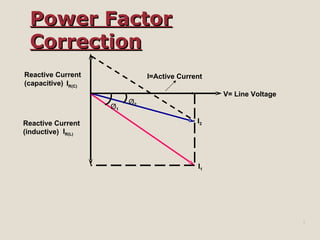
Power FactorPower Factor
CorrectionCorrection
5
Ø2
Ø1
V= Line Voltage
I=Active Current
I1
I2
IR(L)
IR(C)
Reactive Current
(inductive)
Reactive Current
(capacitive)
6
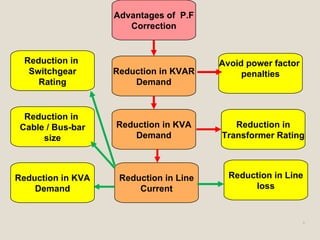
Reduction in
Transformer Rating
Reduction in KVAR
Demand
Advantages of P.F
Correction
Reduction in KVA
Demand
Reduction in Line
Current
Reduction in Line
loss
Reduction in
Cable / Bus-bar
size
Reduction in
Switchgear
Rating
Avoid power factor
penalties
Reduction in KVA
Demand
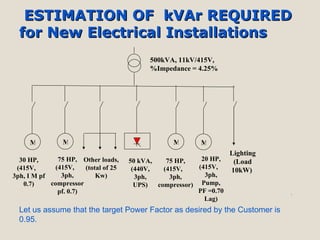
ESTIMATION OF kVAr REQUIREDESTIMATION OF kVAr REQUIRED
for New Electrical Installationsfor New Electrical Installations
7
M M M
75 HP,
(415V,
3ph,
compressor
pf. 0.7)
75 HP,
(415V,
3ph,
compressor)
20 HP,
(415V,
3ph,
Pump,
PF =0.70
Lag)
Other loads,
(total of 25
Kw)
500kVA, 11kV/415V,
%Impedance = 4.25%
50 kVA,
(440V,
3ph,
UPS)
Lighting
(Load
10kW)
M
30 HP,
(415V,
3ph, I M pf
0.7)
Let us assume that the target Power Factor as desired by the Customer is
0.95.
8
Kvar For The Supply Transformer-
For 500 kVA transformer, kVAr = 30 kVAr
Kvar For Induction Motor-
rating of motor = 200 HP x 0.746
= 150 kW
Kvar for motor = 150*[tan(cos-1
(0.95)- tan(cos-1
(0.99)]
= 104 Kvar
Kvar For UPS-
rating of UPS = 50 KVA* 0.7
= 35 Kw
Kvar for UPS = 35 [tan(cos-1
(0.70)- tan(cos-1
(0.99)]
= 25 Kvar
Kvar For Others & lighting load-
Kvar for UPS = 24 [tan(cos-1
(0.70)- tan(cos-1
(0.99)]
= 17 Kvar
Total kvar requirement = (30+104+35+25+17)kvar =211 Kvar
Assuming 15% design assumption and contigency = 221*0.15=31.65 Kvar
Total kvar = 242.65 kvar
Kavr recommended= 250 kvar
Capacitor req. (c) = Qc/V2
(2πf)
Hence Capacitor req. for UPF=106
*250/(2302
*100π)
= 150.51µF.
Type of compensationType of compensation
 Fixed compensation
 Variable compensation(for varying loads)- APFC
 Svc
9
1. Individual compensation
2. Group compensation
3. Central compensation
- Steady Loads
– No load compensation of Induction Motors
– No load compensation of Transformers
Disadvantages of fixed capacitorDisadvantages of fixed capacitor
 Manual operation(on/off)
 Not meet the require kvar under varying
loads.
 Can result leading power factor
 Cause over voltage
 Mal-operation of relays, diesel generators
 Saturation of transformer
 Penalty by electricity authority
10
11
•varying power demand on the supply system.
•power factor also varies as a function of the load requirements.
•difficult to maintain a consistent power factor by use of Fixed
Compensation i.e. fixed capacitors.
• leading power factor under light load conditions(fixed
compensation)
•This result in over voltages, saturation of transformers, mal-
operation of diesel generating sets, penalties by electric supply
authorities.
•automatically variation, without manual intervention, the compensation to
suit the load requirements.
•Automatic Power Factor Correction(APFC) system provide this facility.
•leading power factor will be also prevented.
NEED FOR AUTOMATIC POWER FACTOR
CORRECTION
Benefits of APFCBenefits of APFC
 Consistently high power factor under fluctuating loads
 Prevention of leading power factor
 Eliminate power factor penalty
 Lower energy consumption by reducing losses.
 Continuously sense and monitor load
 Automatically switch on/off relevant capacitors steps for
consistent power factor.
 Ensures easy user interface
 Protect under any internal fault
 Advance µ- relay with communication facility
 Used MPP-H/MD-XL/FF(APP) type capacitors
 User friendly, aesthetecally designed enclosure, dust and vermin
proof.
12
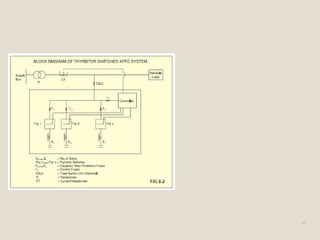
Automatic Power Factor CorrectionAutomatic Power Factor Correction
(APFC):(APFC):
 Capacitors grouped into several steps.
 • Suitable switching devices with coupled with
inrush current limiting devices are provided for
each step
 • Power Factor sensed by CT in line side
 • kVAr required to achieve target PF is computed
by the Microprocessor based APFC relay
 • APFC relay switches appropriate capacitor steps
 • CT senses improved PF and gives feedback
 • Thus target PF is achieved
13
How to Improve Power Factor WithoutHow to Improve Power Factor Without
Causing Harmonic Problem ?Causing Harmonic Problem ?
14
 Conventional capacitors should not be used.
 Capacitors should be replaced by harmonic suppression filters
(series combination of suitable series reactor & capacitors) so
that,
 It offers capacitive reactance at fundamental frequency for
necessary power factor correction.
 It offers inductive reactance at all higher order dominant
harmonic frequencies to avoid resonance.
 Its self series resonance frequency “fR” do not coincide with
predominant harmonics.
Network With HarmonicNetwork With Harmonic
FiltersFilters
15
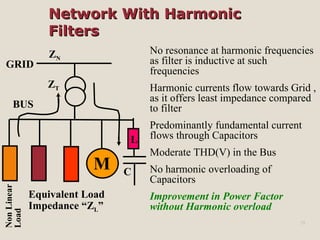
No resonance at harmonic frequencies
as filter is inductive at such
frequencies
Harmonic currents flow towards Grid ,
as it offers least impedance compared
to filter
Predominantly fundamental current
flows through Capacitors
Moderate THD(V) in the Bus
No harmonic overloading of
Capacitors
Improvement in Power Factor
without Harmonic overload
NonLinear
Load
BUS
M
GRID
ZT
Equivalent Load
Impedance “ZL”
ZN
L
C
Specification of capacitors in APFCSpecification of capacitors in APFC
 Qkvar
 Degree Of Protection IP20
 Ambient temperature
 Voltage rise should be≤ 3.0% [% Vc = (Q kvar
*%X)/(kva)]
 Voltage rise due to series reactor and harmonics
 Size of individual capacitor banks (step requirement)
 Directly connected Discharge Device(Resistor, VT)
to discharge the capacitor to reduce voltage to 50
volts within one minute
16
Selection of switching equipmentSelection of switching equipment
FOR LT
 Switch- fuse units/CBs/ Thyristers
 Switch should be quick make and break type
 Rating of CB, contactors, fuse and cable should be≥130% of
capacitor rated current.
 For automatic switching, each step capacitor should be provided
with fuse and contactor.
FOR HT
 Ht capacitor is connected to bus by CB
 Cb rating should be ≥ maximum operating voltage of circuit
 Continuous current rating of CB should be ≥ 135% of rated
capacitor bank current
17
Harmonics and parallel resonanceHarmonics and parallel resonance
 H=Kp ± 1 (converter) where k= 1,2,3,4,…….
 p= pulsating index
 High Harmonics current produces high harmonics
voltages.
 When harminics current frequency and parrellel
resonance become equal than corrosponding
harmonics voltage produces over current in
capacitor.
18
Series reactorSeries reactor
 XT= Xc/h2
 Supress high inrush current to safe value at
time of capacitor switching.
 Improve voltage waveform
 Reactor should be able to carry 135%of rated
contineous current.
Discharge VT
 To discharge voltage of capacitor
19
TYPES OF CAPACITOR TECHNOLOGIESTYPES OF CAPACITOR TECHNOLOGIES
20
 MPP - METALLISED POLYPROPYLENE
 MD - MIXED DIELECTRIC
 FF/ALL PP - FILM - FOIL OR ALL POLY
PROPELENE
 MD -XL - MIXED DIELECTRIC LOW LOSS
METALISED POLYPROPELENE CAPACITORMETALISED POLYPROPELENE CAPACITOR
21
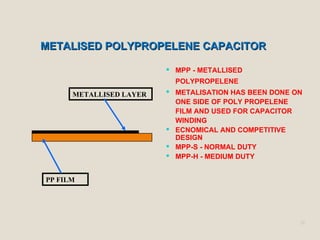
 MPP - METALLISED
POLYPROPELENE
 METALISATION HAS BEEN DONE ON
ONE SIDE OF POLY PROPELENE
FILM AND USED FOR CAPACITOR
WINDING
 ECNOMICAL AND COMPETITIVE
DESIGN
 MPP-S - NORMAL DUTY
 MPP-H - MEDIUM DUTY
PP FILM
METALLISED LAYER
MIXEDMIXED DIELECTRIC TYPEDIELECTRIC TYPE
22
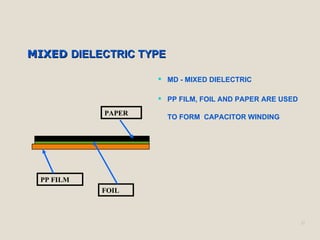
 MD - MIXED DIELECTRIC
 PP FILM, FOIL AND PAPER ARE USED
TO FORM CAPACITOR WINDING
PP FILM
FOIL
PAPER
FILM FOIL OR APPFILM FOIL OR APP
23
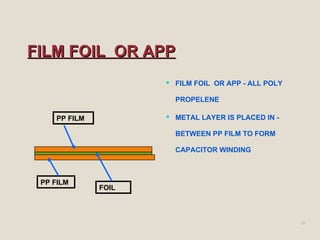
 FILM FOIL OR APP - ALL POLY
PROPELENE
 METAL LAYER IS PLACED IN -
BETWEEN PP FILM TO FORM
CAPACITOR WINDING
PP FILM
FOIL
PP FILM
FILM FOIL OR APPFILM FOIL OR APP
24
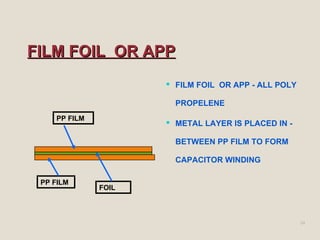
 FILM FOIL OR APP - ALL POLY
PROPELENE
 METAL LAYER IS PLACED IN -
BETWEEN PP FILM TO FORM
CAPACITOR WINDING
PP FILM
FOIL
PP FILM
MIXED DIELECTRIC - LOWMIXED DIELECTRIC - LOW
LOSSLOSS
25
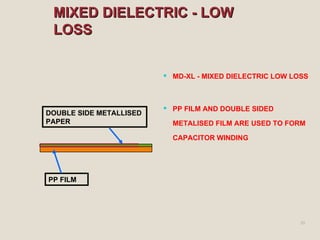
 MD-XL - MIXED DIELECTRIC LOW LOSS
 PP FILM AND DOUBLE SIDED
METALISED FILM ARE USED TO FORM
CAPACITOR WINDING
PP FILM
DOUBLE SIDE METALLISED
PAPER
26
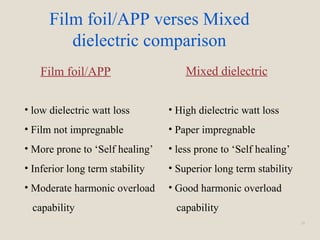
Film foil/APP verses Mixed
dielectric comparison
Film foil/APP Mixed dielectric
• low dielectric watt loss
• Film not impregnable
• More prone to ‘Self healing’
• Inferior long term stability
• Moderate harmonic overload
capability
• High dielectric watt loss
• Paper impregnable
• less prone to ‘Self healing’
• Superior long term stability
• Good harmonic overload
capability
27
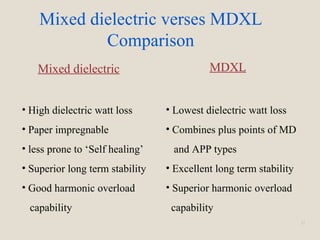
Mixed dielectric verses MDXL
Comparison
Mixed dielectric MDXL
• High dielectric watt loss
• Paper impregnable
• less prone to ‘Self healing’
• Superior long term stability
• Good harmonic overload
capability
• Lowest dielectric watt loss
• Combines plus points of MD
and APP types
• Excellent long term stability
• Superior harmonic overload
capability
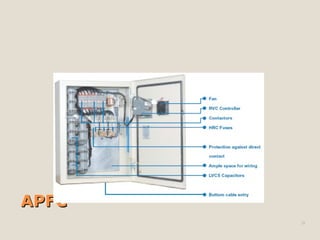
APFCAPFC
28
29
30
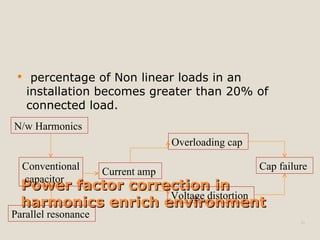
Power factor correction inPower factor correction in
harmonics enrich environmentharmonics enrich environment
 percentage of Non linear loads in an
installation becomes greater than 20% of
connected load.
31
Conventional
capacitor
N/w Harmonics
Parallel resonance
Current amp
Overloading cap
Voltage distortion
Cap failure
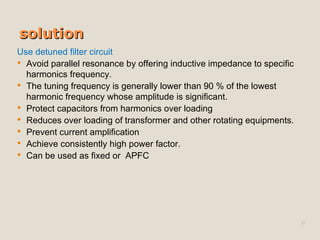
solutionsolution
Use detuned filter circuit
 Avoid parallel resonance by offering inductive impedance to specific
harmonics frequency.
 The tuning frequency is generally lower than 90 % of the lowest
harmonic frequency whose amplitude is significant.
 Protect capacitors from harmonics over loading
 Reduces over loading of transformer and other rotating equipments.
 Prevent current amplification
 Achieve consistently high power factor.
 Can be used as fixed or APFC
32
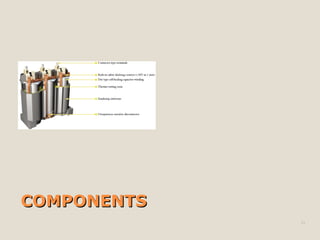
COMPONENTSCOMPONENTS
33
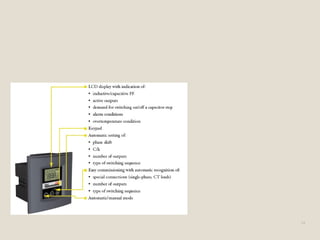
CONTROLLERCONTROLLER
34
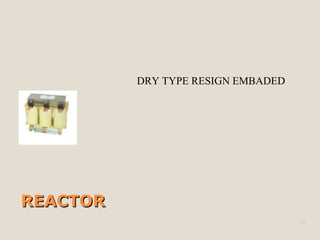
REACTORREACTOR
35
DRY TYPE RESIGN EMBADED
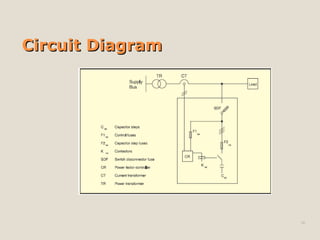
Circuit DiagramCircuit Diagram
36
37
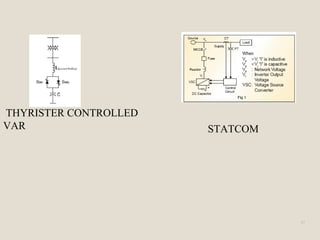
THYRISTER CONTROLLED
VAR STATCOM

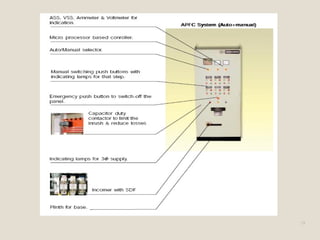
Apfc panel

  • 1.
    Power Factor &APFCPower Factor & APFC 1 By: Ravi Shankar Singh
  • 2.
    What is powerfactor…?What is power factor…? 2 Power Factor = Active Power (kW)/Apparent Power (kVA) PF≤1.0 Usually P.F is always “Lag” (Inductive) Some time P.F can be “Lead” (Capacitive).
  • 3.
    Origin of LowPower FactorOrigin of Low Power Factor 3  Electrical Equipment need Reactive Power  Inductive loads draw Reactive Power  Phase difference between current & Voltage reduces “Displacement PF”.  Reactive Power to maintain magnetic fields in Motors.  Non-Linear loads reduces “Distortion PF”.  True PF, being product of displacement and distortion PF is lower than both. Capacitors can only improve displacement PF.
  • 4.
    Disadvantages of lowpower factorDisadvantages of low power factor  Inefficient use of Electrical Energy:  Overloading of Transformer/Generator;  Overloading of Cable, Switchgear, Busbar …  Higher temperature due to increased losses  Imposes larger kVA demand  Limits No. of loads that can be connected  Reduced revenue to Electrical Utilities  Poor Voltage regulation 4
  • 5.
    Power FactorPower Factor CorrectionCorrection 5 Ø2 Ø1 V=Line Voltage I=Active Current I1 I2 IR(L) IR(C) Reactive Current (inductive) Reactive Current (capacitive)
  • 6.
    6 Reduction in Transformer Rating Reductionin KVAR Demand Advantages of P.F Correction Reduction in KVA Demand Reduction in Line Current Reduction in Line loss Reduction in Cable / Bus-bar size Reduction in Switchgear Rating Avoid power factor penalties Reduction in KVA Demand
  • 7.
    ESTIMATION OF kVArREQUIREDESTIMATION OF kVAr REQUIRED for New Electrical Installationsfor New Electrical Installations 7 M M M 75 HP, (415V, 3ph, compressor pf. 0.7) 75 HP, (415V, 3ph, compressor) 20 HP, (415V, 3ph, Pump, PF =0.70 Lag) Other loads, (total of 25 Kw) 500kVA, 11kV/415V, %Impedance = 4.25% 50 kVA, (440V, 3ph, UPS) Lighting (Load 10kW) M 30 HP, (415V, 3ph, I M pf 0.7) Let us assume that the target Power Factor as desired by the Customer is 0.95.
  • 8.
    8 Kvar For TheSupply Transformer- For 500 kVA transformer, kVAr = 30 kVAr Kvar For Induction Motor- rating of motor = 200 HP x 0.746 = 150 kW Kvar for motor = 150*[tan(cos-1 (0.95)- tan(cos-1 (0.99)] = 104 Kvar Kvar For UPS- rating of UPS = 50 KVA* 0.7 = 35 Kw Kvar for UPS = 35 [tan(cos-1 (0.70)- tan(cos-1 (0.99)] = 25 Kvar Kvar For Others & lighting load- Kvar for UPS = 24 [tan(cos-1 (0.70)- tan(cos-1 (0.99)] = 17 Kvar Total kvar requirement = (30+104+35+25+17)kvar =211 Kvar Assuming 15% design assumption and contigency = 221*0.15=31.65 Kvar Total kvar = 242.65 kvar Kavr recommended= 250 kvar Capacitor req. (c) = Qc/V2 (2πf) Hence Capacitor req. for UPF=106 *250/(2302 *100π) = 150.51µF.
  • 9.
    Type of compensationTypeof compensation  Fixed compensation  Variable compensation(for varying loads)- APFC  Svc 9 1. Individual compensation 2. Group compensation 3. Central compensation - Steady Loads – No load compensation of Induction Motors – No load compensation of Transformers
  • 10.
    Disadvantages of fixedcapacitorDisadvantages of fixed capacitor  Manual operation(on/off)  Not meet the require kvar under varying loads.  Can result leading power factor  Cause over voltage  Mal-operation of relays, diesel generators  Saturation of transformer  Penalty by electricity authority 10
  • 11.
    11 •varying power demandon the supply system. •power factor also varies as a function of the load requirements. •difficult to maintain a consistent power factor by use of Fixed Compensation i.e. fixed capacitors. • leading power factor under light load conditions(fixed compensation) •This result in over voltages, saturation of transformers, mal- operation of diesel generating sets, penalties by electric supply authorities. •automatically variation, without manual intervention, the compensation to suit the load requirements. •Automatic Power Factor Correction(APFC) system provide this facility. •leading power factor will be also prevented. NEED FOR AUTOMATIC POWER FACTOR CORRECTION
  • 12.
    Benefits of APFCBenefitsof APFC  Consistently high power factor under fluctuating loads  Prevention of leading power factor  Eliminate power factor penalty  Lower energy consumption by reducing losses.  Continuously sense and monitor load  Automatically switch on/off relevant capacitors steps for consistent power factor.  Ensures easy user interface  Protect under any internal fault  Advance µ- relay with communication facility  Used MPP-H/MD-XL/FF(APP) type capacitors  User friendly, aesthetecally designed enclosure, dust and vermin proof. 12
  • 13.
    Automatic Power FactorCorrectionAutomatic Power Factor Correction (APFC):(APFC):  Capacitors grouped into several steps.  • Suitable switching devices with coupled with inrush current limiting devices are provided for each step  • Power Factor sensed by CT in line side  • kVAr required to achieve target PF is computed by the Microprocessor based APFC relay  • APFC relay switches appropriate capacitor steps  • CT senses improved PF and gives feedback  • Thus target PF is achieved 13
  • 14.
    How to ImprovePower Factor WithoutHow to Improve Power Factor Without Causing Harmonic Problem ?Causing Harmonic Problem ? 14  Conventional capacitors should not be used.  Capacitors should be replaced by harmonic suppression filters (series combination of suitable series reactor & capacitors) so that,  It offers capacitive reactance at fundamental frequency for necessary power factor correction.  It offers inductive reactance at all higher order dominant harmonic frequencies to avoid resonance.  Its self series resonance frequency “fR” do not coincide with predominant harmonics.
  • 15.
    Network With HarmonicNetworkWith Harmonic FiltersFilters 15 No resonance at harmonic frequencies as filter is inductive at such frequencies Harmonic currents flow towards Grid , as it offers least impedance compared to filter Predominantly fundamental current flows through Capacitors Moderate THD(V) in the Bus No harmonic overloading of Capacitors Improvement in Power Factor without Harmonic overload NonLinear Load BUS M GRID ZT Equivalent Load Impedance “ZL” ZN L C
  • 16.
    Specification of capacitorsin APFCSpecification of capacitors in APFC  Qkvar  Degree Of Protection IP20  Ambient temperature  Voltage rise should be≤ 3.0% [% Vc = (Q kvar *%X)/(kva)]  Voltage rise due to series reactor and harmonics  Size of individual capacitor banks (step requirement)  Directly connected Discharge Device(Resistor, VT) to discharge the capacitor to reduce voltage to 50 volts within one minute 16
  • 17.
    Selection of switchingequipmentSelection of switching equipment FOR LT  Switch- fuse units/CBs/ Thyristers  Switch should be quick make and break type  Rating of CB, contactors, fuse and cable should be≥130% of capacitor rated current.  For automatic switching, each step capacitor should be provided with fuse and contactor. FOR HT  Ht capacitor is connected to bus by CB  Cb rating should be ≥ maximum operating voltage of circuit  Continuous current rating of CB should be ≥ 135% of rated capacitor bank current 17
  • 18.
    Harmonics and parallelresonanceHarmonics and parallel resonance  H=Kp ± 1 (converter) where k= 1,2,3,4,…….  p= pulsating index  High Harmonics current produces high harmonics voltages.  When harminics current frequency and parrellel resonance become equal than corrosponding harmonics voltage produces over current in capacitor. 18
  • 19.
    Series reactorSeries reactor XT= Xc/h2  Supress high inrush current to safe value at time of capacitor switching.  Improve voltage waveform  Reactor should be able to carry 135%of rated contineous current. Discharge VT  To discharge voltage of capacitor 19
  • 20.
    TYPES OF CAPACITORTECHNOLOGIESTYPES OF CAPACITOR TECHNOLOGIES 20  MPP - METALLISED POLYPROPYLENE  MD - MIXED DIELECTRIC  FF/ALL PP - FILM - FOIL OR ALL POLY PROPELENE  MD -XL - MIXED DIELECTRIC LOW LOSS
  • 21.
    METALISED POLYPROPELENE CAPACITORMETALISEDPOLYPROPELENE CAPACITOR 21  MPP - METALLISED POLYPROPELENE  METALISATION HAS BEEN DONE ON ONE SIDE OF POLY PROPELENE FILM AND USED FOR CAPACITOR WINDING  ECNOMICAL AND COMPETITIVE DESIGN  MPP-S - NORMAL DUTY  MPP-H - MEDIUM DUTY PP FILM METALLISED LAYER
  • 22.
    MIXEDMIXED DIELECTRIC TYPEDIELECTRICTYPE 22  MD - MIXED DIELECTRIC  PP FILM, FOIL AND PAPER ARE USED TO FORM CAPACITOR WINDING PP FILM FOIL PAPER
  • 23.
    FILM FOIL ORAPPFILM FOIL OR APP 23  FILM FOIL OR APP - ALL POLY PROPELENE  METAL LAYER IS PLACED IN - BETWEEN PP FILM TO FORM CAPACITOR WINDING PP FILM FOIL PP FILM
  • 24.
    FILM FOIL ORAPPFILM FOIL OR APP 24  FILM FOIL OR APP - ALL POLY PROPELENE  METAL LAYER IS PLACED IN - BETWEEN PP FILM TO FORM CAPACITOR WINDING PP FILM FOIL PP FILM
  • 25.
    MIXED DIELECTRIC -LOWMIXED DIELECTRIC - LOW LOSSLOSS 25  MD-XL - MIXED DIELECTRIC LOW LOSS  PP FILM AND DOUBLE SIDED METALISED FILM ARE USED TO FORM CAPACITOR WINDING PP FILM DOUBLE SIDE METALLISED PAPER
  • 26.
    26 Film foil/APP versesMixed dielectric comparison Film foil/APP Mixed dielectric • low dielectric watt loss • Film not impregnable • More prone to ‘Self healing’ • Inferior long term stability • Moderate harmonic overload capability • High dielectric watt loss • Paper impregnable • less prone to ‘Self healing’ • Superior long term stability • Good harmonic overload capability
  • 27.
    27 Mixed dielectric versesMDXL Comparison Mixed dielectric MDXL • High dielectric watt loss • Paper impregnable • less prone to ‘Self healing’ • Superior long term stability • Good harmonic overload capability • Lowest dielectric watt loss • Combines plus points of MD and APP types • Excellent long term stability • Superior harmonic overload capability
  • 28.
  • 29.
  • 30.
  • 31.
    Power factor correctioninPower factor correction in harmonics enrich environmentharmonics enrich environment  percentage of Non linear loads in an installation becomes greater than 20% of connected load. 31 Conventional capacitor N/w Harmonics Parallel resonance Current amp Overloading cap Voltage distortion Cap failure
  • 32.
    solutionsolution Use detuned filtercircuit  Avoid parallel resonance by offering inductive impedance to specific harmonics frequency.  The tuning frequency is generally lower than 90 % of the lowest harmonic frequency whose amplitude is significant.  Protect capacitors from harmonics over loading  Reduces over loading of transformer and other rotating equipments.  Prevent current amplification  Achieve consistently high power factor.  Can be used as fixed or APFC 32
  • 33.
  • 34.
  • 35.
  • 36.
  • 37.