© Fraunhofer IWES
Slide -1- Ron Brandl Project: DEAstabil
Multi-Terminal Power Hardware-in-the-Loop
Test-Bench for Power System Stability
Analyses Focused on Distributed Generation
RT15
Berkeley, CA | 13 - 14 June, 2015
Authors: Ron Brandl, Fraunhofer IWES
Dominik Geibel, Fraunhofer IWES
© Fraunhofer IWES
Slide -2- Ron Brandl, Project: DEAstabil
Multi-Terminal PHIL Test Bench for Power
System Stability Analyses
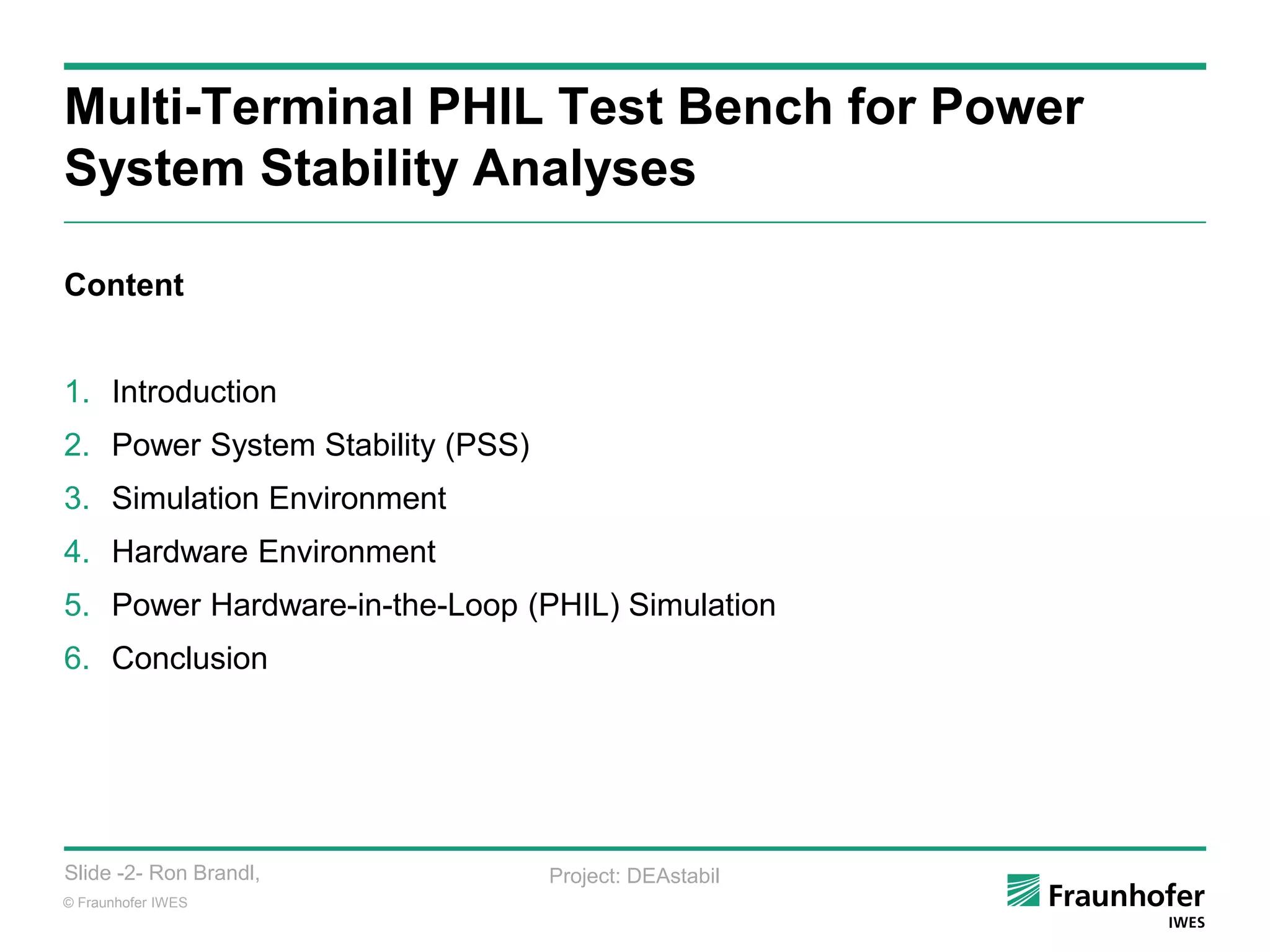
Content
1. Introduction
2. Power System Stability (PSS)
3. Simulation Environment
4. Hardware Environment
5. Power Hardware-in-the-Loop (PHIL) Simulation
6. Conclusion
© Fraunhofer IWES
Slide -3- Ron Brandl Project: DEAstabil
1. Introduction
Motivation
 Large increase in inverter-coupled generating units
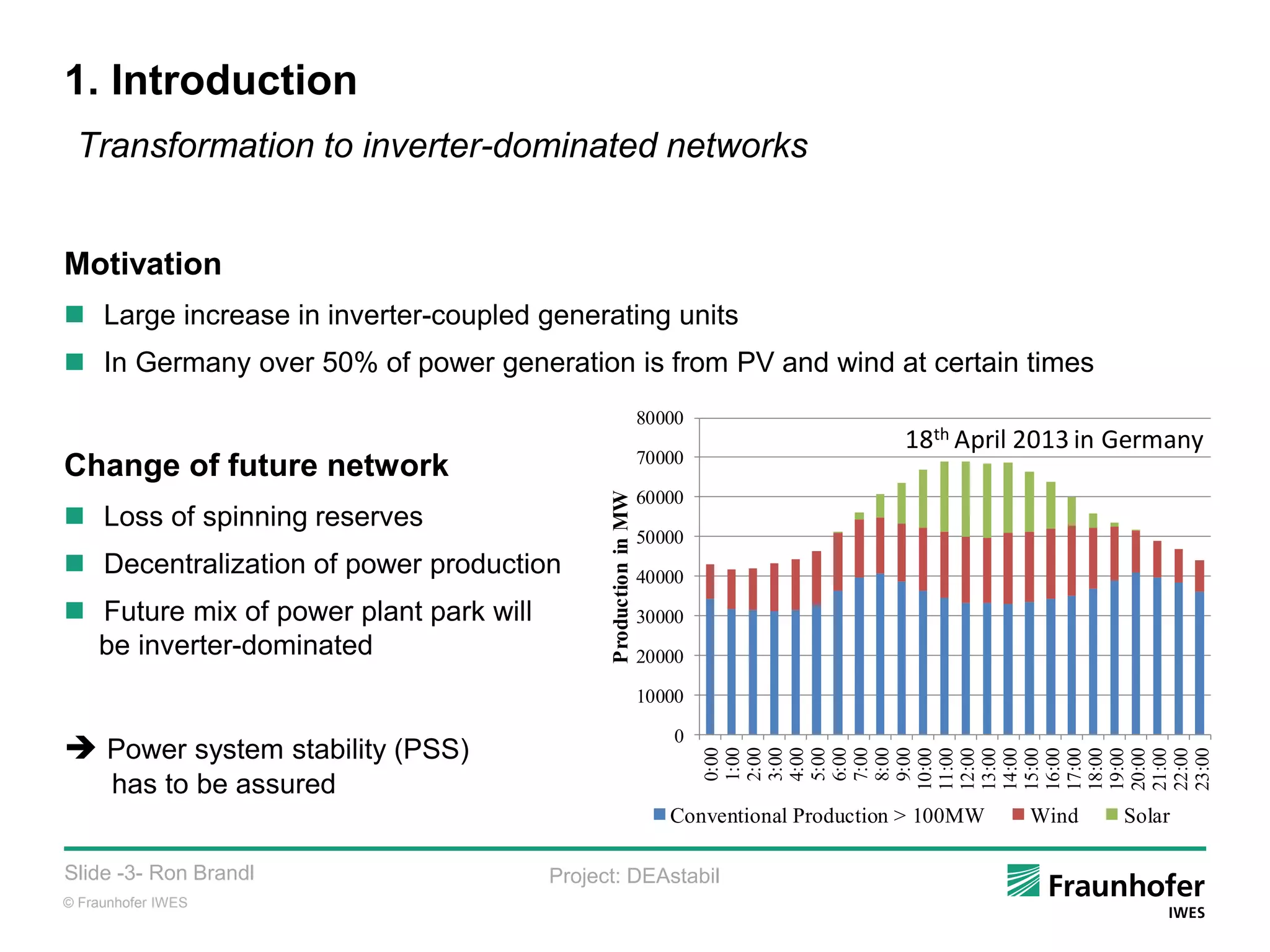
 In Germany over 50% of power generation is from PV and wind at certain times
Change of future network
 Loss of spinning reserves
 Decentralization of power production
 Future mix of power plant park will
be inverter-dominated
 Power system stability (PSS)
has to be assured
Transformation to inverter-dominated networks
0
10000
20000
30000
40000
50000
60000
70000
80000
0:00
1:00
2:00
3:00
4:00
5:00
6:00
7:00
8:00
9:00
10:00
11:00
12:00
13:00
14:00
15:00
16:00
17:00
18:00
19:00
20:00
21:00
22:00
23:00
ProductioninMW
Conventional Production > 100MW Wind Solar
18th April 2013 in Germany
© Fraunhofer IWES
Slide -4- Ron Brandl Project: DEAstabil
2. Power System Stability
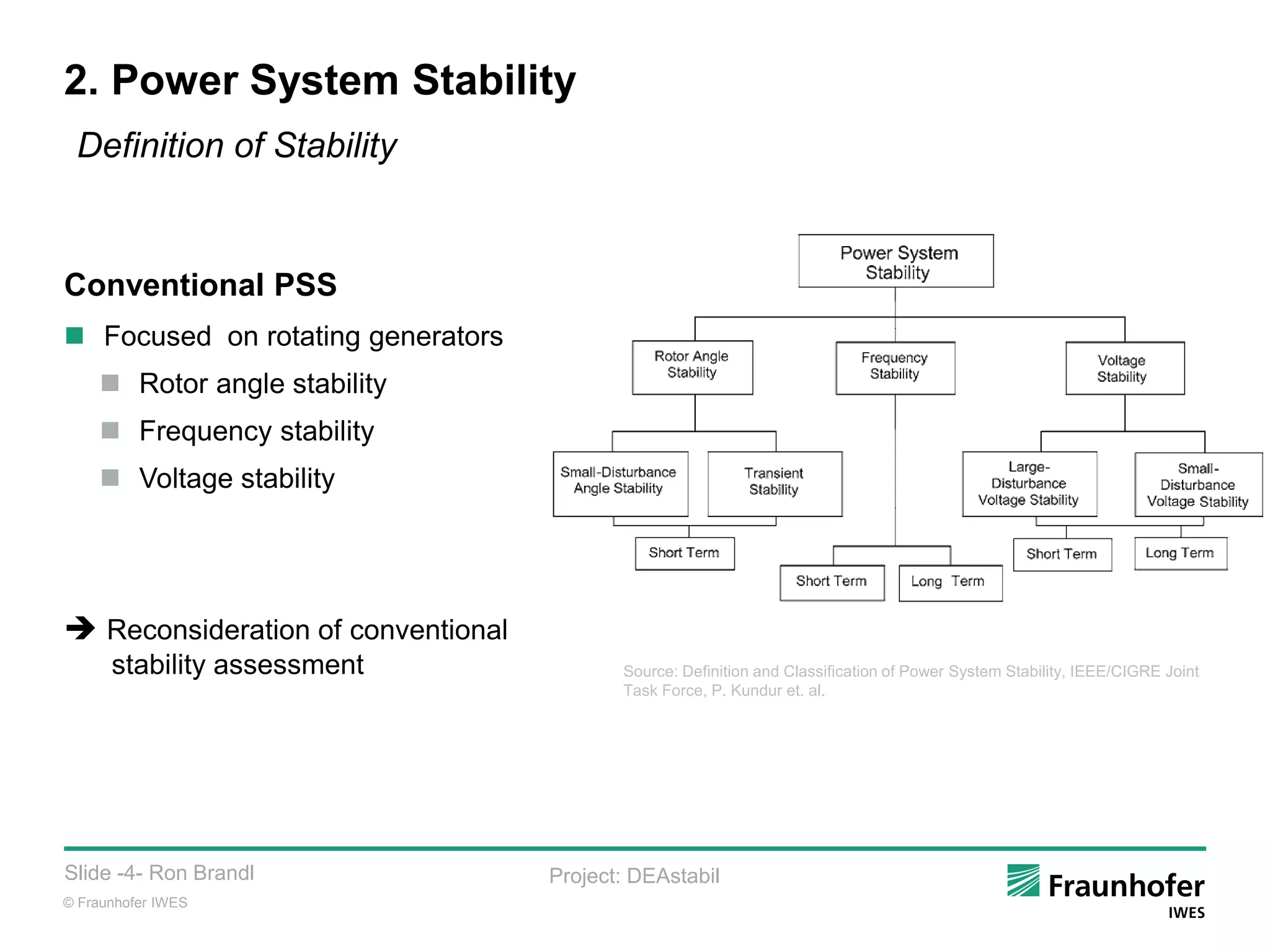
Conventional PSS
 Focused on rotating generators
 Rotor angle stability
 Frequency stability
 Voltage stability
 Reconsideration of conventional
stability assessment Source: Definition and Classification of Power System Stability, IEEE/CIGRE Joint
Task Force, P. Kundur et. al.
Definition of Stability
© Fraunhofer IWES
Slide -5- Ron Brandl Project: DEAstabil
2. Power System Stability
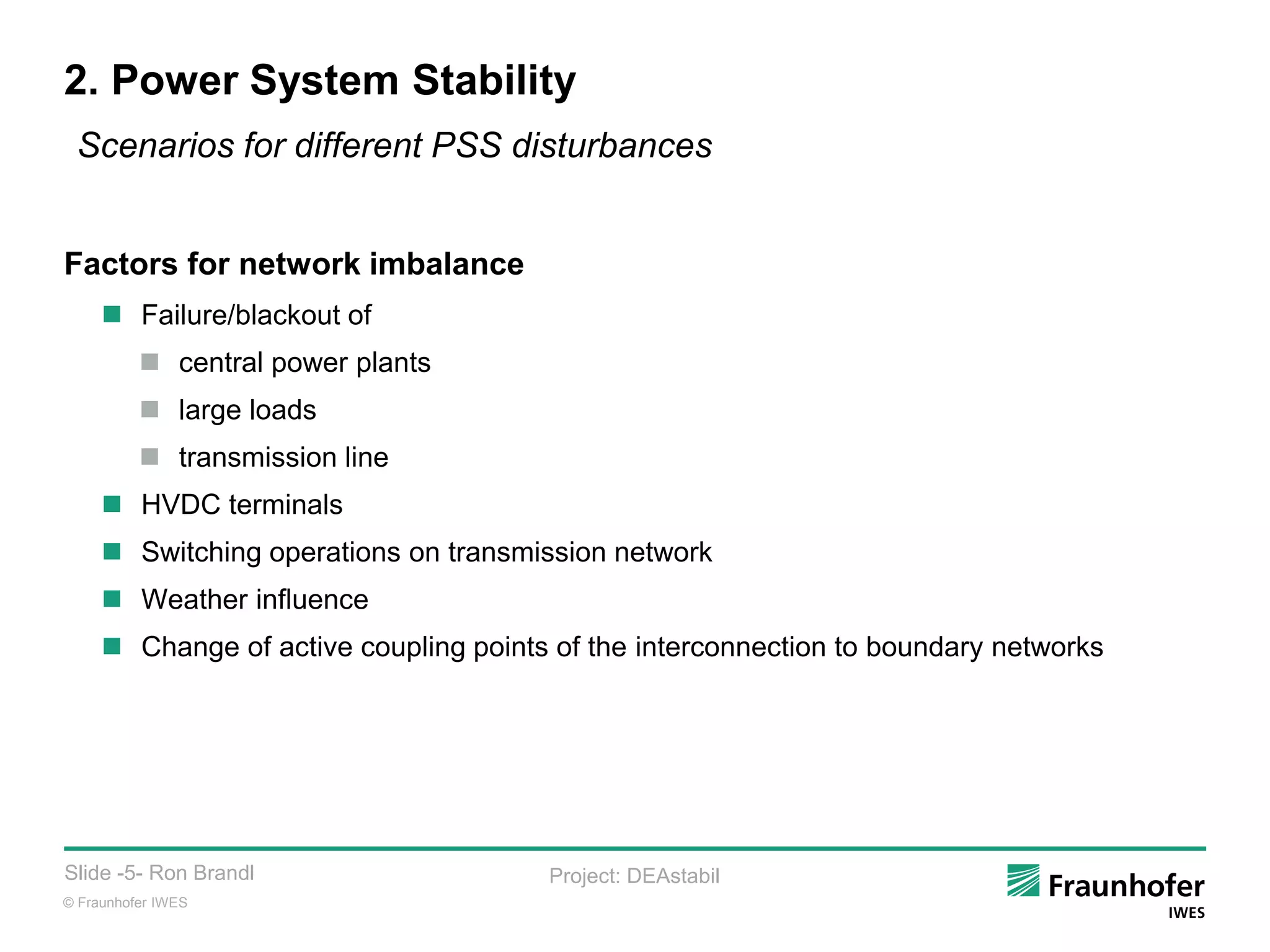
Factors for network imbalance
 Failure/blackout of
 central power plants
 large loads
 transmission line
 HVDC terminals
 Switching operations on transmission network
 Weather influence
 Change of active coupling points of the interconnection to boundary networks
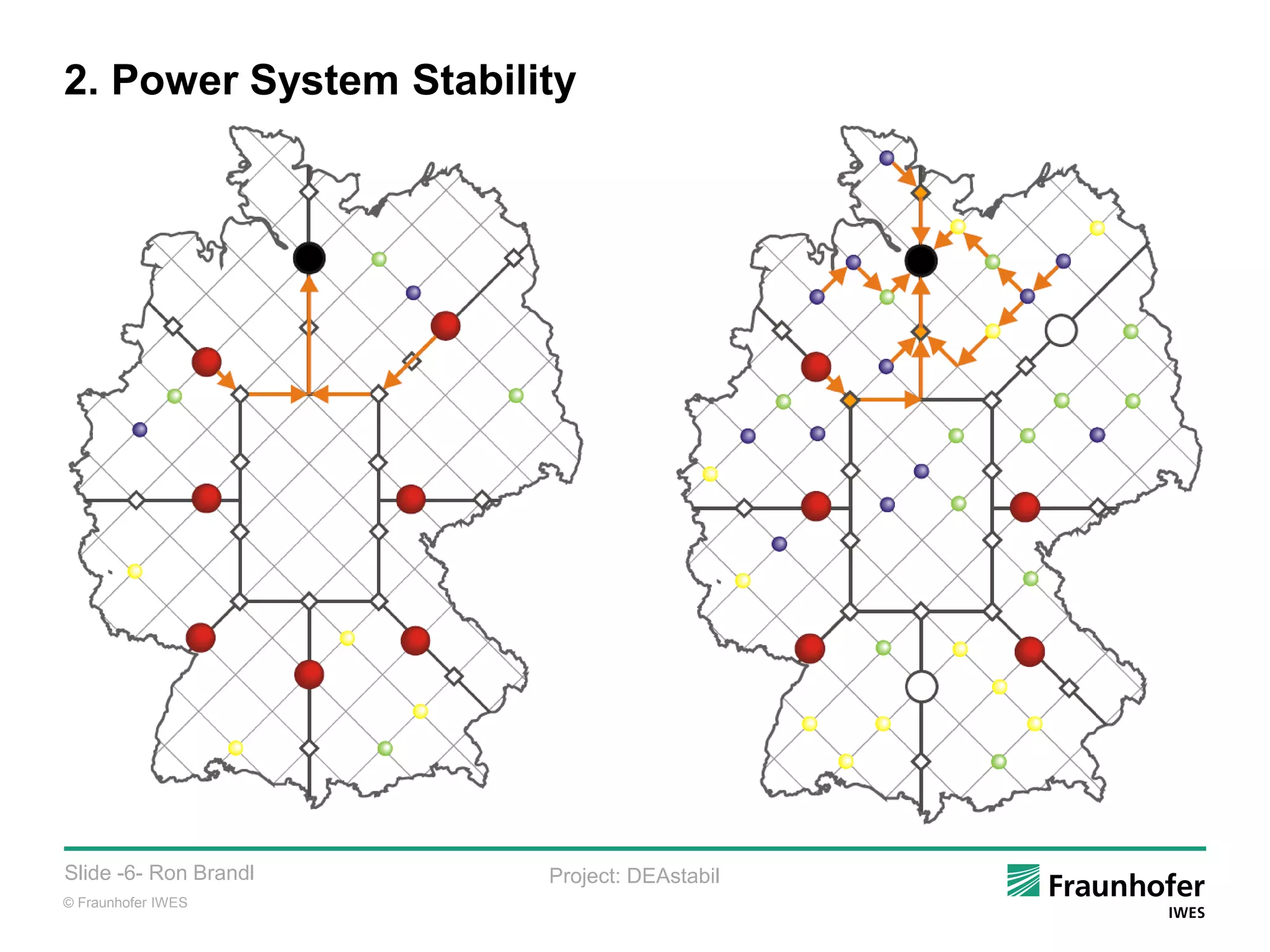
Scenarios for different PSS disturbances
© Fraunhofer IWES
Slide -6- Ron Brandl Project: DEAstabil
2. Power System Stability
© Fraunhofer IWES
Slide -7- Ron Brandl Project: DEAstabil
3. Simulation Environment
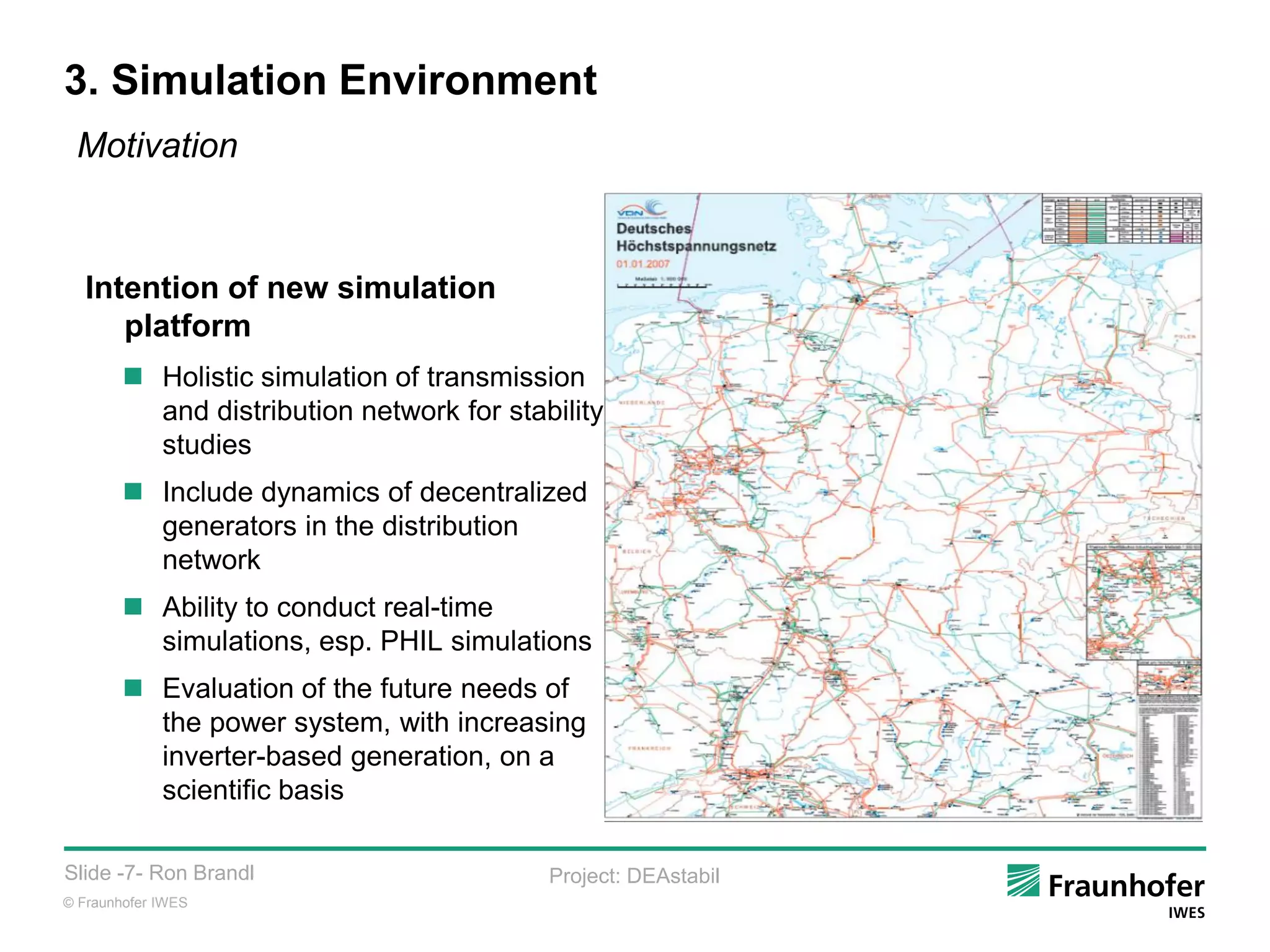
Intention of new simulation
platform
 Holistic simulation of transmission
and distribution network for stability
studies
 Include dynamics of decentralized
generators in the distribution
network
 Ability to conduct real-time
simulations, esp. PHIL simulations
 Evaluation of the future needs of
the power system, with increasing
inverter-based generation, on a
scientific basis
Motivation
© Fraunhofer IWES
Slide -8- Ron Brandl Project: DEAstabil
3. Simulation Environment
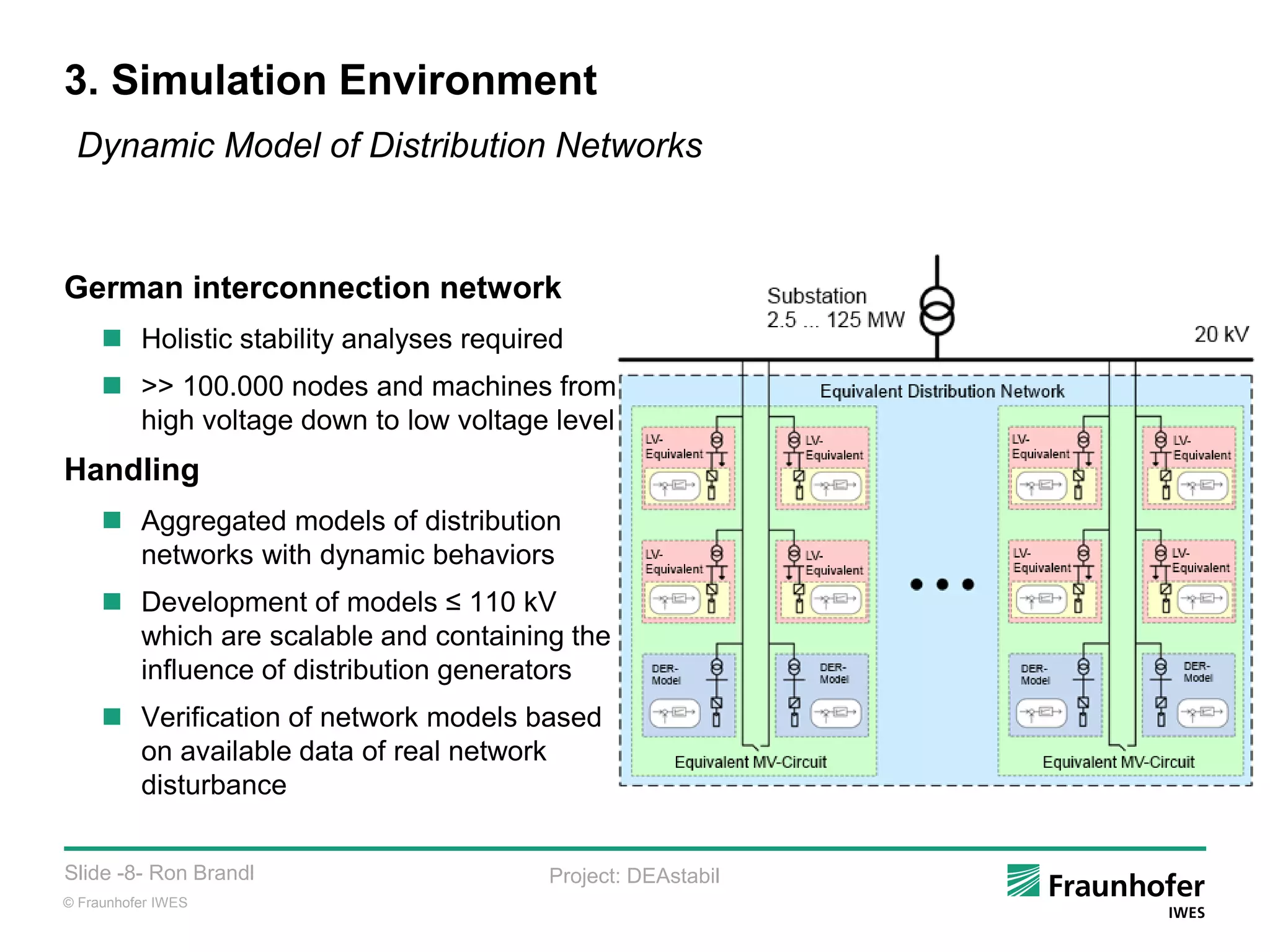
German interconnection network
 Holistic stability analyses required
 >> 100.000 nodes and machines from
high voltage down to low voltage level
Handling
 Aggregated models of distribution
networks with dynamic behaviors
 Development of models ≤ 110 kV
which are scalable and containing the
influence of distribution generators
 Verification of network models based
on available data of real network
disturbance
Dynamic Model of Distribution Networks
© Fraunhofer IWES
Slide -9- Ron Brandl Project: DEAstabil
3. Simulation Environment
Benefits/Summary
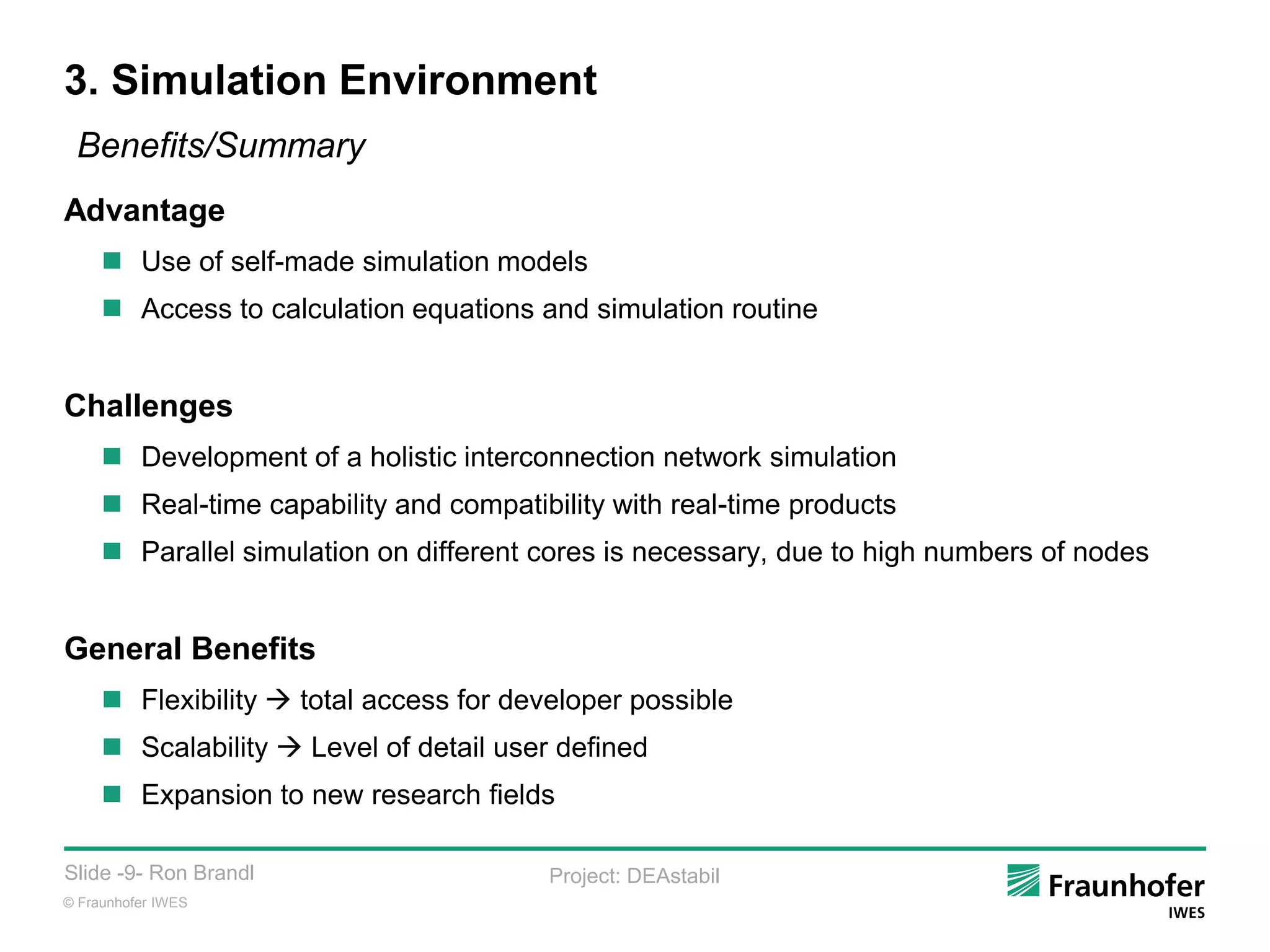
Advantage
 Use of self-made simulation models
 Access to calculation equations and simulation routine
Challenges
 Development of a holistic interconnection network simulation
 Real-time capability and compatibility with real-time products
 Parallel simulation on different cores is necessary, due to high numbers of nodes
General Benefits
 Flexibility  total access for developer possible
 Scalability  Level of detail user defined
 Expansion to new research fields
© Fraunhofer IWES
Slide -10- Ron Brandl Project: DEAstabil
4. Hardware Environment
Laboratory Test bench
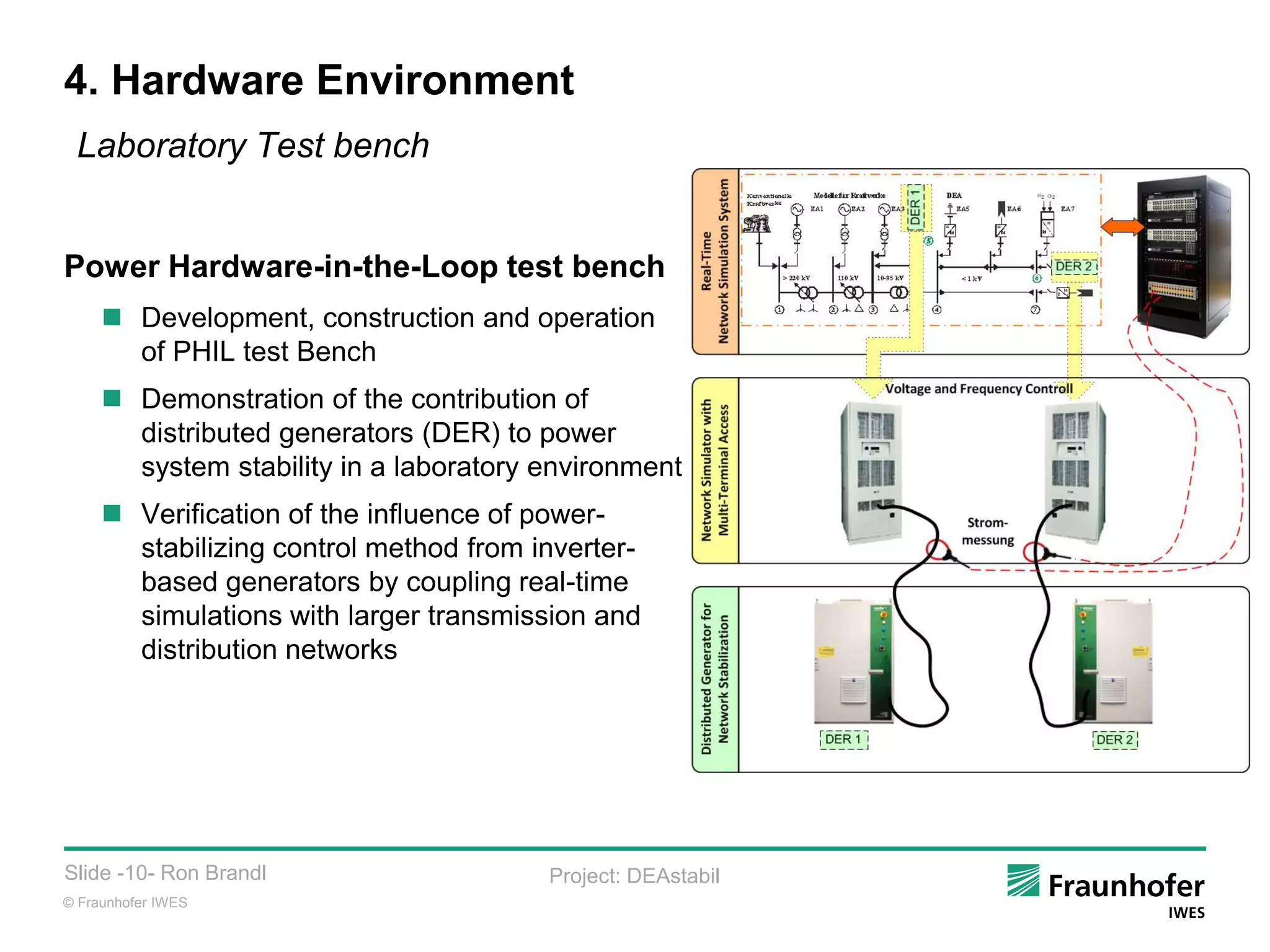
Power Hardware-in-the-Loop test bench
 Development, construction and operation
of PHIL test Bench
 Demonstration of the contribution of
distributed generators (DER) to power
system stability in a laboratory environment
 Verification of the influence of power-
stabilizing control method from inverter-
based generators by coupling real-time
simulations with larger transmission and
distribution networks
© Fraunhofer IWES
Slide -11- Ron Brandl Project: DEAstabil
4. Hardware Environment
Laboratory (under preparation)
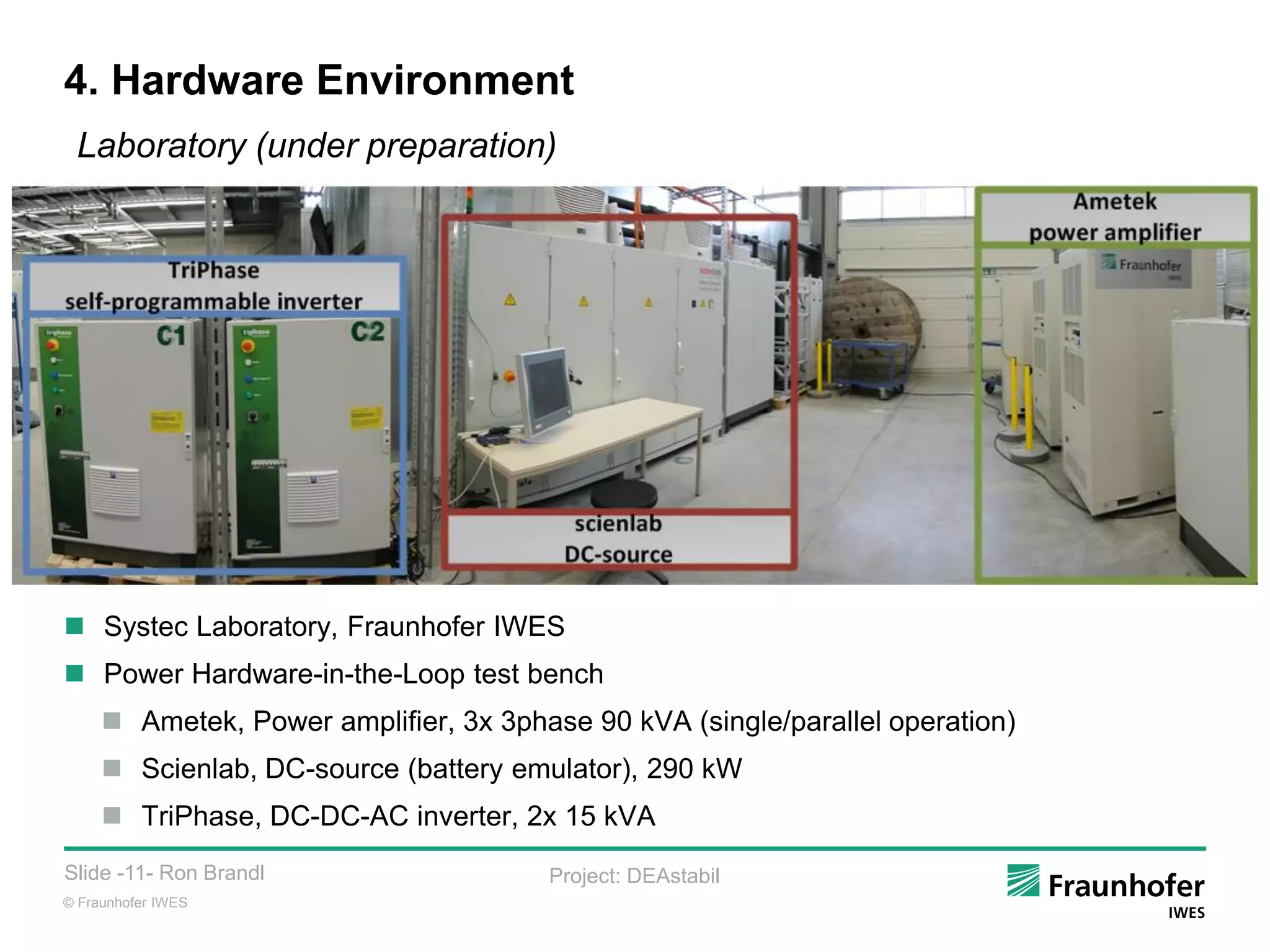
 Systec Laboratory, Fraunhofer IWES
 Power Hardware-in-the-Loop test bench
 Ametek, Power amplifier, 3x 3phase 90 kVA (single/parallel operation)
 Scienlab, DC-source (battery emulator), 290 kW
 TriPhase, DC-DC-AC inverter, 2x 15 kVA
© Fraunhofer IWES
Slide -12- Ron Brandl Project: DEAstabil
5. Power Hardware-in-the-Loop Simulation
Benefits/Summary
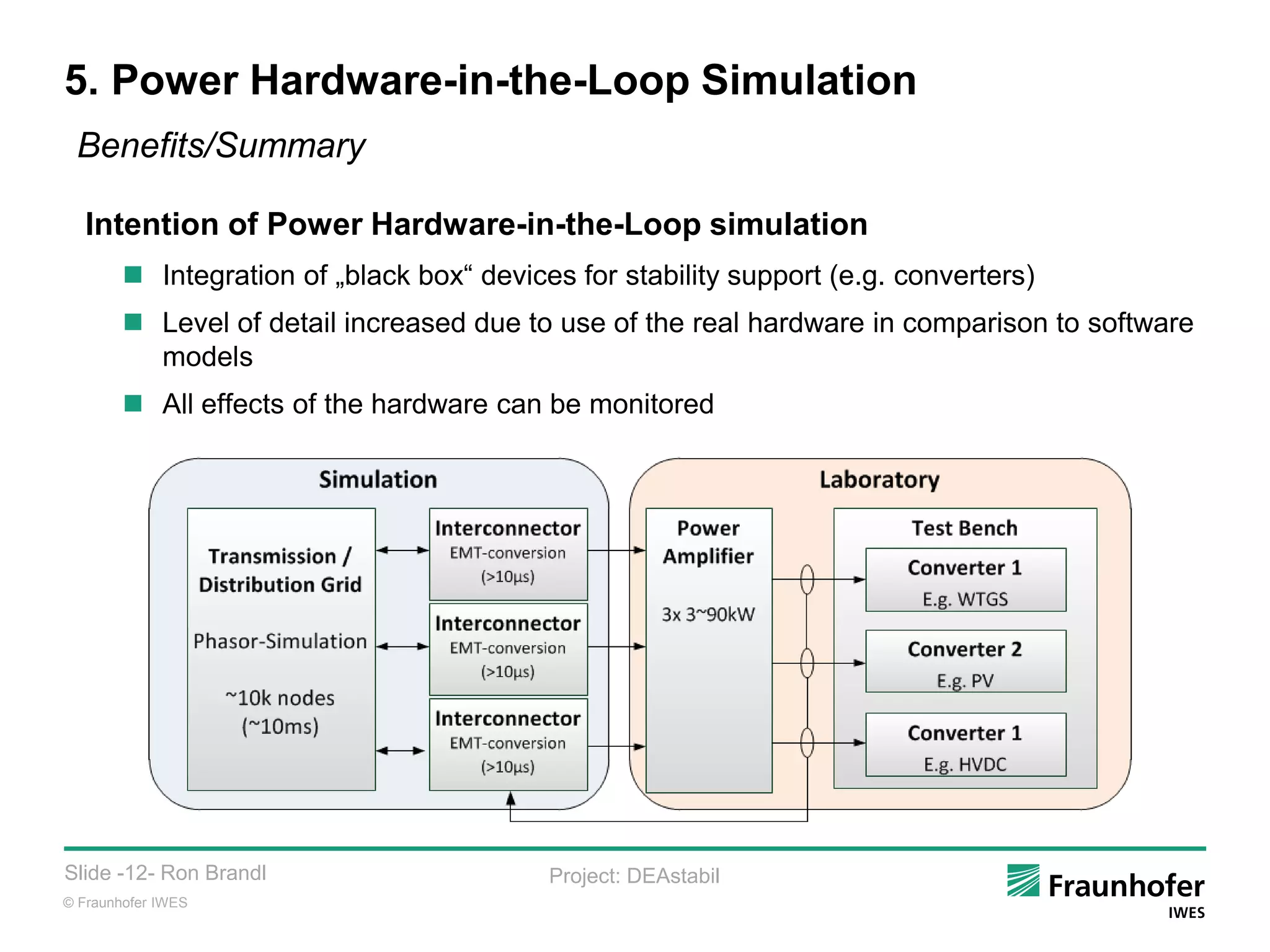
Intention of Power Hardware-in-the-Loop simulation
 Integration of „black box“ devices for stability support (e.g. converters)
 Level of detail increased due to use of the real hardware in comparison to software
models
 All effects of the hardware can be monitored
© Fraunhofer IWES
Slide -13- Ron Brandl Project: DEAstabil
5. Power Hardware-in-the-Loop Simulation
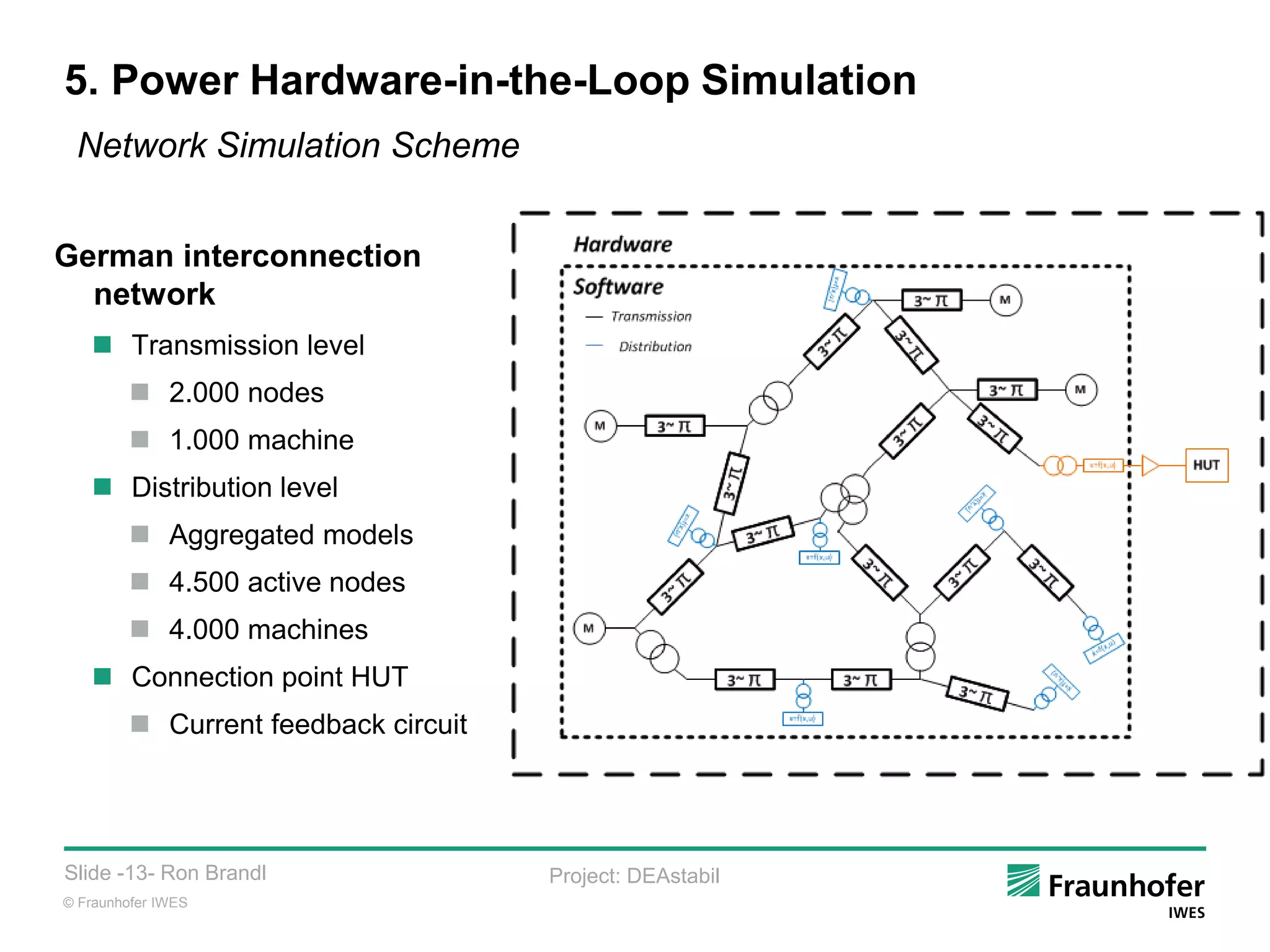
Network Simulation Scheme
German interconnection
network
 Transmission level
 2.000 nodes
 1.000 machine
 Distribution level
 Aggregated models
 4.500 active nodes
 4.000 machines
 Connection point HUT
 Current feedback circuit
© Fraunhofer IWES
Slide -14- Ron Brandl Project: DEAstabil
5. Power Hardware-in-the-Loop Simulation
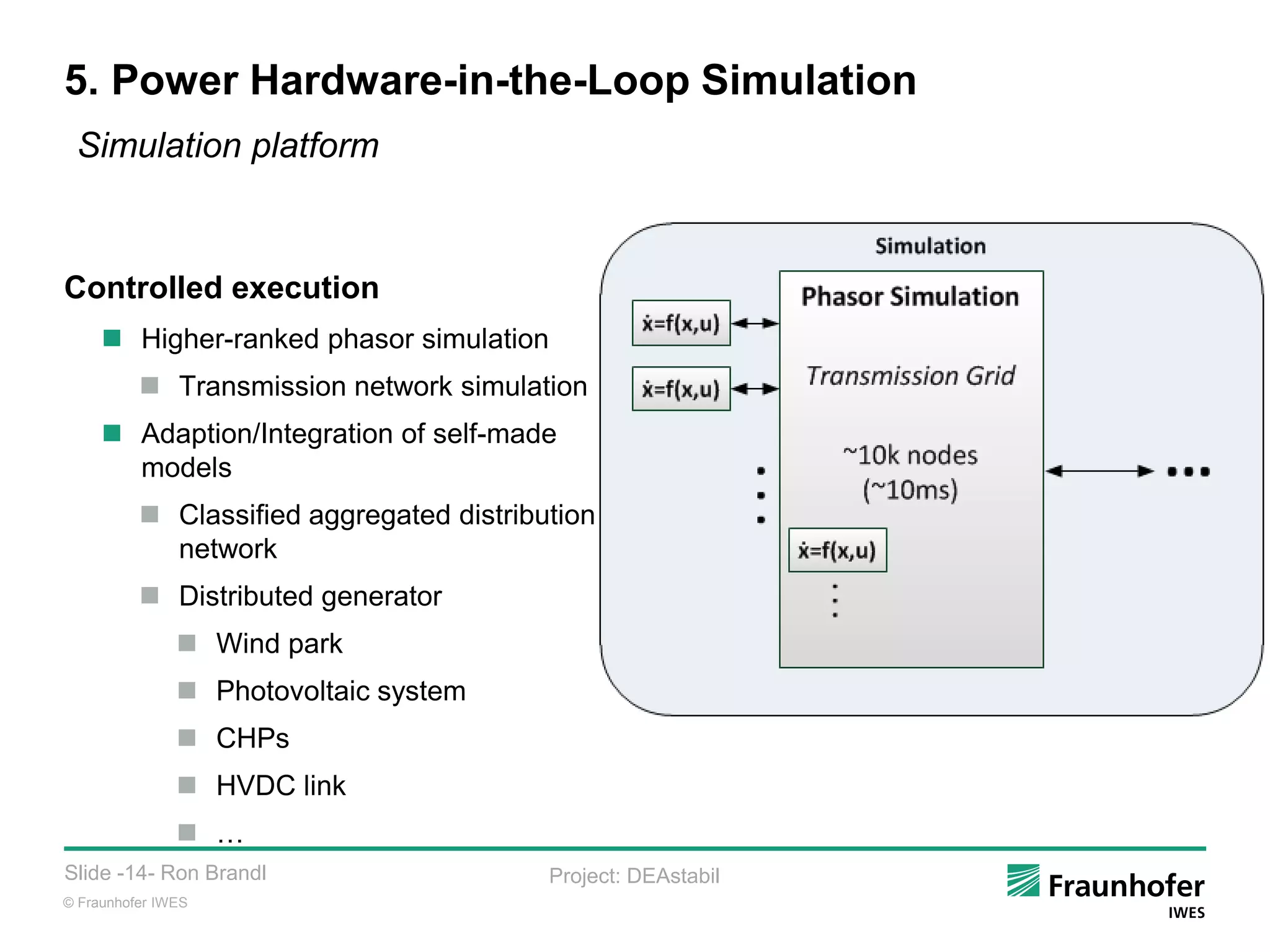
Simulation platform
Controlled execution
 Higher-ranked phasor simulation
 Transmission network simulation
 Adaption/Integration of self-made
models
 Classified aggregated distribution
network
 Distributed generator
 Wind park
 Photovoltaic system
 CHPs
 HVDC link
 …
© Fraunhofer IWES
Slide -15- Ron Brandl Project: DEAstabil
6. Conclusion
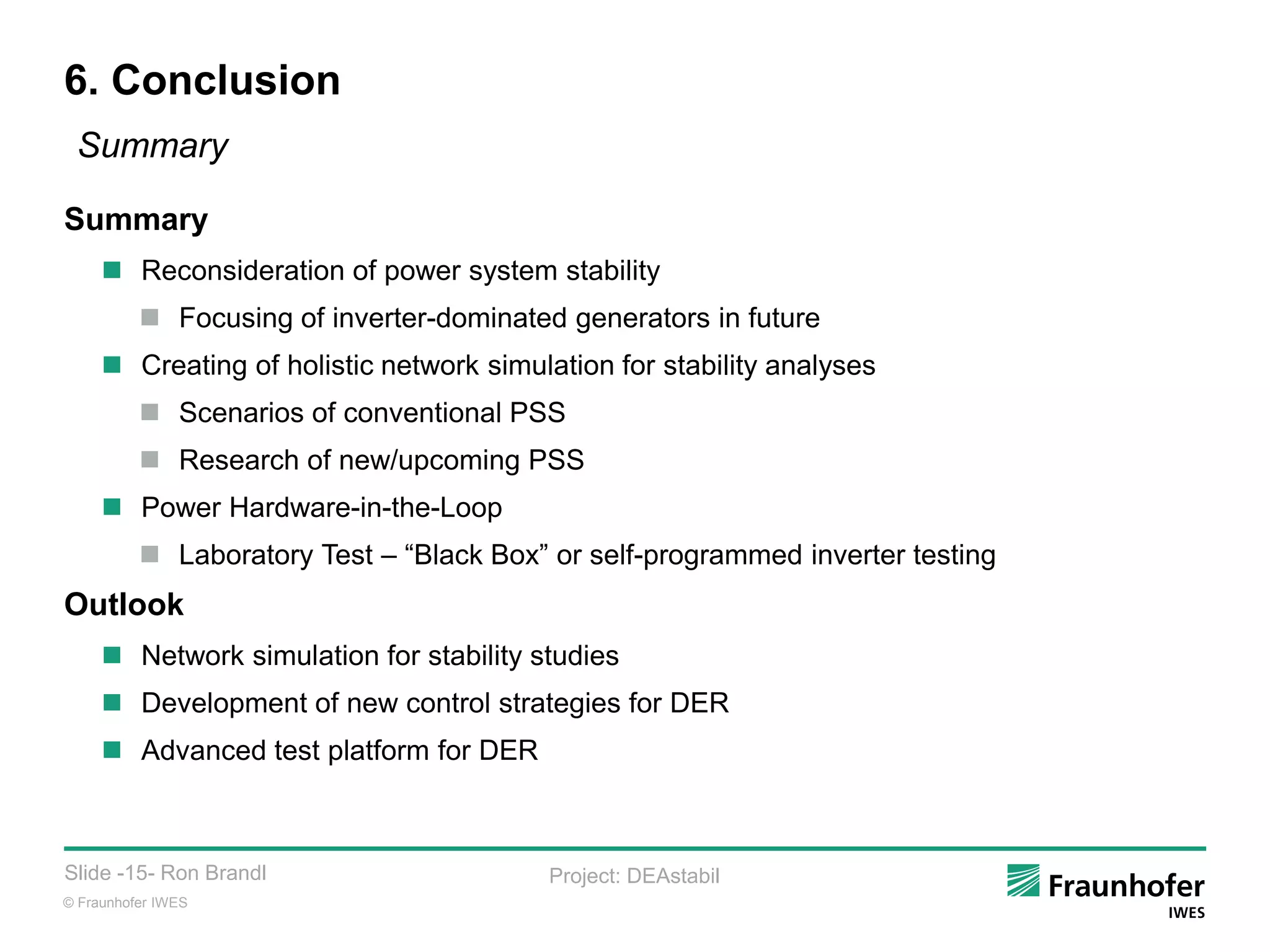
Summary
Summary
 Reconsideration of power system stability
 Focusing of inverter-dominated generators in future
 Creating of holistic network simulation for stability analyses
 Scenarios of conventional PSS
 Research of new/upcoming PSS
 Power Hardware-in-the-Loop
 Laboratory Test – “Black Box” or self-programmed inverter testing
Outlook
 Network simulation for stability studies
 Development of new control strategies for DER
 Advanced test platform for DER
© Fraunhofer IWES
Slide -16- Ron Brandl Project: DEAstabil
Thanks for your attention
Ron Brandl
Fraunhofer Intitute of Wind Energy and Energy System Technologies
Koenigstor 59
34119 Kassel/Germany
Ron.Brandl@iwes.fraunhofer.de
Acknowledgement
We acknowledge the support of our work by the
German Ministry for the Environment, Nature and
Nuclear Safety and the Projekträger Jülich within
the project “DEA-Stabil: Beitrag der Windenergie
und Photovoltaik im Verteilungsnetz zur Stabilität
des deutschen Verbundnetzes” (FKZ 0325585).

RT15 Berkeley | Multi-Terminal Power Hardware-in-the-Loop Test-Bench for Power System Stability Analyses Focused on Distributed Generation - Fraunhofer

  • 1.
    © Fraunhofer IWES Slide-1- Ron Brandl Project: DEAstabil Multi-Terminal Power Hardware-in-the-Loop Test-Bench for Power System Stability Analyses Focused on Distributed Generation RT15 Berkeley, CA | 13 - 14 June, 2015 Authors: Ron Brandl, Fraunhofer IWES Dominik Geibel, Fraunhofer IWES
  • 2.
    © Fraunhofer IWES Slide-2- Ron Brandl, Project: DEAstabil Multi-Terminal PHIL Test Bench for Power System Stability Analyses Content 1. Introduction 2. Power System Stability (PSS) 3. Simulation Environment 4. Hardware Environment 5. Power Hardware-in-the-Loop (PHIL) Simulation 6. Conclusion
  • 3.
    © Fraunhofer IWES Slide-3- Ron Brandl Project: DEAstabil 1. Introduction Motivation  Large increase in inverter-coupled generating units  In Germany over 50% of power generation is from PV and wind at certain times Change of future network  Loss of spinning reserves  Decentralization of power production  Future mix of power plant park will be inverter-dominated  Power system stability (PSS) has to be assured Transformation to inverter-dominated networks 0 10000 20000 30000 40000 50000 60000 70000 80000 0:00 1:00 2:00 3:00 4:00 5:00 6:00 7:00 8:00 9:00 10:00 11:00 12:00 13:00 14:00 15:00 16:00 17:00 18:00 19:00 20:00 21:00 22:00 23:00 ProductioninMW Conventional Production > 100MW Wind Solar 18th April 2013 in Germany
  • 4.
    © Fraunhofer IWES Slide-4- Ron Brandl Project: DEAstabil 2. Power System Stability Conventional PSS  Focused on rotating generators  Rotor angle stability  Frequency stability  Voltage stability  Reconsideration of conventional stability assessment Source: Definition and Classification of Power System Stability, IEEE/CIGRE Joint Task Force, P. Kundur et. al. Definition of Stability
  • 5.
    © Fraunhofer IWES Slide-5- Ron Brandl Project: DEAstabil 2. Power System Stability Factors for network imbalance  Failure/blackout of  central power plants  large loads  transmission line  HVDC terminals  Switching operations on transmission network  Weather influence  Change of active coupling points of the interconnection to boundary networks Scenarios for different PSS disturbances
  • 6.
    © Fraunhofer IWES Slide-6- Ron Brandl Project: DEAstabil 2. Power System Stability
  • 7.
    © Fraunhofer IWES Slide-7- Ron Brandl Project: DEAstabil 3. Simulation Environment Intention of new simulation platform  Holistic simulation of transmission and distribution network for stability studies  Include dynamics of decentralized generators in the distribution network  Ability to conduct real-time simulations, esp. PHIL simulations  Evaluation of the future needs of the power system, with increasing inverter-based generation, on a scientific basis Motivation
  • 8.
    © Fraunhofer IWES Slide-8- Ron Brandl Project: DEAstabil 3. Simulation Environment German interconnection network  Holistic stability analyses required  >> 100.000 nodes and machines from high voltage down to low voltage level Handling  Aggregated models of distribution networks with dynamic behaviors  Development of models ≤ 110 kV which are scalable and containing the influence of distribution generators  Verification of network models based on available data of real network disturbance Dynamic Model of Distribution Networks
  • 9.
    © Fraunhofer IWES Slide-9- Ron Brandl Project: DEAstabil 3. Simulation Environment Benefits/Summary Advantage  Use of self-made simulation models  Access to calculation equations and simulation routine Challenges  Development of a holistic interconnection network simulation  Real-time capability and compatibility with real-time products  Parallel simulation on different cores is necessary, due to high numbers of nodes General Benefits  Flexibility  total access for developer possible  Scalability  Level of detail user defined  Expansion to new research fields
  • 10.
    © Fraunhofer IWES Slide-10- Ron Brandl Project: DEAstabil 4. Hardware Environment Laboratory Test bench Power Hardware-in-the-Loop test bench  Development, construction and operation of PHIL test Bench  Demonstration of the contribution of distributed generators (DER) to power system stability in a laboratory environment  Verification of the influence of power- stabilizing control method from inverter- based generators by coupling real-time simulations with larger transmission and distribution networks
  • 11.
    © Fraunhofer IWES Slide-11- Ron Brandl Project: DEAstabil 4. Hardware Environment Laboratory (under preparation)  Systec Laboratory, Fraunhofer IWES  Power Hardware-in-the-Loop test bench  Ametek, Power amplifier, 3x 3phase 90 kVA (single/parallel operation)  Scienlab, DC-source (battery emulator), 290 kW  TriPhase, DC-DC-AC inverter, 2x 15 kVA
  • 12.
    © Fraunhofer IWES Slide-12- Ron Brandl Project: DEAstabil 5. Power Hardware-in-the-Loop Simulation Benefits/Summary Intention of Power Hardware-in-the-Loop simulation  Integration of „black box“ devices for stability support (e.g. converters)  Level of detail increased due to use of the real hardware in comparison to software models  All effects of the hardware can be monitored
  • 13.
    © Fraunhofer IWES Slide-13- Ron Brandl Project: DEAstabil 5. Power Hardware-in-the-Loop Simulation Network Simulation Scheme German interconnection network  Transmission level  2.000 nodes  1.000 machine  Distribution level  Aggregated models  4.500 active nodes  4.000 machines  Connection point HUT  Current feedback circuit
  • 14.
    © Fraunhofer IWES Slide-14- Ron Brandl Project: DEAstabil 5. Power Hardware-in-the-Loop Simulation Simulation platform Controlled execution  Higher-ranked phasor simulation  Transmission network simulation  Adaption/Integration of self-made models  Classified aggregated distribution network  Distributed generator  Wind park  Photovoltaic system  CHPs  HVDC link  …
  • 15.
    © Fraunhofer IWES Slide-15- Ron Brandl Project: DEAstabil 6. Conclusion Summary Summary  Reconsideration of power system stability  Focusing of inverter-dominated generators in future  Creating of holistic network simulation for stability analyses  Scenarios of conventional PSS  Research of new/upcoming PSS  Power Hardware-in-the-Loop  Laboratory Test – “Black Box” or self-programmed inverter testing Outlook  Network simulation for stability studies  Development of new control strategies for DER  Advanced test platform for DER
  • 16.
    © Fraunhofer IWES Slide-16- Ron Brandl Project: DEAstabil Thanks for your attention Ron Brandl Fraunhofer Intitute of Wind Energy and Energy System Technologies Koenigstor 59 34119 Kassel/Germany Ron.Brandl@iwes.fraunhofer.de Acknowledgement We acknowledge the support of our work by the German Ministry for the Environment, Nature and Nuclear Safety and the Projekträger Jülich within the project “DEA-Stabil: Beitrag der Windenergie und Photovoltaik im Verteilungsnetz zur Stabilität des deutschen Verbundnetzes” (FKZ 0325585).