Fishbone Diagrams (cause and effect, or Ishikawa diagrams) John Ham OISM 470W
Overview  (1 of 2)   Definition Uses Ishikawa Use within organizations benefits Creation of the Diagram Steps 1-9
Overview  (2 of 2) Example  Service example Exercise Ham Industries
Fishbone (Cause and Effect or Ishikawa) Diagrams  (1 of 4) Named after Kaoru Ishikawa Japanese Quality pioneer Resembles skeleton of a fish Focus on causes rather than symptoms of a problem Emphasizes group communication and brainstorming  Stimulates discussion
Fishbone (Cause and Effect or Ishikawa) Diagrams  (2 of 4) One of Seven basic tools of Japanese Quality Leads to increased understanding of complex problems Visual and presentational tool
Fishbone (Cause and Effect or Ishikawa) Diagrams  (3 of 4) Typically done on paper or chalkboard Recently some computer programs have been created to make Fishbone Diagrams Ishikawa Environment
Use in Organizations  (1 of 2) Can be used to improve any product, process, or service Any area of the company that is experiencing a problem Isolates all relevant causes
Use in Organizations  (2 of 2) Helps bring a problem into light  Group discussion and brainstorming Finds reasons for quality variations, and the relationships between them
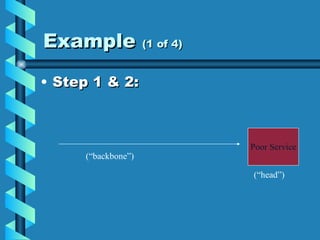
Creating Fishbone Diagrams  (1 of 4) As a group: 1. Establish problem (effect) -state in clear terms -agreed upon by entire  group 2. Problem becomes the  “head” of the fish -draw line to head (“backbone”)
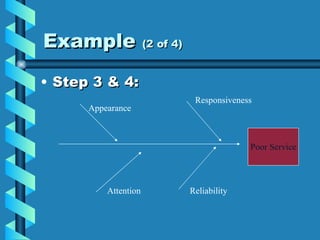
Creating a Fishbone Diagram  (2 of 4) Decide major causes of the problem - by brainstorming - if the effect or problem is part of a process the major steps in the process can be used 4. Connect major causes to backbone of the fish with slanting arrows
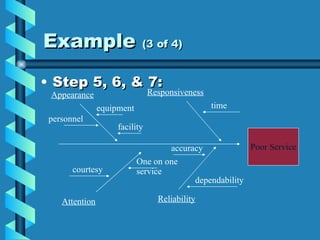
Creating a Fishbone Diagram  (3 of 4) 5. Brainstorm secondary causes  for each of the major causes 6. Connect these secondary  causes to their respective  major causes 7. Repeat steps 5 & 6 for sub- causes dividing with  increased specificity  - usually four or five levels
Creating a Fishbone Diagram  (4 of 4) 8. Analyze and evaluate causes  and sub-causes -may require the use of statistical,  analytical, and graphical tools 9. Decide and take action
Example  (1 of 4) Step 1 & 2: Poor Service (“backbone”) (“head”)
Example  (2 of 4) Step 3 & 4: Poor Service Responsiveness Reliability Appearance Attention
Example  (3 of 4) Step 5, 6, & 7: Poor Service Responsiveness Appearance Attention Reliability time courtesy personnel facility equipment One on one service dependability accuracy
Example  (4 of 4) Step 8 & 9: Use tools to analyze and evaluate causes Pareto diagrams, charts, and graphs Statistical analysis for causes in processes Decide and take action Use fishbone diagram, analysis and evaluations to find causes that can be fixed Take action to eliminate and fix problem causes
Exercise Create a Fishbone (cause and effect, Ishikawa) Diagram for the following: Management at Ham Industries has noticed that the productivity of its workers is well below the standard.  After interviewing its employees, it was noticed that a vast majority felt dissatisfied and unhappy with their work. Your boss has asked you and a group of your peers to find the causes of worker dissatisfaction .  Include all possible causes to at least the secondary level.
Summary  (1 of 3) Fishbone Diagrams - visual diagram  - resembles fish skeleton - identifies the causes of a problem (effect), and their relationships - created by Kaoru Ishikawa for Quality Management
Summary  (2 of 3) Organizational Uses Increases communication about problems Used to improve any product, process, or service Important part of quality management
Summary  (3 of 3) Creation of Fishbone diagrams Problem or effect is head of fish Identify major, secondary and tertiary causes, and attach to backbone identifying relationships Analyze and Evaluate results Act to fix the problem(s)
Bibliography //home.t-online.de/home/kfmaas/q_ishika.html www.zi.unizh.ch/software/unix/statmath/sas/sasdoc/qc/chap17/sect1.htm www.dti.gov.uk/mbp/bpgt/m9ja00001/m9ja0000110.html Foster, S. Thomas.  Managing Quality: An Integrative Approach. 2001, Prentice-Hall

Fisbone Diagrams Assgnmnt1

  • 1.
    Fishbone Diagrams (causeand effect, or Ishikawa diagrams) John Ham OISM 470W
  • 2.
    Overview (1of 2) Definition Uses Ishikawa Use within organizations benefits Creation of the Diagram Steps 1-9
  • 3.
    Overview (2of 2) Example Service example Exercise Ham Industries
  • 4.
    Fishbone (Cause andEffect or Ishikawa) Diagrams (1 of 4) Named after Kaoru Ishikawa Japanese Quality pioneer Resembles skeleton of a fish Focus on causes rather than symptoms of a problem Emphasizes group communication and brainstorming Stimulates discussion
  • 5.
    Fishbone (Cause andEffect or Ishikawa) Diagrams (2 of 4) One of Seven basic tools of Japanese Quality Leads to increased understanding of complex problems Visual and presentational tool
  • 6.
    Fishbone (Cause andEffect or Ishikawa) Diagrams (3 of 4) Typically done on paper or chalkboard Recently some computer programs have been created to make Fishbone Diagrams Ishikawa Environment
  • 7.
    Use in Organizations (1 of 2) Can be used to improve any product, process, or service Any area of the company that is experiencing a problem Isolates all relevant causes
  • 8.
    Use in Organizations (2 of 2) Helps bring a problem into light Group discussion and brainstorming Finds reasons for quality variations, and the relationships between them
  • 9.
    Creating Fishbone Diagrams (1 of 4) As a group: 1. Establish problem (effect) -state in clear terms -agreed upon by entire group 2. Problem becomes the “head” of the fish -draw line to head (“backbone”)
  • 10.
    Creating a FishboneDiagram (2 of 4) Decide major causes of the problem - by brainstorming - if the effect or problem is part of a process the major steps in the process can be used 4. Connect major causes to backbone of the fish with slanting arrows
  • 11.
    Creating a FishboneDiagram (3 of 4) 5. Brainstorm secondary causes for each of the major causes 6. Connect these secondary causes to their respective major causes 7. Repeat steps 5 & 6 for sub- causes dividing with increased specificity - usually four or five levels
  • 12.
    Creating a FishboneDiagram (4 of 4) 8. Analyze and evaluate causes and sub-causes -may require the use of statistical, analytical, and graphical tools 9. Decide and take action
  • 13.
    Example (1of 4) Step 1 & 2: Poor Service (“backbone”) (“head”)
  • 14.
    Example (2of 4) Step 3 & 4: Poor Service Responsiveness Reliability Appearance Attention
  • 15.
    Example (3of 4) Step 5, 6, & 7: Poor Service Responsiveness Appearance Attention Reliability time courtesy personnel facility equipment One on one service dependability accuracy
  • 16.
    Example (4of 4) Step 8 & 9: Use tools to analyze and evaluate causes Pareto diagrams, charts, and graphs Statistical analysis for causes in processes Decide and take action Use fishbone diagram, analysis and evaluations to find causes that can be fixed Take action to eliminate and fix problem causes
  • 17.
    Exercise Create aFishbone (cause and effect, Ishikawa) Diagram for the following: Management at Ham Industries has noticed that the productivity of its workers is well below the standard. After interviewing its employees, it was noticed that a vast majority felt dissatisfied and unhappy with their work. Your boss has asked you and a group of your peers to find the causes of worker dissatisfaction . Include all possible causes to at least the secondary level.
  • 18.
    Summary (1of 3) Fishbone Diagrams - visual diagram - resembles fish skeleton - identifies the causes of a problem (effect), and their relationships - created by Kaoru Ishikawa for Quality Management
  • 19.
    Summary (2of 3) Organizational Uses Increases communication about problems Used to improve any product, process, or service Important part of quality management
  • 20.
    Summary (3of 3) Creation of Fishbone diagrams Problem or effect is head of fish Identify major, secondary and tertiary causes, and attach to backbone identifying relationships Analyze and Evaluate results Act to fix the problem(s)
  • 21.
    Bibliography //home.t-online.de/home/kfmaas/q_ishika.html www.zi.unizh.ch/software/unix/statmath/sas/sasdoc/qc/chap17/sect1.htmwww.dti.gov.uk/mbp/bpgt/m9ja00001/m9ja0000110.html Foster, S. Thomas. Managing Quality: An Integrative Approach. 2001, Prentice-Hall

Editor's Notes

  • #2 John Ham is a student at Penn State University