Types of Weathering
Er. RAMPRASAD KUMAWAT
M.Tech
DEPARTMENT OF CIVIL
ENGINEERING
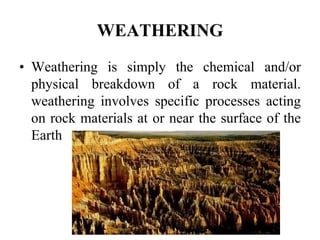
WEATHERING
• Weathering is simply the chemical and/or
physical breakdown of a rock material.
weathering involves specific processes acting
on rock materials at or near the surface of the
Earth
• Weathering is defined as a process of decay,
disintegration and decomposition of rocks under
the influence of certain physical and chemical
agencies.
• Disintegration: It may be defined as the process
of breaking up of rocks into small pieces by the
mechanical agencies of physical agents.
• Decomposition: It may be defined as the process
of breaking up of mineral constituents to form
new components by the chemical actions of the
physical agents.
TYPES OF WEATHERING
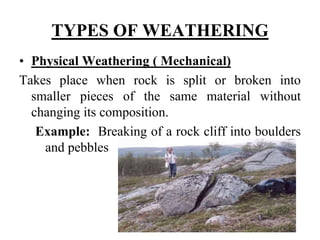
• Physical Weathering ( Mechanical)
Takes place when rock is split or broken into
smaller pieces of the same material without
changing its composition.
Example: Breaking of a rock cliff into boulders
and pebbles
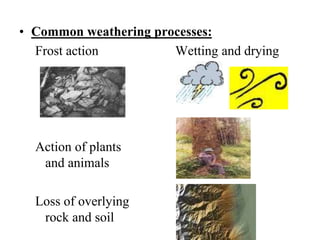
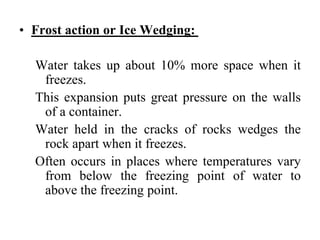
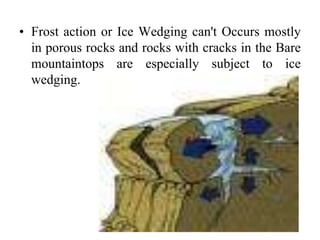
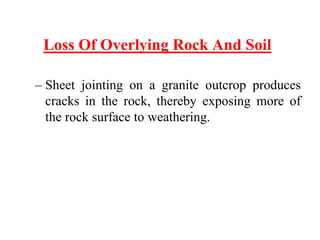
• Common weathering processes:
Frost action Wetting and drying
Action of plants
and animals
Loss of overlying
rock and soil
• Frost action or Ice Wedging:
Water takes up about 10% more space when it
freezes.
This expansion puts great pressure on the walls
of a container.
Water held in the cracks of rocks wedges the
rock apart when it freezes.
Often occurs in places where temperatures vary
from below the freezing point of water to
above the freezing point.
• Frost action or Ice Wedging can't Occurs mostly
in porous rocks and rocks with cracks in the Bare
mountaintops are especially subject to ice
wedging.
• Frost action or Ice Wedging causes:
– Vast fields of large, sharp-cornered boulders.
– Potholes on streets and highways
Repeated Wetted And Drying
• Especially effective at breaking up rocks that
contain clay.
• Clays swell up when wet and shrink when dry.
• Causes rocks that contain clay, such as shale, to fall
apart.
– Larger trees and shrubs may grow in the cracks
of boulders.
– Ants, earthworms, rabbits, woodchucks, and
other animals dig holes in the soil.
– These holes allow air and water to reach the
bedrock and weather it.
Action Of Plants And Animals
Types of Mechanical Weathering
– Sheet jointing on a granite outcrop produces
cracks in the rock, thereby exposing more of
the rock surface to weathering.
Loss Of Overlying Rock And Soil
Granite exfoliation
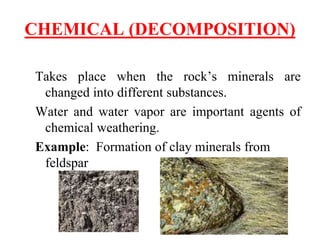
CHEMICAL (DECOMPOSITION)
Takes place when the rock’s minerals are
changed into different substances.
Water and water vapor are important agents of
chemical weathering.
Example: Formation of clay minerals from
feldspar
TYPES OF CHEMICAL WEATHERING
Results mainly from the action of
• Rainwater,
• Oxygen,
• Carbon dioxide, and
• Acids of plant decay.
Agents of Chemical Weathering
• The chemical reaction of water with other
substances is called hydrolysis.
• Common materials undergoing hydrolysis:
– Feldspar Hornblende
Augite
Agents of Chemical Weathering
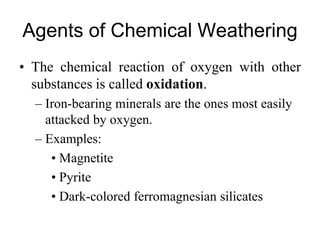
• The chemical reaction of oxygen with other
substances is called oxidation.
– Iron-bearing minerals are the ones most easily
attacked by oxygen.
– Examples:
• Magnetite
• Pyrite
• Dark-colored ferromagnesian silicates
Agents of Chemical Weathering
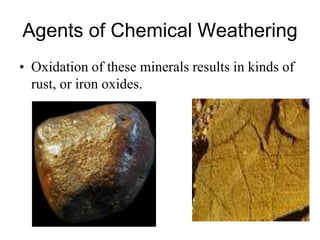
• Oxidation of these minerals results in kinds of
rust, or iron oxides.
Agents of Chemical Weathering
• Carbon dioxide dissolves easily in water.
– It forms a weak acid called carbonic acid.
– This is the same compound that is in
carbonated drinks.
– Attacks many common minerals such as
feldspar, hornblende, augite and biotite mica.
– The original mineral is changed into a clay
mineral.
Agents of Chemical Weathering
• Acids are formed from the decay of plants and
animals.
• These acids are dissolved by rainwater and
carried through the ground to the bedrock.
Agents of Chemical Weathering
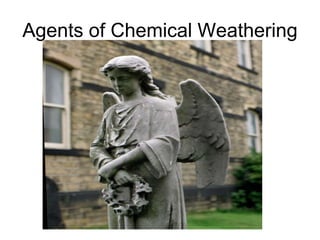
• Carbon dioxide and sulfur compounds released
by industries unite with water in the
atmosphere to form acid rain.
• Increasing amounts of acid rain in the
environment increase the rate of chemical
weathering.
Agents of Chemical Weathering
Chemical Weathering
• Occurs most quickly at the corners and edges
of rock outcrops and boulders.
• These areas are more exposed to chemicals.
• This process rounds the rock and is called
spheroidal weathering.
• Boulders rounded this
way are called
spheroidal boulders
• Thanks!
• Gmail : ramkumawat001@gmail.com

Weathering

  • 1.
    Types of Weathering Er.RAMPRASAD KUMAWAT M.Tech DEPARTMENT OF CIVIL ENGINEERING
  • 2.
    WEATHERING • Weathering issimply the chemical and/or physical breakdown of a rock material. weathering involves specific processes acting on rock materials at or near the surface of the Earth
  • 3.
    • Weathering isdefined as a process of decay, disintegration and decomposition of rocks under the influence of certain physical and chemical agencies. • Disintegration: It may be defined as the process of breaking up of rocks into small pieces by the mechanical agencies of physical agents. • Decomposition: It may be defined as the process of breaking up of mineral constituents to form new components by the chemical actions of the physical agents.
  • 4.
    TYPES OF WEATHERING •Physical Weathering ( Mechanical) Takes place when rock is split or broken into smaller pieces of the same material without changing its composition. Example: Breaking of a rock cliff into boulders and pebbles
  • 5.
    • Common weatheringprocesses: Frost action Wetting and drying Action of plants and animals Loss of overlying rock and soil
  • 6.
    • Frost actionor Ice Wedging: Water takes up about 10% more space when it freezes. This expansion puts great pressure on the walls of a container. Water held in the cracks of rocks wedges the rock apart when it freezes. Often occurs in places where temperatures vary from below the freezing point of water to above the freezing point.
  • 7.
    • Frost actionor Ice Wedging can't Occurs mostly in porous rocks and rocks with cracks in the Bare mountaintops are especially subject to ice wedging.
  • 8.
    • Frost actionor Ice Wedging causes: – Vast fields of large, sharp-cornered boulders. – Potholes on streets and highways
  • 9.
    Repeated Wetted AndDrying • Especially effective at breaking up rocks that contain clay. • Clays swell up when wet and shrink when dry. • Causes rocks that contain clay, such as shale, to fall apart.
  • 10.
    – Larger treesand shrubs may grow in the cracks of boulders. – Ants, earthworms, rabbits, woodchucks, and other animals dig holes in the soil. – These holes allow air and water to reach the bedrock and weather it. Action Of Plants And Animals
  • 11.
  • 14.
    – Sheet jointingon a granite outcrop produces cracks in the rock, thereby exposing more of the rock surface to weathering. Loss Of Overlying Rock And Soil
  • 15.
  • 16.
    CHEMICAL (DECOMPOSITION) Takes placewhen the rock’s minerals are changed into different substances. Water and water vapor are important agents of chemical weathering. Example: Formation of clay minerals from feldspar
  • 17.
    TYPES OF CHEMICALWEATHERING Results mainly from the action of • Rainwater, • Oxygen, • Carbon dioxide, and • Acids of plant decay.
  • 18.
  • 19.
    Agents of ChemicalWeathering • The chemical reaction of water with other substances is called hydrolysis. • Common materials undergoing hydrolysis: – Feldspar Hornblende Augite
  • 20.
    Agents of ChemicalWeathering • The chemical reaction of oxygen with other substances is called oxidation. – Iron-bearing minerals are the ones most easily attacked by oxygen. – Examples: • Magnetite • Pyrite • Dark-colored ferromagnesian silicates
  • 21.
    Agents of ChemicalWeathering • Oxidation of these minerals results in kinds of rust, or iron oxides.
  • 22.
    Agents of ChemicalWeathering • Carbon dioxide dissolves easily in water. – It forms a weak acid called carbonic acid. – This is the same compound that is in carbonated drinks. – Attacks many common minerals such as feldspar, hornblende, augite and biotite mica. – The original mineral is changed into a clay mineral.
  • 23.
    Agents of ChemicalWeathering • Acids are formed from the decay of plants and animals. • These acids are dissolved by rainwater and carried through the ground to the bedrock.
  • 24.
    Agents of ChemicalWeathering • Carbon dioxide and sulfur compounds released by industries unite with water in the atmosphere to form acid rain. • Increasing amounts of acid rain in the environment increase the rate of chemical weathering.
  • 25.
  • 26.
    Chemical Weathering • Occursmost quickly at the corners and edges of rock outcrops and boulders. • These areas are more exposed to chemicals. • This process rounds the rock and is called spheroidal weathering. • Boulders rounded this way are called spheroidal boulders
  • 27.
    • Thanks! • Gmail: ramkumawat001@gmail.com