INTRODUCTION
•The Earth is constantly changing or
altered physically as we have
observed. The changes driven by
different forces of nature create new
land forms. One of these forces is
weathering
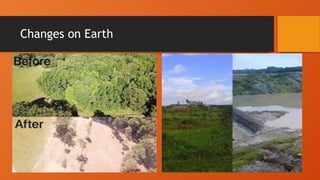
Changes on Earth
ROCKS
•Rocks are naturally occurring mass
of different kinds of minerals
Classification of Rocks
1.igneous,
2.2.metamorphic and
3.sedimentary rocks.

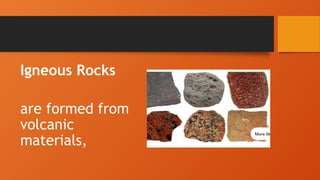
Igneous Rocks
are formed from
volcanic
materials,
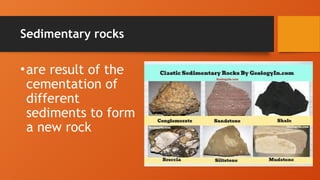
Sedimentary rocks
•are result of the
cementation of
different
sediments to form
a new rock
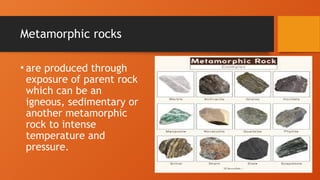
Metamorphic rocks
• are produced through
exposure of parent rock
which can be an
igneous, sedimentary or
another metamorphic
rock to intense
temperature and
pressure.
•rocks are made up of components
that can be broken down overtime.
Continuous exposure to external
environmental forces can separate
these components.
• A rock disintegrates or even dissolves because
a chemical reaction changes the composition
of the rock. When certain types of rock come
in contact with rainwater, a chemical reaction
occurs, slowly transforming the rock into
substances that dissolve in water. As these
substances dissolve, they get washed away
Guide Questions:
•1. Are you familiar with these changes in
rocks when in contact with the
environment?
•2. What particular place/s in your locality
where such occurrence is observed?
OBJECTIVES
1. identify the different agents of weathering;
2. identify the different types of physical, chemical, and biological weathering;
3. describe physical, chemical, and biological weathering; and
4. explain how rocks undergo weathering
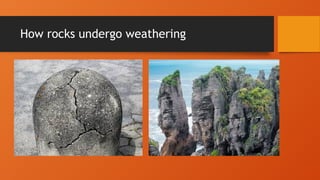
How rocks undergo weathering
Weathering
Weathering
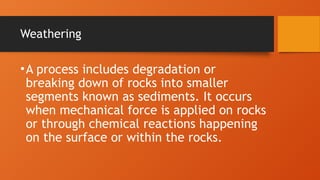
•A process includes degradation or
breaking down of rocks into smaller
segments known as sediments. It occurs
when mechanical force is applied on rocks
or through chemical reactions happening
on the surface or within the rocks.
•Weathering is the process of breakdown of
rocks at the Earth’s surface, by the action of
water, ice, acids, salts, plants, animals,
gravity and changing temperatures. There
are three types of weathering: physical
weathering, chemical weathering, and
biological weathering.
Agents of Weathering
•1. Water
• (Either in liquid or solid form) is one of the agents of mechanical
weathering.
• In liquid form, it seeped into cracks and crevices of rocks and
when the temperature dropped, it freezes and definitely will
expand in the form of ice. The ice then works as a wedge which
slowly widens the cracks and splits the rock. When the ice melts,
the liquid water performs the act of erosion by carrying away the
tiny rock fragments lost in the split.
•2. Salt
• In the process of haloclasty, salts served as an
agent of weathering. Saltwater sometimes gets
into the cracks and pores of rock. When it
evaporates, salt crystals are left behind and
grow in the cracks and pores which caused
pressure on the rock and slowly break it apart.
3. Temperature
Temperature changes can also contribute to
weathering through the process called thermal
stress. During thermal stress, rock tend to expand
with heat and contract with low temperature. As
this happens repeatedly, the structure of the rock
weakens and over time crumbles.
4.Plants
when the seed of a tree being spread in the
environment sprout in soil that has collected in a
cracked rock. As the roots grow, they widen the
cracks, eventually breaking the rock into pieces.
Over time, trees can break apart even large rocks.
Even small plants, such as mosses, can enlarge tiny
cracks as they grow.
•5. Animals
• Animals that tunnel underground, such as
moles and prairie dogs, also work to break
apart rock and soil. Other animals dig and
trample rock aboveground, causing rock to
slowly crumble.
Types of Weathering
Understanding Physical and Chemical Processes
MARGIE R. LLENO
What is Weathering?
•Weathering is the process that breaks down
rocks and minerals into smaller particles.
•It occurs due to exposure to atmospheric
conditions.
•Key types: Physical (Mechanical) Weathering
and Chemical Weathering.
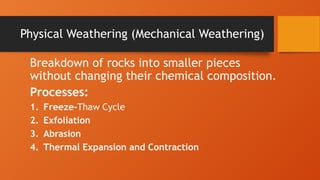
Physical Weathering (Mechanical Weathering)
Breakdown of rocks into smaller pieces
without changing their chemical composition.
Processes:
1. Freeze-Thaw Cycle
2. Exfoliation
3. Abrasion
4. Thermal Expansion and Contraction
Physical Weathering (Mechanical Weathering)
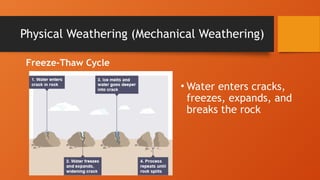
Freeze-Thaw Cycle
• Water enters cracks,
freezes, expands, and
breaks the rock
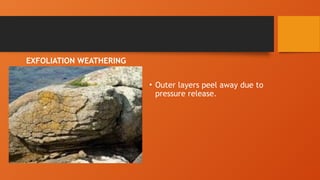
EXFOLIATION WEATHERING
• Outer layers peel away due to
pressure release.
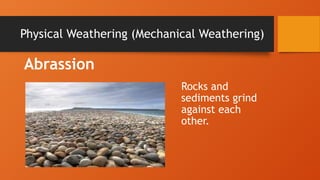
Physical Weathering (Mechanical Weathering)
Abrassion
Rocks and
sediments grind
against each
other.
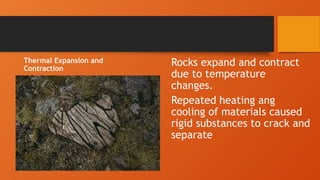
Thermal Expansion and
Contraction
Rocks expand and contract
due to temperature
changes.
Repeated heating ang
cooling of materials caused
rigid substances to crack and
separate
Chemical Weathering
•Breakdown of rocks through chemical changes, altering the
mineral composition.
•Processes:
•Hydrolysis: Reaction with water to form new minerals.
•Oxidation: Reaction with oxygen, often turning minerals
into rust.
•Carbonation: Reaction with carbon dioxide forming
carbonic acid, which dissolves minerals.
•Dissolution: Minerals dissolve in water.
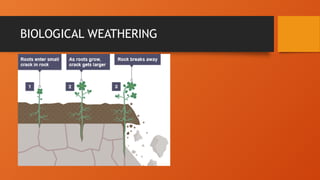
Biological Weathering
Weathering caused by living organisms.
Processes:
Physical Means
• Plant Roots: Roots penetrate and break rocks apart.
• Burrowing Animals: Disrupt soil and rock layers.
Chemical compounds
• Lichen and Moss: Produce acids that chemically
weather rocks.
BIOLOGICAL WEATHERING
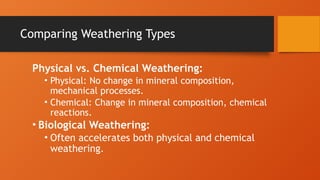
Comparing Weathering Types
Physical vs. Chemical Weathering:
• Physical: No change in mineral composition,
mechanical processes.
• Chemical: Change in mineral composition, chemical
reactions.
• Biological Weathering:
• Often accelerates both physical and chemical
weathering.
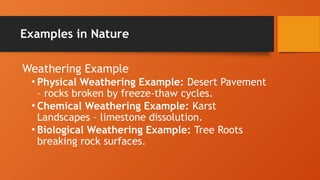
Examples in Nature
Weathering Example
• Physical Weathering Example: Desert Pavement
– rocks broken by freeze-thaw cycles.
• Chemical Weathering Example: Karst
Landscapes – limestone dissolution.
• Biological Weathering Example: Tree Roots
breaking rock surfaces.
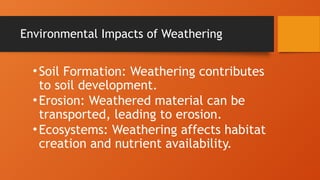
Environmental Impacts of Weathering
•Soil Formation: Weathering contributes
to soil development.
•Erosion: Weathered material can be
transported, leading to erosion.
•Ecosystems: Weathering affects habitat
creation and nutrient availability.
Reflection
•Weathering is a crucial geological
process.
•Both physical and chemical weathering
contribute to landscape changes.
•Biological weathering plays a significant
role in the ecosystem.
Questions?
• Nagiging marupok ba ang ROCKS?
Different agents that cause weathering on
rocks.

Earth Science for STEM Quarter 2 – Module 1: Weathering

  • 1.
    INTRODUCTION •The Earth isconstantly changing or altered physically as we have observed. The changes driven by different forces of nature create new land forms. One of these forces is weathering
  • 2.
  • 3.
    ROCKS •Rocks are naturallyoccurring mass of different kinds of minerals
  • 4.
  • 5.
    Igneous Rocks are formedfrom volcanic materials,
  • 6.
    Sedimentary rocks •are resultof the cementation of different sediments to form a new rock
  • 7.
    Metamorphic rocks • areproduced through exposure of parent rock which can be an igneous, sedimentary or another metamorphic rock to intense temperature and pressure.
  • 8.
    •rocks are madeup of components that can be broken down overtime. Continuous exposure to external environmental forces can separate these components.
  • 9.
    • A rockdisintegrates or even dissolves because a chemical reaction changes the composition of the rock. When certain types of rock come in contact with rainwater, a chemical reaction occurs, slowly transforming the rock into substances that dissolve in water. As these substances dissolve, they get washed away
  • 10.
    Guide Questions: •1. Areyou familiar with these changes in rocks when in contact with the environment? •2. What particular place/s in your locality where such occurrence is observed?
  • 11.
    OBJECTIVES 1. identify thedifferent agents of weathering; 2. identify the different types of physical, chemical, and biological weathering; 3. describe physical, chemical, and biological weathering; and 4. explain how rocks undergo weathering
  • 12.
  • 15.
  • 16.
    Weathering •A process includesdegradation or breaking down of rocks into smaller segments known as sediments. It occurs when mechanical force is applied on rocks or through chemical reactions happening on the surface or within the rocks.
  • 17.
    •Weathering is theprocess of breakdown of rocks at the Earth’s surface, by the action of water, ice, acids, salts, plants, animals, gravity and changing temperatures. There are three types of weathering: physical weathering, chemical weathering, and biological weathering.
  • 18.
    Agents of Weathering •1.Water • (Either in liquid or solid form) is one of the agents of mechanical weathering. • In liquid form, it seeped into cracks and crevices of rocks and when the temperature dropped, it freezes and definitely will expand in the form of ice. The ice then works as a wedge which slowly widens the cracks and splits the rock. When the ice melts, the liquid water performs the act of erosion by carrying away the tiny rock fragments lost in the split.
  • 19.
    •2. Salt • Inthe process of haloclasty, salts served as an agent of weathering. Saltwater sometimes gets into the cracks and pores of rock. When it evaporates, salt crystals are left behind and grow in the cracks and pores which caused pressure on the rock and slowly break it apart.
  • 20.
    3. Temperature Temperature changescan also contribute to weathering through the process called thermal stress. During thermal stress, rock tend to expand with heat and contract with low temperature. As this happens repeatedly, the structure of the rock weakens and over time crumbles.
  • 21.
    4.Plants when the seedof a tree being spread in the environment sprout in soil that has collected in a cracked rock. As the roots grow, they widen the cracks, eventually breaking the rock into pieces. Over time, trees can break apart even large rocks. Even small plants, such as mosses, can enlarge tiny cracks as they grow.
  • 22.
    •5. Animals • Animalsthat tunnel underground, such as moles and prairie dogs, also work to break apart rock and soil. Other animals dig and trample rock aboveground, causing rock to slowly crumble.
  • 23.
    Types of Weathering UnderstandingPhysical and Chemical Processes MARGIE R. LLENO
  • 24.
    What is Weathering? •Weatheringis the process that breaks down rocks and minerals into smaller particles. •It occurs due to exposure to atmospheric conditions. •Key types: Physical (Mechanical) Weathering and Chemical Weathering.
  • 25.
    Physical Weathering (MechanicalWeathering) Breakdown of rocks into smaller pieces without changing their chemical composition. Processes: 1. Freeze-Thaw Cycle 2. Exfoliation 3. Abrasion 4. Thermal Expansion and Contraction
  • 26.
    Physical Weathering (MechanicalWeathering) Freeze-Thaw Cycle • Water enters cracks, freezes, expands, and breaks the rock
  • 27.
    EXFOLIATION WEATHERING • Outerlayers peel away due to pressure release.
  • 28.
    Physical Weathering (MechanicalWeathering) Abrassion Rocks and sediments grind against each other.
  • 29.
    Thermal Expansion and Contraction Rocksexpand and contract due to temperature changes. Repeated heating ang cooling of materials caused rigid substances to crack and separate
  • 30.
    Chemical Weathering •Breakdown ofrocks through chemical changes, altering the mineral composition. •Processes: •Hydrolysis: Reaction with water to form new minerals. •Oxidation: Reaction with oxygen, often turning minerals into rust. •Carbonation: Reaction with carbon dioxide forming carbonic acid, which dissolves minerals. •Dissolution: Minerals dissolve in water.
  • 32.
    Biological Weathering Weathering causedby living organisms. Processes: Physical Means • Plant Roots: Roots penetrate and break rocks apart. • Burrowing Animals: Disrupt soil and rock layers. Chemical compounds • Lichen and Moss: Produce acids that chemically weather rocks.
  • 33.
  • 34.
    Comparing Weathering Types Physicalvs. Chemical Weathering: • Physical: No change in mineral composition, mechanical processes. • Chemical: Change in mineral composition, chemical reactions. • Biological Weathering: • Often accelerates both physical and chemical weathering.
  • 35.
    Examples in Nature WeatheringExample • Physical Weathering Example: Desert Pavement – rocks broken by freeze-thaw cycles. • Chemical Weathering Example: Karst Landscapes – limestone dissolution. • Biological Weathering Example: Tree Roots breaking rock surfaces.
  • 36.
    Environmental Impacts ofWeathering •Soil Formation: Weathering contributes to soil development. •Erosion: Weathered material can be transported, leading to erosion. •Ecosystems: Weathering affects habitat creation and nutrient availability.
  • 37.
    Reflection •Weathering is acrucial geological process. •Both physical and chemical weathering contribute to landscape changes. •Biological weathering plays a significant role in the ecosystem.
  • 38.
  • 39.
    Different agents thatcause weathering on rocks.