DEPARTMENT OF ELECTRONICS ENGINEERING
SCHOOL OF ENGINEERING AND TECHNOLOGY
PONDICHERRY UNIVERSITY,KALAPET,
PUDUCHERRY-605014
SIMULATION
ON
“WDM SYSTEMS”
SUBMITTED BY
FAIZAN SHAFI [21304012]
ECENG-636 [FSON]
M.Tech (ECE) – II year
SUBMITTED TO
Dr. R. Nakkeeran
ASSOCIATE PROFESSOR
Dept. Of Electronics Engineering
CONTENTS
 WAVELENGTH DIVISION MULTIPLEXING
 CATEGORIES OF WDM
 WORKING PRINCIPLE OF WDM
 ADVANTAGE & DISADVANTAGES OF WDM
 APPLICATIONS OF WDM
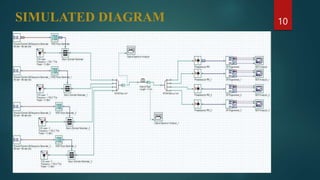
 SIMULATED DIAGRAM
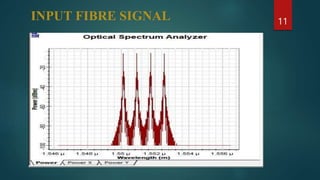
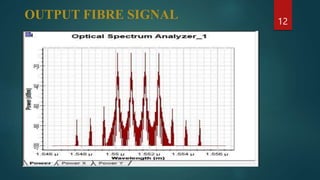
 INPUT & OUTPUT FIBRE SIGNAL
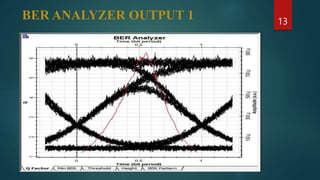
 BER ANALYZER OUTPUTS
 SOFTWARE USED
 REFERENCES
WAVELENGTH DIVISION MULTIPLEXING
 In fibre optic communications Wavelength Division Multiplexing or WDM
is a technology which multiplexes a number of optical carrier signals onto
a single optical fibre by using different wavelengths of laser light. This
technique enables us to get high bit rate and efficient use of fibre
bandwidth. WDM allows communication in both the directions in the
fiber cable.
 In WDM, the optical signals from different sources or (transponders) are
combined by a multiplexer, which is essentially an optical combiner. They
are combined so that their wavelengths are different. The combined
signal is transmitted via a single optical fiber strand. At the receiving end,
a demultiplexer splits the incoming beam into its components and each of
the beams is send to the corresponding receivers.
3
EXAMPLE
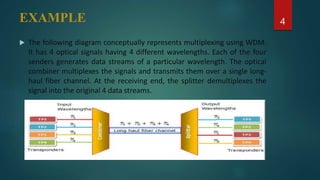
 The following diagram conceptually represents multiplexing using WDM.
It has 4 optical signals having 4 different wavelengths. Each of the four
senders generates data streams of a particular wavelength. The optical
combiner multiplexes the signals and transmits them over a single long-
haul fiber channel. At the receiving end, the splitter demultiplexes the
signal into the original 4 data streams.
4
CATEGORIES OF WDM
Based upon the wavelength, WDM systems are divided into three
categories:-
• Normal(WDM) :- Normal WDM (sometimes called BWDM) uses the two
normal wavelengths 1310 and 1550 nm on one fiber.
• Coarse WDM (CWDM) :- CWDM generally operates with 8 channels where
the spacing between the channels is 20 nm (nanometers) apart. It
consumes less energy than DWDM and is less expensive. However, the
capacity of the links as well as the distance supported is lesser.
• Dense WDM (DWDM) :- In DWDM, the number of multiplexed channels
are much larger than CWDM. It is either 40 at 100GHz spacing or 80 with
50GHz spacing. Due to this, they can transmit the huge quantity of data
through a single fiber link. DWDM is generally applied in core networks of
telecommunications and cable networks. It is also used in cloud data
centers for their IaaS services.
5
WORKING PRINCIPLE OF WDM
 WDM is a technology that enables various optical signals to be transmitted
by a single fiber. Its principle is essentially the same as Frequency Division
Multiplexing (FDM). That is, several signals are transmitted using different
carriers, occupying non-overlapping parts of a frequency spectrum.
 WDM technique enables bidirectional communications over a single strand
of fiber, also called wavelength-division duplexing, as well as multiplication
of capacity.
 Most WDM systems operate on single-mode fiber optical cables which
have a core diameter of 9 µm. Certain forms of WDM can also be used in
multi-mode fiber cables (also known as premises cables) which have core
diameters of 50 or 62.5 µm.
6
ADVANTAGES OF WDM
Advantages of WDM are :-
• Easier to reconfigure
• Full duplex transmission is possible
• It provides higher bandwidth
• Optical component are similar and more reliable
• High security
• This could be the best approach as it is simple to implement
7
DISADVANTAGES OF WDM
Disadvantages of WDM are :-
• Signals cannot be very close i.e., signals are more crowded
• Cost of the system increases with the addition of optical components
• Difficulty in wavelength tuning
• Difficulty in a cascaded topology
• Costly
8
APPLICATIONS OF WDM
Applications of WDM are :-
• The technology of WDM is widely used in Optical Transport Networks.
The rapid growth of data service demands a higher quality of the capacity
of transmission equipments, network bandwidth and the ability of multi-
service transmission.
• In SONET network.
• Dense WDM multiplexing allow to muxed and demuxed numbers of
channel closer to one another to achieve greater efficiency.
• Optical transport network.
• Local exchange network.
9
SIMULATED DIAGRAM 10
INPUT FIBRE SIGNAL 11
OUTPUT FIBRE SIGNAL 12
BER ANALYZER OUTPUT 1 13
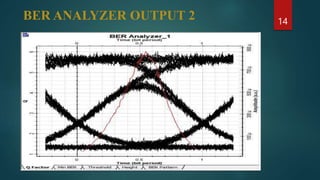
BER ANALYZER OUTPUT 2 14
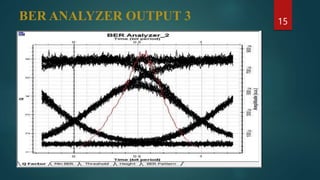
BER ANALYZER OUTPUT 3 15
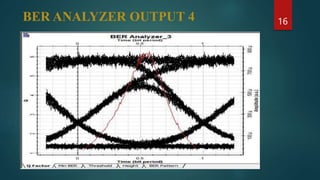
BER ANALYZER OUTPUT 4 16
SOFTWARE USED
 OPTISYSTEM 19
17
REFERENCES
 https://en.wikipedia.org/wiki/Wavelength-division_multiplexing
 https://www.tutorialspoint.com/wavelength-division-multiplexing
 https://www.ciena.com/insights/what-is/What-Is-WDM.html
 https://www.smartoptics.com/this-is-wdm/the-basics-of-wavelength-division-
multiplexing-wdm/
18
19

WDM SYSTEMS

  • 1.
    DEPARTMENT OF ELECTRONICSENGINEERING SCHOOL OF ENGINEERING AND TECHNOLOGY PONDICHERRY UNIVERSITY,KALAPET, PUDUCHERRY-605014 SIMULATION ON “WDM SYSTEMS” SUBMITTED BY FAIZAN SHAFI [21304012] ECENG-636 [FSON] M.Tech (ECE) – II year SUBMITTED TO Dr. R. Nakkeeran ASSOCIATE PROFESSOR Dept. Of Electronics Engineering
  • 2.
    CONTENTS  WAVELENGTH DIVISIONMULTIPLEXING  CATEGORIES OF WDM  WORKING PRINCIPLE OF WDM  ADVANTAGE & DISADVANTAGES OF WDM  APPLICATIONS OF WDM  SIMULATED DIAGRAM  INPUT & OUTPUT FIBRE SIGNAL  BER ANALYZER OUTPUTS  SOFTWARE USED  REFERENCES
  • 3.
    WAVELENGTH DIVISION MULTIPLEXING In fibre optic communications Wavelength Division Multiplexing or WDM is a technology which multiplexes a number of optical carrier signals onto a single optical fibre by using different wavelengths of laser light. This technique enables us to get high bit rate and efficient use of fibre bandwidth. WDM allows communication in both the directions in the fiber cable.  In WDM, the optical signals from different sources or (transponders) are combined by a multiplexer, which is essentially an optical combiner. They are combined so that their wavelengths are different. The combined signal is transmitted via a single optical fiber strand. At the receiving end, a demultiplexer splits the incoming beam into its components and each of the beams is send to the corresponding receivers. 3
  • 4.
    EXAMPLE  The followingdiagram conceptually represents multiplexing using WDM. It has 4 optical signals having 4 different wavelengths. Each of the four senders generates data streams of a particular wavelength. The optical combiner multiplexes the signals and transmits them over a single long- haul fiber channel. At the receiving end, the splitter demultiplexes the signal into the original 4 data streams. 4
  • 5.
    CATEGORIES OF WDM Basedupon the wavelength, WDM systems are divided into three categories:- • Normal(WDM) :- Normal WDM (sometimes called BWDM) uses the two normal wavelengths 1310 and 1550 nm on one fiber. • Coarse WDM (CWDM) :- CWDM generally operates with 8 channels where the spacing between the channels is 20 nm (nanometers) apart. It consumes less energy than DWDM and is less expensive. However, the capacity of the links as well as the distance supported is lesser. • Dense WDM (DWDM) :- In DWDM, the number of multiplexed channels are much larger than CWDM. It is either 40 at 100GHz spacing or 80 with 50GHz spacing. Due to this, they can transmit the huge quantity of data through a single fiber link. DWDM is generally applied in core networks of telecommunications and cable networks. It is also used in cloud data centers for their IaaS services. 5
  • 6.
    WORKING PRINCIPLE OFWDM  WDM is a technology that enables various optical signals to be transmitted by a single fiber. Its principle is essentially the same as Frequency Division Multiplexing (FDM). That is, several signals are transmitted using different carriers, occupying non-overlapping parts of a frequency spectrum.  WDM technique enables bidirectional communications over a single strand of fiber, also called wavelength-division duplexing, as well as multiplication of capacity.  Most WDM systems operate on single-mode fiber optical cables which have a core diameter of 9 µm. Certain forms of WDM can also be used in multi-mode fiber cables (also known as premises cables) which have core diameters of 50 or 62.5 µm. 6
  • 7.
    ADVANTAGES OF WDM Advantagesof WDM are :- • Easier to reconfigure • Full duplex transmission is possible • It provides higher bandwidth • Optical component are similar and more reliable • High security • This could be the best approach as it is simple to implement 7
  • 8.
    DISADVANTAGES OF WDM Disadvantagesof WDM are :- • Signals cannot be very close i.e., signals are more crowded • Cost of the system increases with the addition of optical components • Difficulty in wavelength tuning • Difficulty in a cascaded topology • Costly 8
  • 9.
    APPLICATIONS OF WDM Applicationsof WDM are :- • The technology of WDM is widely used in Optical Transport Networks. The rapid growth of data service demands a higher quality of the capacity of transmission equipments, network bandwidth and the ability of multi- service transmission. • In SONET network. • Dense WDM multiplexing allow to muxed and demuxed numbers of channel closer to one another to achieve greater efficiency. • Optical transport network. • Local exchange network. 9
  • 10.
  • 11.
  • 12.
  • 13.
  • 14.
  • 15.
  • 16.
  • 17.
  • 18.
    REFERENCES  https://en.wikipedia.org/wiki/Wavelength-division_multiplexing  https://www.tutorialspoint.com/wavelength-division-multiplexing https://www.ciena.com/insights/what-is/What-Is-WDM.html  https://www.smartoptics.com/this-is-wdm/the-basics-of-wavelength-division- multiplexing-wdm/ 18
  • 19.