VibrationVibration
What is vibration?What is vibration?
 When we are sitting in our homeWhen we are sitting in our home
or any place where we are fully oror any place where we are fully or
partially touching the ground andpartially touching the ground and
suddenly earthquake comessuddenly earthquake comes
which shakes everything, Itswhich shakes everything, Its
Vibration.Vibration.
 when a fully automatic machinewhen a fully automatic machine
stops rotating and in the endstops rotating and in the end
vibrates too much is vibration.vibrates too much is vibration.
 The extra ordinary motion ofThe extra ordinary motion of
anything around us is consideredanything around us is considered
as vibrations.as vibrations.
MAIN CAUSE OFMAIN CAUSE OF
VIBRATIONVIBRATION
1.Unbalanced force in the different parts of the1.Unbalanced force in the different parts of the
machine.machine.
2.Lack of lubricants between two mating surface.2.Lack of lubricants between two mating surface.
3.External load or force which make system3.External load or force which make system
vibrant.vibrant.
4.Lack of balancing of force in machine part.4.Lack of balancing of force in machine part.
5.Earthquakes5.Earthquakes
6.Winds which may cause vibration in6.Winds which may cause vibration in
transmission and telephone lines.transmission and telephone lines.
HARMFUL EFFECTS OFHARMFUL EFFECTS OF
VIBRATIONVIBRATION
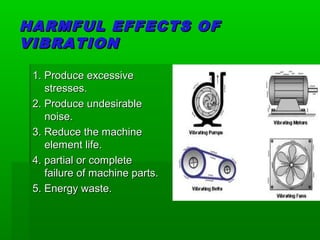
1. Produce excessive1. Produce excessive
stresses.stresses.
2. Produce undesirable2. Produce undesirable
noise.noise.
3. Reduce the machine3. Reduce the machine
element life.element life.
4. partial or complete4. partial or complete
failure of machine parts.failure of machine parts.
5. Energy waste.5. Energy waste.
WHERE VIBRARION EFFECTWHERE VIBRARION EFFECT
REQUIREDREQUIRED
1. In musical1. In musical
instruments.instruments.
2. In vibrating2. In vibrating
screen.screen.
3. stress relieving.3. stress relieving.
4. In Mobile phones.4. In Mobile phones.
5. Motion of turning5. Motion of turning
fork.fork.
6. Vibration in loud6. Vibration in loud
speaker.speaker.
ELEMINATION OR REDUCTION OFELEMINATION OR REDUCTION OF
VIBRATIONVIBRATION
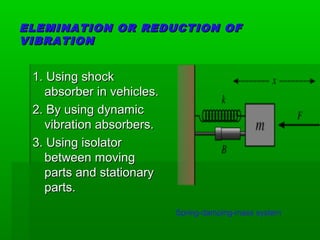
1. Using shock1. Using shock
absorber in vehicles.absorber in vehicles.
2. By using dynamic2. By using dynamic
vibration absorbers.vibration absorbers.
3. Using isolator3. Using isolator
between movingbetween moving
parts and stationaryparts and stationary
parts.parts.
Spring-damping-mass system
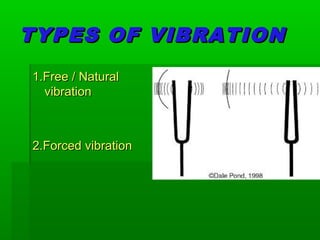
TYPES OF VIBRATIONTYPES OF VIBRATION
1.Free / Natural1.Free / Natural
vibrationvibration
2.Forced vibration2.Forced vibration
FREE VIBRATIONFREE VIBRATION
When there no externalWhen there no external
excitations force on body orexcitations force on body or
body itself vibrate without anybody itself vibrate without any
external force, then vibrationexternal force, then vibration
in the body is called naturalin the body is called natural
or free vibration. this type ofor free vibration. this type of
vibration occurs when avibration occurs when a
system is set off with an initialsystem is set off with an initial
input and then allow toinput and then allow to
vibration freely.vibration freely.
- A system with free vibration- A system with free vibration
vibrates with one or more ofvibrates with one or more of
its natural frequency.its natural frequency.
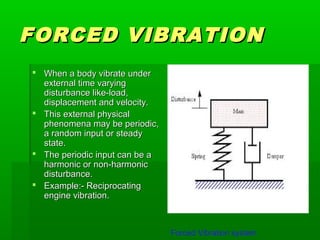
FORCED VIBRATIONFORCED VIBRATION
 When a body vibrate underWhen a body vibrate under
external time varyingexternal time varying
disturbance like-load,disturbance like-load,
displacement and velocity.displacement and velocity.
 This external physicalThis external physical
phenomena may be periodic,phenomena may be periodic,
a random input or steadya random input or steady
state.state.
 The periodic input can be aThe periodic input can be a
harmonic or non-harmonicharmonic or non-harmonic
disturbance.disturbance.
 Example:- ReciprocatingExample:- Reciprocating
engine vibration.engine vibration.
Forced Vibration system
FUNDAMENTALS OFFUNDAMENTALS OF
VIBRATIONSVIBRATIONS
 1.Periodic motion1.Periodic motion --
when a moving body repeats itswhen a moving body repeats its
motion or itself after a equal interval of time, then thismotion or itself after a equal interval of time, then this
motion is called periodic motion.motion is called periodic motion.
 2.Time period -2.Time period -
Time taken to complete one cycle.Time taken to complete one cycle.
 3. Frequency -3. Frequency -
Number of cycles moved by a bodyNumber of cycles moved by a body
per unit time.per unit time.
 4. Amplitude of motion -4. Amplitude of motion -
The maximum displacement of aThe maximum displacement of a
vibrating body from the mean position.vibrating body from the mean position.
 5. Natural frequency -5. Natural frequency -
frequency of free vibration of thefrequency of free vibration of the
system and it will be constant for a given system.system and it will be constant for a given system.
 6. Resonance -6. Resonance -
when the frequency of external force iswhen the frequency of external force is
equal to the natural frequency of the system, then thisequal to the natural frequency of the system, then this
condition is called resonance, and the amplitude ofcondition is called resonance, and the amplitude of
vibration at the resonance become excessive.vibration at the resonance become excessive.
 7.Damping -7.Damping -
Resistance to the motion of the vibratingResistance to the motion of the vibrating
body.body.
For more visitFor more visit
www.studyhubz.comwww.studyhubz.com
Thank youThank you
A Power Point Presentation byA Power Point Presentation by
Yogendra Singh ShekhawatYogendra Singh Shekhawat
B. Tech, Mechanical EngineeringB. Tech, Mechanical Engineering

Vibration

  • 1.
  • 2.
    What is vibration?Whatis vibration?  When we are sitting in our homeWhen we are sitting in our home or any place where we are fully oror any place where we are fully or partially touching the ground andpartially touching the ground and suddenly earthquake comessuddenly earthquake comes which shakes everything, Itswhich shakes everything, Its Vibration.Vibration.  when a fully automatic machinewhen a fully automatic machine stops rotating and in the endstops rotating and in the end vibrates too much is vibration.vibrates too much is vibration.  The extra ordinary motion ofThe extra ordinary motion of anything around us is consideredanything around us is considered as vibrations.as vibrations.
  • 3.
    MAIN CAUSE OFMAINCAUSE OF VIBRATIONVIBRATION 1.Unbalanced force in the different parts of the1.Unbalanced force in the different parts of the machine.machine. 2.Lack of lubricants between two mating surface.2.Lack of lubricants between two mating surface. 3.External load or force which make system3.External load or force which make system vibrant.vibrant. 4.Lack of balancing of force in machine part.4.Lack of balancing of force in machine part. 5.Earthquakes5.Earthquakes 6.Winds which may cause vibration in6.Winds which may cause vibration in transmission and telephone lines.transmission and telephone lines.
  • 4.
    HARMFUL EFFECTS OFHARMFULEFFECTS OF VIBRATIONVIBRATION 1. Produce excessive1. Produce excessive stresses.stresses. 2. Produce undesirable2. Produce undesirable noise.noise. 3. Reduce the machine3. Reduce the machine element life.element life. 4. partial or complete4. partial or complete failure of machine parts.failure of machine parts. 5. Energy waste.5. Energy waste.
  • 5.
    WHERE VIBRARION EFFECTWHEREVIBRARION EFFECT REQUIREDREQUIRED 1. In musical1. In musical instruments.instruments. 2. In vibrating2. In vibrating screen.screen. 3. stress relieving.3. stress relieving. 4. In Mobile phones.4. In Mobile phones. 5. Motion of turning5. Motion of turning fork.fork. 6. Vibration in loud6. Vibration in loud speaker.speaker.
  • 6.
    ELEMINATION OR REDUCTIONOFELEMINATION OR REDUCTION OF VIBRATIONVIBRATION 1. Using shock1. Using shock absorber in vehicles.absorber in vehicles. 2. By using dynamic2. By using dynamic vibration absorbers.vibration absorbers. 3. Using isolator3. Using isolator between movingbetween moving parts and stationaryparts and stationary parts.parts. Spring-damping-mass system
  • 7.
    TYPES OF VIBRATIONTYPESOF VIBRATION 1.Free / Natural1.Free / Natural vibrationvibration 2.Forced vibration2.Forced vibration
  • 8.
    FREE VIBRATIONFREE VIBRATION Whenthere no externalWhen there no external excitations force on body orexcitations force on body or body itself vibrate without anybody itself vibrate without any external force, then vibrationexternal force, then vibration in the body is called naturalin the body is called natural or free vibration. this type ofor free vibration. this type of vibration occurs when avibration occurs when a system is set off with an initialsystem is set off with an initial input and then allow toinput and then allow to vibration freely.vibration freely. - A system with free vibration- A system with free vibration vibrates with one or more ofvibrates with one or more of its natural frequency.its natural frequency.
  • 9.
    FORCED VIBRATIONFORCED VIBRATION When a body vibrate underWhen a body vibrate under external time varyingexternal time varying disturbance like-load,disturbance like-load, displacement and velocity.displacement and velocity.  This external physicalThis external physical phenomena may be periodic,phenomena may be periodic, a random input or steadya random input or steady state.state.  The periodic input can be aThe periodic input can be a harmonic or non-harmonicharmonic or non-harmonic disturbance.disturbance.  Example:- ReciprocatingExample:- Reciprocating engine vibration.engine vibration. Forced Vibration system
  • 10.
    FUNDAMENTALS OFFUNDAMENTALS OF VIBRATIONSVIBRATIONS 1.Periodic motion1.Periodic motion -- when a moving body repeats itswhen a moving body repeats its motion or itself after a equal interval of time, then thismotion or itself after a equal interval of time, then this motion is called periodic motion.motion is called periodic motion.  2.Time period -2.Time period - Time taken to complete one cycle.Time taken to complete one cycle.  3. Frequency -3. Frequency - Number of cycles moved by a bodyNumber of cycles moved by a body per unit time.per unit time.
  • 11.
     4. Amplitudeof motion -4. Amplitude of motion - The maximum displacement of aThe maximum displacement of a vibrating body from the mean position.vibrating body from the mean position.  5. Natural frequency -5. Natural frequency - frequency of free vibration of thefrequency of free vibration of the system and it will be constant for a given system.system and it will be constant for a given system.  6. Resonance -6. Resonance - when the frequency of external force iswhen the frequency of external force is equal to the natural frequency of the system, then thisequal to the natural frequency of the system, then this condition is called resonance, and the amplitude ofcondition is called resonance, and the amplitude of vibration at the resonance become excessive.vibration at the resonance become excessive.  7.Damping -7.Damping - Resistance to the motion of the vibratingResistance to the motion of the vibrating body.body.
  • 12.
    For more visitFormore visit www.studyhubz.comwww.studyhubz.com Thank youThank you A Power Point Presentation byA Power Point Presentation by Yogendra Singh ShekhawatYogendra Singh Shekhawat B. Tech, Mechanical EngineeringB. Tech, Mechanical Engineering