Measurement in Physics


   AP Physics C
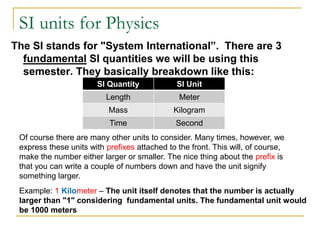
SI units for Physics
The SI stands for "System International”. There are 3
  fundamental SI quantities we will be using this
  semester. They basically breakdown like this:
                       SI Quantity             SI Unit
                          Length                Meter
                           Mass               Kilogram
                           Time                Second
 Of course there are many other units to consider. Many times, however, we
 express these units with prefixes attached to the front. This will, of course,
 make the number either larger or smaller. The nice thing about the prefix is
 that you can write a couple of numbers down and have the unit signify
 something larger.
 Example: 1 Kilometer – The unit itself denotes that the number is actually
 larger than "1" considering fundamental units. The fundamental unit would
 be 1000 meters
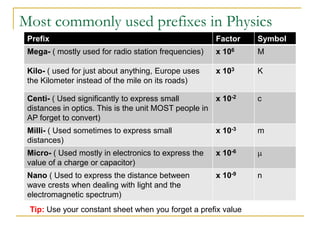
Most commonly used prefixes in Physics
 Prefix                                               Factor   Symbol
 Mega- ( mostly used for radio station frequencies)   x 106    M

 Kilo- ( used for just about anything, Europe uses    x 103    K
 the Kilometer instead of the mile on its roads)

 Centi- ( Used significantly to express small         x 10-2   c
 distances in optics. This is the unit MOST people in
 AP forget to convert)
 Milli- ( Used sometimes to express small             x 10-3   m
 distances)
 Micro- ( Used mostly in electronics to express the   x 10-6
 value of a charge or capacitor)
 Nano ( Used to express the distance between          x 10-9   n
 wave crests when dealing with light and the
 electromagnetic spectrum)
 Tip: Use your constant sheet when you forget a prefix value
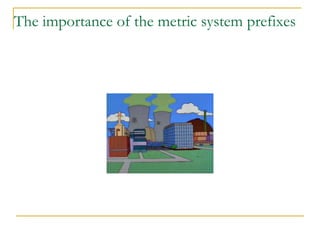
The importance of the metric system prefixes
Example
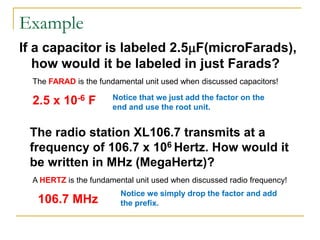
If a capacitor is labeled 2.5 F(microFarads),
   how would it be labeled in just Farads?
  The FARAD is the fundamental unit used when discussed capacitors!
                       Notice that we just add the factor on the
  2.5 x 10⁻⁶ F         end and use the root unit.


 The radio station XL106.7 transmits at a
 frequency of 106.7 x 10⁶ Hertz. How would it
 be written in MHz (MegaHertz)?
  A HERTZ is the fundamental unit used when discussed radio frequency!
                         Notice we simply drop the factor and add
   106.7 MHz             the prefix.
SI: Derived Units
 units that come from multiplying or dividing fundamental units

Physical Quantity              Unit Name                  Symbol

         area                square meter                    m2
       volume                 cubic meter                    m3
                               meter per
       speed                                                m/s
                                second
                                meter per
    acceleration                                            m/s2
                             second squared
   weight, force                 newton                N (kg·m/s²)
   energy, work                   joule                   J (N·m)
Dimensional Analysis
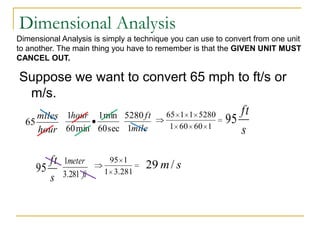
Dimensional Analysis is simply a technique you can use to convert from one unit
to another. The main thing you have to remember is that the GIVEN UNIT MUST
CANCEL OUT.

Suppose we want to convert 65 mph to ft/s or
  m/s.
    miles 1hour 1 min 5280 ft 65 1 1 5280    ft
 65                            1 60 60 1
                                          95
    hour 60 min 60 sec 1mile                 s

        ft   1meter      95 1
                                   29 m / s
     95      3.281 ft   1 3.281
        s
Trigonometric Functions
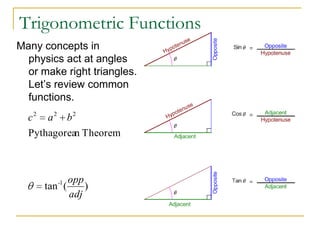
Many concepts in
  physics act at angles
  or make right triangles.
  Let’s review common
  functions.
  c2 a2 b2
  Pythagorean Theorem


         -1 opp
      tan (     )
            adj
Example
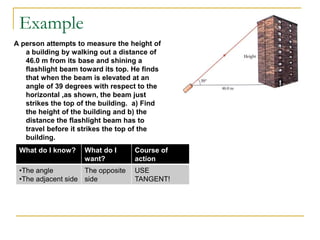
A person attempts to measure the height of
   a building by walking out a distance of
   46.0 m from its base and shining a
   flashlight beam toward its top. He finds
   that when the beam is elevated at an
   angle of 39 degrees with respect to the
   horizontal ,as shown, the beam just
   strikes the top of the building. a) Find
   the height of the building and b) the
   distance the flashlight beam has to
   travel before it strikes the top of the
   building.
 What do I know?    What do I      Course of
                    want?          action
 •The angle         The opposite   USE
 •The adjacent side side           TANGENT!
Example
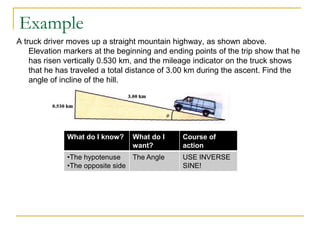
A truck driver moves up a straight mountain highway, as shown above.
    Elevation markers at the beginning and ending points of the trip show that he
    has risen vertically 0.530 km, and the mileage indicator on the truck shows
    that he has traveled a total distance of 3.00 km during the ascent. Find the
    angle of incline of the hill.


              What do I know?    What do I     Course of
                                 want?         action
              •The hypotenuse    The Angle     USE INVERSE
              •The opposite side               SINE!
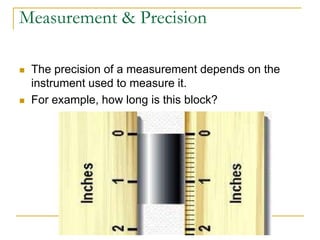
Measurement & Precision

   The precision of a measurement depends on the
    instrument used to measure it.
   For example, how long is this block?
Measurement & Precision

   Imagine you have a piece of string that is
    exactly 1 foot long.
   Now imagine you were to use that string to
    measure the length of your pencil. How
    precise could you be about the length of the
    pencil?
   Since the pencil is less than 1 foot, we must
    be dealing with a fraction of a foot. But what
    fraction can we reliably estimate as the length
    of the pencil?
Measurement & Precision

   Suppose the pencil is slightly over half the 1 foot
    string. You guess, “Well it must be about 7 inches,
    so I’ll say 7/12 of a foot.”
   Here’s the problem: If you convert 7/12 to a
    decimal, you get 0.583.
   Can you reliably say, without a doubt, that the pencil
    is 0.583 and not 0.584 or 0.582?
   You can’t. The string didn’t allow you to distinguish
    between those lengths… you didn’t have enough
    precision.
   So, what can you estimate, reliably?
Measurement & Precision

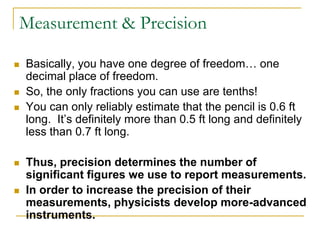
   Basically, you have one degree of freedom… one
    decimal place of freedom.
   So, the only fractions you can use are tenths!
   You can only reliably estimate that the pencil is 0.6 ft
    long. It’s definitely more than 0.5 ft long and definitely
    less than 0.7 ft long.

   Thus, precision determines the number of
    significant figures we use to report measurements.
   In order to increase the precision of their
    measurements, physicists develop more-advanced
    instruments.
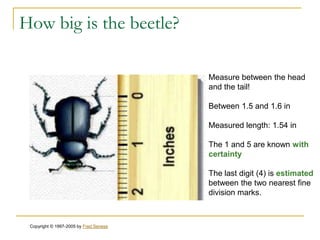
How big is the beetle?

                                        Measure between the head
                                        and the tail!

                                        Between 1.5 and 1.6 in

                                        Measured length: 1.54 in

                                        The 1 and 5 are known with
                                        certainty

                                        The last digit (4) is estimated
                                        between the two nearest fine
                                        division marks.


 Copyright © 1997-2005 by Fred Senese
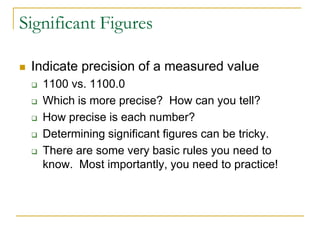
Significant Figures

   Indicate precision of a measured value
       1100 vs. 1100.0
       Which is more precise? How can you tell?
       How precise is each number?
       Determining significant figures can be tricky.
       There are some very basic rules you need to
        know. Most importantly, you need to practice!
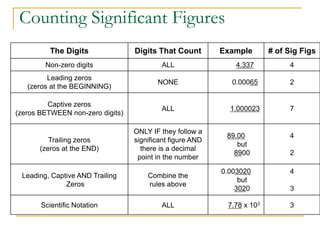
Counting Significant Figures
          The Digits              Digits That Count        Example       # of Sig Figs
        Non-zero digits                    ALL                 4.337          4
         Leading zeros
                                         NONE                0.00065          2
   (zeros at the BEGINNING)

         Captive zeros
                                           ALL               1.000023         7
(zeros BETWEEN non-zero digits)

                                  ONLY IF they follow a
                                                            89.00             4
          Trailing zeros          significant figure AND
                                                               but
       (zeros at the END)           there is a decimal
                                                              8900            2
                                   point in the number

                                                           0.003020           4
 Leading, Captive AND Trailing        Combine the
                                                                but
              Zeros                   rules above
                                                               3020           3

       Scientific Notation                 ALL              7.78 x 10³        3
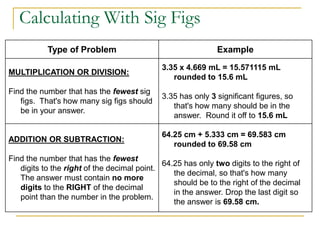
Calculating With Sig Figs
           Type of Problem                                   Example
                                             3.35 x 4.669 mL = 15.571115 mL
MULTIPLICATION OR DIVISION:
                                                rounded to 15.6 mL
Find the number that has the fewest sig
                                             3.35 has only 3 significant figures, so
   figs. That's how many sig figs should
                                                that's how many should be in the
   be in your answer.
                                                answer. Round it off to 15.6 mL

                                             64.25 cm + 5.333 cm = 69.583 cm
ADDITION OR SUBTRACTION:
                                                rounded to 69.58 cm
Find the number that has the fewest
                                             64.25 has only two digits to the right of
   digits to the right of the decimal point.
                                                the decimal, so that's how many
   The answer must contain no more
                                                should be to the right of the decimal
   digits to the RIGHT of the decimal
                                                in the answer. Drop the last digit so
   point than the number in the problem.
                                                the answer is 69.58 cm.
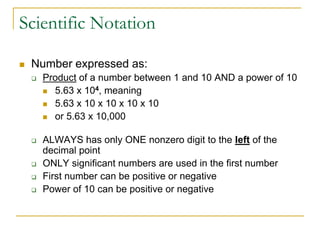
Scientific Notation

   Number expressed as:
       Product of a number between 1 and 10 AND a power of 10
         5.63 x 10⁴, meaning

         5.63 x 10 x 10 x 10 x 10

         or 5.63 x 10,000


       ALWAYS has only ONE nonzero digit to the left of the
        decimal point
       ONLY significant numbers are used in the first number
       First number can be positive or negative
       Power of 10 can be positive or negative
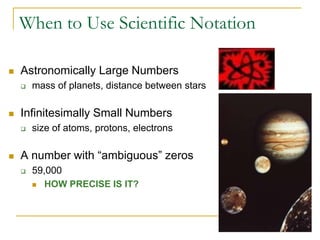
When to Use Scientific Notation

   Astronomically Large Numbers
       mass of planets, distance between stars

   Infinitesimally Small Numbers
       size of atoms, protons, electrons

   A number with “ambiguous” zeros
       59,000
         HOW PRECISE IS IT?
Order of Magnitude

   Approximation based on a number of
    assumptions
       may need to modify assumptions if more precise
        results are needed
   Order of magnitude is the power of 10 that
    applies
Order of Magnitude – Process
   Estimate a number and express it in scientific notation
       The multiplier of the power of 10 needs to be between 1 and
        10
   Divide the number by the power of 10
   Compare the remaining value to 3.162 ( 10 )
       If the remainder is less than 3.162, the order of magnitude is
        the power of 10 in the scientific notation
       If the remainder is greater than 3.162, the order of magnitude
        is one more than the power of 10 in the scientific notation
   Easier – Find the logarithm (base 10) of the number,
    round it to the nearest whole number, and use that as
    the power of 10
Using Order of Magnitude

   Estimating too high for one number is often
    canceled by estimating too low for another
    number
       The resulting order of magnitude is generally
        reliable within about a factor of 10
   Working the problem allows you to drop
    digits, make reasonable approximations and
    simplify approximations
   With practice, your results will become better
    and better
Uncertainty in Measurements

   There is uncertainty in every measurement –
    this uncertainty carries over through the
    calculations
       May be due to the apparatus, the experimenter,
        and/or the number of measurements made
       Need a technique to account for this uncertainty
   We will use rules for significant figures to
    approximate the uncertainty in results of
    calculations
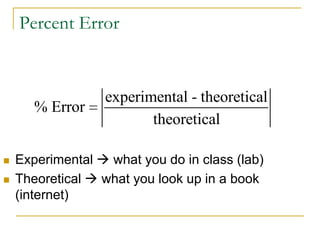
Percent Error


                  experimental - theoretical
       % Error
                         theoretical

   Experimental  what you do in class (lab)
   Theoretical  what you look up in a book
    (internet)
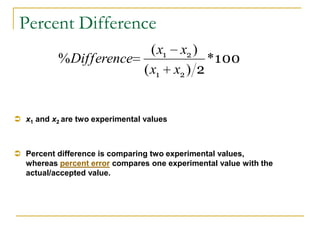
Percent Difference
                          ( x1 x2 )
           % Difference             * 100
                        ( x1 x2 ) 2


 x1 and x2 are two experimental values


 Percent difference is comparing two experimental values,
  whereas percent error compares one experimental value with the
  actual/accepted value.

Measurement

  • 1.
  • 2.
    SI units forPhysics The SI stands for "System International”. There are 3 fundamental SI quantities we will be using this semester. They basically breakdown like this: SI Quantity SI Unit Length Meter Mass Kilogram Time Second Of course there are many other units to consider. Many times, however, we express these units with prefixes attached to the front. This will, of course, make the number either larger or smaller. The nice thing about the prefix is that you can write a couple of numbers down and have the unit signify something larger. Example: 1 Kilometer – The unit itself denotes that the number is actually larger than "1" considering fundamental units. The fundamental unit would be 1000 meters
  • 3.
    Most commonly usedprefixes in Physics Prefix Factor Symbol Mega- ( mostly used for radio station frequencies) x 106 M Kilo- ( used for just about anything, Europe uses x 103 K the Kilometer instead of the mile on its roads) Centi- ( Used significantly to express small x 10-2 c distances in optics. This is the unit MOST people in AP forget to convert) Milli- ( Used sometimes to express small x 10-3 m distances) Micro- ( Used mostly in electronics to express the x 10-6 value of a charge or capacitor) Nano ( Used to express the distance between x 10-9 n wave crests when dealing with light and the electromagnetic spectrum) Tip: Use your constant sheet when you forget a prefix value
  • 4.
    The importance ofthe metric system prefixes
  • 5.
    Example If a capacitoris labeled 2.5 F(microFarads), how would it be labeled in just Farads? The FARAD is the fundamental unit used when discussed capacitors! Notice that we just add the factor on the 2.5 x 10⁻⁶ F end and use the root unit. The radio station XL106.7 transmits at a frequency of 106.7 x 10⁶ Hertz. How would it be written in MHz (MegaHertz)? A HERTZ is the fundamental unit used when discussed radio frequency! Notice we simply drop the factor and add 106.7 MHz the prefix.
  • 6.
    SI: Derived Units units that come from multiplying or dividing fundamental units Physical Quantity Unit Name Symbol area square meter m2 volume cubic meter m3 meter per speed m/s second meter per acceleration m/s2 second squared weight, force newton N (kg·m/s²) energy, work joule J (N·m)
  • 7.
    Dimensional Analysis Dimensional Analysisis simply a technique you can use to convert from one unit to another. The main thing you have to remember is that the GIVEN UNIT MUST CANCEL OUT. Suppose we want to convert 65 mph to ft/s or m/s. miles 1hour 1 min 5280 ft 65 1 1 5280 ft 65 1 60 60 1 95 hour 60 min 60 sec 1mile s ft 1meter 95 1 29 m / s 95 3.281 ft 1 3.281 s
  • 8.
    Trigonometric Functions Many conceptsin physics act at angles or make right triangles. Let’s review common functions. c2 a2 b2 Pythagorean Theorem -1 opp tan ( ) adj
  • 9.
    Example A person attemptsto measure the height of a building by walking out a distance of 46.0 m from its base and shining a flashlight beam toward its top. He finds that when the beam is elevated at an angle of 39 degrees with respect to the horizontal ,as shown, the beam just strikes the top of the building. a) Find the height of the building and b) the distance the flashlight beam has to travel before it strikes the top of the building. What do I know? What do I Course of want? action •The angle The opposite USE •The adjacent side side TANGENT!
  • 10.
    Example A truck drivermoves up a straight mountain highway, as shown above. Elevation markers at the beginning and ending points of the trip show that he has risen vertically 0.530 km, and the mileage indicator on the truck shows that he has traveled a total distance of 3.00 km during the ascent. Find the angle of incline of the hill. What do I know? What do I Course of want? action •The hypotenuse The Angle USE INVERSE •The opposite side SINE!
  • 11.
    Measurement & Precision  The precision of a measurement depends on the instrument used to measure it.  For example, how long is this block?
  • 12.
    Measurement & Precision  Imagine you have a piece of string that is exactly 1 foot long.  Now imagine you were to use that string to measure the length of your pencil. How precise could you be about the length of the pencil?  Since the pencil is less than 1 foot, we must be dealing with a fraction of a foot. But what fraction can we reliably estimate as the length of the pencil?
  • 13.
    Measurement & Precision  Suppose the pencil is slightly over half the 1 foot string. You guess, “Well it must be about 7 inches, so I’ll say 7/12 of a foot.”  Here’s the problem: If you convert 7/12 to a decimal, you get 0.583.  Can you reliably say, without a doubt, that the pencil is 0.583 and not 0.584 or 0.582?  You can’t. The string didn’t allow you to distinguish between those lengths… you didn’t have enough precision.  So, what can you estimate, reliably?
  • 14.
    Measurement & Precision  Basically, you have one degree of freedom… one decimal place of freedom.  So, the only fractions you can use are tenths!  You can only reliably estimate that the pencil is 0.6 ft long. It’s definitely more than 0.5 ft long and definitely less than 0.7 ft long.  Thus, precision determines the number of significant figures we use to report measurements.  In order to increase the precision of their measurements, physicists develop more-advanced instruments.
  • 15.
    How big isthe beetle? Measure between the head and the tail! Between 1.5 and 1.6 in Measured length: 1.54 in The 1 and 5 are known with certainty The last digit (4) is estimated between the two nearest fine division marks. Copyright © 1997-2005 by Fred Senese
  • 16.
    Significant Figures  Indicate precision of a measured value  1100 vs. 1100.0  Which is more precise? How can you tell?  How precise is each number?  Determining significant figures can be tricky.  There are some very basic rules you need to know. Most importantly, you need to practice!
  • 17.
    Counting Significant Figures The Digits Digits That Count Example # of Sig Figs Non-zero digits ALL 4.337 4 Leading zeros NONE 0.00065 2 (zeros at the BEGINNING) Captive zeros ALL 1.000023 7 (zeros BETWEEN non-zero digits) ONLY IF they follow a 89.00 4 Trailing zeros significant figure AND but (zeros at the END) there is a decimal 8900 2 point in the number 0.003020 4 Leading, Captive AND Trailing Combine the but Zeros rules above 3020 3 Scientific Notation ALL 7.78 x 10³ 3
  • 18.
    Calculating With SigFigs Type of Problem Example 3.35 x 4.669 mL = 15.571115 mL MULTIPLICATION OR DIVISION: rounded to 15.6 mL Find the number that has the fewest sig 3.35 has only 3 significant figures, so figs. That's how many sig figs should that's how many should be in the be in your answer. answer. Round it off to 15.6 mL 64.25 cm + 5.333 cm = 69.583 cm ADDITION OR SUBTRACTION: rounded to 69.58 cm Find the number that has the fewest 64.25 has only two digits to the right of digits to the right of the decimal point. the decimal, so that's how many The answer must contain no more should be to the right of the decimal digits to the RIGHT of the decimal in the answer. Drop the last digit so point than the number in the problem. the answer is 69.58 cm.
  • 19.
    Scientific Notation  Number expressed as:  Product of a number between 1 and 10 AND a power of 10  5.63 x 10⁴, meaning  5.63 x 10 x 10 x 10 x 10  or 5.63 x 10,000  ALWAYS has only ONE nonzero digit to the left of the decimal point  ONLY significant numbers are used in the first number  First number can be positive or negative  Power of 10 can be positive or negative
  • 20.
    When to UseScientific Notation  Astronomically Large Numbers  mass of planets, distance between stars  Infinitesimally Small Numbers  size of atoms, protons, electrons  A number with “ambiguous” zeros  59,000  HOW PRECISE IS IT?
  • 21.
    Order of Magnitude  Approximation based on a number of assumptions  may need to modify assumptions if more precise results are needed  Order of magnitude is the power of 10 that applies
  • 22.
    Order of Magnitude– Process  Estimate a number and express it in scientific notation  The multiplier of the power of 10 needs to be between 1 and 10  Divide the number by the power of 10  Compare the remaining value to 3.162 ( 10 )  If the remainder is less than 3.162, the order of magnitude is the power of 10 in the scientific notation  If the remainder is greater than 3.162, the order of magnitude is one more than the power of 10 in the scientific notation  Easier – Find the logarithm (base 10) of the number, round it to the nearest whole number, and use that as the power of 10
  • 23.
    Using Order ofMagnitude  Estimating too high for one number is often canceled by estimating too low for another number  The resulting order of magnitude is generally reliable within about a factor of 10  Working the problem allows you to drop digits, make reasonable approximations and simplify approximations  With practice, your results will become better and better
  • 24.
    Uncertainty in Measurements  There is uncertainty in every measurement – this uncertainty carries over through the calculations  May be due to the apparatus, the experimenter, and/or the number of measurements made  Need a technique to account for this uncertainty  We will use rules for significant figures to approximate the uncertainty in results of calculations
  • 25.
    Percent Error experimental - theoretical % Error theoretical  Experimental  what you do in class (lab)  Theoretical  what you look up in a book (internet)
  • 26.
    Percent Difference ( x1 x2 ) % Difference * 100 ( x1 x2 ) 2  x1 and x2 are two experimental values  Percent difference is comparing two experimental values, whereas percent error compares one experimental value with the actual/accepted value.