Kidanemariam Jembere,
Technical Advisor, GWP Africa Coordination Unit
K.Jembere@cgiar.org
Vulnerability Assessment and Options Appraisal in
Developing an Adaptation Program in Uganda
(water resources management system)
Presentation for LEG Regional Training on NAPs
27 February-3 March 2017, Lilongwe, Malawi
The National Adaptation Plan Global
Support Programme (NAP-GSP)
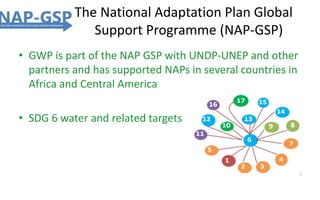
• GWP is part of the NAP GSP with UNDP-UNEP and other
partners and has supported NAPs in several countries in
Africa and Central America
• SDG 6 water and related targets
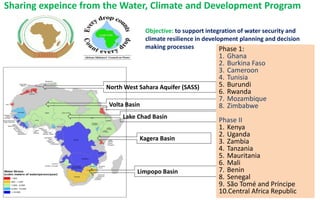
North West Sahara Aquifer (SASS)
Volta Basin
Lake Chad Basin
Limpopo Basin
Kagera Basin
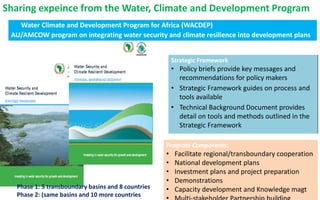
Sharing expeince from the Water, Climate and Development Program
Phase 1:
1. Ghana
2. Burkina Faso
3. Cameroon
4. Tunisia
5. Burundi
6. Rwanda
7. Mozambique
8. Zimbabwe
Phase II
1. Kenya
2. Uganda
3. Zambia
4. Tanzania
5. Mauritania
6. Mali
7. Benin
8. Senegal
9. São Tomé and Príncipe
10.Central Africa Republic
Objective: to support integration of water security and
climate resilience in development planning and decision
making processes
Water Climate and Development Program for Africa (WACDEP)
AU/AMCOW program on integrating water security and climate resilience into development plans
Sharing expeince from the Water, Climate and Development Program
Strategic Framework
• Policy briefs provide key messages and
recommendations for policy makers
• Strategic Framework guides on process and
tools available
• Technical Background Document provides
detail on tools and methods outlined in the
Strategic Framework
Program Components:
• Facilitate regional/transboundary cooperation
• National development plans
• Investment plans and project preparation
• Demonstrations
• Capacity development and Knowledge magtPhase 1: 5 transboundary basins and 8 countries
Phase 2: (same basins and 10 more countries
Vulnerability Assessment and Options Appraisal in
Developing an Adaptation Program in Uganda
(water resources management system)
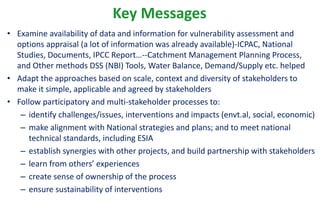
Key Messages
• Examine availability of data and information for vulnerability assessment and
options appraisal (a lot of information was already available)-ICPAC, National
Studies, Documents, IPCC Report…--Catchment Management Planning Process,
and Other methods DSS (NBI) Tools, Water Balance, Demand/Supply etc. helped
• Adapt the approaches based on scale, context and diversity of stakeholders to
make it simple, applicable and agreed by stakeholders
• Follow participatory and multi-stakeholder processes to:
– identify challenges/issues, interventions and impacts (envt.al, social, economic)
– make alignment with National strategies and plans; and to meet national
technical standards, including ESIA
– establish synergies with other projects, and build partnership with stakeholders
– learn from others’ experiences
– create sense of ownership of the process
– ensure sustainability of interventions
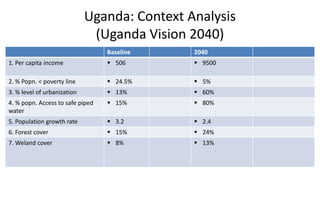
Uganda: Context Analysis
(Uganda Vision 2040)
Baseline 2040
1. Per capita income  506  9500
2. % Popn. < poverty line  24.5%  5%
3. % level of urbanization  13%  60%
4. % popn. Access to safe piped
water
 15%  80%
5. Population growth rate  3.2  2.4
6. Forest cover  15%  24%
7. Weland cover  8%  13%
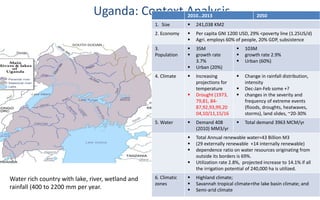
Uganda: Context Analysis2010…2013 2050
1. Size  241,038 KM2
2. Economy  Per capita GNI 1200 USD, 29% <poverty line (1.25US/d)
 Agri. employs 60% of people, 20% GDP, subsistence
3.
Population
 35M
 growth rate
3.7%
 Urban (20%)
 103M
 growth rate 2.9%
 Urban (60%)
4. Climate  Increasing
projections for
temperature
 Drought (1973,
79,81, 84-
87,92,93,99,20
04,10/11,15/16
 Change in rainfall distribution,
intensity
 Dec-Jan-Feb some +?
 changes in the severity and
frequency of extreme events
(floods, droughts, heatwaves,
storms), land slides, ~20-30%
5. Water  Demand 408
(2010) MM3/yr
 Total demand 3963 MCM/yr
 Total Annual renewable water=43 Billion M3
 (29 externally renewable +14 internally renewable)
 dependence ratio on water resources originating from
outside its borders is 69%.
 Utilization rate 2.8%, projected increase to 14.1% if all
the irrigation potential of 240,000 ha is utilized.
6. Climatic
zones
 Highland climate;
 Savannah tropical climate+the lake basin climate; and
 Semi-arid climate
Water rich country with lake, river, wetland and
rainfall (400 to 2200 mm per year.
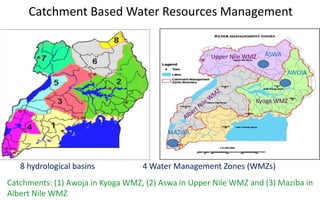
Catchment Based Water Resources Management
8 hydrological basins 4 Water Management Zones (WMZs)
AWOJA
ASWA
MAZIBA
Upper Nile WMZ
Kyoga WMZ
Catchments: (1) Awoja in Kyoga WMZ, (2) Aswa in Upper Nile WMZ and (3) Maziba in
Albert Nile WMZ
Catchment selection criteria
• Relative degree of vulnerability to climate change, and severity of other
challenges such as land degradation, water scarcity and population pressure
• Sensitivity of ecological systems such as degraded highlands, wetlands, grazing
lands/savannah.
• Broader representation of climatic zones of Uganda..
• Representation of diverse livelihood and social systems
Note: Prioritization of catchments done by MWE as part of Catchment Management
Planning process.
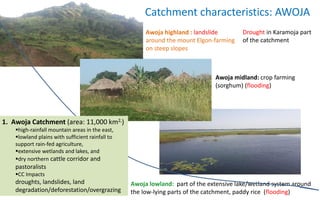
Awoja highland : landslide
around the mount Elgon-farming
on steep slopes
Awoja midland: crop farming
(sorghum) (flooding)
Awoja lowland: part of the extensive lake/wetland system around
the low-lying parts of the catchment, paddy rice (flooding)
Drought in Karamoja part
of the catchment
1. Awoja Catchment (area: 11,000 km2,)
high-rainfall mountain areas in the east,
lowland plains with sufficient rainfall to
support rain-fed agriculture,
extensive wetlands and lakes, and
dry northern cattle corridor and
pastoralists
CC Impacts
droughts, landslides, land
degradation/deforestation/overgrazing
Catchment characteristics: AWOJA
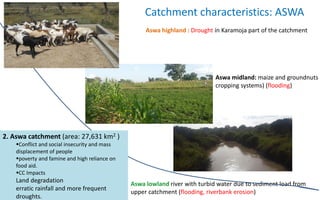
Aswa highland : Drought in Karamoja part of the catchment
Aswa midland: maize and groundnuts
cropping systems) (flooding)
Aswa lowland river with turbid water due to sediment load from
upper catchment (flooding, riverbank erosion)
Catchment characteristics: ASWA
2. Aswa catchment (area: 27,631 km2 )
Conflict and social insecurity and mass
displacement of people
poverty and famine and high reliance on
food aid.
CC Impacts
Land degradation
erratic rainfall and more frequent
droughts.
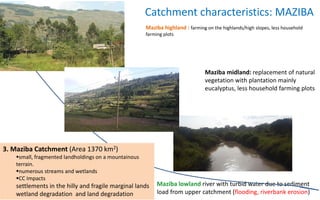
Maziba highland : farming on the highlands/high slopes, less household
farming plots
Maziba midland: replacement of natural
vegetation with plantation mainly
eucalyptus, less household farming plots
Maziba lowland river with turbid water due to sediment
load from upper catchment (flooding, riverbank erosion)
Catchment characteristics: MAZIBA
3. Maziba Catchment (Area 1370 km2)
small, fragmented landholdings on a mountainous
terrain.
numerous streams and wetlands
CC Impacts
settlements in the hilly and fragile marginal lands
wetland degradation and land degradation
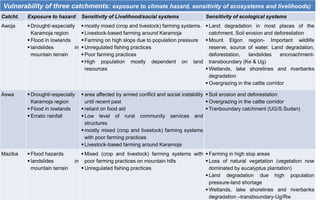
Vulnerability of three catchments: exposure to climate hazard, sensitivity of ecosystems and livelihoods)
Catcht. Exposure to hazard Sensitivity of Livelihood/social systems Sensitivity of ecological systems
Awoja  Drought/-especially
Karamoja region
 Flood in lowlands
 landslides in
mountain terrain
 mostly mixed (crop and livestock) farming systems.
 Livestock-based farming around Karamoja
 Farming on high slops due to population pressure
 Unregulated fishing practices
 Poor farming practices
 High population mostly dependent on land
resources
 Land degradation in most places of the
catchment. Soil erosion and deforestation
 Mount Elgon region- Important wildlife
reserve, source of water. Land degradation,
deforestation, landslides encroachment-
transboundary (Ke & Ug)
 Wetlands, lake shorelines and riverbanks
degradation
 Overgrazing in the cattle corridor
Aswa  Drought/-especially
Karamoja region
 Flood in lowlands
 Erratic rainfall
 area affected by armed conflict and social instability
until recent past
 reliant on food aid
 Low level of rural community services and
structures
 mostly mixed (crop and livestock) farming systems
with poor farming practices
 Livestock-based farming around Karamoja
 Soil erosion and deforestation
 Overgrazing in the cattle corridor
 Tranboundary catchment (UG/S.Sudan)
Maziba  Flood hazards
 landslides in
mountain terrain
 Mixed (crop and livestock) farming systems with
poor farming practices on mountain hills
 Unregulated fishing practices
 Farming in high slop areas
 Loss of natural vegetation (vegetation now
dominated by eucalyptus plantation)
 Land degradation due high population
pressure-land shortage
 Wetlands, lake shorelines and riverbanks
degradation –transboundary-Ug/Rw
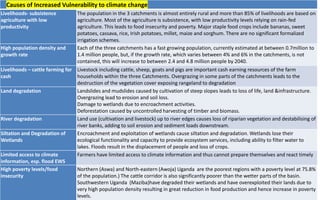
Causes of Increased Vulnerability to climate change
Livelihoods- subsistence
agriculture with low
productivity
The population in the 3 catchments is almost entirely rural and more than 85% of livelihoods are based on
agriculture. Most of the agriculture is subsistence, with low productivity levels relying on rain-fed
agriculture. This leads to food insecurity and poverty. Major staple food crops include bananas, sweet
potatoes, cassava, rice, Irish potatoes, millet, maize and sorghum. There are no significant formalized
irrigation schemes.
High population density and
growth rate
Each of the three catchments has a fast growing population, currently estimated at between 0.7million to
1.4 million people, but, if the growth rate, which varies between 4% and 6% in the catchments, is not
contained, this will increase to between 2.4 and 4.8 million people by 2040.
Livelihoods – cattle farming for
cash
Livestock including cattle, sheep, goats and pigs are important cash earning resources of the farm
households within the three Catchments. Overgrazing in some parts of the catchments leads to the
destruction of the vegetation cover exposing rangeland to degradation
Land degradation Landslides and mudslides caused by cultivation of steep slopes leads to loss of life, land &infrastructure.
Overgrazing lead to erosion and soil loss.
Damage to wetlands due to encroachment activities.
Deforestation caused by uncontrolled harvesting of timber and biomass.
River degradation Land use (cultivation and livestock) up to river edges causes loss of riparian vegetation and destabilising of
river banks, adding to soil erosion and sediment loads downstream.
Siltation and Degradation of
Wetlands
Encroachment and exploitation of wetlands cause siltation and degradation. Wetlands lose their
ecological functionality and capacity to provide ecosystem services, including ability to filter water to
lakes. Floods result in the displacement of people and loss of crops.
Limited access to climate
information, esp. flood EWS
Farmers have limited access to climate information and thus cannot prepare themselves and react timely
High poverty levels/food
insecurity
Northern (Aswa) and North-eastern (Awoja) Uganda are the poorest regions with a poverty level at 75.8%
of the population.) The cattle corridor is also significantly poorer than the wetter parts of the basin.
Southwestern Uganda (Maziba)have degraded their wetlands and have overexploited their lands due to
very high population density resulting in great reduction in food production and hence increase in poverty
levels.
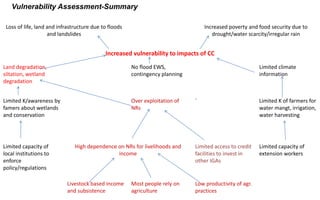
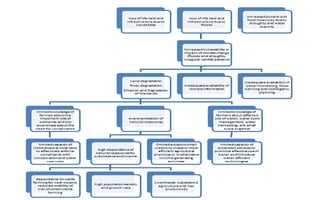
Loss of life, land and infrastructure due to floods
and landslides
Increased poverty and food security due to
drought/water scarcity/irregular rain
Increased vulnerability to impacts of CC
Land degradation,
siltation, wetland
degradation
No flood EWS,
contingency planning
Limited climate
information
Limited K/awareness by
famers about wetlands
and conservation
Over exploitation of
NRs
` Limited K of farmers for
water mangt, irrigation,
water harvesting
Limited capacity of
local institutions to
enforce
policy/regulations
High dependence on NRs for livelihoods and
income
Limited access to credit
facilities to invest in
other IGAs
Limited capacity of
extension workers
Livestock based income
and subsistence
Most people rely on
agriculture
Low productivity of agr.
practices
Vulnerability Assessment-Summary
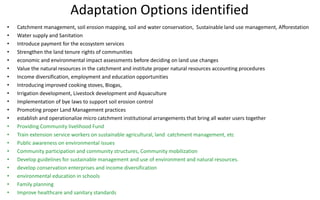
Adaptation Options identified
• Catchment management, soil erosion mapping, soil and water conservation, Sustainable land use management, Afforestation
• Water supply and Sanitation
• Introduce payment for the ecosystem services
• Strengthen the land tenure rights of communities
• economic and environmental impact assessments before deciding on land use changes
• Value the natural resources in the catchment and institute proper natural resources accounting procedures
• Income diversification, employment and education opportunities
• Introducing improved cooking stoves, Biogas,
• Irrigation development, Livestock development and Aquaculture
• Implementation of bye laws to support soil erosion control
• Promoting proper Land Management practices
• establish and operationalize micro catchment institutional arrangements that bring all water users together
• Providing Community livelihood Fund
• Train extension service workers on sustainable agricultural, land catchment management, etc
• Public awareness on environmental issues
• Community participation and community structures, Community mobilization
• Develop guidelines for sustainable management and use of environment and natural resources.
• develop conservation enterprises and income diversification
• environmental education in schools
• Family planning
• Improve healthcare and sanitary standards
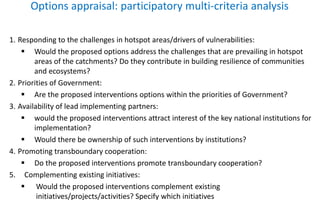
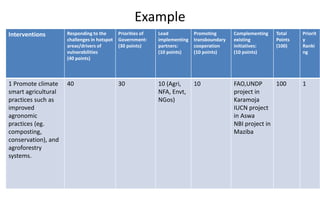
Options appraisal: participatory multi-criteria analysis
1. Responding to the challenges in hotspot areas/drivers of vulnerabilities:
 Would the proposed options address the challenges that are prevailing in hotspot
areas of the catchments? Do they contribute in building resilience of communities
and ecosystems?
2. Priorities of Government:
 Are the proposed interventions options within the priorities of Government?
3. Availability of lead implementing partners:
 would the proposed interventions attract interest of the key national institutions for
implementation?
 Would there be ownership of such interventions by institutions?
4. Promoting transboundary cooperation:
 Do the proposed interventions promote transboundary cooperation?
5. Complementing existing initiatives:
 Would the proposed interventions complement existing
initiatives/projects/activities? Specify which initiatives
Example
Interventions Responding to the
challenges in hotspot
areas/drivers of
vulnerabilities
(40 points)
Priorities of
Government:
(30 points)
Lead
implementing
partners:
(10 points)
Promoting
transboundary
cooperation
(10 points)
Complementing
existing
initiatives:
(10 points)
Total
Points
(100)
Priorit
y
Ranki
ng
1 Promote climate
smart agricultural
practices such as
improved
agronomic
practices (eg.
composting,
conservation), and
agroforestry
systems.
40 30 10 (Agri,
NFA, Envt,
NGos)
10 FAO,UNDP
project in
Karamoja
IUCN project
in Aswa
NBI project in
Maziba
100 1
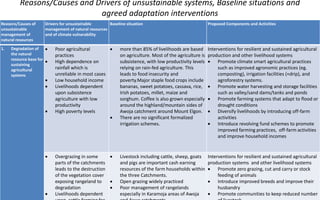
Reasons/Causes and Drivers of unsustainable systems, Baseline situations and
agreed adaptation interventions
Reasons/Causes of
unsustainable
management of
natural resources
Drivers for unsustainable
management of natural resources
and of climate vulnerability
Baseline situation Proposed Components and Activities
1. Degradation of
the natural
resource base for
sustaining
agricultural
systems
 Poor agricultural
practices
 High dependence on
rainfall which is
unreliable in most cases
 Low household income
 Livelihoods dependent
upon subsistence
agriculture with low
productivity
 High poverty levels
 more than 85% of livelihoods are based
on agriculture. Most of the agriculture is
subsistence, with low productivity levels
relying on rain-fed agriculture. This
leads to food insecurity and
poverty.Major staple food crops include
bananas, sweet potatoes, cassava, rice,
Irish potatoes, millet, maize and
sorghum. Coffee is also grown especially
around the highland/mountain sides of
Awoja catchment around Mount Elgon.
 There are no significant formalized
irrigation schemes.
Interventions for resilient and sustained agricultural
production and other livelihood systems
 Promote climate smart agricultural practices
such as improved agronomic practices (eg.
composting), irrigation facilities (+drip), and
agroforestry systems.
 Promote water harvesting and storage facilities
such as valley/sand dams/tanks and ponds
 Promote farming systems that adapt to flood or
drought conditions
 Diversify livelihoods by introducing off-farm
activities
 Introduce revolving fund schemes to promote
improved farming practices, off-farm activities
and improve household incomes
 Overgrazing in some
parts of the catchments
leads to the destruction
of the vegetation cover
exposing rangeland to
degradation
 Livelihoods dependent
 Livestock including cattle, sheep, goats
and pigs are important cash earning
resources of the farm households within
the three Catchments.
 Open grazing widely practiced
 Poor management of rangelands
especially in Karamoja areas of Awoja
Interventions for resilient and sustained agricultural
production systems and other livelihood systems
 Promote zero grazing, cut and carry or stock
feeding of animals
 Introduce improved breeds and improve their
husbandry
 Promote communities to keep reduced number
Reasons/Causes and Drivers of unsustainable systems, Baseline situations and
agreed adaptation interventions
Reasons/Causes of
unsustainable
management of
natural resources
Drivers for unsustainable
management of natural resources
and of climate vulnerability
Baseline situation Proposed Components and Activities
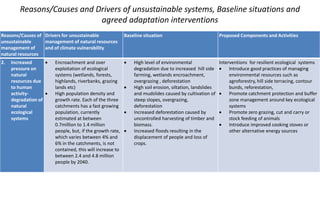
2. Increased
pressure on
natural
resources due
to human
activity-
degradation of
natural
ecological
systems
 Encroachment and over
exploitation of ecological
systems (wetlands, forests,
highlands, riverbanks, grazing
lands etc)
 High population density and
growth rate. Each of the three
catchments has a fast growing
population, currently
estimated at between
0.7million to 1.4 million
people, but, if the growth rate,
which varies between 4% and
6% in the catchments, is not
contained, this will increase to
between 2.4 and 4.8 million
people by 2040.
 High level of environmental
degradation due to increased hill side
farming, wetlands encroachment,
overgrazing , deforestation
 High soil erosion, siltation, landslides
and mudslides caused by cultivation of
steep slopes, overgrazing,
deforestation
 Increased deforestation caused by
uncontrolled harvesting of timber and
biomass.
 Increased floods resulting in the
displacement of people and loss of
crops.
Interventions for resilient ecological systems
 Introduce good practices of managing
environmental resources such as
agroforestry, hill side terracing, contour
bunds, reforestation,
 Promote catchment protection and buffer
zone management around key ecological
systems
 Promote zero grazing, cut and carry or
stock feeding of animals
 Introduce improved cooking stoves or
other alternative energy sources
Reasons/Causes and Drivers of unsustainable systems, Baseline situations and
agreed adaptation interventions
Reasons/Causes
of unsustainable
management of
natural resources
Drivers for unsustainable
management of natural
resources and of climate
vulnerability
Baseline situation Proposed Components and Activities
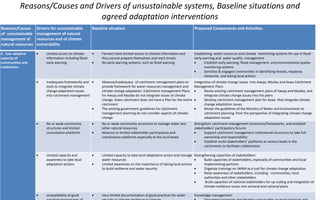
4. Low adaptive
capacity of
communities and
institutions
 Limited access to climate
information including flood
early warning
 Farmers have limited access to climate information and
thus cannot prepare themselves and react timely
 No early warning systems, such as flood warning
Establishing water resources and climate monitoring systems for use in flood
early warning and water quality management
 Establish early warning, flood management, and environmental quality
monitoring systems
 Sensitize & engaged communities in identifying threats, response
measures, and taking local actions
 Inadequate frameworks and
tools to integrate climate
change adaptation issues
into catchment management
 Absence/inadequacy of catchment management plans to
provide framework for water resources management and
climate change adaptation .Catchment management Plans
for Awoja and Maziba do not integrate issues of climate
change. Aswa catchment does not have a Plan for the entire
catchment
 The existing government guidelines for catchment
management planning do not consider aspects of climate
change
Integration of climate change issues into Awoja, Maziba and Aswa Catchment
Management Plans
 Revise existing catchment management plans of Awoja and Maziba, and
integrate climate change issues into the plans
 Develop catchment management plan for Aswa that integrate climate
change adaptation issues
 Revise the guidelines of the Ministry of Water and Environment on
catchment planning from the perspective of integrating climate change
adaptation issues
 No or weak community
structures and limited
consultation platforms
 No or weak community structures to manage water and
other natural resources
 Absence or limited stakeholder participatory and
coordination platforms especially at the local levels
Strengthen catchment management structures/frameworks, and establish
stakeholders’ participatory forums
 Support catchment management institutional structures to take full
ownership and responsibility
 Establish multi-stakeholders’ platforms at various levels in the
catchments to facilitate collaboration
 Limited capacity and
awareness to take local
adaptation actions
 Limited capacity to take local adaptation action and manage
water resources
 Limited awareness on the importance of taking local actions
to build resilience and water security
Strengthening capacities of stakeholders:
 Build capacities of stakeholders, especially of communities and local
implementing partners
 Organize trainings on IWRM as a tool for climate change adaptation
 Raise awareness of stakeholders, including communities, local
authorities and other stakeholders
 Build capacities of national stakeholders for up scaling and integration of
climate resilience issues into sectoral and national plans.
 Unavailability of good  Very limited documentation of good practices for water Knowledge management:
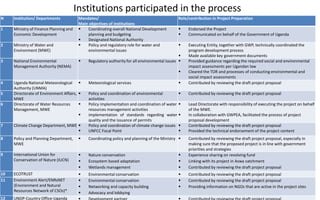
Institutions participated in the process
N Institution/ Departments Mandates/
Main objectives of institutions
Role/contribution in Project Preparation
1 Ministry of Finance Planning and
Economic Development
 Coordinating overall National Development
planning and budgeting
 Designated National Authority
 Endorsed the Project
 Communicated on behalf of the Government of Uganda
2 Ministry of Water and
Environment (MWE)
 Policy and regulatory role for water and
environmental issues
 Executing Entity, together with GWP, technically coordinated the
program development process
 Made available key government documents
3 National Environmental
Management Authority (NEMA)
 Regulatory authority for all environmental issues  Provided guidance regarding the required social and environmental
impact assessments per Ugandan law
 Cleared the TOR and processes of conducting environmental and
social impact assessments
4 Uganda National Meteorological
Authority (UNMA)
 Meteorological services  Contributed by reviewing the draft project proposal
5 Directorate of Environment Affairs,
MWE
 Policy and coordination of environmental
activities
 Contributed by reviewing the draft project proposal
6 Directorate of Water Resources
Management, MWE
 Policy implementation and coordination of water
resources management activities
 implementation of standards regarding water
quality and the issuance of permits
 Lead Directorate with responsibility of executing the project on behalf
of the MWE.
 In collaboration with GWPEA, facilitated the process of project
proposal development
7 Climate Change Department, MWE  Policy and coordination of climate change issues
 UNFCC Focal Point
 Contributed by reviewing the draft project proposal
 Provided the technical endorsement of the project content
8 Policy and Planning Department,
MWE
 Coordinating policy and planning of the Ministry  Contributed by reviewing the draft project proposal, especially in
making sure that the proposed project is in line with government
priorities and strategies
9 International Union for
Conservation of Nature (IUCN)
 Nature conservation
 Ecosystem based adaptation
 Wetlands management
 Experience sharing on revolving fund
 Linking with its project in Aswa catchment
 Contributed by reviewing the draft project proposal
10 ECOTRUST  Environmental conservation  Contributed by reviewing the draft project proposal
11 Environment Alert/ENRsNET
(Environment and Natural
Resources Network of CSOs)*
 Environmental conservation
 Networking and capacity building
 Advocacy and lobbying
 Contributed by reviewing the draft project proposal
 Providing information on NGOs that are active in the project sites
12 UNDP-Country Office-Uganda
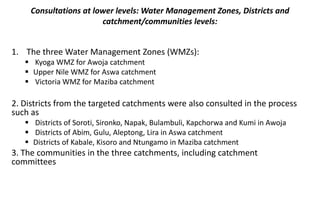
Consultations at lower levels: Water Management Zones, Districts and
catchment/communities levels:
1. The three Water Management Zones (WMZs):
 Kyoga WMZ for Awoja catchment
 Upper Nile WMZ for Aswa catchment
 Victoria WMZ for Maziba catchment
2. Districts from the targeted catchments were also consulted in the process
such as
 Districts of Soroti, Sironko, Napak, Bulambuli, Kapchorwa and Kumi in Awoja
 Districts of Abim, Gulu, Aleptong, Lira in Aswa catchment
 Districts of Kabale, Kisoro and Ntungamo in Maziba catchment
3. The communities in the three catchments, including catchment
committees
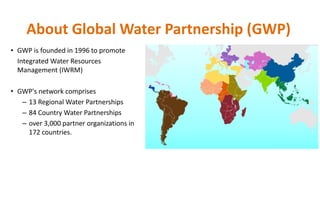
About Global Water Partnership (GWP)
• GWP is founded in 1996 to promote
Integrated Water Resources
Management (IWRM)
• GWP's network comprises
– 13 Regional Water Partnerships
– 84 Country Water Partnerships
– over 3,000 partner organizations in
172 countries.
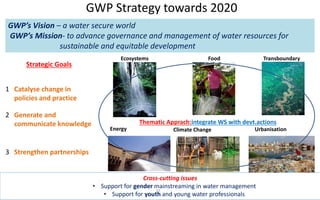
Cross-cutting issues
• Support for gender mainstreaming in water management
• Support for youth and young water professionals
GWP Strategy towards 2020
27
FoodEcosystems Transboundary
Energy Climate Change Urbanisation
Strategic Goals
1 Catalyse change in
policies and practice
2 Generate and
communicate knowledge
3 Strengthen partnerships
GWP’s Vision – a water secure world
GWP’s Mission- to advance governance and management of water resources for
sustainable and equitable development
Thematic Apprach:integrate WS with devt.actions
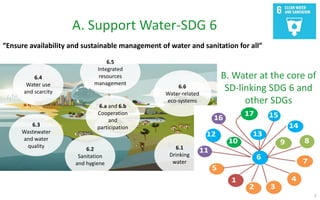
A. Support Water-SDG 6
“Ensure availability and sustainable management of water and sanitation for all”
6.1
Drinking
water
6.2
Sanitation
and hygiene
6.3
Wastewater
and water
quality
6.4
Water use
and scarcity
6.5
Integrated
resources
management
6.6
Water-related
eco-systems
6.a and 6.b
Cooperation
and
participation
B. Water at the core of
SD-linking SDG 6 and
other SDGs
Thank you!
http://www.gwp.org

GWP presentation

  • 1.
    Kidanemariam Jembere, Technical Advisor,GWP Africa Coordination Unit K.Jembere@cgiar.org Vulnerability Assessment and Options Appraisal in Developing an Adaptation Program in Uganda (water resources management system) Presentation for LEG Regional Training on NAPs 27 February-3 March 2017, Lilongwe, Malawi
  • 2.
    The National AdaptationPlan Global Support Programme (NAP-GSP) • GWP is part of the NAP GSP with UNDP-UNEP and other partners and has supported NAPs in several countries in Africa and Central America • SDG 6 water and related targets
  • 3.
    North West SaharaAquifer (SASS) Volta Basin Lake Chad Basin Limpopo Basin Kagera Basin Sharing expeince from the Water, Climate and Development Program Phase 1: 1. Ghana 2. Burkina Faso 3. Cameroon 4. Tunisia 5. Burundi 6. Rwanda 7. Mozambique 8. Zimbabwe Phase II 1. Kenya 2. Uganda 3. Zambia 4. Tanzania 5. Mauritania 6. Mali 7. Benin 8. Senegal 9. São Tomé and Príncipe 10.Central Africa Republic Objective: to support integration of water security and climate resilience in development planning and decision making processes
  • 4.
    Water Climate andDevelopment Program for Africa (WACDEP) AU/AMCOW program on integrating water security and climate resilience into development plans Sharing expeince from the Water, Climate and Development Program Strategic Framework • Policy briefs provide key messages and recommendations for policy makers • Strategic Framework guides on process and tools available • Technical Background Document provides detail on tools and methods outlined in the Strategic Framework Program Components: • Facilitate regional/transboundary cooperation • National development plans • Investment plans and project preparation • Demonstrations • Capacity development and Knowledge magtPhase 1: 5 transboundary basins and 8 countries Phase 2: (same basins and 10 more countries
  • 5.
    Vulnerability Assessment andOptions Appraisal in Developing an Adaptation Program in Uganda (water resources management system)
  • 6.
    Key Messages • Examineavailability of data and information for vulnerability assessment and options appraisal (a lot of information was already available)-ICPAC, National Studies, Documents, IPCC Report…--Catchment Management Planning Process, and Other methods DSS (NBI) Tools, Water Balance, Demand/Supply etc. helped • Adapt the approaches based on scale, context and diversity of stakeholders to make it simple, applicable and agreed by stakeholders • Follow participatory and multi-stakeholder processes to: – identify challenges/issues, interventions and impacts (envt.al, social, economic) – make alignment with National strategies and plans; and to meet national technical standards, including ESIA – establish synergies with other projects, and build partnership with stakeholders – learn from others’ experiences – create sense of ownership of the process – ensure sustainability of interventions
  • 7.
    Uganda: Context Analysis (UgandaVision 2040) Baseline 2040 1. Per capita income  506  9500 2. % Popn. < poverty line  24.5%  5% 3. % level of urbanization  13%  60% 4. % popn. Access to safe piped water  15%  80% 5. Population growth rate  3.2  2.4 6. Forest cover  15%  24% 7. Weland cover  8%  13%
  • 8.
    Uganda: Context Analysis2010…20132050 1. Size  241,038 KM2 2. Economy  Per capita GNI 1200 USD, 29% <poverty line (1.25US/d)  Agri. employs 60% of people, 20% GDP, subsistence 3. Population  35M  growth rate 3.7%  Urban (20%)  103M  growth rate 2.9%  Urban (60%) 4. Climate  Increasing projections for temperature  Drought (1973, 79,81, 84- 87,92,93,99,20 04,10/11,15/16  Change in rainfall distribution, intensity  Dec-Jan-Feb some +?  changes in the severity and frequency of extreme events (floods, droughts, heatwaves, storms), land slides, ~20-30% 5. Water  Demand 408 (2010) MM3/yr  Total demand 3963 MCM/yr  Total Annual renewable water=43 Billion M3  (29 externally renewable +14 internally renewable)  dependence ratio on water resources originating from outside its borders is 69%.  Utilization rate 2.8%, projected increase to 14.1% if all the irrigation potential of 240,000 ha is utilized. 6. Climatic zones  Highland climate;  Savannah tropical climate+the lake basin climate; and  Semi-arid climate Water rich country with lake, river, wetland and rainfall (400 to 2200 mm per year.
  • 9.
    Catchment Based WaterResources Management 8 hydrological basins 4 Water Management Zones (WMZs) AWOJA ASWA MAZIBA Upper Nile WMZ Kyoga WMZ Catchments: (1) Awoja in Kyoga WMZ, (2) Aswa in Upper Nile WMZ and (3) Maziba in Albert Nile WMZ
  • 10.
    Catchment selection criteria •Relative degree of vulnerability to climate change, and severity of other challenges such as land degradation, water scarcity and population pressure • Sensitivity of ecological systems such as degraded highlands, wetlands, grazing lands/savannah. • Broader representation of climatic zones of Uganda.. • Representation of diverse livelihood and social systems Note: Prioritization of catchments done by MWE as part of Catchment Management Planning process.
  • 11.
    Awoja highland :landslide around the mount Elgon-farming on steep slopes Awoja midland: crop farming (sorghum) (flooding) Awoja lowland: part of the extensive lake/wetland system around the low-lying parts of the catchment, paddy rice (flooding) Drought in Karamoja part of the catchment 1. Awoja Catchment (area: 11,000 km2,) high-rainfall mountain areas in the east, lowland plains with sufficient rainfall to support rain-fed agriculture, extensive wetlands and lakes, and dry northern cattle corridor and pastoralists CC Impacts droughts, landslides, land degradation/deforestation/overgrazing Catchment characteristics: AWOJA
  • 12.
    Aswa highland :Drought in Karamoja part of the catchment Aswa midland: maize and groundnuts cropping systems) (flooding) Aswa lowland river with turbid water due to sediment load from upper catchment (flooding, riverbank erosion) Catchment characteristics: ASWA 2. Aswa catchment (area: 27,631 km2 ) Conflict and social insecurity and mass displacement of people poverty and famine and high reliance on food aid. CC Impacts Land degradation erratic rainfall and more frequent droughts.
  • 13.
    Maziba highland :farming on the highlands/high slopes, less household farming plots Maziba midland: replacement of natural vegetation with plantation mainly eucalyptus, less household farming plots Maziba lowland river with turbid water due to sediment load from upper catchment (flooding, riverbank erosion) Catchment characteristics: MAZIBA 3. Maziba Catchment (Area 1370 km2) small, fragmented landholdings on a mountainous terrain. numerous streams and wetlands CC Impacts settlements in the hilly and fragile marginal lands wetland degradation and land degradation
  • 14.
    Vulnerability of threecatchments: exposure to climate hazard, sensitivity of ecosystems and livelihoods) Catcht. Exposure to hazard Sensitivity of Livelihood/social systems Sensitivity of ecological systems Awoja  Drought/-especially Karamoja region  Flood in lowlands  landslides in mountain terrain  mostly mixed (crop and livestock) farming systems.  Livestock-based farming around Karamoja  Farming on high slops due to population pressure  Unregulated fishing practices  Poor farming practices  High population mostly dependent on land resources  Land degradation in most places of the catchment. Soil erosion and deforestation  Mount Elgon region- Important wildlife reserve, source of water. Land degradation, deforestation, landslides encroachment- transboundary (Ke & Ug)  Wetlands, lake shorelines and riverbanks degradation  Overgrazing in the cattle corridor Aswa  Drought/-especially Karamoja region  Flood in lowlands  Erratic rainfall  area affected by armed conflict and social instability until recent past  reliant on food aid  Low level of rural community services and structures  mostly mixed (crop and livestock) farming systems with poor farming practices  Livestock-based farming around Karamoja  Soil erosion and deforestation  Overgrazing in the cattle corridor  Tranboundary catchment (UG/S.Sudan) Maziba  Flood hazards  landslides in mountain terrain  Mixed (crop and livestock) farming systems with poor farming practices on mountain hills  Unregulated fishing practices  Farming in high slop areas  Loss of natural vegetation (vegetation now dominated by eucalyptus plantation)  Land degradation due high population pressure-land shortage  Wetlands, lake shorelines and riverbanks degradation –transboundary-Ug/Rw
  • 15.
    Causes of IncreasedVulnerability to climate change Livelihoods- subsistence agriculture with low productivity The population in the 3 catchments is almost entirely rural and more than 85% of livelihoods are based on agriculture. Most of the agriculture is subsistence, with low productivity levels relying on rain-fed agriculture. This leads to food insecurity and poverty. Major staple food crops include bananas, sweet potatoes, cassava, rice, Irish potatoes, millet, maize and sorghum. There are no significant formalized irrigation schemes. High population density and growth rate Each of the three catchments has a fast growing population, currently estimated at between 0.7million to 1.4 million people, but, if the growth rate, which varies between 4% and 6% in the catchments, is not contained, this will increase to between 2.4 and 4.8 million people by 2040. Livelihoods – cattle farming for cash Livestock including cattle, sheep, goats and pigs are important cash earning resources of the farm households within the three Catchments. Overgrazing in some parts of the catchments leads to the destruction of the vegetation cover exposing rangeland to degradation Land degradation Landslides and mudslides caused by cultivation of steep slopes leads to loss of life, land &infrastructure. Overgrazing lead to erosion and soil loss. Damage to wetlands due to encroachment activities. Deforestation caused by uncontrolled harvesting of timber and biomass. River degradation Land use (cultivation and livestock) up to river edges causes loss of riparian vegetation and destabilising of river banks, adding to soil erosion and sediment loads downstream. Siltation and Degradation of Wetlands Encroachment and exploitation of wetlands cause siltation and degradation. Wetlands lose their ecological functionality and capacity to provide ecosystem services, including ability to filter water to lakes. Floods result in the displacement of people and loss of crops. Limited access to climate information, esp. flood EWS Farmers have limited access to climate information and thus cannot prepare themselves and react timely High poverty levels/food insecurity Northern (Aswa) and North-eastern (Awoja) Uganda are the poorest regions with a poverty level at 75.8% of the population.) The cattle corridor is also significantly poorer than the wetter parts of the basin. Southwestern Uganda (Maziba)have degraded their wetlands and have overexploited their lands due to very high population density resulting in great reduction in food production and hence increase in poverty levels.
  • 16.
    Loss of life,land and infrastructure due to floods and landslides Increased poverty and food security due to drought/water scarcity/irregular rain Increased vulnerability to impacts of CC Land degradation, siltation, wetland degradation No flood EWS, contingency planning Limited climate information Limited K/awareness by famers about wetlands and conservation Over exploitation of NRs ` Limited K of farmers for water mangt, irrigation, water harvesting Limited capacity of local institutions to enforce policy/regulations High dependence on NRs for livelihoods and income Limited access to credit facilities to invest in other IGAs Limited capacity of extension workers Livestock based income and subsistence Most people rely on agriculture Low productivity of agr. practices Vulnerability Assessment-Summary
  • 18.
    Adaptation Options identified •Catchment management, soil erosion mapping, soil and water conservation, Sustainable land use management, Afforestation • Water supply and Sanitation • Introduce payment for the ecosystem services • Strengthen the land tenure rights of communities • economic and environmental impact assessments before deciding on land use changes • Value the natural resources in the catchment and institute proper natural resources accounting procedures • Income diversification, employment and education opportunities • Introducing improved cooking stoves, Biogas, • Irrigation development, Livestock development and Aquaculture • Implementation of bye laws to support soil erosion control • Promoting proper Land Management practices • establish and operationalize micro catchment institutional arrangements that bring all water users together • Providing Community livelihood Fund • Train extension service workers on sustainable agricultural, land catchment management, etc • Public awareness on environmental issues • Community participation and community structures, Community mobilization • Develop guidelines for sustainable management and use of environment and natural resources. • develop conservation enterprises and income diversification • environmental education in schools • Family planning • Improve healthcare and sanitary standards
  • 19.
    Options appraisal: participatorymulti-criteria analysis 1. Responding to the challenges in hotspot areas/drivers of vulnerabilities:  Would the proposed options address the challenges that are prevailing in hotspot areas of the catchments? Do they contribute in building resilience of communities and ecosystems? 2. Priorities of Government:  Are the proposed interventions options within the priorities of Government? 3. Availability of lead implementing partners:  would the proposed interventions attract interest of the key national institutions for implementation?  Would there be ownership of such interventions by institutions? 4. Promoting transboundary cooperation:  Do the proposed interventions promote transboundary cooperation? 5. Complementing existing initiatives:  Would the proposed interventions complement existing initiatives/projects/activities? Specify which initiatives
  • 20.
    Example Interventions Responding tothe challenges in hotspot areas/drivers of vulnerabilities (40 points) Priorities of Government: (30 points) Lead implementing partners: (10 points) Promoting transboundary cooperation (10 points) Complementing existing initiatives: (10 points) Total Points (100) Priorit y Ranki ng 1 Promote climate smart agricultural practices such as improved agronomic practices (eg. composting, conservation), and agroforestry systems. 40 30 10 (Agri, NFA, Envt, NGos) 10 FAO,UNDP project in Karamoja IUCN project in Aswa NBI project in Maziba 100 1
  • 21.
    Reasons/Causes and Driversof unsustainable systems, Baseline situations and agreed adaptation interventions Reasons/Causes of unsustainable management of natural resources Drivers for unsustainable management of natural resources and of climate vulnerability Baseline situation Proposed Components and Activities 1. Degradation of the natural resource base for sustaining agricultural systems  Poor agricultural practices  High dependence on rainfall which is unreliable in most cases  Low household income  Livelihoods dependent upon subsistence agriculture with low productivity  High poverty levels  more than 85% of livelihoods are based on agriculture. Most of the agriculture is subsistence, with low productivity levels relying on rain-fed agriculture. This leads to food insecurity and poverty.Major staple food crops include bananas, sweet potatoes, cassava, rice, Irish potatoes, millet, maize and sorghum. Coffee is also grown especially around the highland/mountain sides of Awoja catchment around Mount Elgon.  There are no significant formalized irrigation schemes. Interventions for resilient and sustained agricultural production and other livelihood systems  Promote climate smart agricultural practices such as improved agronomic practices (eg. composting), irrigation facilities (+drip), and agroforestry systems.  Promote water harvesting and storage facilities such as valley/sand dams/tanks and ponds  Promote farming systems that adapt to flood or drought conditions  Diversify livelihoods by introducing off-farm activities  Introduce revolving fund schemes to promote improved farming practices, off-farm activities and improve household incomes  Overgrazing in some parts of the catchments leads to the destruction of the vegetation cover exposing rangeland to degradation  Livelihoods dependent  Livestock including cattle, sheep, goats and pigs are important cash earning resources of the farm households within the three Catchments.  Open grazing widely practiced  Poor management of rangelands especially in Karamoja areas of Awoja Interventions for resilient and sustained agricultural production systems and other livelihood systems  Promote zero grazing, cut and carry or stock feeding of animals  Introduce improved breeds and improve their husbandry  Promote communities to keep reduced number
  • 22.
    Reasons/Causes and Driversof unsustainable systems, Baseline situations and agreed adaptation interventions Reasons/Causes of unsustainable management of natural resources Drivers for unsustainable management of natural resources and of climate vulnerability Baseline situation Proposed Components and Activities 2. Increased pressure on natural resources due to human activity- degradation of natural ecological systems  Encroachment and over exploitation of ecological systems (wetlands, forests, highlands, riverbanks, grazing lands etc)  High population density and growth rate. Each of the three catchments has a fast growing population, currently estimated at between 0.7million to 1.4 million people, but, if the growth rate, which varies between 4% and 6% in the catchments, is not contained, this will increase to between 2.4 and 4.8 million people by 2040.  High level of environmental degradation due to increased hill side farming, wetlands encroachment, overgrazing , deforestation  High soil erosion, siltation, landslides and mudslides caused by cultivation of steep slopes, overgrazing, deforestation  Increased deforestation caused by uncontrolled harvesting of timber and biomass.  Increased floods resulting in the displacement of people and loss of crops. Interventions for resilient ecological systems  Introduce good practices of managing environmental resources such as agroforestry, hill side terracing, contour bunds, reforestation,  Promote catchment protection and buffer zone management around key ecological systems  Promote zero grazing, cut and carry or stock feeding of animals  Introduce improved cooking stoves or other alternative energy sources
  • 23.
    Reasons/Causes and Driversof unsustainable systems, Baseline situations and agreed adaptation interventions Reasons/Causes of unsustainable management of natural resources Drivers for unsustainable management of natural resources and of climate vulnerability Baseline situation Proposed Components and Activities 4. Low adaptive capacity of communities and institutions  Limited access to climate information including flood early warning  Farmers have limited access to climate information and thus cannot prepare themselves and react timely  No early warning systems, such as flood warning Establishing water resources and climate monitoring systems for use in flood early warning and water quality management  Establish early warning, flood management, and environmental quality monitoring systems  Sensitize & engaged communities in identifying threats, response measures, and taking local actions  Inadequate frameworks and tools to integrate climate change adaptation issues into catchment management  Absence/inadequacy of catchment management plans to provide framework for water resources management and climate change adaptation .Catchment management Plans for Awoja and Maziba do not integrate issues of climate change. Aswa catchment does not have a Plan for the entire catchment  The existing government guidelines for catchment management planning do not consider aspects of climate change Integration of climate change issues into Awoja, Maziba and Aswa Catchment Management Plans  Revise existing catchment management plans of Awoja and Maziba, and integrate climate change issues into the plans  Develop catchment management plan for Aswa that integrate climate change adaptation issues  Revise the guidelines of the Ministry of Water and Environment on catchment planning from the perspective of integrating climate change adaptation issues  No or weak community structures and limited consultation platforms  No or weak community structures to manage water and other natural resources  Absence or limited stakeholder participatory and coordination platforms especially at the local levels Strengthen catchment management structures/frameworks, and establish stakeholders’ participatory forums  Support catchment management institutional structures to take full ownership and responsibility  Establish multi-stakeholders’ platforms at various levels in the catchments to facilitate collaboration  Limited capacity and awareness to take local adaptation actions  Limited capacity to take local adaptation action and manage water resources  Limited awareness on the importance of taking local actions to build resilience and water security Strengthening capacities of stakeholders:  Build capacities of stakeholders, especially of communities and local implementing partners  Organize trainings on IWRM as a tool for climate change adaptation  Raise awareness of stakeholders, including communities, local authorities and other stakeholders  Build capacities of national stakeholders for up scaling and integration of climate resilience issues into sectoral and national plans.  Unavailability of good  Very limited documentation of good practices for water Knowledge management:
  • 24.
    Institutions participated inthe process N Institution/ Departments Mandates/ Main objectives of institutions Role/contribution in Project Preparation 1 Ministry of Finance Planning and Economic Development  Coordinating overall National Development planning and budgeting  Designated National Authority  Endorsed the Project  Communicated on behalf of the Government of Uganda 2 Ministry of Water and Environment (MWE)  Policy and regulatory role for water and environmental issues  Executing Entity, together with GWP, technically coordinated the program development process  Made available key government documents 3 National Environmental Management Authority (NEMA)  Regulatory authority for all environmental issues  Provided guidance regarding the required social and environmental impact assessments per Ugandan law  Cleared the TOR and processes of conducting environmental and social impact assessments 4 Uganda National Meteorological Authority (UNMA)  Meteorological services  Contributed by reviewing the draft project proposal 5 Directorate of Environment Affairs, MWE  Policy and coordination of environmental activities  Contributed by reviewing the draft project proposal 6 Directorate of Water Resources Management, MWE  Policy implementation and coordination of water resources management activities  implementation of standards regarding water quality and the issuance of permits  Lead Directorate with responsibility of executing the project on behalf of the MWE.  In collaboration with GWPEA, facilitated the process of project proposal development 7 Climate Change Department, MWE  Policy and coordination of climate change issues  UNFCC Focal Point  Contributed by reviewing the draft project proposal  Provided the technical endorsement of the project content 8 Policy and Planning Department, MWE  Coordinating policy and planning of the Ministry  Contributed by reviewing the draft project proposal, especially in making sure that the proposed project is in line with government priorities and strategies 9 International Union for Conservation of Nature (IUCN)  Nature conservation  Ecosystem based adaptation  Wetlands management  Experience sharing on revolving fund  Linking with its project in Aswa catchment  Contributed by reviewing the draft project proposal 10 ECOTRUST  Environmental conservation  Contributed by reviewing the draft project proposal 11 Environment Alert/ENRsNET (Environment and Natural Resources Network of CSOs)*  Environmental conservation  Networking and capacity building  Advocacy and lobbying  Contributed by reviewing the draft project proposal  Providing information on NGOs that are active in the project sites 12 UNDP-Country Office-Uganda
  • 25.
    Consultations at lowerlevels: Water Management Zones, Districts and catchment/communities levels: 1. The three Water Management Zones (WMZs):  Kyoga WMZ for Awoja catchment  Upper Nile WMZ for Aswa catchment  Victoria WMZ for Maziba catchment 2. Districts from the targeted catchments were also consulted in the process such as  Districts of Soroti, Sironko, Napak, Bulambuli, Kapchorwa and Kumi in Awoja  Districts of Abim, Gulu, Aleptong, Lira in Aswa catchment  Districts of Kabale, Kisoro and Ntungamo in Maziba catchment 3. The communities in the three catchments, including catchment committees
  • 26.
    About Global WaterPartnership (GWP) • GWP is founded in 1996 to promote Integrated Water Resources Management (IWRM) • GWP's network comprises – 13 Regional Water Partnerships – 84 Country Water Partnerships – over 3,000 partner organizations in 172 countries.
  • 27.
    Cross-cutting issues • Supportfor gender mainstreaming in water management • Support for youth and young water professionals GWP Strategy towards 2020 27 FoodEcosystems Transboundary Energy Climate Change Urbanisation Strategic Goals 1 Catalyse change in policies and practice 2 Generate and communicate knowledge 3 Strengthen partnerships GWP’s Vision – a water secure world GWP’s Mission- to advance governance and management of water resources for sustainable and equitable development Thematic Apprach:integrate WS with devt.actions
  • 28.
    A. Support Water-SDG6 “Ensure availability and sustainable management of water and sanitation for all” 6.1 Drinking water 6.2 Sanitation and hygiene 6.3 Wastewater and water quality 6.4 Water use and scarcity 6.5 Integrated resources management 6.6 Water-related eco-systems 6.a and 6.b Cooperation and participation B. Water at the core of SD-linking SDG 6 and other SDGs
  • 29.