Irrigation Engineering
27-08-2017 1Dept.of Civil Engg.Pietech,Raipur
27-08-2017 Dept.of Civil Engg.Pietech,Raipur
2
• Introduction
• Necessity and scope of irrigation
• Engineering - benefits and ill effects of irrigation
• Irrigation development in India
• Classification and types of irrigation systems
• Soil-water plant relationship and Type of soil
• Water requirements of crop and its Important terminology
• Duty delta and base period and Irrigation efficiencies
• Method of measuring irrigation water
• References
Contents
27-08-2017 Dept.of Civil Engg.Pietech,Raipur 3
Course goals
This course has two specific goals:
To introduce students to basic concepts of soil,
water, plants, their interactions, as well as
irrigation and drainage systems design, planning
and management.
To develop analytical skills relevant to the areas
mentioned in (i) above, particularly the design of
irrigation and drainage projects.
Definition
• Irrigation may be defined as the process of supplying
water by artificial means to agricultural fields for crop
production. If water available to the plants from rainfall
is not sufficient, it is supplemented by irrigation water.
• In order to achieve this objective, an irrigation system
is required to be developed that involves planning,
design, construction, operation and maintenance of
various irrigation works:
27-08-2017 Dept.of Civil Engg.Pietech,Raipur 4
27-08-2017 Dept.of Civil Engg.Pietech,Raipur 5
• Source: River, Reservoirs
• Control structure: Barrages, Head Regulators
• Distribution system: Irrigation Canals
Definition
Irrigation Engineering
Irrigation engineering involves:
• Conception
• Planning
• Design
• Construction
• Operation
• Management of irrigation system.
27-08-2017 Dept.of Civil Engg.Pietech,Raipur 6
Necessity of irrigation
• Insufficient rainfall
• Uneven distribution of rainfall
• Improvement of perennial crop
• Development of agriculture in desert area
27-08-2017 Dept.of Civil Engg.Pietech,Raipur 7
Benefits of irrigation
• Increase in crop yield
• Protection from famine
• Cultivation of superior crops
• Elimination of mixed cropping
• Economic development
• Hydro power generation
• Domestic and industrial water supply
27-08-2017 Dept.of Civil Engg.Pietech,Raipur 8
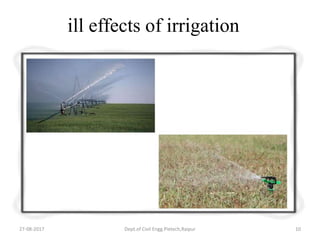
ill effects of irrigation
• Rising of water table
• Formation of marshy land
• Dampness in weather
• Loss of valuable lands
27-08-2017 Dept.of Civil Engg.Pietech,Raipur 9
27-08-2017 Dept.of Civil Engg.Pietech,Raipur 10
ill effects of irrigation
Irrigation development in India
• Among Asian countries India has largest arable land
(40%).
• Only USA has more arable land than India.
• In a monsoon climate and an agrarian economy like
India, irrigation has played a major role in the production
process. There is evidence of the practice of irrigation
since the establishment of settled agriculture during the
Indus Valley Civilization (2500 BC).
27-08-2017 Dept.of Civil Engg.Pietech,Raipur 11
Irrigation development in India
• At beginning of 19th century, there was large no of
water tanks in peninsular India and several canals in
northern India were build.
• The upper Ganga canal, upper Bari Doab canal and
the Krishna and Godavari delta system were
constructed between 1836-1866.
27-08-2017 Dept.of Civil Engg.Pietech,Raipur 12
Irrigation development in India
• During the last fifty years, gross irrigated area (GIA)
of India has increased more than three fold from 22 to
76 million Hectares.
• Groundwater irrigation in India developed during the
period of green revolution and contributed much in
increasing the gross irrigated area of the country.
27-08-2017 Dept.of Civil Engg.Pietech,Raipur 13
Irrigation development in India
• In the last five decades, groundwater irrigation has
increased from 5 million hectares to 35million
hectares.
27-08-2017 Dept.of Civil Engg.Pietech,Raipur 14
Classification of irrigation schemes
Irrigation projects in India are classified into
three categories.
• Major
• Medium
• Minor
according to the area cultivated.
27-08-2017 Dept.of Civil Engg.Pietech,Raipur 15
Classification of irrigation schemes
• Major irrigation projects: projects which have a
culturable command area (CCA) of more than 10,000
ha but more than 2,000 ha utilize mostly surface
water resources.
• Medium irrigation projects: projects which have CCA
less than 10,000 ha. But more than 2,000 ha utilizes
mostly surface water resources.
27-08-2017 Dept.of Civil Engg.Pietech,Raipur 16
Classification of irrigation schemes
• Minor irrigation projects: projects with CCA less than
or equal to 2,000 ha. Utilizes both ground water and
local surface water resources.
27-08-2017 Dept.of Civil Engg.Pietech,Raipur 17
Types of irrigation systems
The classification of the irrigation systems can also be
based on the way the water is applied to the agricultural
land as –
1. Flow irrigation system: where the irrigation water is
conveyed by growing to the irrigated land.
• Direct irrigation
• Reservoir/tank/storage irrigation
27-08-2017 Dept.of Civil Engg.Pietech,Raipur 18
Types of irrigation systems
2. Lift irrigation system: Where the irrigation water is
available at a level lower than that of the land to be
irrigated and hence the water is lifted up by pumps
or by other mechanical devices for lifting water and
conveyed to the agricultural land through channels
flowing under gravity.
27-08-2017 Dept.of Civil Engg.Pietech,Raipur 19
Types of irrigation systems
3.Inundation/flooding type irrigation system: In which
large quantities of water flowing in a river during floods
is allowed to inundate the land to be cultivated, thereby
saturating the soil.
• The excess water is then drained off and the land is used
for cultivation.
• It is also common in the areas near river deltas, where the
slope of the river and land is small.
27-08-2017 Dept.of Civil Engg.Pietech,Raipur 20
Types of irrigation systems
4. Perennial irrigation system: In which irrigation water
is supplied according to the crop water requirement at
regular intervals, throughout the life cycle of the crop.
• The water for such irrigation may be obtained from
rivers or from wells.
27-08-2017 Dept.of Civil Engg.Pietech,Raipur 21
Some important terms
1. Culturable Command Area (CCA): The gross
command area contains unfertile barren land, alkaline
soil, local ponds, villages and other areas as
habitation.
• These areas are called unculturable areas. The
remaining area on which crops can be grown
satisfactorily is known as cultivable command area
(CCA).
27-08-2017 Dept.of Civil Engg.Pietech,Raipur 22
27-08-2017 Dept.of Civil Engg.Pietech,Raipur 23
Culturable command area can further be
divided into 2 categories
Culturable cultivated area:
It is the area in which crop is grown at a particular
time or crop season.
Culturable uncultivated area:
It is the area in which crop is not sown in a particular
season.
2. Gross command area (GCA): The total area lying
between drainage boundaries which can be
commanded or irrigated by a canal system.
3. Water Tanks: These are dug areas of lands for storing
excess rain water.
4. Water logged area: An agricultural land is said to be
waterlogged when its productivity or fertility is
affected by high water table.
27-08-2017 Dept.of Civil Engg.Pietech,Raipur 24
• The height of capillary fringe is more for fine grained soil
and less for coarse grained ones.
5. Outlet: This is a small structure which admits water from the
distributing channel to a water course of field channel. Thus
an outlet is a sort of head regulator for the field channel.
6. Permanent wilting point: or the wilting coefficient is that
water content at which plants can no longer extract
sufficient water from the soil for its growth.
27-08-2017 Dept.of Civil Engg.Pietech,Raipur 25
Soil Water Relationships
27-08-2017 Dept.of Civil Engg.Pietech,Raipur 26
Types of Groundwater
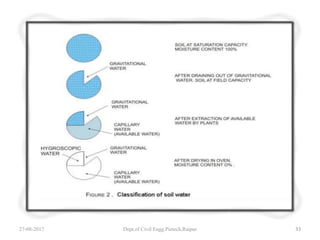
• Gravitational – also called “free water.” This is the
water that drains out of the soil after it has been wetted.
• This water moves downward through the soil because of
the pull of gravity, This water also feeds wells and
springs.
• Capillary – water that moves into and is held in the
soil by capillary forces (or pertaining to the attraction
or repulsion between a solid and a liquid).
27-08-2017 Dept.of Civil Engg.Pietech,Raipur 27
Types of Groundwater
• Hygroscopic - very thin water films around
the soil particles.
• These films are held by extremely strong
• forces that cause the water molecules to be arranged in
a semi-solid form.
• Hygroscopic Water - is held so strongly by the soil
particles (adhesion), that it is not available to the plants.
27-08-2017 Dept.of Civil Engg.Pietech,Raipur 28
Types of Groundwater
• Capillary Water is held by cohesive forces greater than
gravity and is available to plants.
• Gravitational Water is that water which cannot be held
against gravity.
• Saturation Point – the moisture point at which all of the
pore spaces are filled with water.
• Field Capacity – the maximum amount of water left in
the soil after losses of water to the forces of gravity
have ceased and before surface evaporation begins.
27-08-2017 Dept.of Civil Engg.Pietech,Raipur 29
Types of Groundwater
• Wilting Point – the point at which the plant can no
longer obtain sufficient water from the soil to meet its
transpiration needs.
• At this point the plant enters permanent wilt and dies.
• Available Soil Water – that amount present in a soil
which can be moved by plants.
• It is designated as the difference between the field
capacity and the wilting point.
27-08-2017 Dept.of Civil Engg.Pietech,Raipur 30
Types of Groundwater
• Saturation capacity: this is the total water content of
the soil when all the pores of the soil are filled with
water.
• It is also termed as the maximum water holding
capacity of the soil.
• At saturation capacity, the soil moisture tension is
almost equal to zero.
27-08-2017 Dept.of Civil Engg.Pietech,Raipur 31
Types of Groundwater
• Temporary wilting point: this denotes the soil water
content at which the plant wilts at day time, but
recovers during right or when water is added to the
soil.
• Ultimate wilting point: at such a soil water content,
the plant wilts and fails to regain life even after
addition of water to soil.
27-08-2017 Dept.of Civil Engg.Pietech,Raipur 32
27-08-2017 Dept.of Civil Engg.Pietech,Raipur 33
27-08-2017 Dept.of Civil Engg.Pietech,Raipur 34
Water requirements of crops
Introduction
• The term water requirements of a crop means the total
quantity of all water and the way in which a crop
requires water, from the time it is sown to the time it is
harvested.
• The water requirement of crop varies with the crop as
well as with the place.
• The same crop may have different water requirements
at different places of the same country.
27-08-2017 Dept.of Civil Engg.Pietech,Raipur 35
Factors affecting water requirement
• Water table: high water table less requirement, vice
versa.
• Climate: In hot climate evaporation loss is more, hence
requirement more, vice versa.
• Ground slope: ground is steep, the water flows down
very quickly and soil gets little time to absorb, so
requirement more. If ground is flat less requirement.
27-08-2017 Dept.of Civil Engg.Pietech,Raipur 36
• Intensity of irrigation: if intensity of irrigation for a
particular crop is high, then more area comes under the
irrigation system and requirement is more, vice versa.
• Type of soil: sandy soil water percolates very quickly,
so requirement is more. Clay soil retention capacity is
more, so less requirement.
• Method of application of water: surface method more
water is required to meet up evaporation. In sub surface
and sprinkler method less water required.
27-08-2017 Dept.of Civil Engg.Pietech,Raipur 37
• Method of ploughing: In deep ploughing less water
required, because soil can retain moisture for longer
period. In shallow ploughing more water required.
27-08-2017 Dept.of Civil Engg.Pietech,Raipur 38
Base Period
27-08-2017 Dept.of Civil Engg.Pietech,Raipur 39
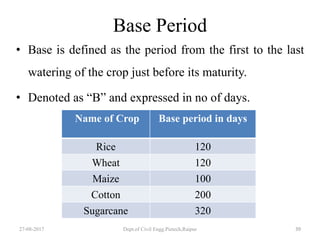
• Base is defined as the period from the first to the last
watering of the crop just before its maturity.
• Denoted as “B” and expressed in no of days.
• p
Crop
Name of Crop Base period in days
Rice 120
Wheat 120
Maize 100
Cotton 200
Sugarcane 320
Delta
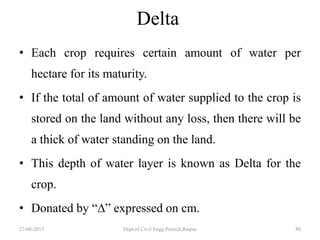
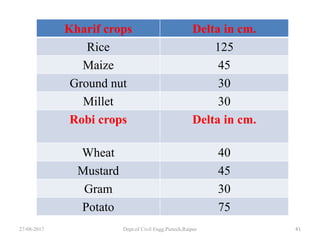
• Each crop requires certain amount of water per
hectare for its maturity.
• If the total of amount of water supplied to the crop is
stored on the land without any loss, then there will be
a thick of water standing on the land.
• This depth of water layer is known as Delta for the
crop.
• Donated by “∆” expressed on cm.
27-08-2017 Dept.of Civil Engg.Pietech,Raipur 40
27-08-2017 Dept.of Civil Engg.Pietech,Raipur 41
Kharif crops Delta in cm.
Rice 125
Maize 45
Ground nut 30
Millet 30
Robi crops Delta in cm.
Wheat 40
Mustard 45
Gram 30
Potato 75
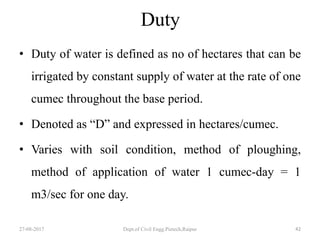
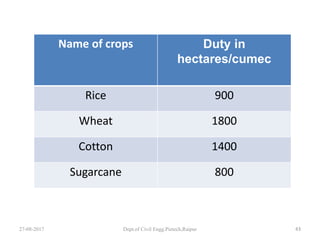
Duty
• Duty of water is defined as no of hectares that can be
irrigated by constant supply of water at the rate of one
cumec throughout the base period.
• Denoted as “D” and expressed in hectares/cumec.
• Varies with soil condition, method of ploughing,
method of application of water 1 cumec-day = 1
m3/sec for one day.
27-08-2017 Dept.of Civil Engg.Pietech,Raipur 42
27-08-2017 Dept.of Civil Engg.Pietech,Raipur 43
Name of crops Duty in
hectares/cumec
Rice 900
Wheat 1800
Cotton 1400
Sugarcane 800
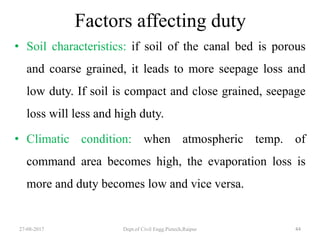
Factors affecting duty
• Soil characteristics: if soil of the canal bed is porous
and coarse grained, it leads to more seepage loss and
low duty. If soil is compact and close grained, seepage
loss will less and high duty.
• Climatic condition: when atmospheric temp. of
command area becomes high, the evaporation loss is
more and duty becomes low and vice versa.
27-08-2017 Dept.of Civil Engg.Pietech,Raipur 44
Factors affecting duty
• Rainfall: if rainfall is sufficient during crop period, less
quantity of irrigation water shall be required and duty will
more and vice versa.
• Base period: when base period is longer, the water
requirement will be more and duty will low and vice versa.
• Type of crop: water requirement of various crops are
different. So the duty also varies.
• Topography of agricultural land: if land has slight slope
duty will high as water requirement optimum. As slope
increases duty increases because there is wastage of water.
27-08-2017 Dept.of Civil Engg.Pietech,Raipur 45
27-08-2017 Dept.of Civil Engg.Pietech,Raipur 46
• Method of ploughing: deep ploughing by tractor requires
less quantity of water, duty is high. Shallow ploughing by
bullocks requires more quantity of water, duty is low.
• Methods of irrigation: duty is high in case of perennial
irrigation system as compared to inundation irrigation
system. Because in perennial system head regulator is used.
• Water tax: if some tax is imposed on the basis of volume of
water consumption, the farmer will use the water
economically, duty will be high.
Methods of improving duty
• Proper ploughing: Ploughing should be done properly and
deeply, so that moisture retaining capacity of soil is
increased.
• Methods of supplying water: this should be decided
according to the field and soil conditions.
• Furrow method – crops shown in row
• Contour method – hilly area
• Basin method – for orchards
• Flooding method – plain lands
27-08-2017 Dept.of Civil Engg.Pietech,Raipur 47
• Canal lining: to reduce percolation loss the canals
should be lined according to site condition.
• Transmission loss: to reduce this canals should be
taken close to the irrigable land as far as possible.
• Crop rotation: crop rotation should be adopted to
increase the moisture retaining capacity and fertility of
the soil.
• Implementation of tax: the water tax should be
imposed on the basis of volume of water consumption.
27-08-2017 Dept.of Civil Engg.Pietech,Raipur 48
Types of soil
• Alluvial soil: formed by deposition of silt carried by river
water during flood Silt is formed due to weathering action of
rocks by heavy current of river water in the hilly regions.
• Found in Indo –Gangetic plains, Brahmaputra plains.
• Black soil: originated by weathering action on Mainly found
in AP, MP, TN, Gujarat. They are sticky when wet and very
hard when dry
• Suitable for cultivation of cotton.
27-08-2017 Dept.of Civil Engg.Pietech,Raipur 49
• Red soil: formed by weathering action of rocks of
igneous and metamorphic group.
• Water absorbing capacity very low Found in
Karnataka, TN, Orissa, WB, Maharashtra etc.
• Laterite soil: formed by weathering action of laterite
rocks.
• Yellowish red in color and having good drainage
property, Found in Kerala, Karnataka, Orissa, Assam
etc.
27-08-2017 Dept.of Civil Engg.Pietech,Raipur 50
Consumptive use of water
• It is defined as total quantity of water used for the
growth of plants by transpiration and the amount of
water lost by evaporation.
• It is also known as Evapo-transpiration Expressed in
hectare-meter or as depth of water in meters
• The value of consumptive use of water is vary from
crop to crop, time to time, place to place.
27-08-2017 Dept.of Civil Engg.Pietech,Raipur 51
Irrigation efficiencies
• Efficiency is the ratio of the water output to the water input,
and is usually expressed as percentage.
• Input minus output is nothing but losses, and hence, if
losses are more, output is less and, therefore, efficiency is less.
• Hence, efficiency is inversely proportional to the losses.
• Water is lost in irrigation during various processes and,
therefore, there are different kinds of irrigation efficiencies.
27-08-2017 Dept.of Civil Engg.Pietech,Raipur 52
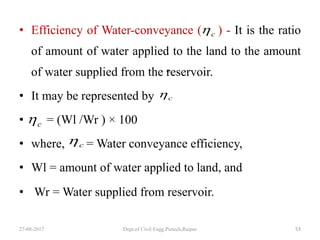
• Efficiency of Water-conveyance ( ) - It is the ratio
of amount of water applied to the land to the amount
of water supplied from the reservoir.
• It may be represented by
• = (Wl /Wr ) × 100
• where, = Water conveyance efficiency,
• Wl = amount of water applied to land, and
• Wr = Water supplied from reservoir.
27-08-2017 Dept.of Civil Engg.Pietech,Raipur 53
u
c
c
c
c
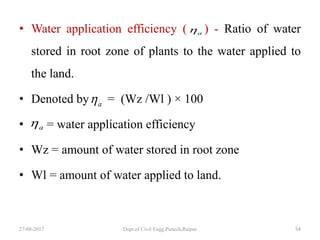
• Water application efficiency ( ) - Ratio of water
stored in root zone of plants to the water applied to
the land.
• Denoted by = (Wz /Wl ) × 100
• = water application efficiency
• Wz = amount of water stored in root zone
• Wl = amount of water applied to land.
27-08-2017 Dept.of Civil Engg.Pietech,Raipur 54
a
a
a
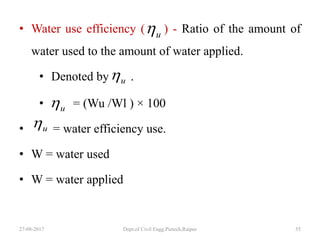
• Water use efficiency ( ) - Ratio of the amount of
water used to the amount of water applied.
• Denoted by .
• = (Wu /Wl ) × 100
• = water efficiency use.
• W = water used
• W = water applied
27-08-2017 Dept.of Civil Engg.Pietech,Raipur 55
u
u
u
u
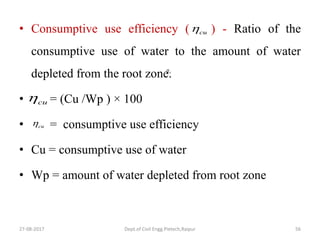
• Consumptive use efficiency ( ) - Ratio of the
consumptive use of water to the amount of water
depleted from the root zone.
• = (Cu /Wp ) × 100
• = consumptive use efficiency
• Cu = consumptive use of water
• Wp = amount of water depleted from root zone
27-08-2017 Dept.of Civil Engg.Pietech,Raipur 56
a
cu
cu
cu
Methods of Measuring Irrigation
Water
• a) Direct method: Collect water in a contained of
known volume e.g. bucket. Measure the time required
for water from an irrigation source e.g. siphon to fill
the bucket.
• Flow rate = Volume/time, m3/hr or Lit./s or Lps etc.
27-08-2017 Dept.of Civil Engg.Pietech,Raipur 57
Dept.of Civil Engg.Pietech,Raipur
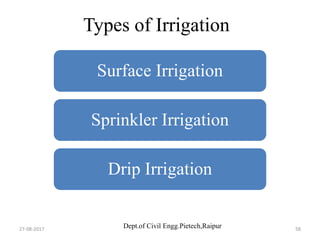
Types of Irrigation
Surface Irrigation
Sprinkler Irrigation
Drip Irrigation
27-08-2017 58
Dept.of Civil Engg.Pietech,Raipur
Definition
Surface irrigation is defined as the group of
application techniques where water is applied and
distributed over the soil surface by gravity.
It is by far the most common form
of irrigation throughout the world
27-08-2017 59
Dept.of Civil Engg.Pietech,Raipur
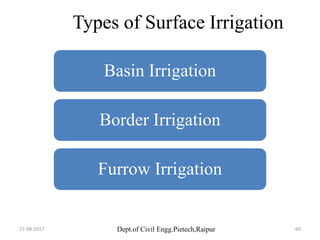
Types of Surface Irrigation
Basin Irrigation
Border Irrigation
Furrow Irrigation
27-08-2017 60
Dept.of Civil Engg.Pietech,Raipur
Introduction
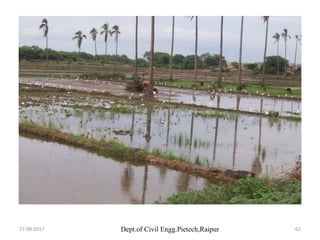
Basin irrigation is the most common form of surface
irrigation, particularly in regions with layouts of small
fields.
If a field is level in all directions, is encompassed by a
dyke to prevent runoff, and provides an undirected flow
of water onto the field, it is herein called a basin.
A basin is typically square in shape but exists in all
sorts of irregular and rectangular configurations.
27-08-2017 61
Dept.of Civil Engg.Pietech,Raipur27-08-2017 62
Dept.of Civil Engg.Pietech,Raipur
Suitable Crops for Basin Irrigation
27-08-2017 63
Dept.of Civil Engg.Pietech,Raipur
Suitable Crops for Basin Irrigation
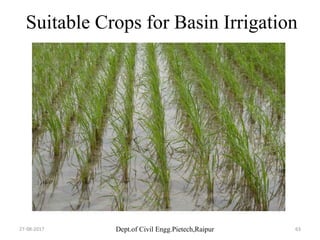
Paddy rice grows best when its roots are submerged
in water and so basin irrigation is the best method to
use for this crop.
Not suited to crops which cannot stand in wet or
waterlogged conditions for periods longer than 24
hours (e.g. potatoes, beet and carrots, etc.)
27-08-2017 64
Dept.of Civil Engg.Pietech,Raipur
Suitable Land Slopes for
Basin Irrigation
The flatter the land surface, the easier it is to construct
basins.
On flat land only minor leveling may be required to
obtain level basins.
27-08-2017 65
Dept.of Civil Engg.Pietech,Raipur
Water Application Methods
Direct Method
Cascade Method
27-08-2017 66
Dept.of Civil Engg.Pietech,Raipur
Direct Method of Water Application
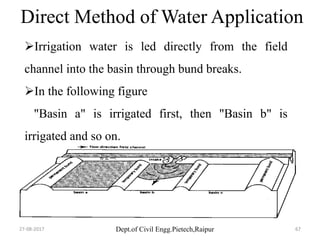
Irrigation water is led directly from the field
channel into the basin through bund breaks.
In the following figure
"Basin a" is irrigated first, then "Basin b" is
irrigated and so on.
This method can be used for most crop types and
is suitable for most soils.
27-08-2017 67
Dept.of Civil Engg.Pietech,Raipur
Cascade Method of Water Application
27-08-2017 68
Dept.of Civil Engg.Pietech,Raipur
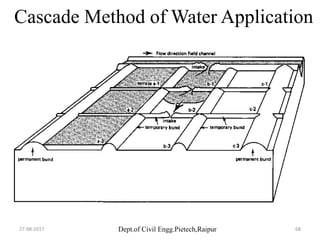
In the following figure the water is supplied to the
highest terrace (a.1) and is allowed to flow through
terrace a.2 until the lowest terrace (a.3) is filled.
The intake of terrace a.1 is then closed and the
irrigation water is diverted to terrace b.1 until b.1, b.2
and b.3 are filled, and so on.
27-08-2017 69
Dept.of Civil Engg.Pietech,Raipur
Introduction
Border irrigation can be viewed as an extension of basin
irrigation to sloping, long rectangular or contoured field
shapes, with free draining conditions at the lower end.
27-08-2017 70
Dept.of Civil Engg.Pietech,Raipur
Introduction (Contd.)
Above figure illustrates a typical border configuration
in which a field is divided into sloping borders.
Water is applied to individual borders from small
hand-dug checks from the field head ditch.
When the water is shut off, it recedes from the upper
end to the lower end.
27-08-2017
71
Introduction (Contd.)
27-08-2017 Dept.of Civil Engg.Pietech,Raipur 72
Dept.of Civil Engg.Pietech,Raipur27-08-2017 73
Dept.of Civil Engg.Pietech,Raipur
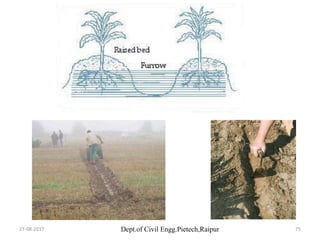
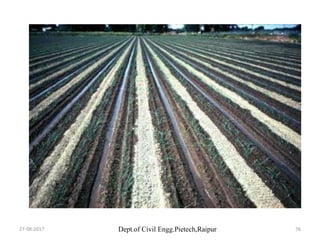
Introduction
Furrow irrigation avoids flooding the entire field
surface by channeling the flow along the primary
direction of the field using ‘furrows,’ ‘creases,’ or
‘corrugations’.
Water infiltrates through the wetted perimeter and
spreads vertically and horizontally to refill the soil
reservoir.
27-08-2017 74
Dept.of Civil Engg.Pietech,Raipur27-08-2017 75
Dept.of Civil Engg.Pietech,Raipur27-08-2017 76
Dept.of Civil Engg.Pietech,Raipur
Introduction
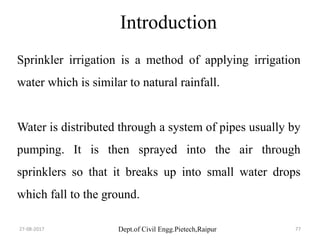
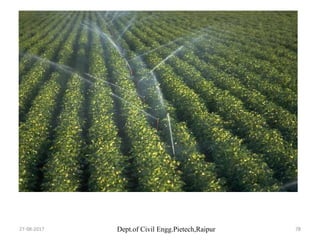
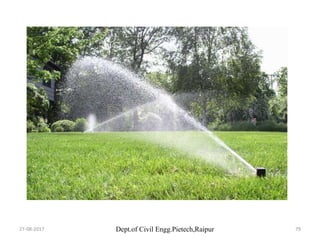
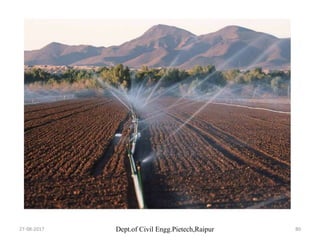
Sprinkler irrigation is a method of applying irrigation
water which is similar to natural rainfall.
Water is distributed through a system of pipes usually by
pumping. It is then sprayed into the air through
sprinklers so that it breaks up into small water drops
which fall to the ground.
27-08-2017 77
Dept.of Civil Engg.Pietech,Raipur27-08-2017 78
Dept.of Civil Engg.Pietech,Raipur27-08-2017 79
Dept.of Civil Engg.Pietech,Raipur27-08-2017 80
Dept.of Civil Engg.Pietech,Raipur
Introduction
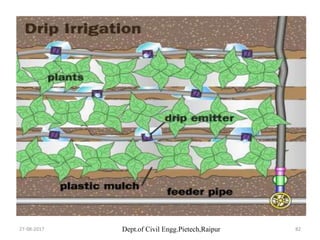
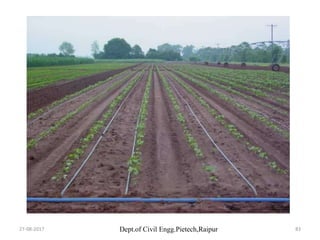
Drip irrigation is sometimes called trickle irrigation and
involves dripping water onto the soil at very low rates (2-20
liters / hour) from a system of small diameter plastic pipes
fitted with outlets called emitters or drippers.
Water is applied close to plants so that only part of the soil
in which the roots grow is wetted, unlike surface and
sprinkler irrigation, which involves wetting the whole soil
profile Suitable for high value row crops.
27-08-2017 81
Dept.of Civil Engg.Pietech,Raipur27-08-2017 82
Dept.of Civil Engg.Pietech,Raipur27-08-2017 83
Dept.of Civil Engg.Pietech,Raipur
The suitability of the various irrigation methods, i.e.
surface, sprinkler or drip irrigation, depends mainly on
the following factors:
 natural conditions
type of crop
type of technology
previous experience with irrigation
required labour inputs
costs and benefits.
27-08-2017 84
Dept.of Civil Engg.Pietech,Raipur
Natural Conditions
Soil type:
Sandy soils have a low water storage capacity and a high
infiltration rate. They therefore need frequent but small
irrigation applications.
Under these circumstances, sprinkler or drip irrigation
are more suitable than surface irrigation.
On loamy or clay soils all three irrigation methods can
be used, but surface irrigation is more commonly found.
27-08-2017 85
27-08-2017 Dept.of Civil Engg.Pietech,Raipur 86
References
Irrigation Engineering and Hydraulic Structures
Santosh Kumar Garg
Khanna Publishers
27-08-2017 Dept.of Civil Engg.Pietech,Raipur 87

A presentation on irrigation engineering

  • 1.
  • 2.
    27-08-2017 Dept.of CivilEngg.Pietech,Raipur 2 • Introduction • Necessity and scope of irrigation • Engineering - benefits and ill effects of irrigation • Irrigation development in India • Classification and types of irrigation systems • Soil-water plant relationship and Type of soil • Water requirements of crop and its Important terminology • Duty delta and base period and Irrigation efficiencies • Method of measuring irrigation water • References Contents
  • 3.
    27-08-2017 Dept.of CivilEngg.Pietech,Raipur 3 Course goals This course has two specific goals: To introduce students to basic concepts of soil, water, plants, their interactions, as well as irrigation and drainage systems design, planning and management. To develop analytical skills relevant to the areas mentioned in (i) above, particularly the design of irrigation and drainage projects.
  • 4.
    Definition • Irrigation maybe defined as the process of supplying water by artificial means to agricultural fields for crop production. If water available to the plants from rainfall is not sufficient, it is supplemented by irrigation water. • In order to achieve this objective, an irrigation system is required to be developed that involves planning, design, construction, operation and maintenance of various irrigation works: 27-08-2017 Dept.of Civil Engg.Pietech,Raipur 4
  • 5.
    27-08-2017 Dept.of CivilEngg.Pietech,Raipur 5 • Source: River, Reservoirs • Control structure: Barrages, Head Regulators • Distribution system: Irrigation Canals Definition
  • 6.
    Irrigation Engineering Irrigation engineeringinvolves: • Conception • Planning • Design • Construction • Operation • Management of irrigation system. 27-08-2017 Dept.of Civil Engg.Pietech,Raipur 6
  • 7.
    Necessity of irrigation •Insufficient rainfall • Uneven distribution of rainfall • Improvement of perennial crop • Development of agriculture in desert area 27-08-2017 Dept.of Civil Engg.Pietech,Raipur 7
  • 8.
    Benefits of irrigation •Increase in crop yield • Protection from famine • Cultivation of superior crops • Elimination of mixed cropping • Economic development • Hydro power generation • Domestic and industrial water supply 27-08-2017 Dept.of Civil Engg.Pietech,Raipur 8
  • 9.
    ill effects ofirrigation • Rising of water table • Formation of marshy land • Dampness in weather • Loss of valuable lands 27-08-2017 Dept.of Civil Engg.Pietech,Raipur 9
  • 10.
    27-08-2017 Dept.of CivilEngg.Pietech,Raipur 10 ill effects of irrigation
  • 11.
    Irrigation development inIndia • Among Asian countries India has largest arable land (40%). • Only USA has more arable land than India. • In a monsoon climate and an agrarian economy like India, irrigation has played a major role in the production process. There is evidence of the practice of irrigation since the establishment of settled agriculture during the Indus Valley Civilization (2500 BC). 27-08-2017 Dept.of Civil Engg.Pietech,Raipur 11
  • 12.
    Irrigation development inIndia • At beginning of 19th century, there was large no of water tanks in peninsular India and several canals in northern India were build. • The upper Ganga canal, upper Bari Doab canal and the Krishna and Godavari delta system were constructed between 1836-1866. 27-08-2017 Dept.of Civil Engg.Pietech,Raipur 12
  • 13.
    Irrigation development inIndia • During the last fifty years, gross irrigated area (GIA) of India has increased more than three fold from 22 to 76 million Hectares. • Groundwater irrigation in India developed during the period of green revolution and contributed much in increasing the gross irrigated area of the country. 27-08-2017 Dept.of Civil Engg.Pietech,Raipur 13
  • 14.
    Irrigation development inIndia • In the last five decades, groundwater irrigation has increased from 5 million hectares to 35million hectares. 27-08-2017 Dept.of Civil Engg.Pietech,Raipur 14
  • 15.
    Classification of irrigationschemes Irrigation projects in India are classified into three categories. • Major • Medium • Minor according to the area cultivated. 27-08-2017 Dept.of Civil Engg.Pietech,Raipur 15
  • 16.
    Classification of irrigationschemes • Major irrigation projects: projects which have a culturable command area (CCA) of more than 10,000 ha but more than 2,000 ha utilize mostly surface water resources. • Medium irrigation projects: projects which have CCA less than 10,000 ha. But more than 2,000 ha utilizes mostly surface water resources. 27-08-2017 Dept.of Civil Engg.Pietech,Raipur 16
  • 17.
    Classification of irrigationschemes • Minor irrigation projects: projects with CCA less than or equal to 2,000 ha. Utilizes both ground water and local surface water resources. 27-08-2017 Dept.of Civil Engg.Pietech,Raipur 17
  • 18.
    Types of irrigationsystems The classification of the irrigation systems can also be based on the way the water is applied to the agricultural land as – 1. Flow irrigation system: where the irrigation water is conveyed by growing to the irrigated land. • Direct irrigation • Reservoir/tank/storage irrigation 27-08-2017 Dept.of Civil Engg.Pietech,Raipur 18
  • 19.
    Types of irrigationsystems 2. Lift irrigation system: Where the irrigation water is available at a level lower than that of the land to be irrigated and hence the water is lifted up by pumps or by other mechanical devices for lifting water and conveyed to the agricultural land through channels flowing under gravity. 27-08-2017 Dept.of Civil Engg.Pietech,Raipur 19
  • 20.
    Types of irrigationsystems 3.Inundation/flooding type irrigation system: In which large quantities of water flowing in a river during floods is allowed to inundate the land to be cultivated, thereby saturating the soil. • The excess water is then drained off and the land is used for cultivation. • It is also common in the areas near river deltas, where the slope of the river and land is small. 27-08-2017 Dept.of Civil Engg.Pietech,Raipur 20
  • 21.
    Types of irrigationsystems 4. Perennial irrigation system: In which irrigation water is supplied according to the crop water requirement at regular intervals, throughout the life cycle of the crop. • The water for such irrigation may be obtained from rivers or from wells. 27-08-2017 Dept.of Civil Engg.Pietech,Raipur 21
  • 22.
    Some important terms 1.Culturable Command Area (CCA): The gross command area contains unfertile barren land, alkaline soil, local ponds, villages and other areas as habitation. • These areas are called unculturable areas. The remaining area on which crops can be grown satisfactorily is known as cultivable command area (CCA). 27-08-2017 Dept.of Civil Engg.Pietech,Raipur 22
  • 23.
    27-08-2017 Dept.of CivilEngg.Pietech,Raipur 23 Culturable command area can further be divided into 2 categories Culturable cultivated area: It is the area in which crop is grown at a particular time or crop season. Culturable uncultivated area: It is the area in which crop is not sown in a particular season.
  • 24.
    2. Gross commandarea (GCA): The total area lying between drainage boundaries which can be commanded or irrigated by a canal system. 3. Water Tanks: These are dug areas of lands for storing excess rain water. 4. Water logged area: An agricultural land is said to be waterlogged when its productivity or fertility is affected by high water table. 27-08-2017 Dept.of Civil Engg.Pietech,Raipur 24
  • 25.
    • The heightof capillary fringe is more for fine grained soil and less for coarse grained ones. 5. Outlet: This is a small structure which admits water from the distributing channel to a water course of field channel. Thus an outlet is a sort of head regulator for the field channel. 6. Permanent wilting point: or the wilting coefficient is that water content at which plants can no longer extract sufficient water from the soil for its growth. 27-08-2017 Dept.of Civil Engg.Pietech,Raipur 25
  • 26.
    Soil Water Relationships 27-08-2017Dept.of Civil Engg.Pietech,Raipur 26
  • 27.
    Types of Groundwater •Gravitational – also called “free water.” This is the water that drains out of the soil after it has been wetted. • This water moves downward through the soil because of the pull of gravity, This water also feeds wells and springs. • Capillary – water that moves into and is held in the soil by capillary forces (or pertaining to the attraction or repulsion between a solid and a liquid). 27-08-2017 Dept.of Civil Engg.Pietech,Raipur 27
  • 28.
    Types of Groundwater •Hygroscopic - very thin water films around the soil particles. • These films are held by extremely strong • forces that cause the water molecules to be arranged in a semi-solid form. • Hygroscopic Water - is held so strongly by the soil particles (adhesion), that it is not available to the plants. 27-08-2017 Dept.of Civil Engg.Pietech,Raipur 28
  • 29.
    Types of Groundwater •Capillary Water is held by cohesive forces greater than gravity and is available to plants. • Gravitational Water is that water which cannot be held against gravity. • Saturation Point – the moisture point at which all of the pore spaces are filled with water. • Field Capacity – the maximum amount of water left in the soil after losses of water to the forces of gravity have ceased and before surface evaporation begins. 27-08-2017 Dept.of Civil Engg.Pietech,Raipur 29
  • 30.
    Types of Groundwater •Wilting Point – the point at which the plant can no longer obtain sufficient water from the soil to meet its transpiration needs. • At this point the plant enters permanent wilt and dies. • Available Soil Water – that amount present in a soil which can be moved by plants. • It is designated as the difference between the field capacity and the wilting point. 27-08-2017 Dept.of Civil Engg.Pietech,Raipur 30
  • 31.
    Types of Groundwater •Saturation capacity: this is the total water content of the soil when all the pores of the soil are filled with water. • It is also termed as the maximum water holding capacity of the soil. • At saturation capacity, the soil moisture tension is almost equal to zero. 27-08-2017 Dept.of Civil Engg.Pietech,Raipur 31
  • 32.
    Types of Groundwater •Temporary wilting point: this denotes the soil water content at which the plant wilts at day time, but recovers during right or when water is added to the soil. • Ultimate wilting point: at such a soil water content, the plant wilts and fails to regain life even after addition of water to soil. 27-08-2017 Dept.of Civil Engg.Pietech,Raipur 32
  • 33.
    27-08-2017 Dept.of CivilEngg.Pietech,Raipur 33
  • 34.
    27-08-2017 Dept.of CivilEngg.Pietech,Raipur 34 Water requirements of crops
  • 35.
    Introduction • The termwater requirements of a crop means the total quantity of all water and the way in which a crop requires water, from the time it is sown to the time it is harvested. • The water requirement of crop varies with the crop as well as with the place. • The same crop may have different water requirements at different places of the same country. 27-08-2017 Dept.of Civil Engg.Pietech,Raipur 35
  • 36.
    Factors affecting waterrequirement • Water table: high water table less requirement, vice versa. • Climate: In hot climate evaporation loss is more, hence requirement more, vice versa. • Ground slope: ground is steep, the water flows down very quickly and soil gets little time to absorb, so requirement more. If ground is flat less requirement. 27-08-2017 Dept.of Civil Engg.Pietech,Raipur 36
  • 37.
    • Intensity ofirrigation: if intensity of irrigation for a particular crop is high, then more area comes under the irrigation system and requirement is more, vice versa. • Type of soil: sandy soil water percolates very quickly, so requirement is more. Clay soil retention capacity is more, so less requirement. • Method of application of water: surface method more water is required to meet up evaporation. In sub surface and sprinkler method less water required. 27-08-2017 Dept.of Civil Engg.Pietech,Raipur 37
  • 38.
    • Method ofploughing: In deep ploughing less water required, because soil can retain moisture for longer period. In shallow ploughing more water required. 27-08-2017 Dept.of Civil Engg.Pietech,Raipur 38
  • 39.
    Base Period 27-08-2017 Dept.ofCivil Engg.Pietech,Raipur 39 • Base is defined as the period from the first to the last watering of the crop just before its maturity. • Denoted as “B” and expressed in no of days. • p Crop Name of Crop Base period in days Rice 120 Wheat 120 Maize 100 Cotton 200 Sugarcane 320
  • 40.
    Delta • Each croprequires certain amount of water per hectare for its maturity. • If the total of amount of water supplied to the crop is stored on the land without any loss, then there will be a thick of water standing on the land. • This depth of water layer is known as Delta for the crop. • Donated by “∆” expressed on cm. 27-08-2017 Dept.of Civil Engg.Pietech,Raipur 40
  • 41.
    27-08-2017 Dept.of CivilEngg.Pietech,Raipur 41 Kharif crops Delta in cm. Rice 125 Maize 45 Ground nut 30 Millet 30 Robi crops Delta in cm. Wheat 40 Mustard 45 Gram 30 Potato 75
  • 42.
    Duty • Duty ofwater is defined as no of hectares that can be irrigated by constant supply of water at the rate of one cumec throughout the base period. • Denoted as “D” and expressed in hectares/cumec. • Varies with soil condition, method of ploughing, method of application of water 1 cumec-day = 1 m3/sec for one day. 27-08-2017 Dept.of Civil Engg.Pietech,Raipur 42
  • 43.
    27-08-2017 Dept.of CivilEngg.Pietech,Raipur 43 Name of crops Duty in hectares/cumec Rice 900 Wheat 1800 Cotton 1400 Sugarcane 800
  • 44.
    Factors affecting duty •Soil characteristics: if soil of the canal bed is porous and coarse grained, it leads to more seepage loss and low duty. If soil is compact and close grained, seepage loss will less and high duty. • Climatic condition: when atmospheric temp. of command area becomes high, the evaporation loss is more and duty becomes low and vice versa. 27-08-2017 Dept.of Civil Engg.Pietech,Raipur 44
  • 45.
    Factors affecting duty •Rainfall: if rainfall is sufficient during crop period, less quantity of irrigation water shall be required and duty will more and vice versa. • Base period: when base period is longer, the water requirement will be more and duty will low and vice versa. • Type of crop: water requirement of various crops are different. So the duty also varies. • Topography of agricultural land: if land has slight slope duty will high as water requirement optimum. As slope increases duty increases because there is wastage of water. 27-08-2017 Dept.of Civil Engg.Pietech,Raipur 45
  • 46.
    27-08-2017 Dept.of CivilEngg.Pietech,Raipur 46 • Method of ploughing: deep ploughing by tractor requires less quantity of water, duty is high. Shallow ploughing by bullocks requires more quantity of water, duty is low. • Methods of irrigation: duty is high in case of perennial irrigation system as compared to inundation irrigation system. Because in perennial system head regulator is used. • Water tax: if some tax is imposed on the basis of volume of water consumption, the farmer will use the water economically, duty will be high.
  • 47.
    Methods of improvingduty • Proper ploughing: Ploughing should be done properly and deeply, so that moisture retaining capacity of soil is increased. • Methods of supplying water: this should be decided according to the field and soil conditions. • Furrow method – crops shown in row • Contour method – hilly area • Basin method – for orchards • Flooding method – plain lands 27-08-2017 Dept.of Civil Engg.Pietech,Raipur 47
  • 48.
    • Canal lining:to reduce percolation loss the canals should be lined according to site condition. • Transmission loss: to reduce this canals should be taken close to the irrigable land as far as possible. • Crop rotation: crop rotation should be adopted to increase the moisture retaining capacity and fertility of the soil. • Implementation of tax: the water tax should be imposed on the basis of volume of water consumption. 27-08-2017 Dept.of Civil Engg.Pietech,Raipur 48
  • 49.
    Types of soil •Alluvial soil: formed by deposition of silt carried by river water during flood Silt is formed due to weathering action of rocks by heavy current of river water in the hilly regions. • Found in Indo –Gangetic plains, Brahmaputra plains. • Black soil: originated by weathering action on Mainly found in AP, MP, TN, Gujarat. They are sticky when wet and very hard when dry • Suitable for cultivation of cotton. 27-08-2017 Dept.of Civil Engg.Pietech,Raipur 49
  • 50.
    • Red soil:formed by weathering action of rocks of igneous and metamorphic group. • Water absorbing capacity very low Found in Karnataka, TN, Orissa, WB, Maharashtra etc. • Laterite soil: formed by weathering action of laterite rocks. • Yellowish red in color and having good drainage property, Found in Kerala, Karnataka, Orissa, Assam etc. 27-08-2017 Dept.of Civil Engg.Pietech,Raipur 50
  • 51.
    Consumptive use ofwater • It is defined as total quantity of water used for the growth of plants by transpiration and the amount of water lost by evaporation. • It is also known as Evapo-transpiration Expressed in hectare-meter or as depth of water in meters • The value of consumptive use of water is vary from crop to crop, time to time, place to place. 27-08-2017 Dept.of Civil Engg.Pietech,Raipur 51
  • 52.
    Irrigation efficiencies • Efficiencyis the ratio of the water output to the water input, and is usually expressed as percentage. • Input minus output is nothing but losses, and hence, if losses are more, output is less and, therefore, efficiency is less. • Hence, efficiency is inversely proportional to the losses. • Water is lost in irrigation during various processes and, therefore, there are different kinds of irrigation efficiencies. 27-08-2017 Dept.of Civil Engg.Pietech,Raipur 52
  • 53.
    • Efficiency ofWater-conveyance ( ) - It is the ratio of amount of water applied to the land to the amount of water supplied from the reservoir. • It may be represented by • = (Wl /Wr ) × 100 • where, = Water conveyance efficiency, • Wl = amount of water applied to land, and • Wr = Water supplied from reservoir. 27-08-2017 Dept.of Civil Engg.Pietech,Raipur 53 u c c c c
  • 54.
    • Water applicationefficiency ( ) - Ratio of water stored in root zone of plants to the water applied to the land. • Denoted by = (Wz /Wl ) × 100 • = water application efficiency • Wz = amount of water stored in root zone • Wl = amount of water applied to land. 27-08-2017 Dept.of Civil Engg.Pietech,Raipur 54 a a a
  • 55.
    • Water useefficiency ( ) - Ratio of the amount of water used to the amount of water applied. • Denoted by . • = (Wu /Wl ) × 100 • = water efficiency use. • W = water used • W = water applied 27-08-2017 Dept.of Civil Engg.Pietech,Raipur 55 u u u u
  • 56.
    • Consumptive useefficiency ( ) - Ratio of the consumptive use of water to the amount of water depleted from the root zone. • = (Cu /Wp ) × 100 • = consumptive use efficiency • Cu = consumptive use of water • Wp = amount of water depleted from root zone 27-08-2017 Dept.of Civil Engg.Pietech,Raipur 56 a cu cu cu
  • 57.
    Methods of MeasuringIrrigation Water • a) Direct method: Collect water in a contained of known volume e.g. bucket. Measure the time required for water from an irrigation source e.g. siphon to fill the bucket. • Flow rate = Volume/time, m3/hr or Lit./s or Lps etc. 27-08-2017 Dept.of Civil Engg.Pietech,Raipur 57
  • 58.
    Dept.of Civil Engg.Pietech,Raipur Typesof Irrigation Surface Irrigation Sprinkler Irrigation Drip Irrigation 27-08-2017 58
  • 59.
    Dept.of Civil Engg.Pietech,Raipur Definition Surfaceirrigation is defined as the group of application techniques where water is applied and distributed over the soil surface by gravity. It is by far the most common form of irrigation throughout the world 27-08-2017 59
  • 60.
    Dept.of Civil Engg.Pietech,Raipur Typesof Surface Irrigation Basin Irrigation Border Irrigation Furrow Irrigation 27-08-2017 60
  • 61.
    Dept.of Civil Engg.Pietech,Raipur Introduction Basinirrigation is the most common form of surface irrigation, particularly in regions with layouts of small fields. If a field is level in all directions, is encompassed by a dyke to prevent runoff, and provides an undirected flow of water onto the field, it is herein called a basin. A basin is typically square in shape but exists in all sorts of irregular and rectangular configurations. 27-08-2017 61
  • 62.
  • 63.
    Dept.of Civil Engg.Pietech,Raipur SuitableCrops for Basin Irrigation 27-08-2017 63
  • 64.
    Dept.of Civil Engg.Pietech,Raipur SuitableCrops for Basin Irrigation Paddy rice grows best when its roots are submerged in water and so basin irrigation is the best method to use for this crop. Not suited to crops which cannot stand in wet or waterlogged conditions for periods longer than 24 hours (e.g. potatoes, beet and carrots, etc.) 27-08-2017 64
  • 65.
    Dept.of Civil Engg.Pietech,Raipur SuitableLand Slopes for Basin Irrigation The flatter the land surface, the easier it is to construct basins. On flat land only minor leveling may be required to obtain level basins. 27-08-2017 65
  • 66.
    Dept.of Civil Engg.Pietech,Raipur WaterApplication Methods Direct Method Cascade Method 27-08-2017 66
  • 67.
    Dept.of Civil Engg.Pietech,Raipur DirectMethod of Water Application Irrigation water is led directly from the field channel into the basin through bund breaks. In the following figure "Basin a" is irrigated first, then "Basin b" is irrigated and so on. This method can be used for most crop types and is suitable for most soils. 27-08-2017 67
  • 68.
    Dept.of Civil Engg.Pietech,Raipur CascadeMethod of Water Application 27-08-2017 68
  • 69.
    Dept.of Civil Engg.Pietech,Raipur Inthe following figure the water is supplied to the highest terrace (a.1) and is allowed to flow through terrace a.2 until the lowest terrace (a.3) is filled. The intake of terrace a.1 is then closed and the irrigation water is diverted to terrace b.1 until b.1, b.2 and b.3 are filled, and so on. 27-08-2017 69
  • 70.
    Dept.of Civil Engg.Pietech,Raipur Introduction Borderirrigation can be viewed as an extension of basin irrigation to sloping, long rectangular or contoured field shapes, with free draining conditions at the lower end. 27-08-2017 70
  • 71.
    Dept.of Civil Engg.Pietech,Raipur Introduction(Contd.) Above figure illustrates a typical border configuration in which a field is divided into sloping borders. Water is applied to individual borders from small hand-dug checks from the field head ditch. When the water is shut off, it recedes from the upper end to the lower end. 27-08-2017 71
  • 72.
    Introduction (Contd.) 27-08-2017 Dept.ofCivil Engg.Pietech,Raipur 72
  • 73.
  • 74.
    Dept.of Civil Engg.Pietech,Raipur Introduction Furrowirrigation avoids flooding the entire field surface by channeling the flow along the primary direction of the field using ‘furrows,’ ‘creases,’ or ‘corrugations’. Water infiltrates through the wetted perimeter and spreads vertically and horizontally to refill the soil reservoir. 27-08-2017 74
  • 75.
  • 76.
  • 77.
    Dept.of Civil Engg.Pietech,Raipur Introduction Sprinklerirrigation is a method of applying irrigation water which is similar to natural rainfall. Water is distributed through a system of pipes usually by pumping. It is then sprayed into the air through sprinklers so that it breaks up into small water drops which fall to the ground. 27-08-2017 77
  • 78.
  • 79.
  • 80.
  • 81.
    Dept.of Civil Engg.Pietech,Raipur Introduction Dripirrigation is sometimes called trickle irrigation and involves dripping water onto the soil at very low rates (2-20 liters / hour) from a system of small diameter plastic pipes fitted with outlets called emitters or drippers. Water is applied close to plants so that only part of the soil in which the roots grow is wetted, unlike surface and sprinkler irrigation, which involves wetting the whole soil profile Suitable for high value row crops. 27-08-2017 81
  • 82.
  • 83.
  • 84.
    Dept.of Civil Engg.Pietech,Raipur Thesuitability of the various irrigation methods, i.e. surface, sprinkler or drip irrigation, depends mainly on the following factors:  natural conditions type of crop type of technology previous experience with irrigation required labour inputs costs and benefits. 27-08-2017 84
  • 85.
    Dept.of Civil Engg.Pietech,Raipur NaturalConditions Soil type: Sandy soils have a low water storage capacity and a high infiltration rate. They therefore need frequent but small irrigation applications. Under these circumstances, sprinkler or drip irrigation are more suitable than surface irrigation. On loamy or clay soils all three irrigation methods can be used, but surface irrigation is more commonly found. 27-08-2017 85
  • 86.
    27-08-2017 Dept.of CivilEngg.Pietech,Raipur 86 References Irrigation Engineering and Hydraulic Structures Santosh Kumar Garg Khanna Publishers
  • 87.
    27-08-2017 Dept.of CivilEngg.Pietech,Raipur 87