College of forestry
Assignment on
‘watershed Analysis And Planning Using
GIS’
Submitted by Submitted to
VISHAL (16055)
DIKSHA DEV (16064)
SHAHRUKH BEG(16060)
Surbhi Jayara (16067)
Dr. Deepa Rawat
_INDEX_
1. Watershed Analysis; Introduction and Definition
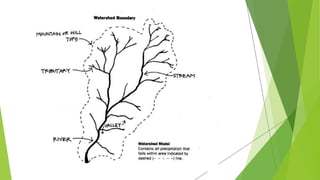
2. Components of watershed.
3. Delineation of watershed.
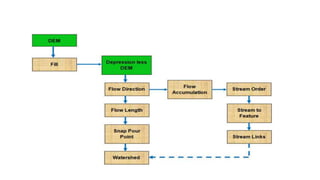
4. Steps involved in watershed delineation.
5. Factors influencing watershed analysis
6. Application of watershed analysis.
7. Benefits derived from watershed methodology.
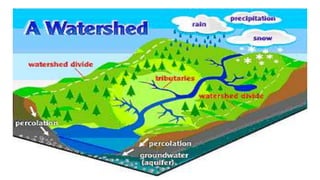
Watershed ;
 A watershed is an area of land that
feeds all the water running under it and
draining off of it into a body of water . It
combines with other watersheds to form
a network of rivers and streams that
progressively drain into larger water areas.
Watershed Analysis:
Watershed analysis refers to the process of
using DEM and raster data operations to
delineate watersheds and to derive features
such as stream ,stream networks ,catchment
areas , basin etc.
Traditionally, the use of geographic
information systems for watershed management
Projects has been limited to a supporting role in
Mapping and related to engineering activities-not
often serving as a driving resource in the
analytical process .
Watershed studies conducted using a GIS
Platform have demonstrated that the spatial
analysis capabilities of GIS hold the key to improv
-ed watershed modeling techniques .This approac
-h allowed for the establishment of more accurate ,
Efficient and high – quality products.
In watershed analysis using GIS, the
data is gathered in a variety of formats
including spatial data ,non-spatial data
and digital remote sensing data ….
Effective data analysis requires
incorporation of both spatial and non-
spatial entities that may change in time.
Objectives of Watershed;
 1. Production of food, fodder, fuel.
 2 Pollution control
 3. Over exploitation of resources should be minimized
 4. Water storage, flood control, checking sedimentation.
 5. Wild life preservation
 6. Erosion control and prevention of soil, degradation and
conservation of soil and water.
 7. Employment generation through industrial development dairy
fishery production.
 8. Recharging of ground water to provide regular water supply
for consumption and industry as well as irrigation.
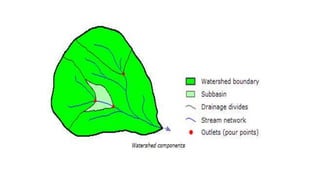
Components of watershed:
Broadly a watershed have five
components ;
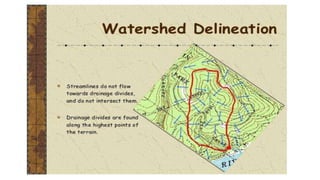
*Watershed Boundary
*Subbasin
*Drainage divides
*Stream networks
*Outlets
Delineation Of Watershed;
Delineation of watershed can be divided
into two types;
: Area based method
: Point based method
Steps involved in delineation of
watershed;
When delineating watersheds or defining stream
networks, we proceed through a series of steps,which are ;
1. DEM acquisition-:
The first input required for watershed analysis is
DEM. In a DEM , each cell of raster GIS layer has a value
corresponding to its elevation .
DEM data files contain the elevation of the terrain over a
specified area ,usually at a fixed grid interval over the “bare
earth”.
_FILL_
Fill sinks in a surface raster to remove
small imperfection -s in a data. A filled
DEM or elevation raster is a void of
depression. A common method to
remove depression is to increase its
cell value to the lowest overflo
-w point out of the sink .This results in
flat surface.
Flow Direction;
A flow direction raster shows the
direction water will
flow out of each cell of a filled elevation raster .
A widely used method for deriving flow direction
is the D8method ,used by Arc GIS.
D8 method produces good results in the
zone of convergent flows and along well
defined valleys.

Flow Accumulation_
A flow accumulation raster tabulates
for each cell the no. of cells that will flow to it.
The tabulation is based on the flow direction
raster.
5. STREAM NETWORK;
 Stream network can be derived from
a flow accumulation raster .
The derivation is based on threshold
accumulation value.
Threshold values between 100 to 500 cells
seem to best capture the stream network in
the area.
6.STREAM LINKS;
Assigning a unique value and
associating with flow direction to each
section of stream network is a step to derive
stream links.
7. Area -wide watersheds;
Inputs required for area-
wide watersheds delineation are
flow direction raster and stream
network raster.
A denser stream network
will have more but smaller
watersheds.
8. Point-Based Watersheds;
 Delineation of individual watershed
-s based on point of intersection [ pour point ] foll
-ows the same steps as for delineation of Area-
wide watersheds .
Point based watersheds delineation
Is based on the point of interest . This point of
interest may be stream gauge stations or dams.
Factor Influencing Watershed Analysis ;
 There are two main factors which
effects watershed analysis, these are as
follows;
1. DEM; A 30m DEM likely to be too coarse to
provide detailed topographic features for
geomorphic and hydrologic modeling.
2. Algorithm ; Choice of algorithm is also an
important factor in watershed analysis.
Application of watershed analysis ;
Watershed analysis is used for the
management and planning of natural resources .
1. To provide necessary inputs for hydrological
modeling .
2. Flood prediction modeling and snow-melt
run-off models etc.
3. Watershed analysis provides catchment bound
-aries but also hydrological parameters useful for
Management programs .
Benefits derived from Watershed Metodology ;
1. The crop yield has increased by in dry land
farming.
2. The soil loss due to erosion was brought down..
3. Large extents of barren hill slopes were covered
by vegetation .
4. Large tracts of marginal lands brought under dry
land horticulture.
5. Development of Agro-Horti and Agro-Forestry
systems.
6. Water -resources were harvested through nala
bunds , farm - ponds gully embankments.
7. Regeneration of grasslands for more fodder
and grass.
8. The income of farmers increased considerab
-ly.

watershed analysis and delineation through GIS

  • 1.
    College of forestry Assignmenton ‘watershed Analysis And Planning Using GIS’ Submitted by Submitted to VISHAL (16055) DIKSHA DEV (16064) SHAHRUKH BEG(16060) Surbhi Jayara (16067) Dr. Deepa Rawat
  • 2.
    _INDEX_ 1. Watershed Analysis;Introduction and Definition 2. Components of watershed. 3. Delineation of watershed. 4. Steps involved in watershed delineation. 5. Factors influencing watershed analysis 6. Application of watershed analysis. 7. Benefits derived from watershed methodology.
  • 3.
    Watershed ;  Awatershed is an area of land that feeds all the water running under it and draining off of it into a body of water . It combines with other watersheds to form a network of rivers and streams that progressively drain into larger water areas.
  • 5.
    Watershed Analysis: Watershed analysisrefers to the process of using DEM and raster data operations to delineate watersheds and to derive features such as stream ,stream networks ,catchment areas , basin etc.
  • 6.
    Traditionally, the useof geographic information systems for watershed management Projects has been limited to a supporting role in Mapping and related to engineering activities-not often serving as a driving resource in the analytical process . Watershed studies conducted using a GIS Platform have demonstrated that the spatial analysis capabilities of GIS hold the key to improv -ed watershed modeling techniques .This approac -h allowed for the establishment of more accurate , Efficient and high – quality products.
  • 7.
    In watershed analysisusing GIS, the data is gathered in a variety of formats including spatial data ,non-spatial data and digital remote sensing data …. Effective data analysis requires incorporation of both spatial and non- spatial entities that may change in time.
  • 8.
    Objectives of Watershed; 1. Production of food, fodder, fuel.  2 Pollution control  3. Over exploitation of resources should be minimized  4. Water storage, flood control, checking sedimentation.  5. Wild life preservation  6. Erosion control and prevention of soil, degradation and conservation of soil and water.  7. Employment generation through industrial development dairy fishery production.  8. Recharging of ground water to provide regular water supply for consumption and industry as well as irrigation.
  • 9.
    Components of watershed: Broadlya watershed have five components ; *Watershed Boundary *Subbasin *Drainage divides *Stream networks *Outlets
  • 12.
    Delineation Of Watershed; Delineationof watershed can be divided into two types; : Area based method : Point based method
  • 14.
    Steps involved indelineation of watershed; When delineating watersheds or defining stream networks, we proceed through a series of steps,which are ; 1. DEM acquisition-: The first input required for watershed analysis is DEM. In a DEM , each cell of raster GIS layer has a value corresponding to its elevation . DEM data files contain the elevation of the terrain over a specified area ,usually at a fixed grid interval over the “bare earth”.
  • 16.
    _FILL_ Fill sinks ina surface raster to remove small imperfection -s in a data. A filled DEM or elevation raster is a void of depression. A common method to remove depression is to increase its cell value to the lowest overflo -w point out of the sink .This results in flat surface.
  • 17.
    Flow Direction; A flowdirection raster shows the direction water will flow out of each cell of a filled elevation raster . A widely used method for deriving flow direction is the D8method ,used by Arc GIS. D8 method produces good results in the zone of convergent flows and along well defined valleys. 
  • 18.
    Flow Accumulation_ A flowaccumulation raster tabulates for each cell the no. of cells that will flow to it. The tabulation is based on the flow direction raster.
  • 19.
    5. STREAM NETWORK; Stream network can be derived from a flow accumulation raster . The derivation is based on threshold accumulation value. Threshold values between 100 to 500 cells seem to best capture the stream network in the area.
  • 20.
    6.STREAM LINKS; Assigning aunique value and associating with flow direction to each section of stream network is a step to derive stream links.
  • 21.
    7. Area -widewatersheds; Inputs required for area- wide watersheds delineation are flow direction raster and stream network raster. A denser stream network will have more but smaller watersheds.
  • 22.
    8. Point-Based Watersheds; Delineation of individual watershed -s based on point of intersection [ pour point ] foll -ows the same steps as for delineation of Area- wide watersheds . Point based watersheds delineation Is based on the point of interest . This point of interest may be stream gauge stations or dams.
  • 23.
    Factor Influencing WatershedAnalysis ;  There are two main factors which effects watershed analysis, these are as follows; 1. DEM; A 30m DEM likely to be too coarse to provide detailed topographic features for geomorphic and hydrologic modeling. 2. Algorithm ; Choice of algorithm is also an important factor in watershed analysis.
  • 24.
    Application of watershedanalysis ; Watershed analysis is used for the management and planning of natural resources . 1. To provide necessary inputs for hydrological modeling . 2. Flood prediction modeling and snow-melt run-off models etc. 3. Watershed analysis provides catchment bound -aries but also hydrological parameters useful for Management programs .
  • 25.
    Benefits derived fromWatershed Metodology ; 1. The crop yield has increased by in dry land farming. 2. The soil loss due to erosion was brought down.. 3. Large extents of barren hill slopes were covered by vegetation . 4. Large tracts of marginal lands brought under dry land horticulture. 5. Development of Agro-Horti and Agro-Forestry systems.
  • 26.
    6. Water -resourceswere harvested through nala bunds , farm - ponds gully embankments. 7. Regeneration of grasslands for more fodder and grass. 8. The income of farmers increased considerab -ly.