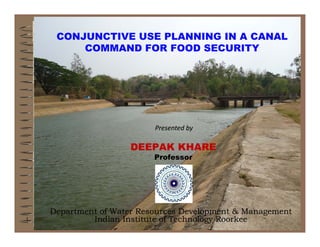
CONJUNCTIVE USE PLANNING IN A CANAL
COMMAND FOR FOOD SECURITYCOMMAND FOR FOOD SECURITY
Presented byPresented by
DEEPAK KHARE
Professor
Department of Water Resources Development & ManagementDepartment of Water Resources Development & Management
Indian Institute of Technology RoorkeeIndian Institute of Technology Roorkee1
INTRODUCTION: WATER SECURITY?
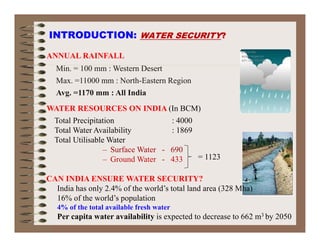
ANNUAL RAINFALL
Min. = 100 mm : Western Desert
Max. =11000 mm : North-Eastern Region
Avg. =1170 mm : All India
WATER RESOURCES ON INDIA (In BCM)WATER RESOURCES ON INDIA (In BCM)
Total Precipitation : 4000
Total Water Availability : 1869
Total Utilisable WaterTotal Utilisable Water
– Surface Water - 690
– Ground Water - 433 = 1123
CAN INDIA ENSURE WATER SECURITY?
India has only 2.4% of the world’s total land area (328 Mha)
16% of the world’s populationp p
4% of the total available fresh water
Per capita water availability is expected to decrease to 662 m3 by 2050
INTRODUCTION: FOOD SECURITY?
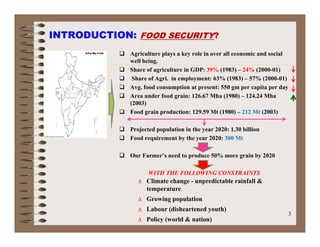
 Agriculture plays a key role in over all economic and social
well being.
 Share of agriculture in GDP: 39% (1983) – 24% (2000-01)
 Sh f A i i l t 63% (1983) 57% (2000 01) Share of Agri. in employment: 63% (1983) – 57% (2000-01)
 Avg. food consumption at present: 550 gm per capita per day
 Area under food grain: 126.67 Mha (1980) – 124.24 Mha
(2003)
 Food grain production: 129.59 Mt (1980) – 212 Mt (2003)
 Projected population in the year 2020: 1.30 billion
 Food requirement by the year 2020: 300 Mt Food requirement by the year 2020: 300 Mt
 Our Farmer’s need to produce 50% more grain by 2020
WITH THE FOLLOWING CONSTRAINTS
∆ Climate change - unpredictable rainfall &
temperature
∆ Growing population
3
g p p
∆ Labour (disheartened youth)
∆ Policy (world & nation)
Water facts and figures (Food
security & Agriculture)
Water facts and figures (Food
security & Agriculture)
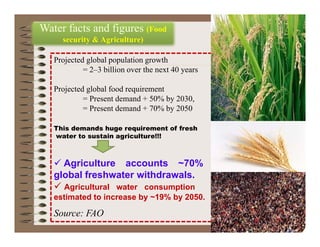
Projected global population growth
= 2–3 billion over the next 40 years
Projected global food requirement
= Present demand + 50% by 2030,
= Present demand + 70% by 2050= Present demand + 70% by 2050
This demands huge requirement of fresh
water to sustain agriculture!!!g
 Agriculture accounts ~70% of
global freshwater withdrawals.
 Agricultural water consumption is
estimated to increase by ~19% by 2050.y y
Source: FAO
CAN INDIA AFFORD WATER SECURITY?
 Land – Available fresh water – Population (A skewed square
ratio))
 Land = approx. 2% of the world’s total land area
 Water = approx. 4% of the total available fresh water
 Population = approx. 16% of the world’s population
 Population – Food requirement (An up-hill task)
 Projected population in the year 2020 = 1.30 billion
 Food requirement by the year 2020 = 300 Mt
 Our Farmer’s need to produce 50% more grain by 2020 to meet Our Farmer s need to produce 50% more grain by 2020 to meet
the requirement
5
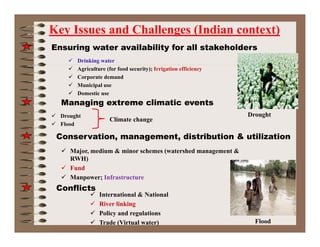
Key Issues and Challenges (Indian context)
E i t il bilit f ll t k h ldEnsuring water availability for all stakeholders
 Drinking water
 Agriculture (for food security); Irrigation efficiency
 Corporate demand Corporate demand
 Municipal use
 Domestic use
Managing extreme climatic events
Drought Drought
 Flood
Conservation, management, distribution & utilization
Climate change
Conservation, management, distribution & utilization
 Major, medium & minor schemes (watershed management &
RWH)
 Fund
Conflicts
u d
 Manpower; Infrastructure
 International & National

Flood
 River linking
 Policy and regulations
 Trade (Virtual water)
ISSUES IN A CANAL IRRIGATION SYSTEM
Reduced Water Use Efficiency (WUE) approx. 38-40 % at present
The major issues pertained to a Canal Command are :
(GOI, 1999 Vol. II: 482).
Intensive irrigation increased water logging, salinity, making the soil
unproductive.
Poor drainage resulting to waterlogging in the Indian subcontinent.
Irrigation service delivery were usually erratic and inequity between the heads
and tail ends of the canals resulting in poor yields.
Cumulative seepage of canal water tends to raise groundwater to the crop root
zone.
Groundwater recharge from canal seepage depends upon the size and the
ti f th l d th f fl h t i ti f il i th b d dcross section of the canal ,depth of flow, characteristics of soils in the bed and
sides.
Distribution losses from the canal command system generally consist of the
evaporation losses and seepageevaporation losses and seepage.
Overexploitation of groundwater resluts in decline of water levels
Intensive Irrigation in canal commands :Intensive Irrigation in canal commands :-
water logging
salinity,
ki h il d imaking the soil unproductive
Water Scarcity for agriculture :-
Overexploitation of groundwaterOverexploitation of groundwater
Lowering of water levels
Causing decline in yield and productivity of wells,
S t i t i l th tSeawater intrusion along the coast,
Drying of spring and shallow dugwells,
Increase in cost of lifting
According to Todd (1980) “Future demand for water requires planning the
maximum utilisation of all existing supplies. This can most economically be
obtained by Conjunctive use of surface water and ground water reservoirs.”
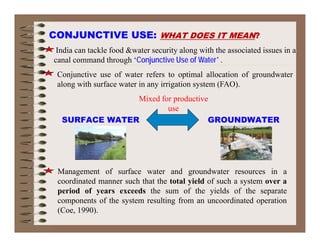
CONJUNCTIVE USE: WHAT DOES IT MEAN?
Conjunctive use of water refers to optimal allocation of groundwater
India can tackle food &water security along with the associated issues in a
canal command through ‘Conjunctive Use of Water’ .
Conjunctive use of water refers to optimal allocation of groundwater
along with surface water in any irrigation system (FAO).
Mixed for productive
use
SURFACE WATER GROUNDWATER
use
M t f f t d d t iManagement of surface water and groundwater resources in a
coordinated manner such that the total yield of such a system over a
period of years exceeds the sum of the yields of the separate
components of the system resulting from an uncoordinated operationcomponents of the system resulting from an uncoordinated operation
(Coe, 1990).
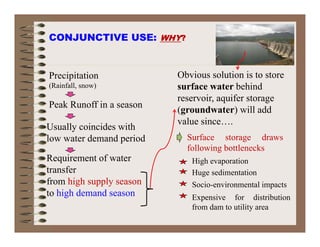
CONJUNCTIVE USE: WHY?
Obvious solution is to storePrecipitation Obvious solution is to store
surface water behind
reservoir, aquifer storage
( d t ) ill dd
Precipitation
(Rainfall, snow)
Peak Runoff in a season
(groundwater) will add
value since….
Usually coincides with
low water demand period Surface storage drawslow water demand period
Requirement of water
transfer
Surface storage draws
following bottlenecks
High evaporation
H di itransfer
from high supply season
to high demand season
Huge sedimentation
Socio-environmental impacts
Expensive for distributionp
from dam to utility area
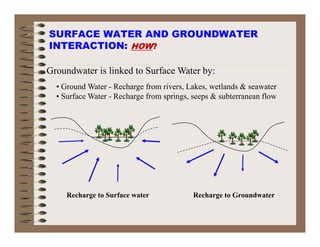
SURFACE WATER AND GROUNDWATER
INTERACTION: HOW?INTERACTION: HOW?
Groundwater is linked to Surface Water by:
• Ground Water - Recharge from rivers, Lakes, wetlands & seawater
• Surface Water - Recharge from springs, seeps & subterranean flow
Recharge to Surface water Recharge to Groundwater
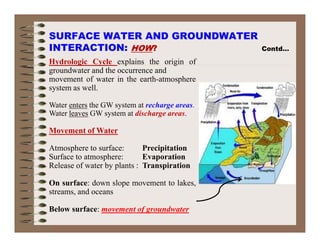
SURFACE WATER AND GROUNDWATER
INTERACTION HOW?
Hydrologic Cycle explains the origin of
groundwater and the occurrence and
f i h h h
INTERACTION: HOW? Contd…
movement of water in the earth-atmosphere
system as well.
Water enters the GW system at recharge areas.y g
Water leaves GW system at discharge areas.
Movement of Water
Atmosphere to surface: Precipitation
Surface to atmosphere: Evaporation
Release of water by plants : Transpiration
On surface: down slope movement to lakes,
streams, and oceans
Below surface: movement of groundwater
SURFACE WATER AND GROUNDWATER
INTERACTION HOW?
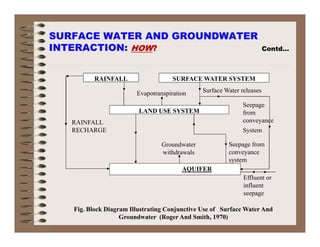
RAINFALL SURFACE WATER SYSTEM
INTERACTION: HOW? Contd…
RAINFALL SURFACE WATER SYSTEM
Seepage
Evapotranspiration Surface Water releases
LAND USE SYSTEM
RAINFALL
RECHARGE
p g
from
conveyance
System
AQUIFER
Groundwater
withdrawals
Seepage from
conveyance
system
AQUIFER
Effluent or
influent
seepage
Fig. Block Diagram Illustrating Conjunctive Use of Surface Water And
Groundwater (Roger And Smith, 1970)
OBJECTIVES IN CONJUNCTIVE WATER USE
 Improved availability and dependability of water supplyp y p y pp y
 Reduce water logging and salinity.(Environmental)
 Improve production, equity and poverty alleviation. Improve production, equity and poverty alleviation.
 Optimize expenditure on rehabilitation.(Fiscal)
 State disengagement from canal irrigation management State disengagement from canal irrigation management.
 Utilize underground storage and improve accessibility
and overall water use efficiencyy
ADVANTAGES OF CONJUNCTIVE WATER USE
1. Use of groundwater helps to reduce peak demands for irrigation,
size of canals and hence construction cost.
2 Supplies from groundwater ensure proper irrigation scheduling2. Supplies from groundwater ensure proper irrigation scheduling,
raising multiple crops and early sowing even if rainfall is delayed.
3. Increased water supply to tail end areas thereby improving equity
and reliability.
4. Groundwater exploitation lowers the water table and reduces
danger of water logging and consequent wastage of water.g gg g q g
5. Surface and sub-surface outflows are minimized, causing reduction
in peak runoff and flood discharge.
6. Increase in overall efficiency of the system due to recycling of
irrigation water.
7. Need for canal lining is reduced as seepage from canals rechargesg p g g
groundwater.
CONSTRAINTS IN IMPLEMENTING
CONJUNCTIVE USE PROGRAMMES
1 Possibilities of deterioration in groundwater quality due to influx of1. Possibilities of deterioration in groundwater quality due to influx of
salts leached down from soil, which may be quite marked as a result of
recycling within zones of depressions and or upland and lateral migration
of saline water into fresh water zones in response to pumping.p p p g
2. Increased power consumption to sustain pumpage from well,
possible dislocation of groundwater supplies due to power failure in
critical periods and decrease in pump efficiency due to large fluctuationscritical periods, and decrease in pump efficiency due to large fluctuations.
3. Operation, supervision and control of conjunctive use and artificial
recharge projects are more complex.
4. Administrative difficulties in evolving acceptable and equitable water
rates, providing motivation and incentives to accept groundwater use
when surface water is available.
ELEMENTS OF CONJUNCTIVE WATER USE
Conjunctive use requires physical facilities forj q p y
1. Water distribution
2 Artificial recharge2. Artificial recharge
3. Pumping of groundwater
Based on the above discussions, three important
components of the conjunctive use planning are:
1. Surface water supply and its conveyance
2. Groundwater supply and withdrawal
3 N t f i lt l l d3. Nature of agricultural lands
Water Management: Supply sideWater Management: Supply side
• Abundant supply of freshwater• Abundant supply of freshwater
• No signs of surface water reduction yet
ButBut
• Increasing risk of pollution
• Uncontrolled groundwater abstraction
• Potential risk of recharge reduction
Water Management: Demand sideWater Management: Demand side
• Lack of awareness on water issues• Lack of awareness on water issues
– One of the least developed regions
– Lack of adequate infrastructureLack of adequate infrastructure
• Increasing demand for fresh water
– Increasing population
– Increasing urbanization
– Intensification of agriculture
Case StudyCase Study
Ch i C i P tt t• Change in Cropping Pattern.pptx
• Tawa-Canal Conditions.pptx
• Water Logging Tawa Canal.pptxLower
Ganga Canal System.pptxg y pp
Water Management Options :
Basis for Consensus
• A basin wide management approach• A basin-wide management approach
• A surface water-groundwater conjunctive development,
use, and management, g
• A regional development policy and water-use strategy
• Effective involvement of all stakeholders
• Balancing water quality and quantity
CHALLENGE OF CONJUNCTIVE USE OF GROUNDWATER & SURFACE
WATER RESOURCESWATER RESOURCES
• Study of Canal System with time and try to incorporate the• Study of Canal System with time and try to incorporate the
possible impact
– * Sections of Canal---M & R Issues
* C i P t– * Cropping Patern
– * Level of Irrigation
• Understand Level of Irrigation and corresponding Yield
• Integrated modelling for tropical climates often demonstratesIntegrated modelling for tropical climates often demonstrates
that cropping intensity for entire command area could be
increased with ‘planned conjunctive use’ and better crop choices
could further enhance ‘irrigation water productivity’g p y
CHALLENGE OF CONJUNCTIVE USE OF GROUNDWATER & SURFACE
• But how to overcome social and economic obstacles to
i li i j i ( li i l f h d l l d
WATER RESOURCES
rationalising conjunctive use (political power of head-canal land
owners, comparative water cost to users and initial capital
investment requirements) ?
• Need very widely to move from ‘opportunistic water engineering
and agricultural development to integrated land and water
t i l di f ll id ti f d t ‘management including full consideration of groundwater ‘
• In our overall long-term interest and especially so facing the
need to adapt to accelerated climate change with
managing/reducing the problems of water-logging,
salinity and scanty supply in tail end regions of anysalinity and scanty supply in tail end regions of any
canal command
Thank You!

27 nov16 conjunctive_use_planning_in_a_canal_command_for_food_security

  • 1.
    CONJUNCTIVE USE PLANNINGIN A CANAL COMMAND FOR FOOD SECURITYCOMMAND FOR FOOD SECURITY Presented byPresented by DEEPAK KHARE Professor Department of Water Resources Development & ManagementDepartment of Water Resources Development & Management Indian Institute of Technology RoorkeeIndian Institute of Technology Roorkee1
  • 2.
    INTRODUCTION: WATER SECURITY? ANNUALRAINFALL Min. = 100 mm : Western Desert Max. =11000 mm : North-Eastern Region Avg. =1170 mm : All India WATER RESOURCES ON INDIA (In BCM)WATER RESOURCES ON INDIA (In BCM) Total Precipitation : 4000 Total Water Availability : 1869 Total Utilisable WaterTotal Utilisable Water – Surface Water - 690 – Ground Water - 433 = 1123 CAN INDIA ENSURE WATER SECURITY? India has only 2.4% of the world’s total land area (328 Mha) 16% of the world’s populationp p 4% of the total available fresh water Per capita water availability is expected to decrease to 662 m3 by 2050
  • 3.
    INTRODUCTION: FOOD SECURITY? Agriculture plays a key role in over all economic and social well being.  Share of agriculture in GDP: 39% (1983) – 24% (2000-01)  Sh f A i i l t 63% (1983) 57% (2000 01) Share of Agri. in employment: 63% (1983) – 57% (2000-01)  Avg. food consumption at present: 550 gm per capita per day  Area under food grain: 126.67 Mha (1980) – 124.24 Mha (2003)  Food grain production: 129.59 Mt (1980) – 212 Mt (2003)  Projected population in the year 2020: 1.30 billion  Food requirement by the year 2020: 300 Mt Food requirement by the year 2020: 300 Mt  Our Farmer’s need to produce 50% more grain by 2020 WITH THE FOLLOWING CONSTRAINTS ∆ Climate change - unpredictable rainfall & temperature ∆ Growing population 3 g p p ∆ Labour (disheartened youth) ∆ Policy (world & nation)
  • 4.
    Water facts andfigures (Food security & Agriculture) Water facts and figures (Food security & Agriculture) Projected global population growth = 2–3 billion over the next 40 years Projected global food requirement = Present demand + 50% by 2030, = Present demand + 70% by 2050= Present demand + 70% by 2050 This demands huge requirement of fresh water to sustain agriculture!!!g  Agriculture accounts ~70% of global freshwater withdrawals.  Agricultural water consumption is estimated to increase by ~19% by 2050.y y Source: FAO
  • 5.
    CAN INDIA AFFORDWATER SECURITY?  Land – Available fresh water – Population (A skewed square ratio))  Land = approx. 2% of the world’s total land area  Water = approx. 4% of the total available fresh water  Population = approx. 16% of the world’s population  Population – Food requirement (An up-hill task)  Projected population in the year 2020 = 1.30 billion  Food requirement by the year 2020 = 300 Mt  Our Farmer’s need to produce 50% more grain by 2020 to meet Our Farmer s need to produce 50% more grain by 2020 to meet the requirement 5
  • 6.
    Key Issues andChallenges (Indian context) E i t il bilit f ll t k h ldEnsuring water availability for all stakeholders  Drinking water  Agriculture (for food security); Irrigation efficiency  Corporate demand Corporate demand  Municipal use  Domestic use Managing extreme climatic events Drought Drought  Flood Conservation, management, distribution & utilization Climate change Conservation, management, distribution & utilization  Major, medium & minor schemes (watershed management & RWH)  Fund Conflicts u d  Manpower; Infrastructure  International & National  Flood  River linking  Policy and regulations  Trade (Virtual water)
  • 7.
    ISSUES IN ACANAL IRRIGATION SYSTEM Reduced Water Use Efficiency (WUE) approx. 38-40 % at present The major issues pertained to a Canal Command are : (GOI, 1999 Vol. II: 482). Intensive irrigation increased water logging, salinity, making the soil unproductive. Poor drainage resulting to waterlogging in the Indian subcontinent. Irrigation service delivery were usually erratic and inequity between the heads and tail ends of the canals resulting in poor yields. Cumulative seepage of canal water tends to raise groundwater to the crop root zone. Groundwater recharge from canal seepage depends upon the size and the ti f th l d th f fl h t i ti f il i th b d dcross section of the canal ,depth of flow, characteristics of soils in the bed and sides. Distribution losses from the canal command system generally consist of the evaporation losses and seepageevaporation losses and seepage. Overexploitation of groundwater resluts in decline of water levels
  • 8.
    Intensive Irrigation incanal commands :Intensive Irrigation in canal commands :- water logging salinity, ki h il d imaking the soil unproductive Water Scarcity for agriculture :- Overexploitation of groundwaterOverexploitation of groundwater Lowering of water levels Causing decline in yield and productivity of wells, S t i t i l th tSeawater intrusion along the coast, Drying of spring and shallow dugwells, Increase in cost of lifting According to Todd (1980) “Future demand for water requires planning the maximum utilisation of all existing supplies. This can most economically be obtained by Conjunctive use of surface water and ground water reservoirs.”
  • 9.
    CONJUNCTIVE USE: WHATDOES IT MEAN? Conjunctive use of water refers to optimal allocation of groundwater India can tackle food &water security along with the associated issues in a canal command through ‘Conjunctive Use of Water’ . Conjunctive use of water refers to optimal allocation of groundwater along with surface water in any irrigation system (FAO). Mixed for productive use SURFACE WATER GROUNDWATER use M t f f t d d t iManagement of surface water and groundwater resources in a coordinated manner such that the total yield of such a system over a period of years exceeds the sum of the yields of the separate components of the system resulting from an uncoordinated operationcomponents of the system resulting from an uncoordinated operation (Coe, 1990).
  • 10.
    CONJUNCTIVE USE: WHY? Obvioussolution is to storePrecipitation Obvious solution is to store surface water behind reservoir, aquifer storage ( d t ) ill dd Precipitation (Rainfall, snow) Peak Runoff in a season (groundwater) will add value since…. Usually coincides with low water demand period Surface storage drawslow water demand period Requirement of water transfer Surface storage draws following bottlenecks High evaporation H di itransfer from high supply season to high demand season Huge sedimentation Socio-environmental impacts Expensive for distributionp from dam to utility area
  • 11.
    SURFACE WATER ANDGROUNDWATER INTERACTION: HOW?INTERACTION: HOW? Groundwater is linked to Surface Water by: • Ground Water - Recharge from rivers, Lakes, wetlands & seawater • Surface Water - Recharge from springs, seeps & subterranean flow Recharge to Surface water Recharge to Groundwater
  • 12.
    SURFACE WATER ANDGROUNDWATER INTERACTION HOW? Hydrologic Cycle explains the origin of groundwater and the occurrence and f i h h h INTERACTION: HOW? Contd… movement of water in the earth-atmosphere system as well. Water enters the GW system at recharge areas.y g Water leaves GW system at discharge areas. Movement of Water Atmosphere to surface: Precipitation Surface to atmosphere: Evaporation Release of water by plants : Transpiration On surface: down slope movement to lakes, streams, and oceans Below surface: movement of groundwater
  • 13.
    SURFACE WATER ANDGROUNDWATER INTERACTION HOW? RAINFALL SURFACE WATER SYSTEM INTERACTION: HOW? Contd… RAINFALL SURFACE WATER SYSTEM Seepage Evapotranspiration Surface Water releases LAND USE SYSTEM RAINFALL RECHARGE p g from conveyance System AQUIFER Groundwater withdrawals Seepage from conveyance system AQUIFER Effluent or influent seepage Fig. Block Diagram Illustrating Conjunctive Use of Surface Water And Groundwater (Roger And Smith, 1970)
  • 14.
    OBJECTIVES IN CONJUNCTIVEWATER USE  Improved availability and dependability of water supplyp y p y pp y  Reduce water logging and salinity.(Environmental)  Improve production, equity and poverty alleviation. Improve production, equity and poverty alleviation.  Optimize expenditure on rehabilitation.(Fiscal)  State disengagement from canal irrigation management State disengagement from canal irrigation management.  Utilize underground storage and improve accessibility and overall water use efficiencyy
  • 15.
    ADVANTAGES OF CONJUNCTIVEWATER USE 1. Use of groundwater helps to reduce peak demands for irrigation, size of canals and hence construction cost. 2 Supplies from groundwater ensure proper irrigation scheduling2. Supplies from groundwater ensure proper irrigation scheduling, raising multiple crops and early sowing even if rainfall is delayed. 3. Increased water supply to tail end areas thereby improving equity and reliability. 4. Groundwater exploitation lowers the water table and reduces danger of water logging and consequent wastage of water.g gg g q g 5. Surface and sub-surface outflows are minimized, causing reduction in peak runoff and flood discharge. 6. Increase in overall efficiency of the system due to recycling of irrigation water. 7. Need for canal lining is reduced as seepage from canals rechargesg p g g groundwater.
  • 16.
    CONSTRAINTS IN IMPLEMENTING CONJUNCTIVEUSE PROGRAMMES 1 Possibilities of deterioration in groundwater quality due to influx of1. Possibilities of deterioration in groundwater quality due to influx of salts leached down from soil, which may be quite marked as a result of recycling within zones of depressions and or upland and lateral migration of saline water into fresh water zones in response to pumping.p p p g 2. Increased power consumption to sustain pumpage from well, possible dislocation of groundwater supplies due to power failure in critical periods and decrease in pump efficiency due to large fluctuationscritical periods, and decrease in pump efficiency due to large fluctuations. 3. Operation, supervision and control of conjunctive use and artificial recharge projects are more complex. 4. Administrative difficulties in evolving acceptable and equitable water rates, providing motivation and incentives to accept groundwater use when surface water is available.
  • 17.
    ELEMENTS OF CONJUNCTIVEWATER USE Conjunctive use requires physical facilities forj q p y 1. Water distribution 2 Artificial recharge2. Artificial recharge 3. Pumping of groundwater Based on the above discussions, three important components of the conjunctive use planning are: 1. Surface water supply and its conveyance 2. Groundwater supply and withdrawal 3 N t f i lt l l d3. Nature of agricultural lands
  • 18.
    Water Management: SupplysideWater Management: Supply side • Abundant supply of freshwater• Abundant supply of freshwater • No signs of surface water reduction yet ButBut • Increasing risk of pollution • Uncontrolled groundwater abstraction • Potential risk of recharge reduction
  • 19.
    Water Management: DemandsideWater Management: Demand side • Lack of awareness on water issues• Lack of awareness on water issues – One of the least developed regions – Lack of adequate infrastructureLack of adequate infrastructure • Increasing demand for fresh water – Increasing population – Increasing urbanization – Intensification of agriculture
  • 20.
    Case StudyCase Study Chi C i P tt t• Change in Cropping Pattern.pptx • Tawa-Canal Conditions.pptx • Water Logging Tawa Canal.pptxLower Ganga Canal System.pptxg y pp
  • 21.
    Water Management Options: Basis for Consensus • A basin wide management approach• A basin-wide management approach • A surface water-groundwater conjunctive development, use, and management, g • A regional development policy and water-use strategy • Effective involvement of all stakeholders • Balancing water quality and quantity
  • 22.
    CHALLENGE OF CONJUNCTIVEUSE OF GROUNDWATER & SURFACE WATER RESOURCESWATER RESOURCES • Study of Canal System with time and try to incorporate the• Study of Canal System with time and try to incorporate the possible impact – * Sections of Canal---M & R Issues * C i P t– * Cropping Patern – * Level of Irrigation • Understand Level of Irrigation and corresponding Yield • Integrated modelling for tropical climates often demonstratesIntegrated modelling for tropical climates often demonstrates that cropping intensity for entire command area could be increased with ‘planned conjunctive use’ and better crop choices could further enhance ‘irrigation water productivity’g p y
  • 23.
    CHALLENGE OF CONJUNCTIVEUSE OF GROUNDWATER & SURFACE • But how to overcome social and economic obstacles to i li i j i ( li i l f h d l l d WATER RESOURCES rationalising conjunctive use (political power of head-canal land owners, comparative water cost to users and initial capital investment requirements) ? • Need very widely to move from ‘opportunistic water engineering and agricultural development to integrated land and water t i l di f ll id ti f d t ‘management including full consideration of groundwater ‘ • In our overall long-term interest and especially so facing the need to adapt to accelerated climate change with managing/reducing the problems of water-logging, salinity and scanty supply in tail end regions of anysalinity and scanty supply in tail end regions of any canal command
  • 24.