Water Softening
Methods
12/12/2021 1
Water Softening Methods
❖ Zeolite (Permutit process)
❖ Ion-exchange
❖ Mixed bed ion-exchange
❖ Reverse Osmosis
12/12/2021 2
Permutit or Zeolite Process
o Zeolite is hydrated sodium aluminium silicate having a general formula,
Na2OAl2O3.xSiO2.yH2O.
o It exchanges Na+ ions for Ca2+ and Mg2+ ions.
o Common Zeolite is Na2OAl2O3.3SiO2.2H2O known as natrolith.
o Other gluconites, green sand (iron potassium phyllosilicate with characteristic
green colour, a mineral containing Glauconite)etc. are used for water softening.
o Artificial zeolite used for water softening is Permutit.
o These are porous, glassy particles having higher softening capacity compared to
green sand.
o They are prepared by heating china clay (hydrated aluminium silicate), feldspar
(KAlSi3O8-NaAlSi3O8 – CaAl2Si2O8) are a group of rock-forming tectosilicate
minerals which make up as much as 60% of the earth’s crust) and soda ash
(Na2CO3)
12/12/2021 3
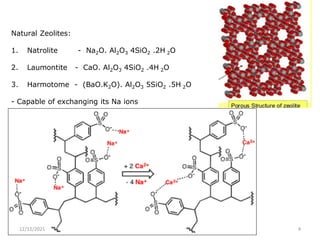
Natural Zeolites:
1. Natrolite - Na2O. Al2O3 4SiO2 .2H 2O
2. Laumontite - CaO. Al2O3 4SiO2 .4H 2O
3. Harmotome - (BaO.K2O). Al2O3 5SiO2 .5H 2O
- Capable of exchanging its Na ions
12/12/2021 4
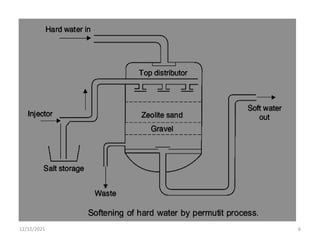
Permutit or Zeolite Process
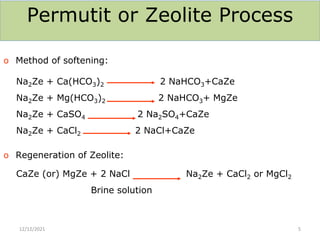
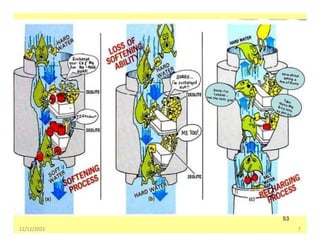
o Method of softening:
Na2Ze + Ca(HCO3)2 2 NaHCO3+CaZe
Na2Ze + Mg(HCO3)2 2 NaHCO3+ MgZe
Na2Ze + CaSO4 2 Na2SO4+CaZe
Na2Ze + CaCl2 2 NaCl+CaZe
o Regeneration of Zeolite:
CaZe (or) MgZe + 2 NaCl Na2Ze + CaCl2 or MgCl2
Brine solution
12/12/2021 5
12/12/2021 6
12/12/2021 7
Zeolite Process
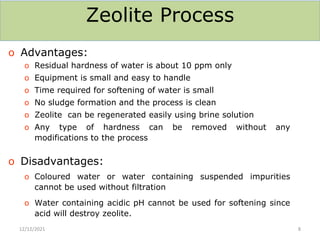
o Advantages:
o Residual hardness of water is about 10 ppm only
o Equipment is small and easy to handle
o Time required for softening of water is small
o No sludge formation and the process is clean
o Zeolite can be regenerated easily using brine solution
o Any type of hardness can be removed without any
modifications to the process
o Disadvantages:
o Coloured water or water containing suspended impurities
cannot be used without filtration
o Water containing acidic pH cannot be used for softening since
acid will destroy zeolite.
12/12/2021 8
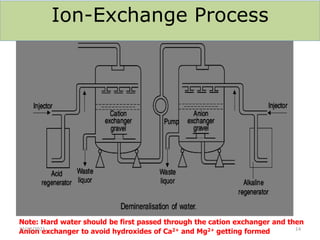
Ion-Exchange Process
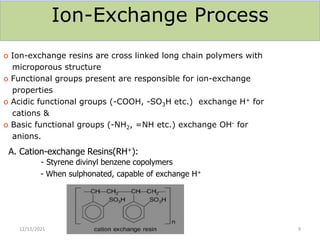
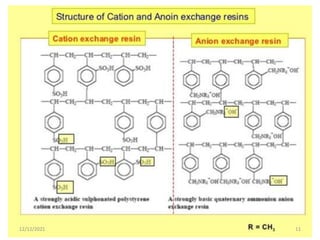
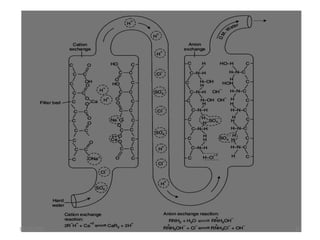
o Ion-exchange resins are cross linked long chain polymers with
microporous structure
o Functional groups present are responsible for ion-exchange
properties
o Acidic functional groups (-COOH, -SO3H etc.) exchange H+ for
cations &
o Basic functional groups (-NH2, =NH etc.) exchange OH- for
anions.
A. Cation-exchange Resins(RH+):
- Styrene divinyl benzene copolymers
- When sulphonated, capable of exchange H+
12/12/2021 9
Ion-Exchange Process
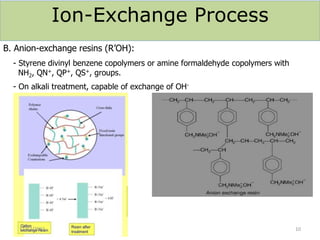
B. Anion-exchange resins (R’OH):
- Styrene divinyl benzene copolymers or amine formaldehyde copolymers with
NH2, QN+, QP+, QS+, groups.
- On alkali treatment, capable of exchange of OH-
12/12/2021 10
12/12/2021 11
12/12/2021 12
Ion-Exchange Process
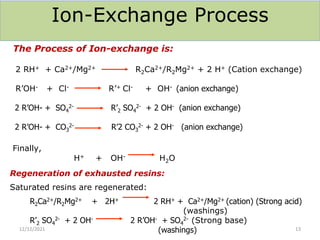
The Process of Ion-exchange is:
2 RH+ + Ca2+/Mg2+ R2Ca2+/R2Mg2+ + 2 H+ (Cation exchange)
R’OH- + Cl- R’+ Cl- + OH- (anion exchange)
2 R’OH- + SO4
2- R’2 SO4
2- + 2 OH- (anion exchange)
2 R’OH- + CO3
2- R’2 CO3
2- + 2 OH- (anion exchange)
Finally,
H+ + OH- H2O
Regeneration of exhausted resins:
Saturated resins are regenerated:
R2Ca2+/R2Mg2+ + 2H+ 2 RH+ + Ca2+/Mg2+ (cation) (Strong acid)
(washings)
R’2 SO4
2- + 2 OH- 2 R’OH- + SO4
2- (Strong base)
(washings)
12/12/2021 13
Ion-Exchange Process
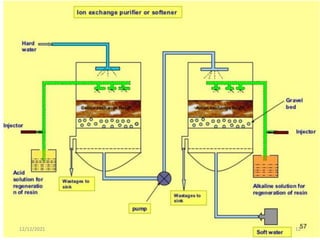
Note: Hard water should be first passed through the cation exchanger and then
Anion exchanger to avoid hydroxides of Ca2+ and Mg2+ getting formed
12/12/2021 14
12/12/2021 15
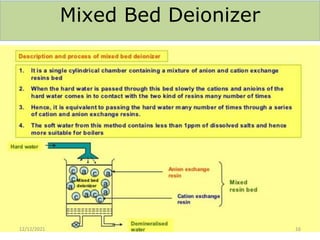
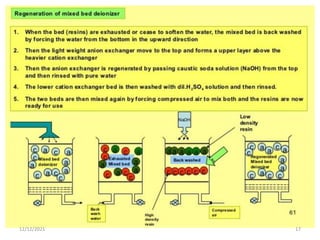
Mixed Bed Deionizer
12/12/2021 16
12/12/2021 17
Advantages & Disadvantages of
ion-exchange process
o Advantages:
- Can be used for highly acid and highly alkaline water
- Residual hardness of water is as low as 2 ppm.
- Very good for treating water for high pressure boilers
o Disadvantages:
- Expensive equipment and chemicals
- Turbidity of water should be < 10 ppm. Otherwise output will
reduce; turbidity needs to be coagulated before treatment.
- Needs skilled labour
12/12/2021 18
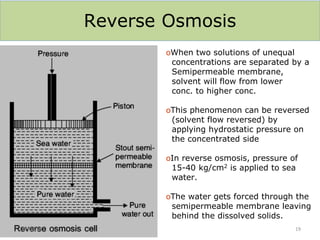
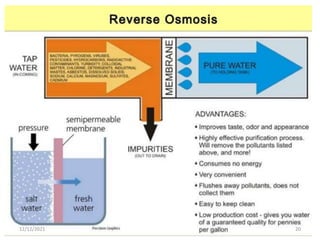
Reverse Osmosis
oWhen two solutions of unequal
concentrations are separated by a
Semipermeable membrane,
solvent will flow from lower
conc. to higher conc.
oThis phenomenon can be reversed
(solvent flow reversed) by
applying hydrostatic pressure on
the concentrated side
oIn reverse osmosis, pressure of
15-40 kg/cm2 is applied to sea
water.
oThe water gets forced through the
semipermeable membrane leaving
behind the dissolved solids.
12/12/2021 19
12/12/2021 20
Advantages of Reverse Osmosis
o Advantage is in removing ionic, non-ionic, colloidal and high molecular wt.
organic matter.
o It removes colloidal silica (which is not removed during demineralisation)
o Cost is only the replacement cost of membranes (life is 2 years)
o Membrane replacement is fast and hence uninterrupted water supply can
be ensured
o Because of the above reasons this process is being adopted for converting
sea water into potable water and for high pressure boilers.
12/12/2021 21

Water softening methods

  • 1.
  • 2.
    Water Softening Methods ❖Zeolite (Permutit process) ❖ Ion-exchange ❖ Mixed bed ion-exchange ❖ Reverse Osmosis 12/12/2021 2
  • 3.
    Permutit or ZeoliteProcess o Zeolite is hydrated sodium aluminium silicate having a general formula, Na2OAl2O3.xSiO2.yH2O. o It exchanges Na+ ions for Ca2+ and Mg2+ ions. o Common Zeolite is Na2OAl2O3.3SiO2.2H2O known as natrolith. o Other gluconites, green sand (iron potassium phyllosilicate with characteristic green colour, a mineral containing Glauconite)etc. are used for water softening. o Artificial zeolite used for water softening is Permutit. o These are porous, glassy particles having higher softening capacity compared to green sand. o They are prepared by heating china clay (hydrated aluminium silicate), feldspar (KAlSi3O8-NaAlSi3O8 – CaAl2Si2O8) are a group of rock-forming tectosilicate minerals which make up as much as 60% of the earth’s crust) and soda ash (Na2CO3) 12/12/2021 3
  • 4.
    Natural Zeolites: 1. Natrolite- Na2O. Al2O3 4SiO2 .2H 2O 2. Laumontite - CaO. Al2O3 4SiO2 .4H 2O 3. Harmotome - (BaO.K2O). Al2O3 5SiO2 .5H 2O - Capable of exchanging its Na ions 12/12/2021 4
  • 5.
    Permutit or ZeoliteProcess o Method of softening: Na2Ze + Ca(HCO3)2 2 NaHCO3+CaZe Na2Ze + Mg(HCO3)2 2 NaHCO3+ MgZe Na2Ze + CaSO4 2 Na2SO4+CaZe Na2Ze + CaCl2 2 NaCl+CaZe o Regeneration of Zeolite: CaZe (or) MgZe + 2 NaCl Na2Ze + CaCl2 or MgCl2 Brine solution 12/12/2021 5
  • 6.
  • 7.
  • 8.
    Zeolite Process o Advantages: oResidual hardness of water is about 10 ppm only o Equipment is small and easy to handle o Time required for softening of water is small o No sludge formation and the process is clean o Zeolite can be regenerated easily using brine solution o Any type of hardness can be removed without any modifications to the process o Disadvantages: o Coloured water or water containing suspended impurities cannot be used without filtration o Water containing acidic pH cannot be used for softening since acid will destroy zeolite. 12/12/2021 8
  • 9.
    Ion-Exchange Process o Ion-exchangeresins are cross linked long chain polymers with microporous structure o Functional groups present are responsible for ion-exchange properties o Acidic functional groups (-COOH, -SO3H etc.) exchange H+ for cations & o Basic functional groups (-NH2, =NH etc.) exchange OH- for anions. A. Cation-exchange Resins(RH+): - Styrene divinyl benzene copolymers - When sulphonated, capable of exchange H+ 12/12/2021 9
  • 10.
    Ion-Exchange Process B. Anion-exchangeresins (R’OH): - Styrene divinyl benzene copolymers or amine formaldehyde copolymers with NH2, QN+, QP+, QS+, groups. - On alkali treatment, capable of exchange of OH- 12/12/2021 10
  • 11.
  • 12.
  • 13.
    Ion-Exchange Process The Processof Ion-exchange is: 2 RH+ + Ca2+/Mg2+ R2Ca2+/R2Mg2+ + 2 H+ (Cation exchange) R’OH- + Cl- R’+ Cl- + OH- (anion exchange) 2 R’OH- + SO4 2- R’2 SO4 2- + 2 OH- (anion exchange) 2 R’OH- + CO3 2- R’2 CO3 2- + 2 OH- (anion exchange) Finally, H+ + OH- H2O Regeneration of exhausted resins: Saturated resins are regenerated: R2Ca2+/R2Mg2+ + 2H+ 2 RH+ + Ca2+/Mg2+ (cation) (Strong acid) (washings) R’2 SO4 2- + 2 OH- 2 R’OH- + SO4 2- (Strong base) (washings) 12/12/2021 13
  • 14.
    Ion-Exchange Process Note: Hardwater should be first passed through the cation exchanger and then Anion exchanger to avoid hydroxides of Ca2+ and Mg2+ getting formed 12/12/2021 14
  • 15.
  • 16.
  • 17.
  • 18.
    Advantages & Disadvantagesof ion-exchange process o Advantages: - Can be used for highly acid and highly alkaline water - Residual hardness of water is as low as 2 ppm. - Very good for treating water for high pressure boilers o Disadvantages: - Expensive equipment and chemicals - Turbidity of water should be < 10 ppm. Otherwise output will reduce; turbidity needs to be coagulated before treatment. - Needs skilled labour 12/12/2021 18
  • 19.
    Reverse Osmosis oWhen twosolutions of unequal concentrations are separated by a Semipermeable membrane, solvent will flow from lower conc. to higher conc. oThis phenomenon can be reversed (solvent flow reversed) by applying hydrostatic pressure on the concentrated side oIn reverse osmosis, pressure of 15-40 kg/cm2 is applied to sea water. oThe water gets forced through the semipermeable membrane leaving behind the dissolved solids. 12/12/2021 19
  • 20.
  • 21.
    Advantages of ReverseOsmosis o Advantage is in removing ionic, non-ionic, colloidal and high molecular wt. organic matter. o It removes colloidal silica (which is not removed during demineralisation) o Cost is only the replacement cost of membranes (life is 2 years) o Membrane replacement is fast and hence uninterrupted water supply can be ensured o Because of the above reasons this process is being adopted for converting sea water into potable water and for high pressure boilers. 12/12/2021 21