CHAPTER 2. WATER QUALITY:
DEFINITIONS, CHARACTERISTICS
AND PERSPECTIVES
DR. MUNIRA SHAHBUDDIN
Introduction to
Environmental Engineering
IIUM, Malaysia.
WORLD WATER
DISTRIBUTION
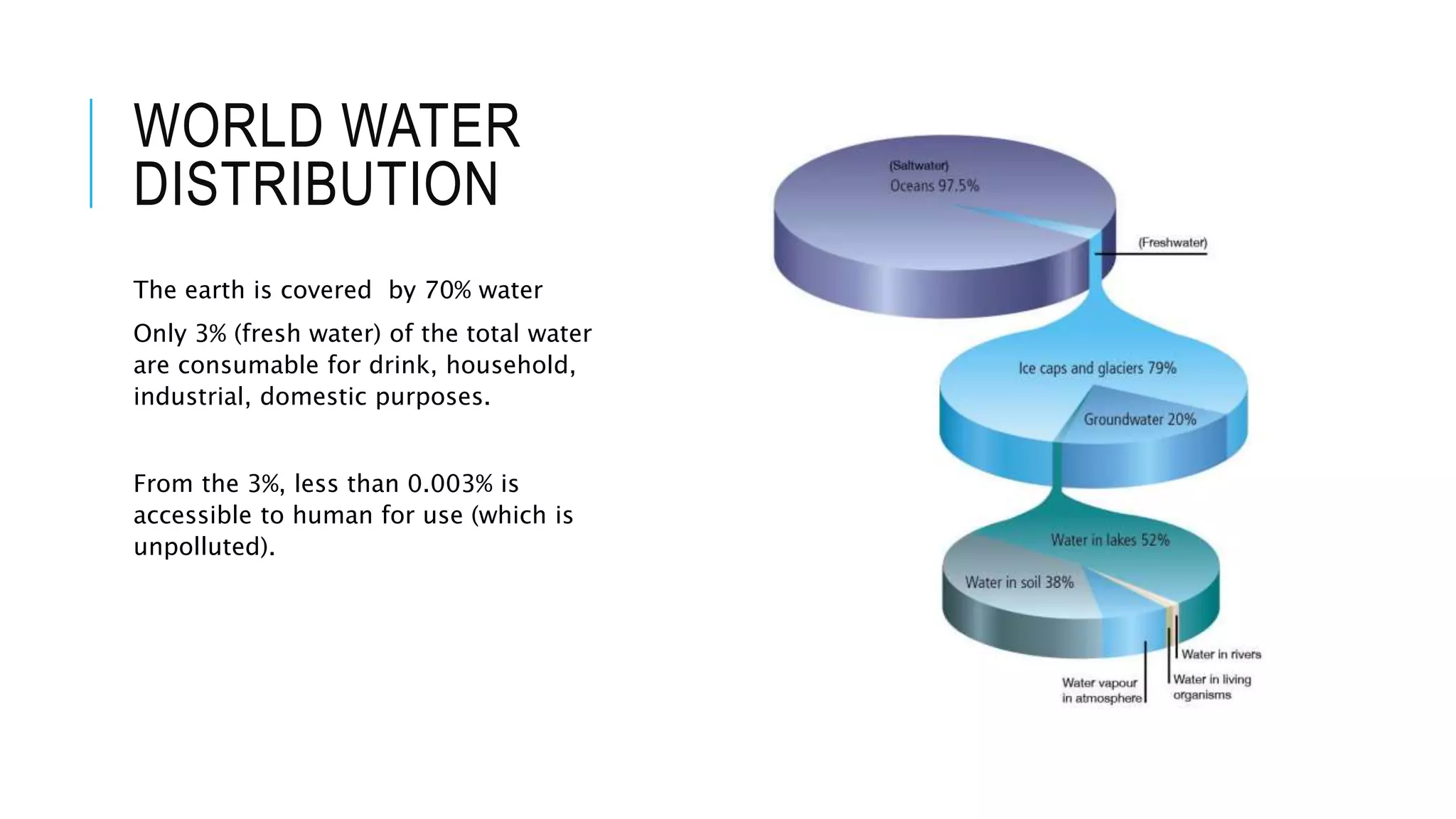
The earth is covered by 70% water
Only 3% (fresh water) of the total water
are consumable for drink, household,
industrial, domestic purposes.
From the 3%, less than 0.003% is
accessible to human for use (which is
unpolluted).
WATER SUSTAINABILITY
Water sustainability is essential to human existence. Civilization
developed around water bodies that could support agriculture,
domestic, transportation and as source for food.
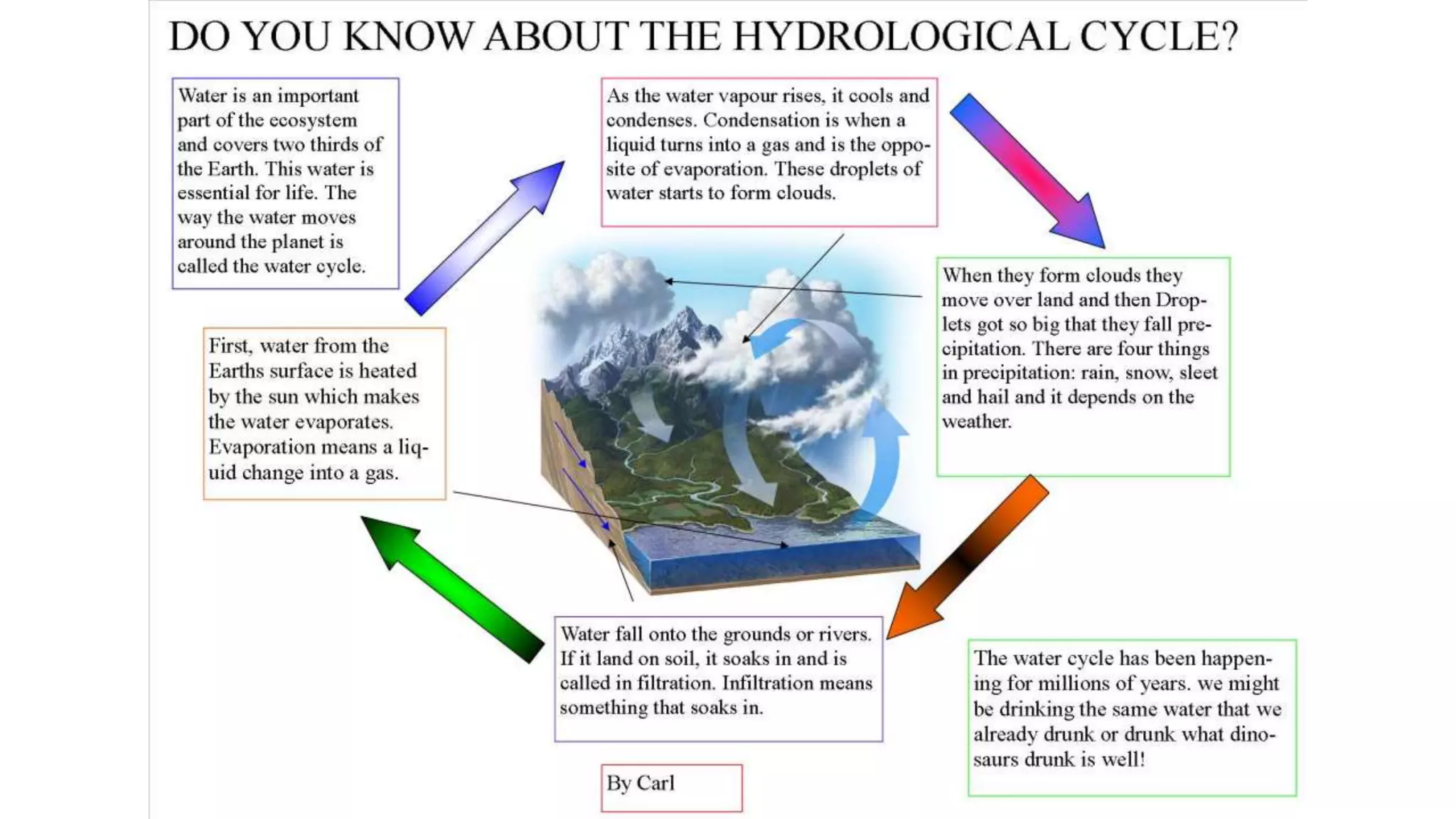
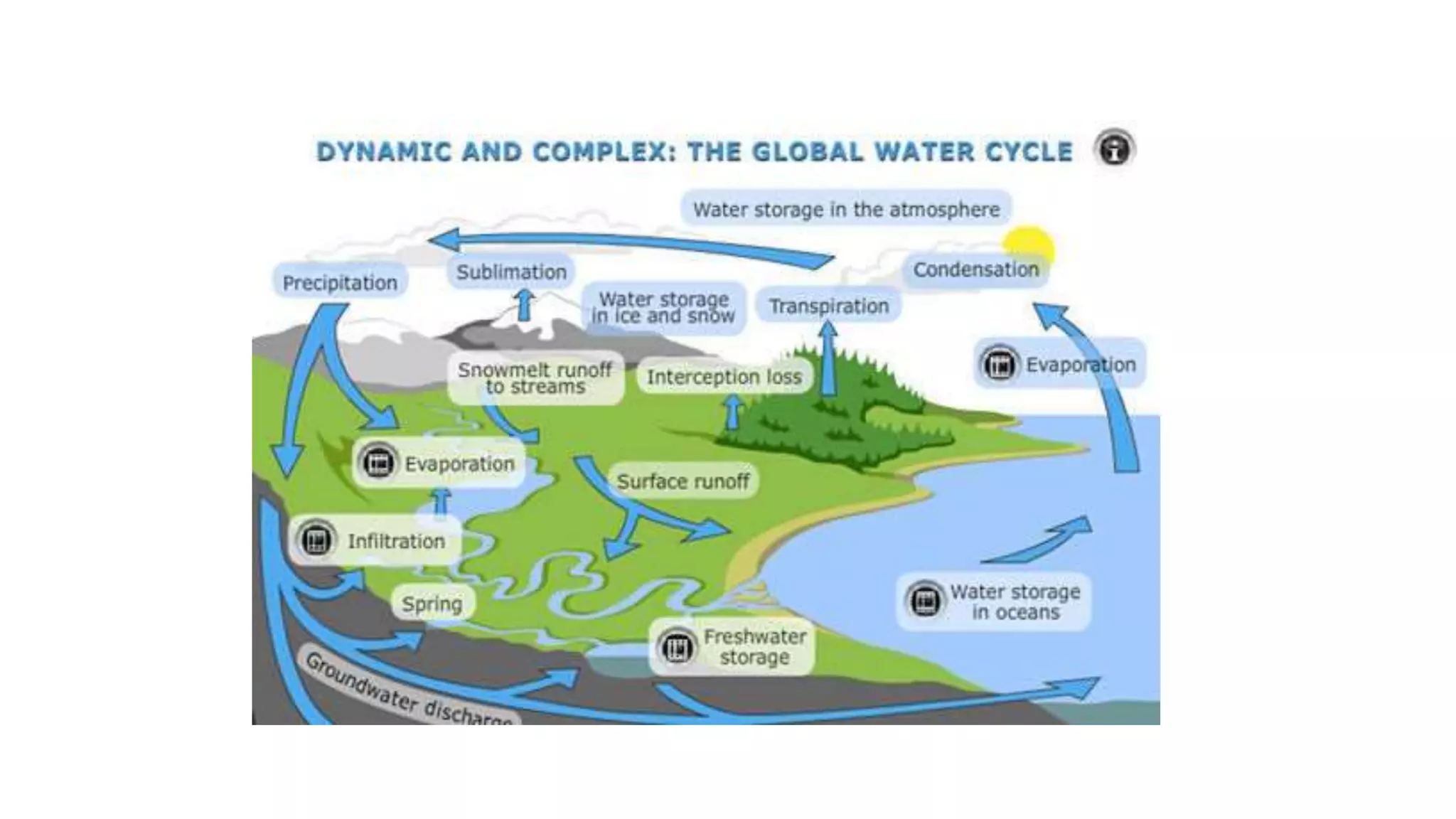
Water is in a constant state of motion, as depicted in the hydrologic
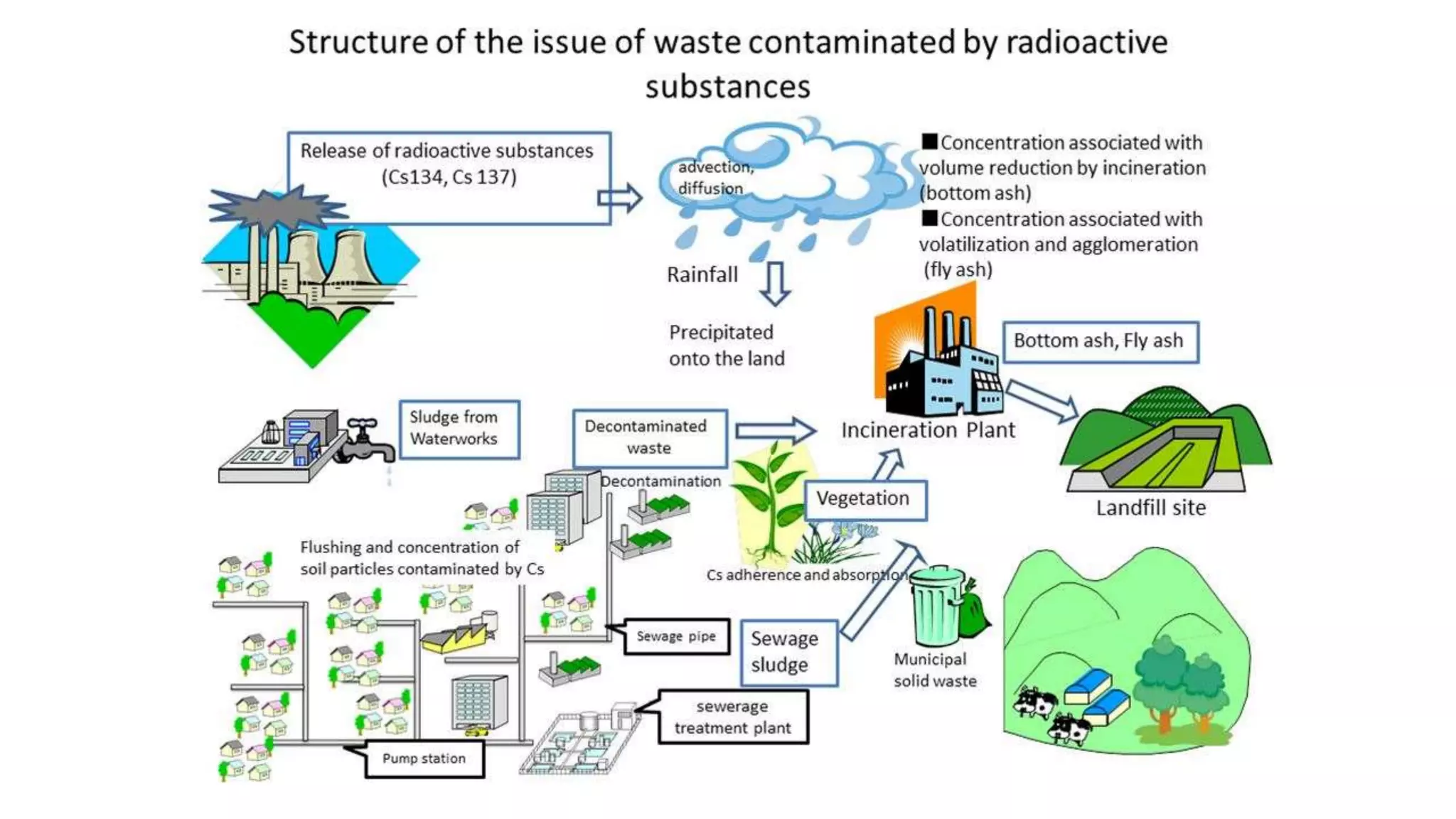
cycle. Human activities contribute to contamination from industrial,
agriculture, domestic use, waste.
The impurities accumulated by water throughout the hydrologic cycle
may be in both suspended and dissolved form – causing pollution in
water reservoir.
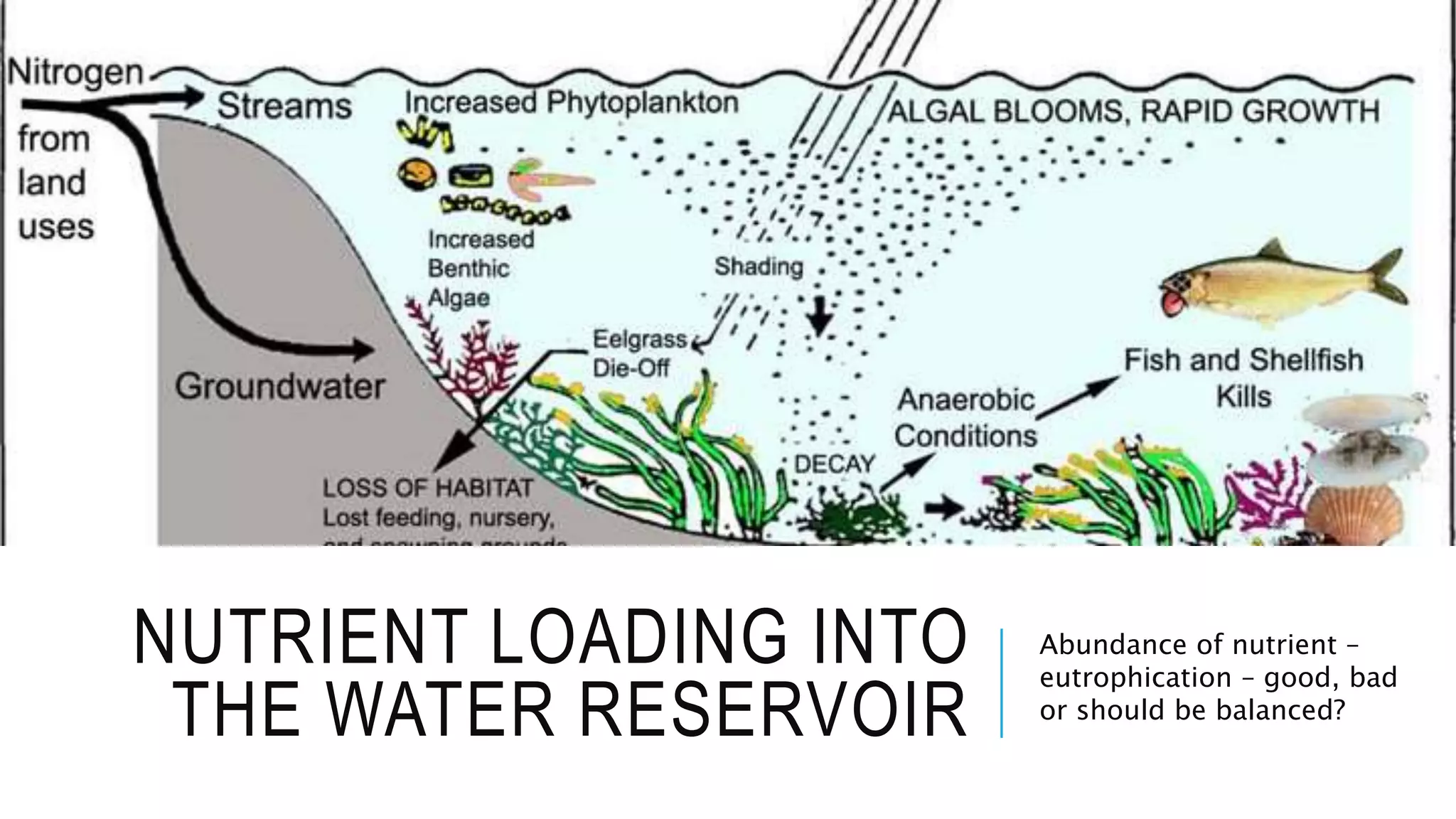
NUTRIENT LOADING INTO
THE WATER RESERVOIR
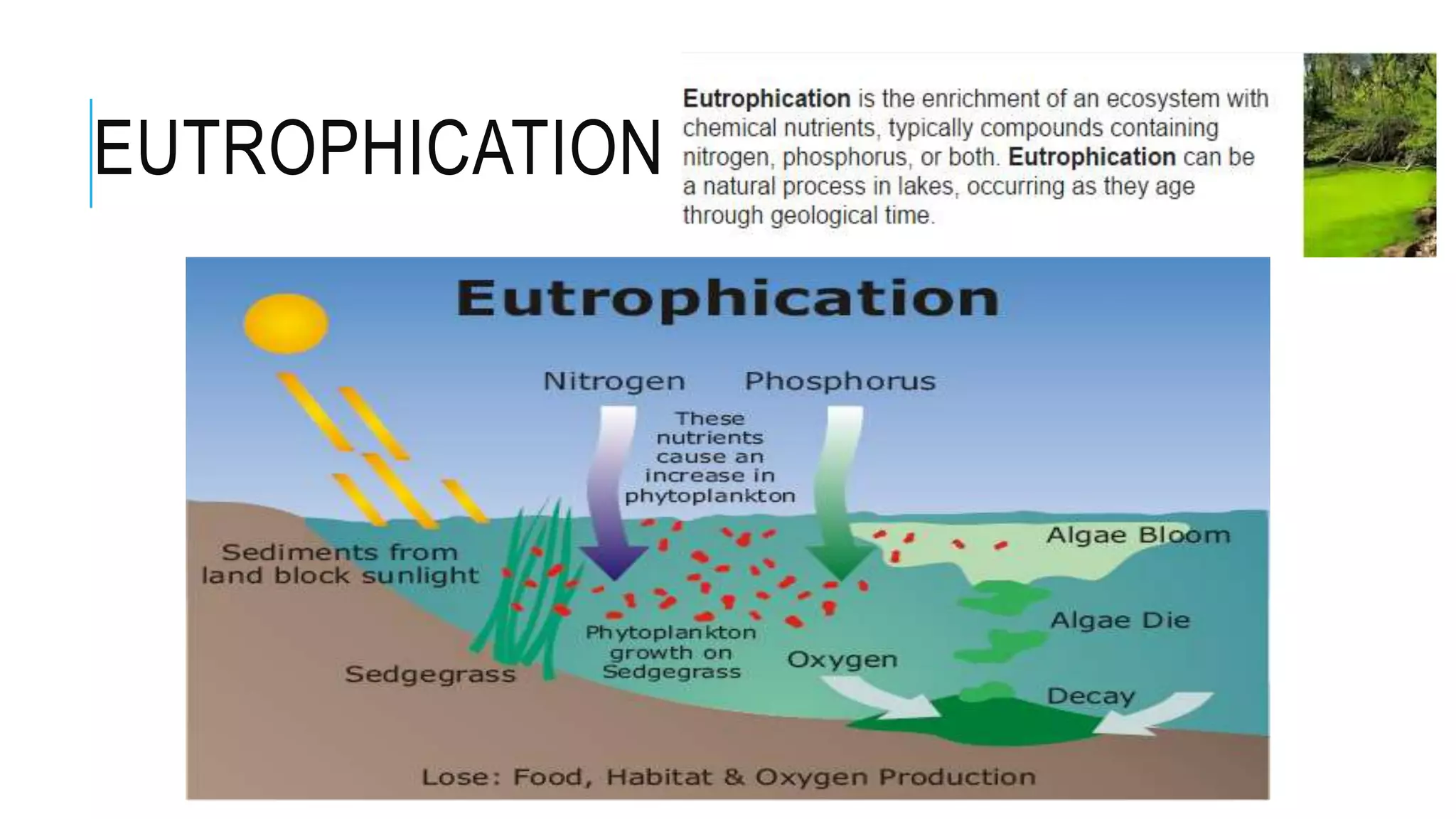
Abundance of nutrient –
eutrophication – good, bad
or should be balanced?
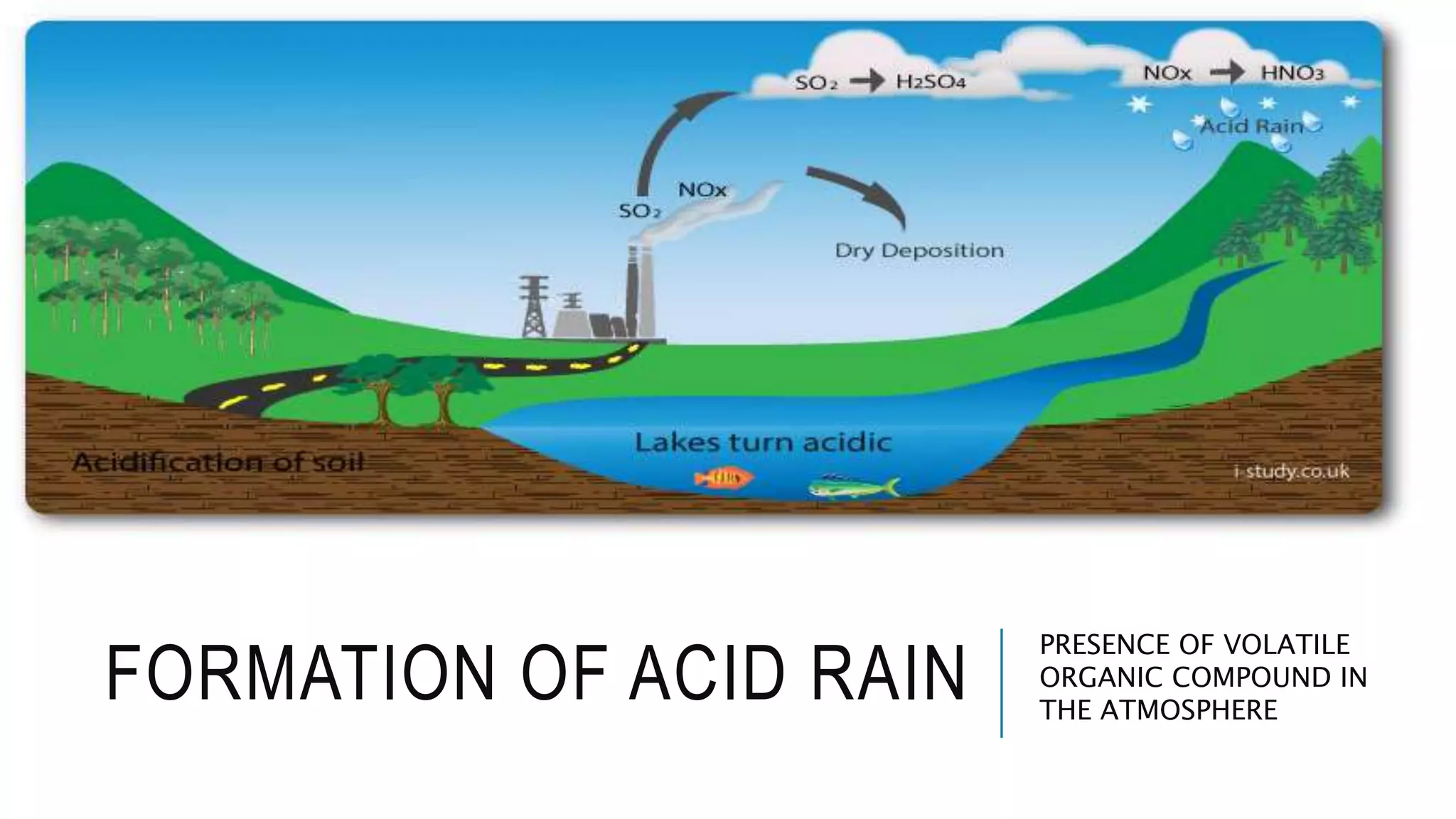
FORMATION OF ACID RAIN
PRESENCE OF VOLATILE
ORGANIC COMPOUND IN
THE ATMOSPHERE
EUTROPHICATION
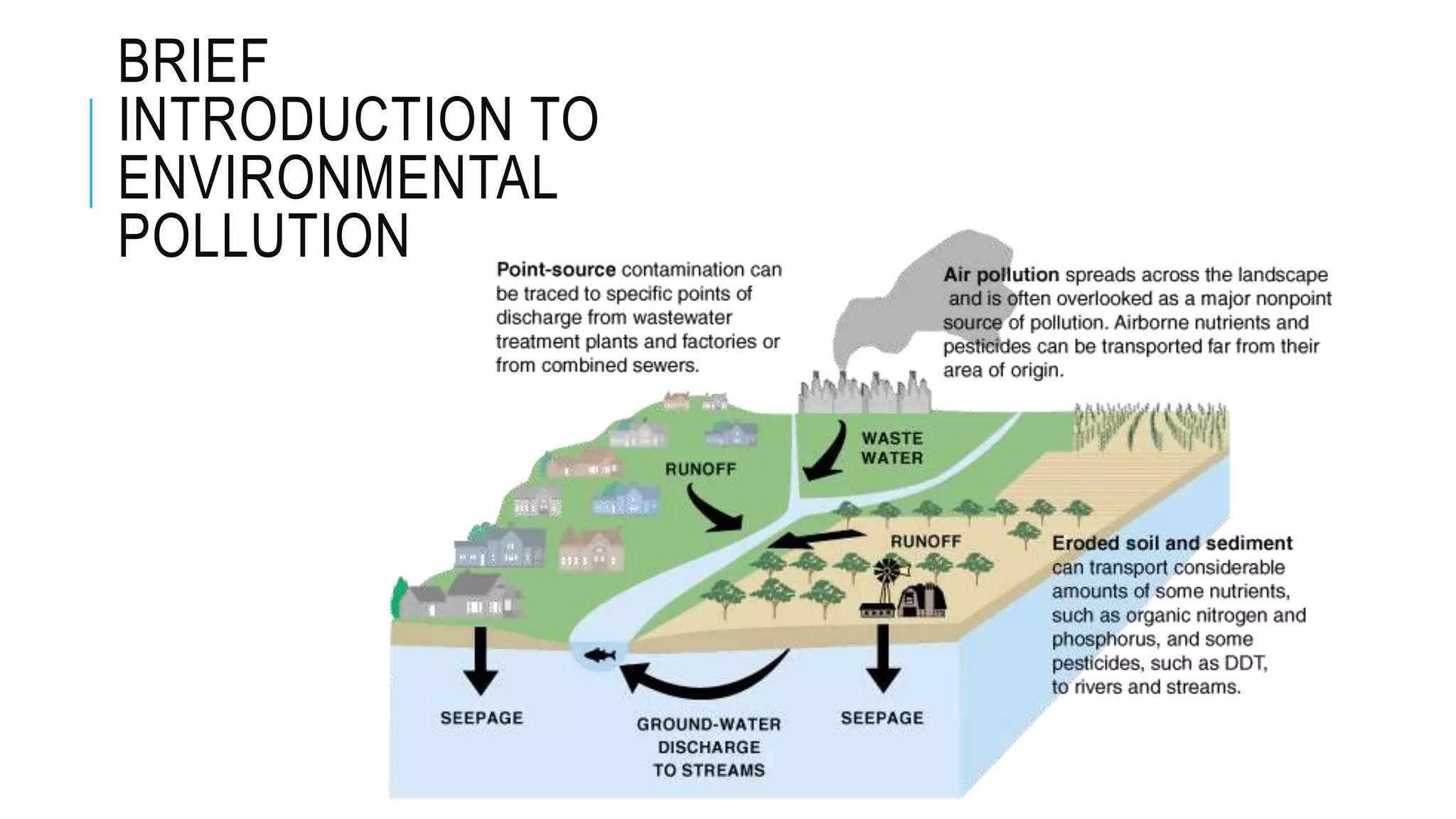
BRIEF
INTRODUCTION TO
ENVIRONMENTAL
POLLUTION
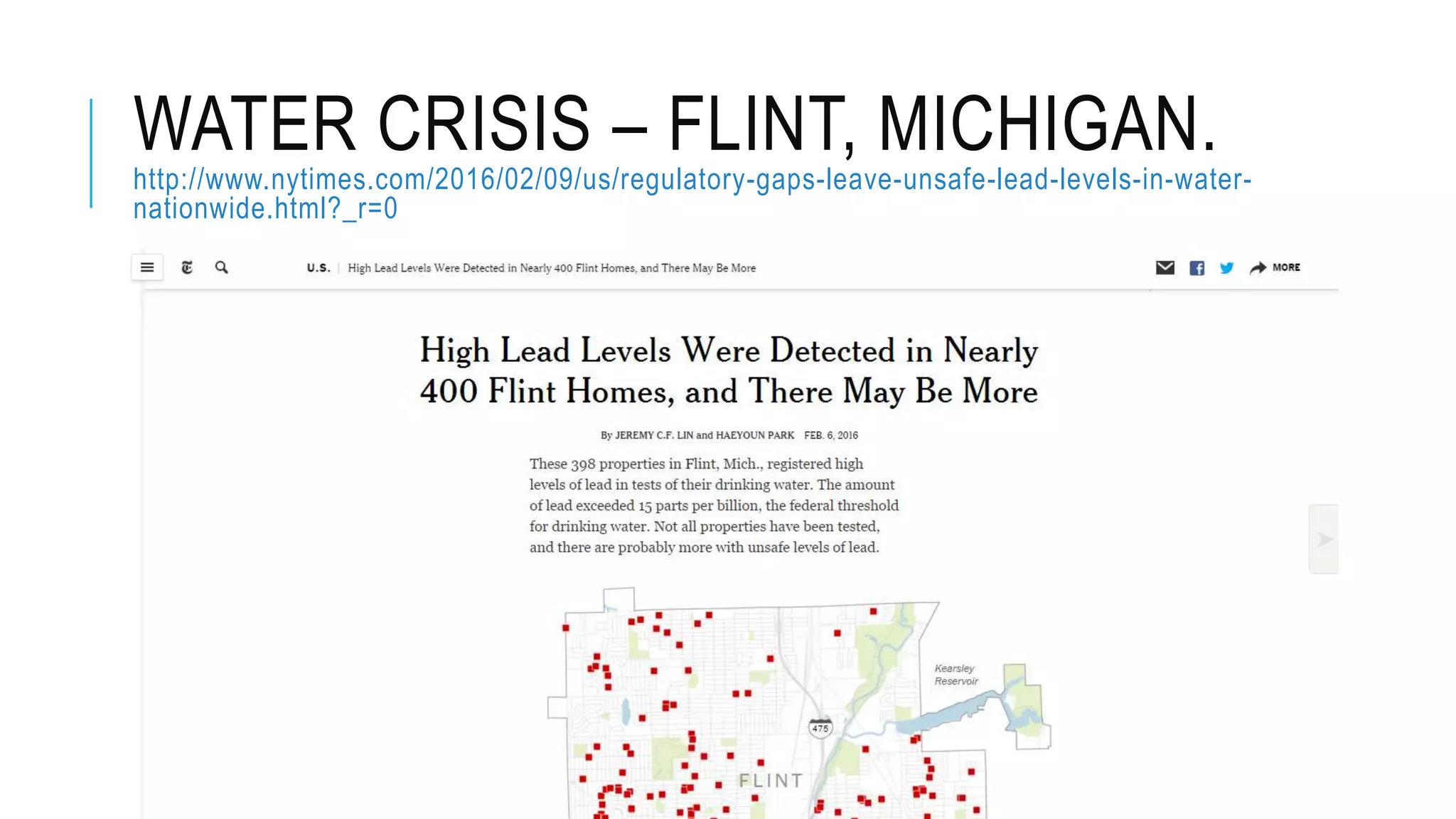
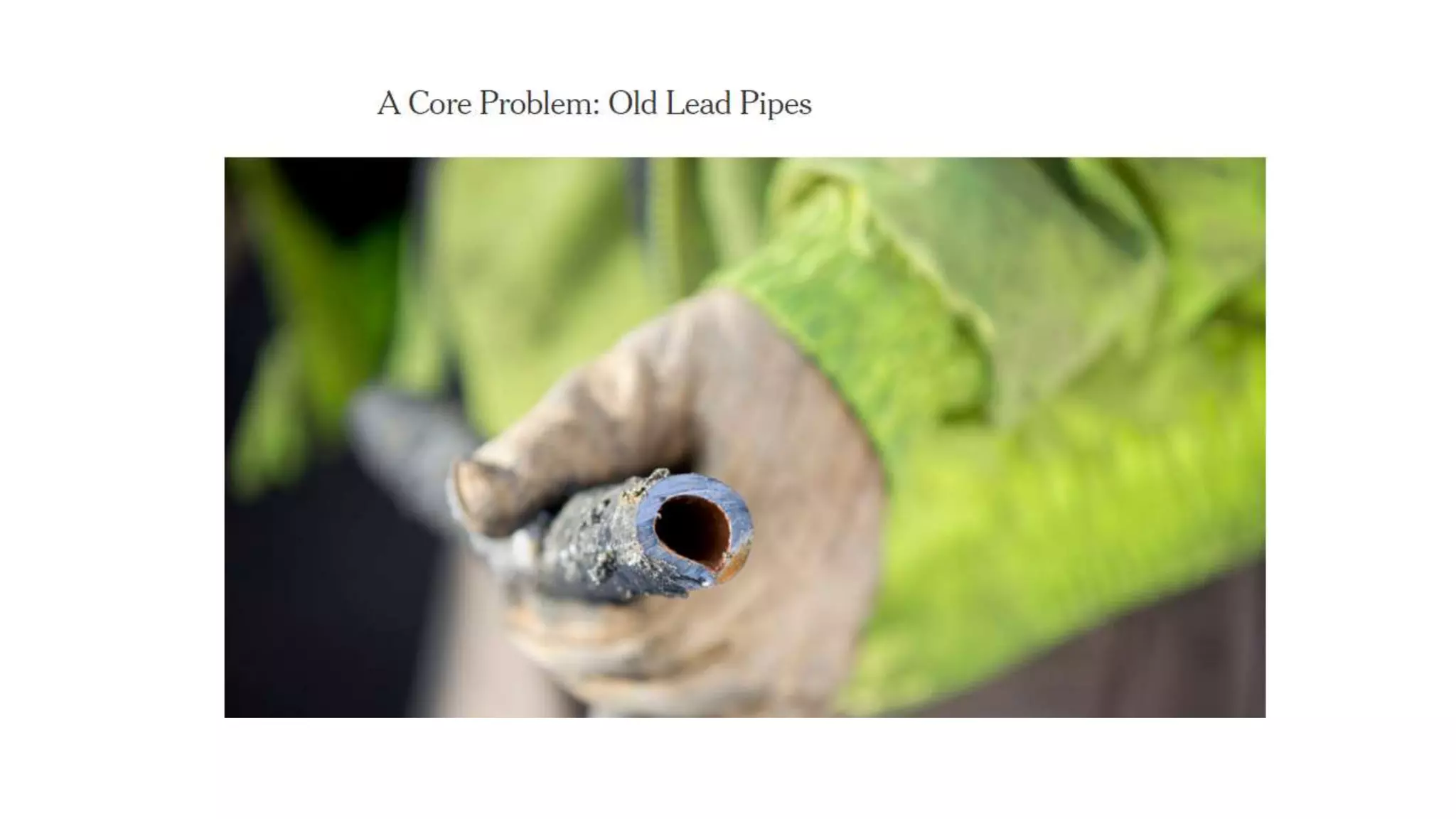
WATER CRISIS – FLINT, MICHIGAN.
http://www.nytimes.com/2016/02/09/us/regulatory-gaps-leave-unsafe-lead-levels-in-water-
nationwide.html?_r=0
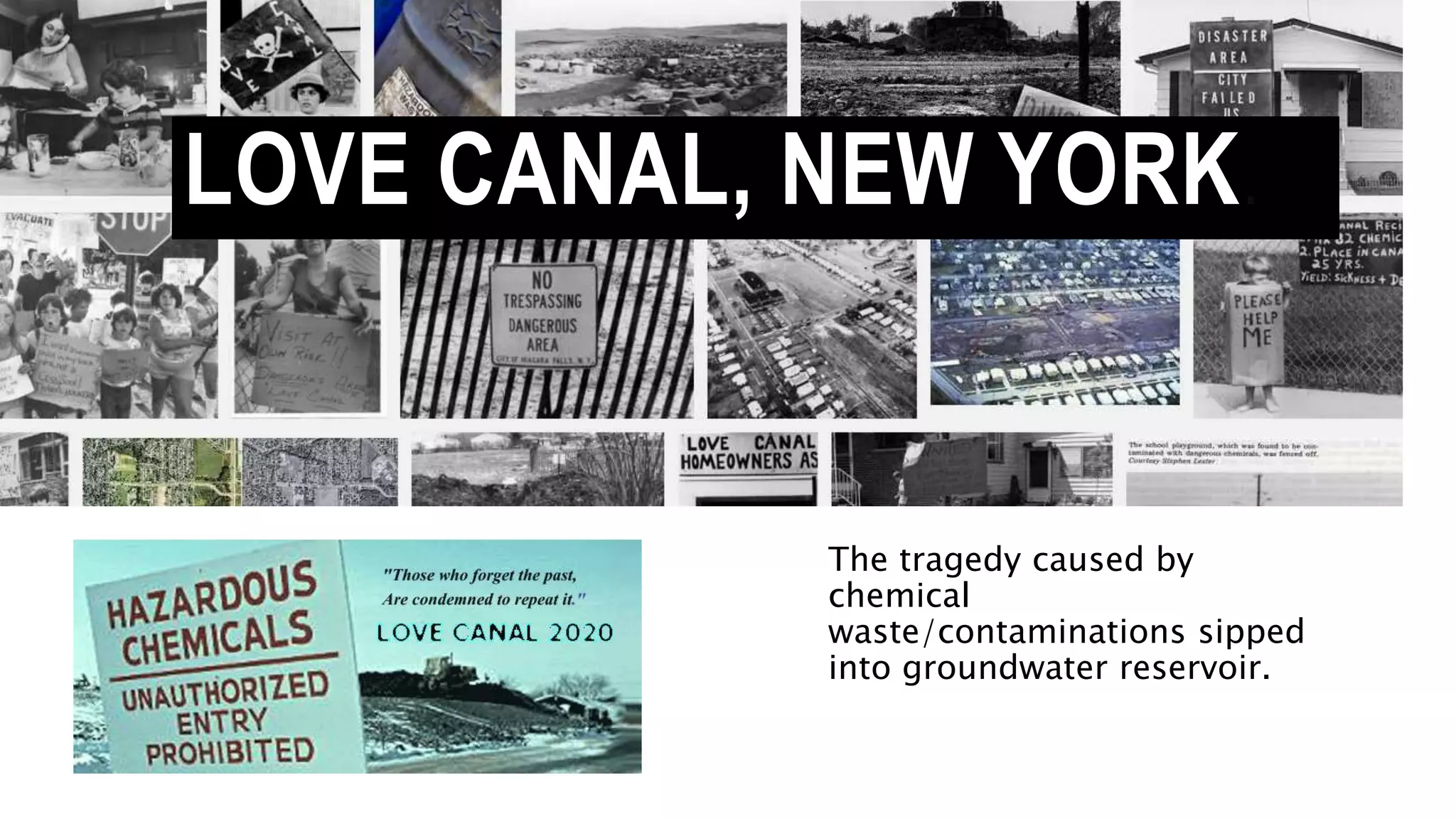
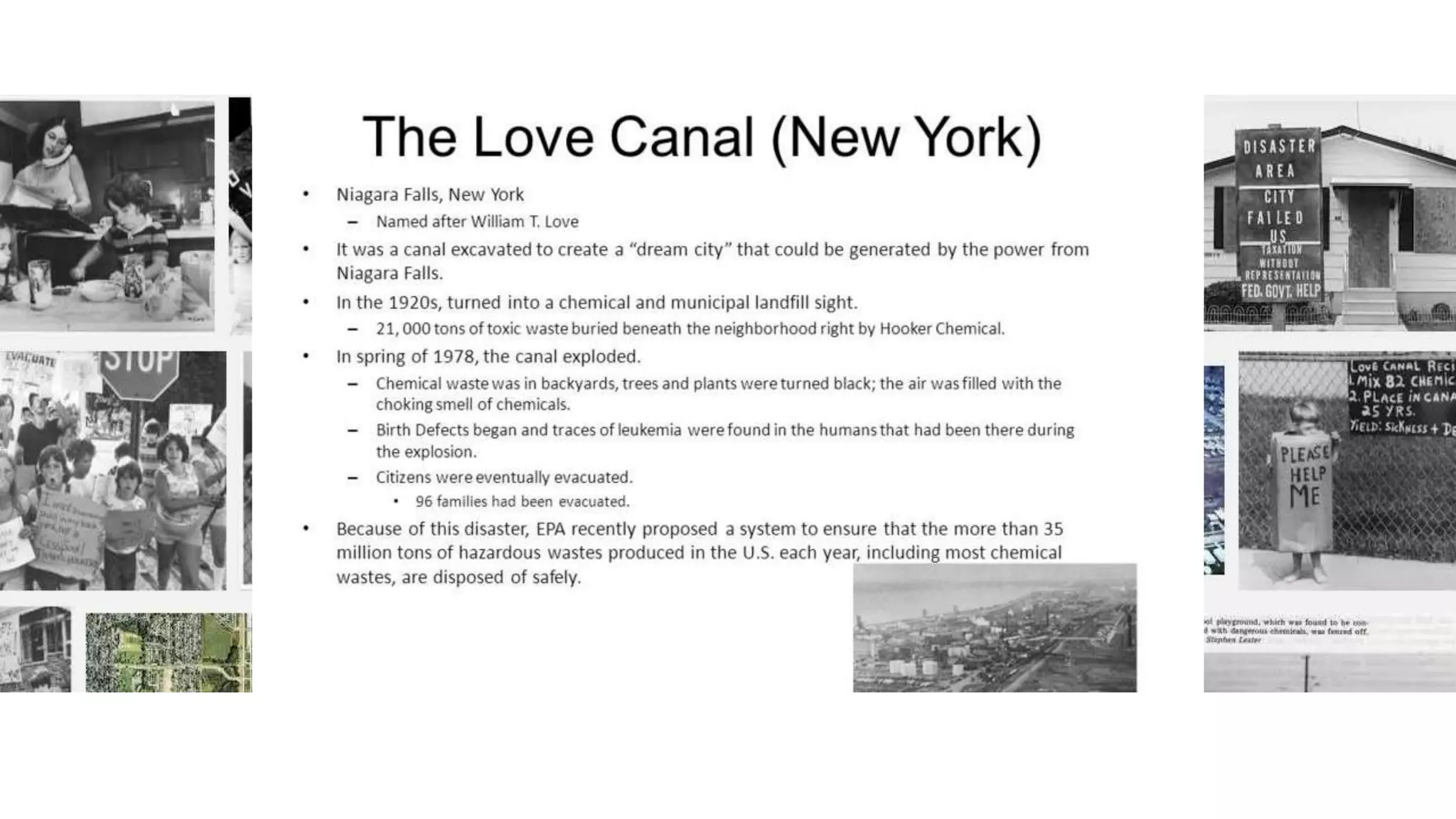
LOVE CANAL, NEW YORK.
The tragedy caused by
chemical
waste/contaminations sipped
into groundwater reservoir.
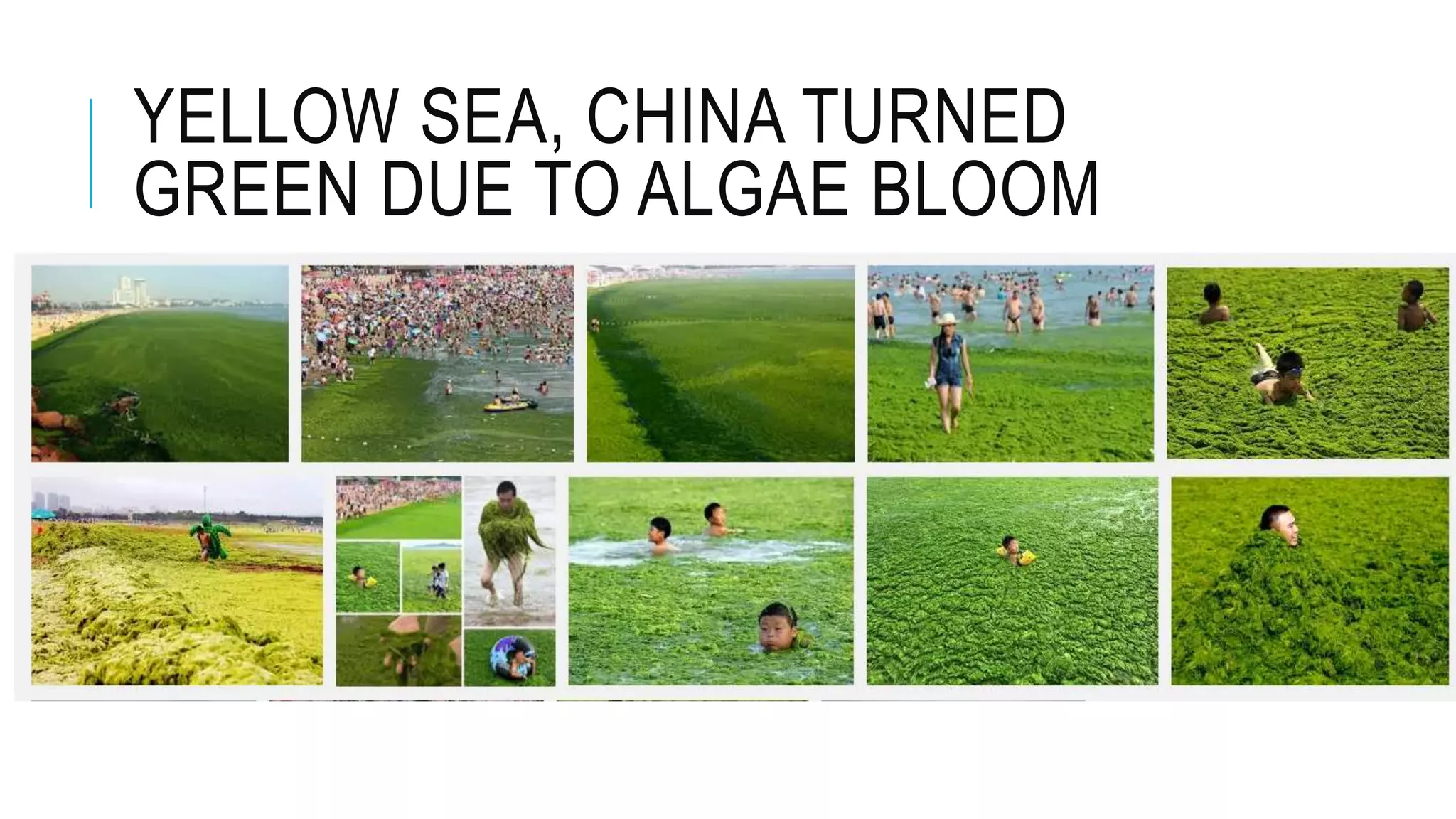
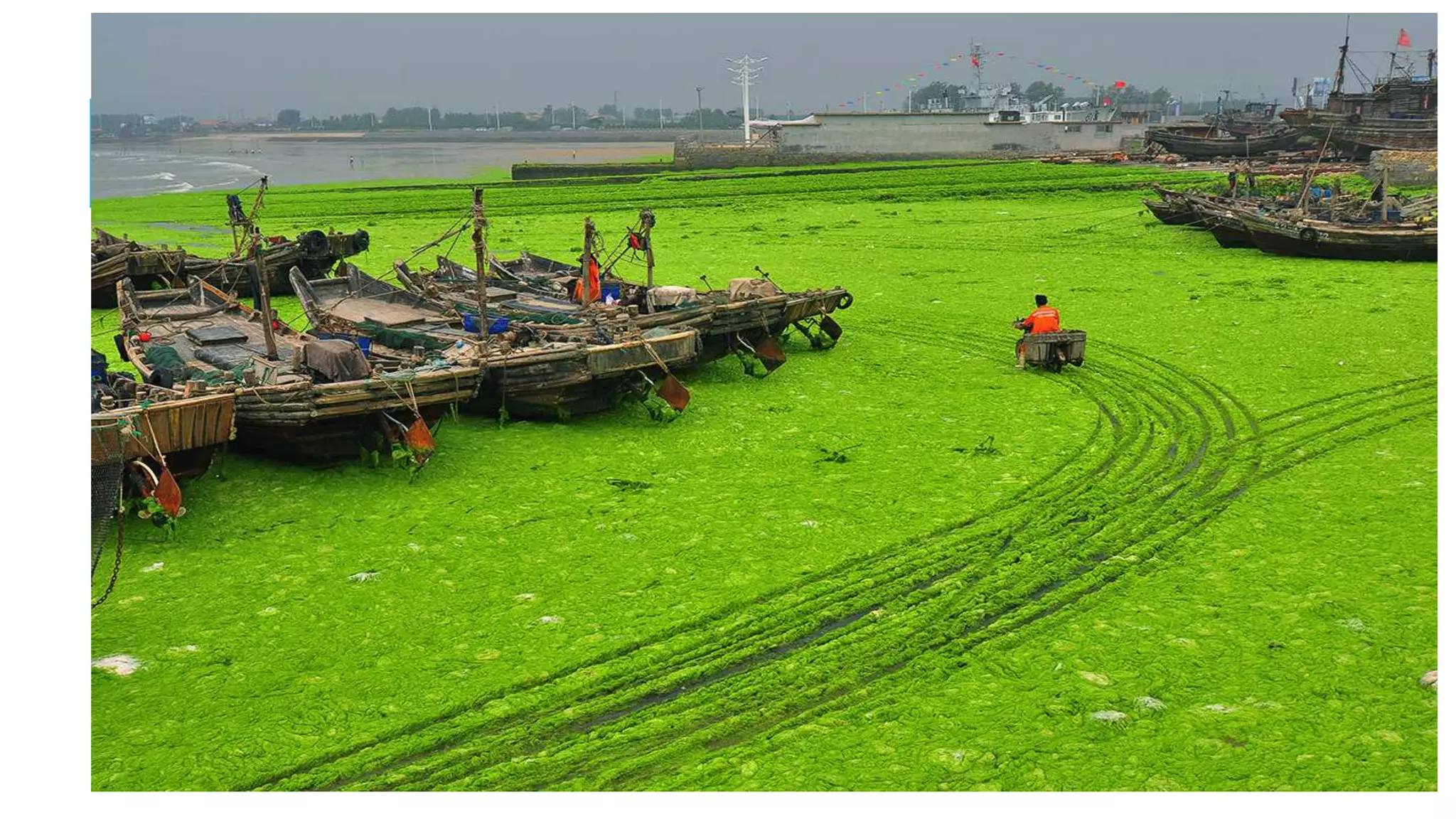
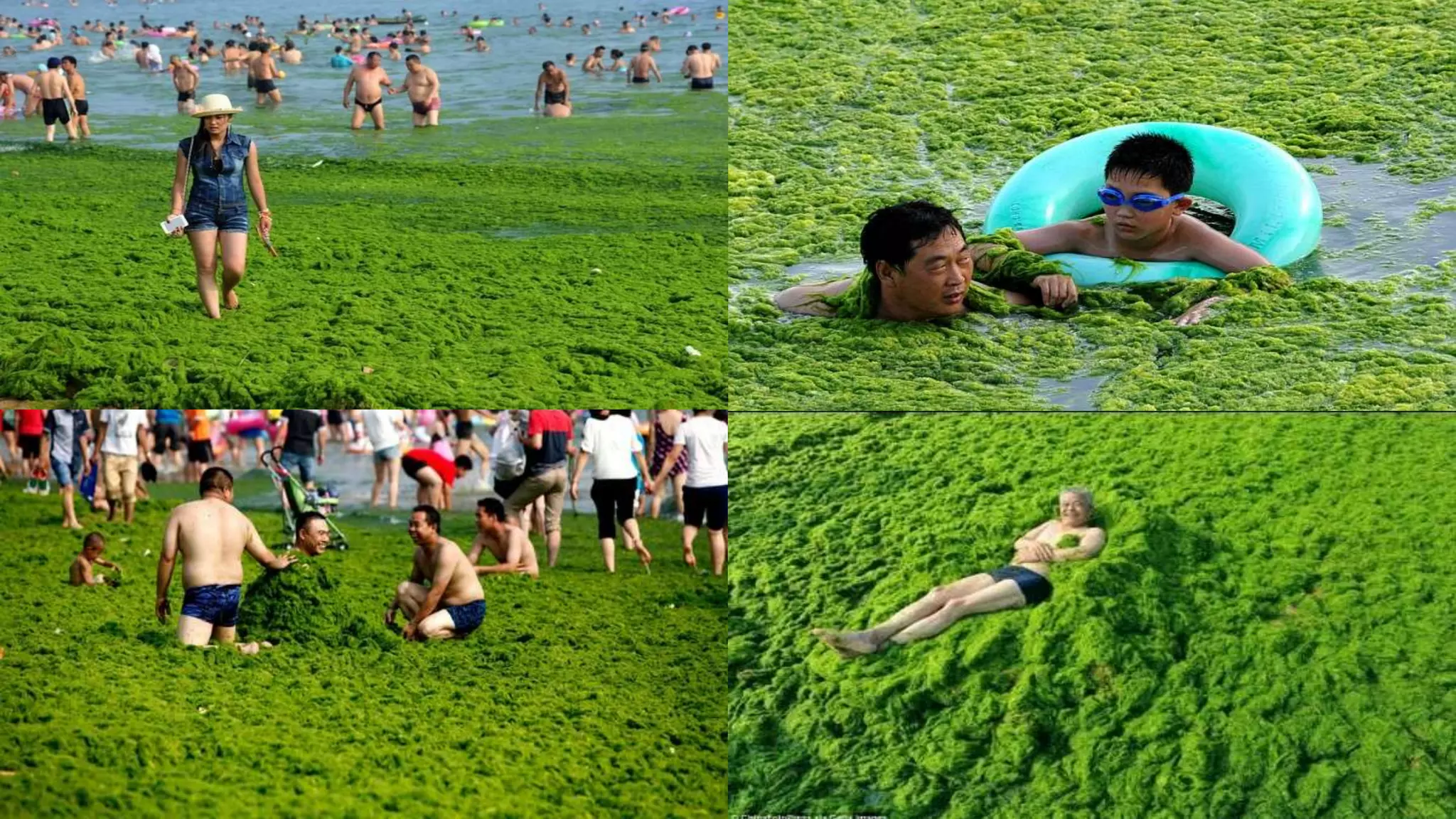
YELLOW SEA, CHINA TURNED
GREEN DUE TO ALGAE BLOOM
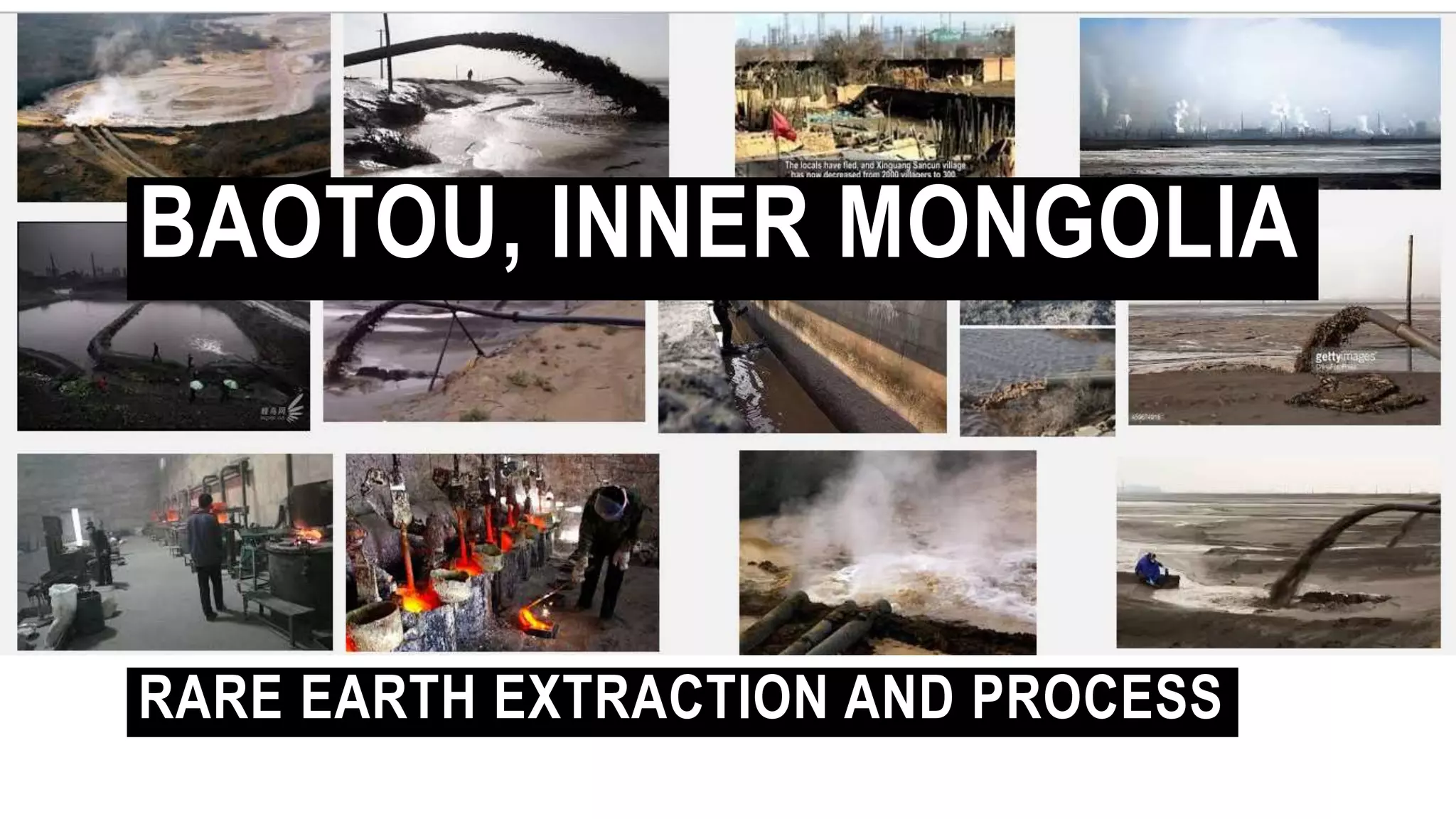
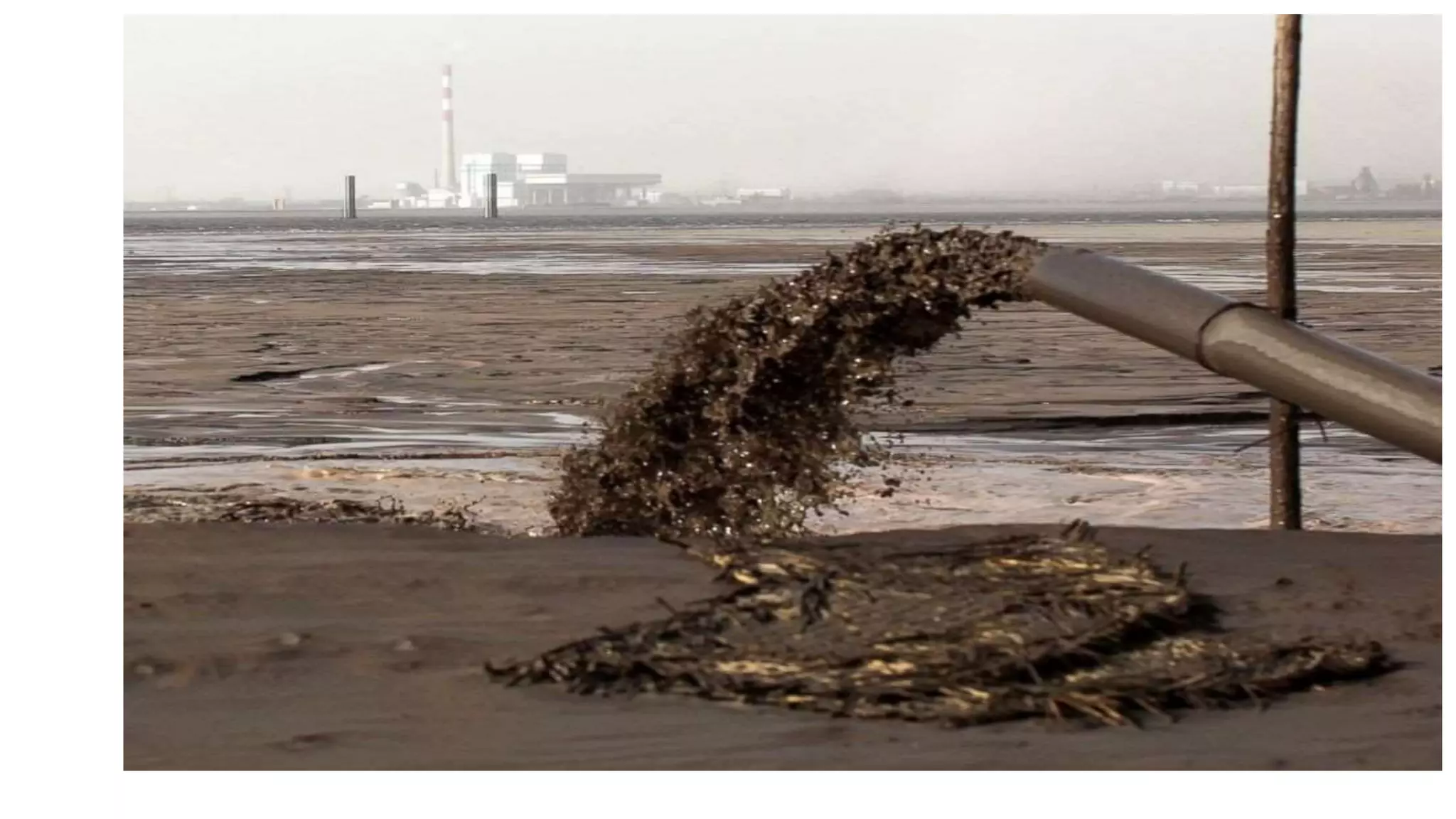
BAOTOU, INNER MONGOLIA
RARE EARTH EXTRACTION AND PROCESS
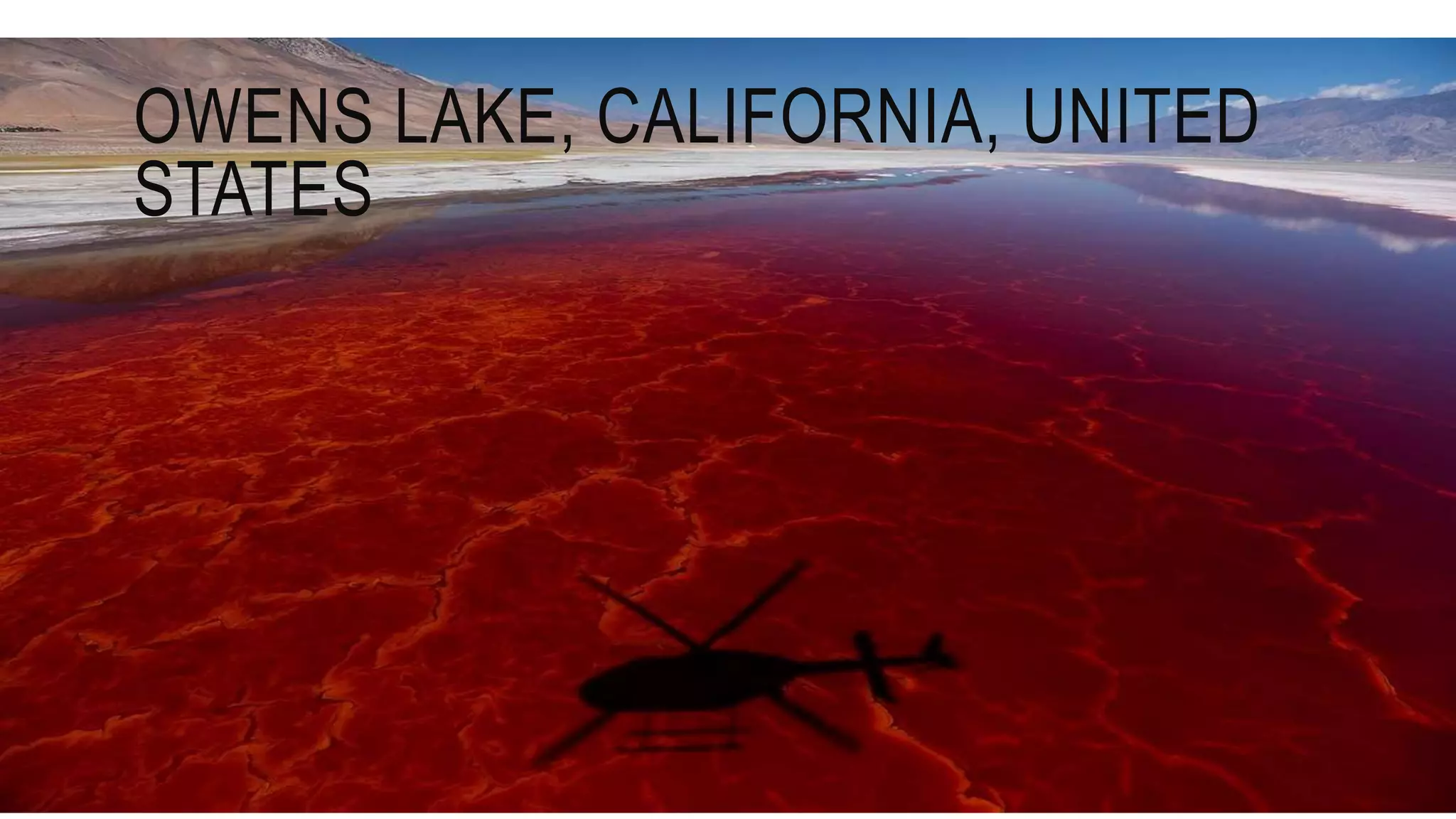
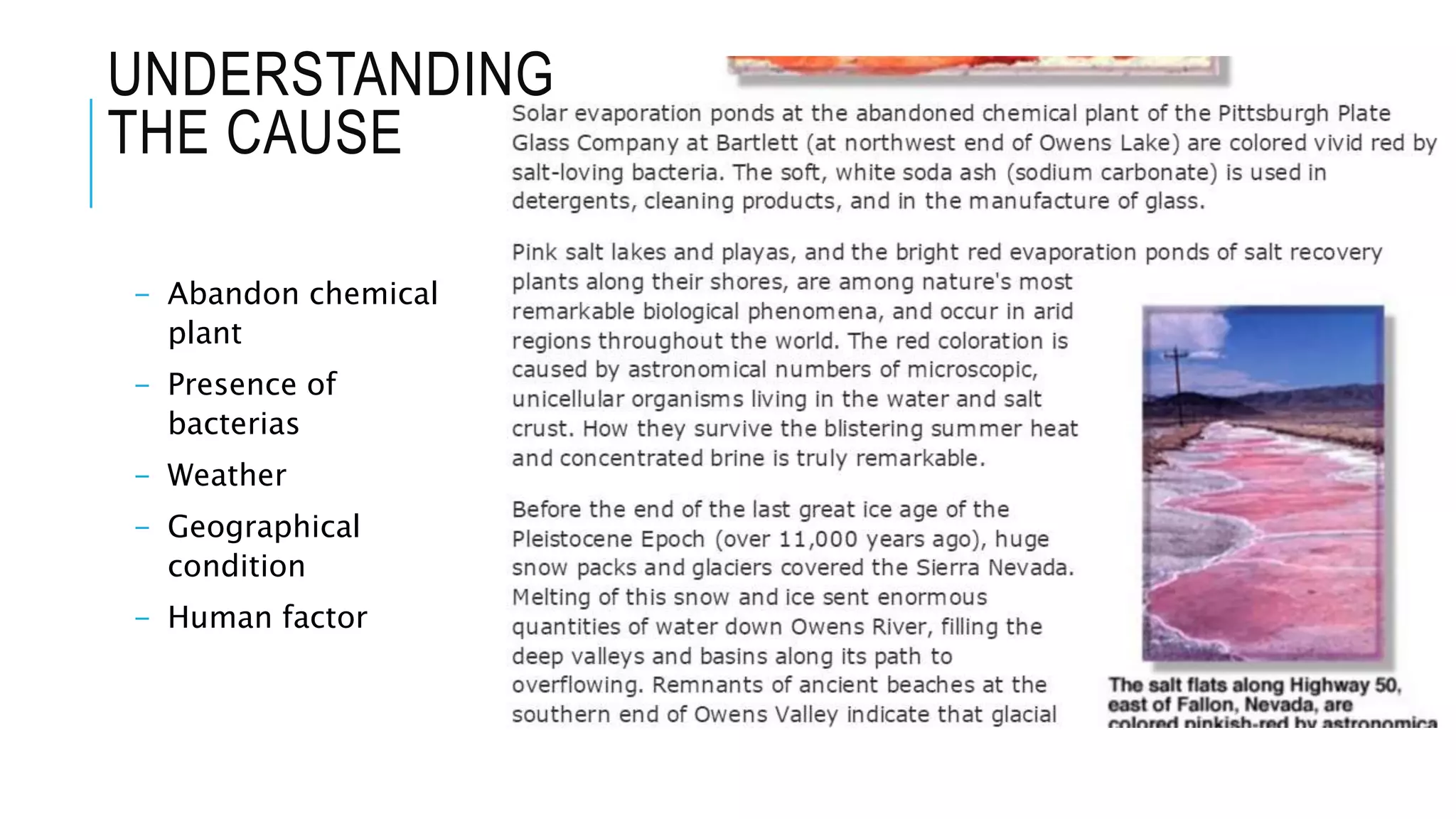
OWENS LAKE, CALIFORNIA, UNITED
STATES
- Abandon chemical
plant
- Presence of
bacterias
- Weather
- Geographical
condition
- Human factor
UNDERSTANDING
THE CAUSE
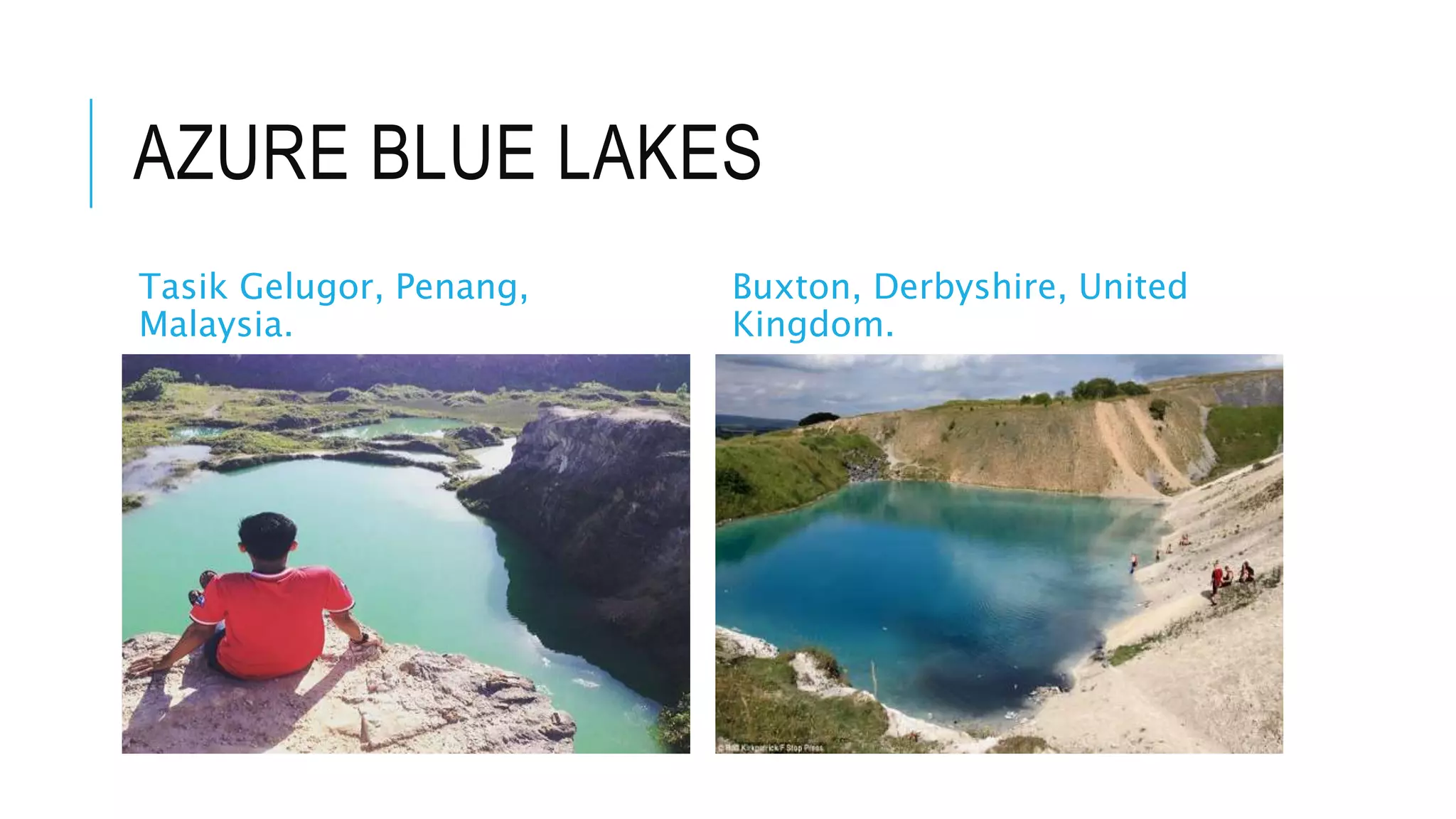
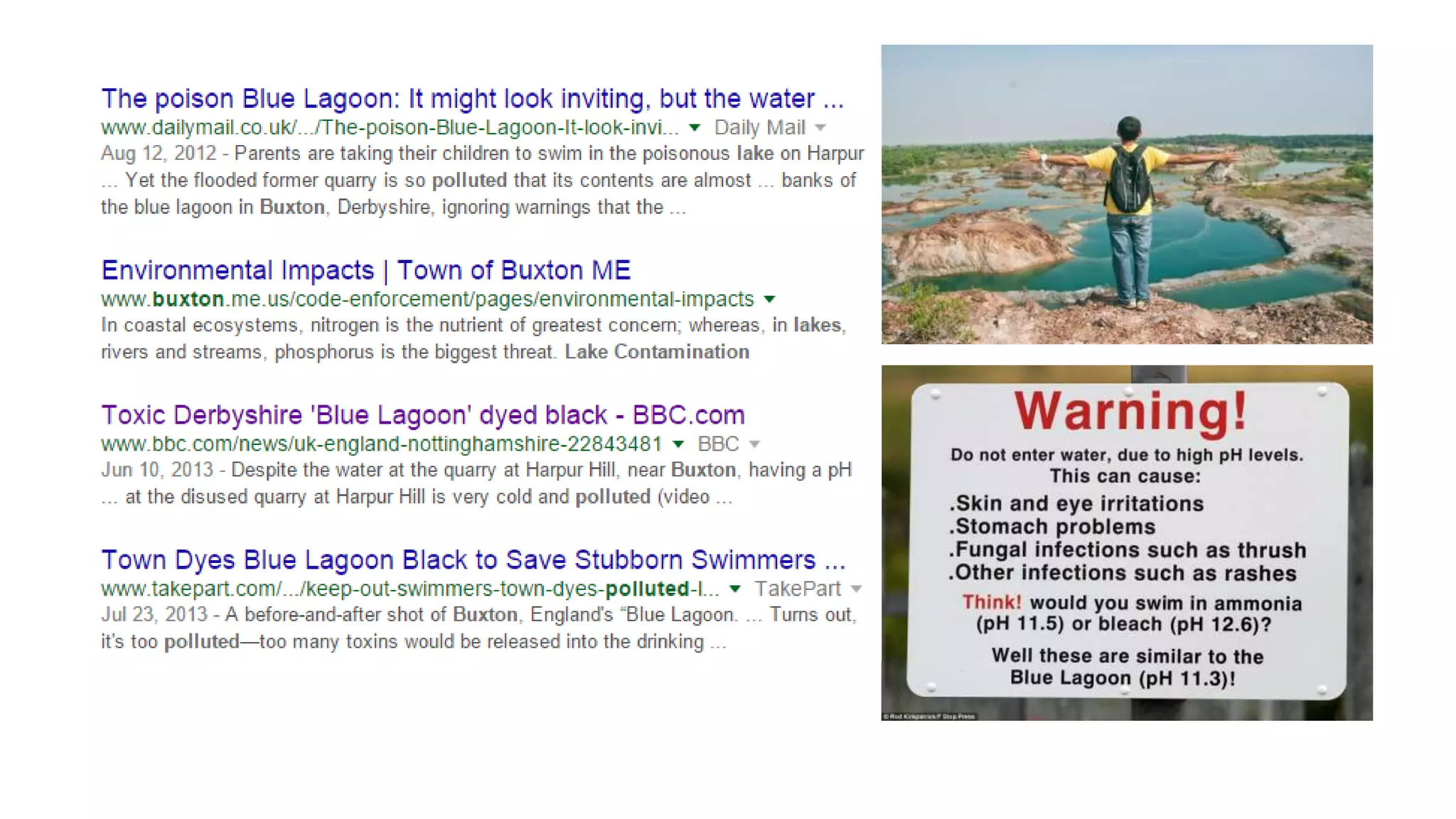
AZURE BLUE LAKES
Tasik Gelugor, Penang,
Malaysia.
Buxton, Derbyshire, United
Kingdom.
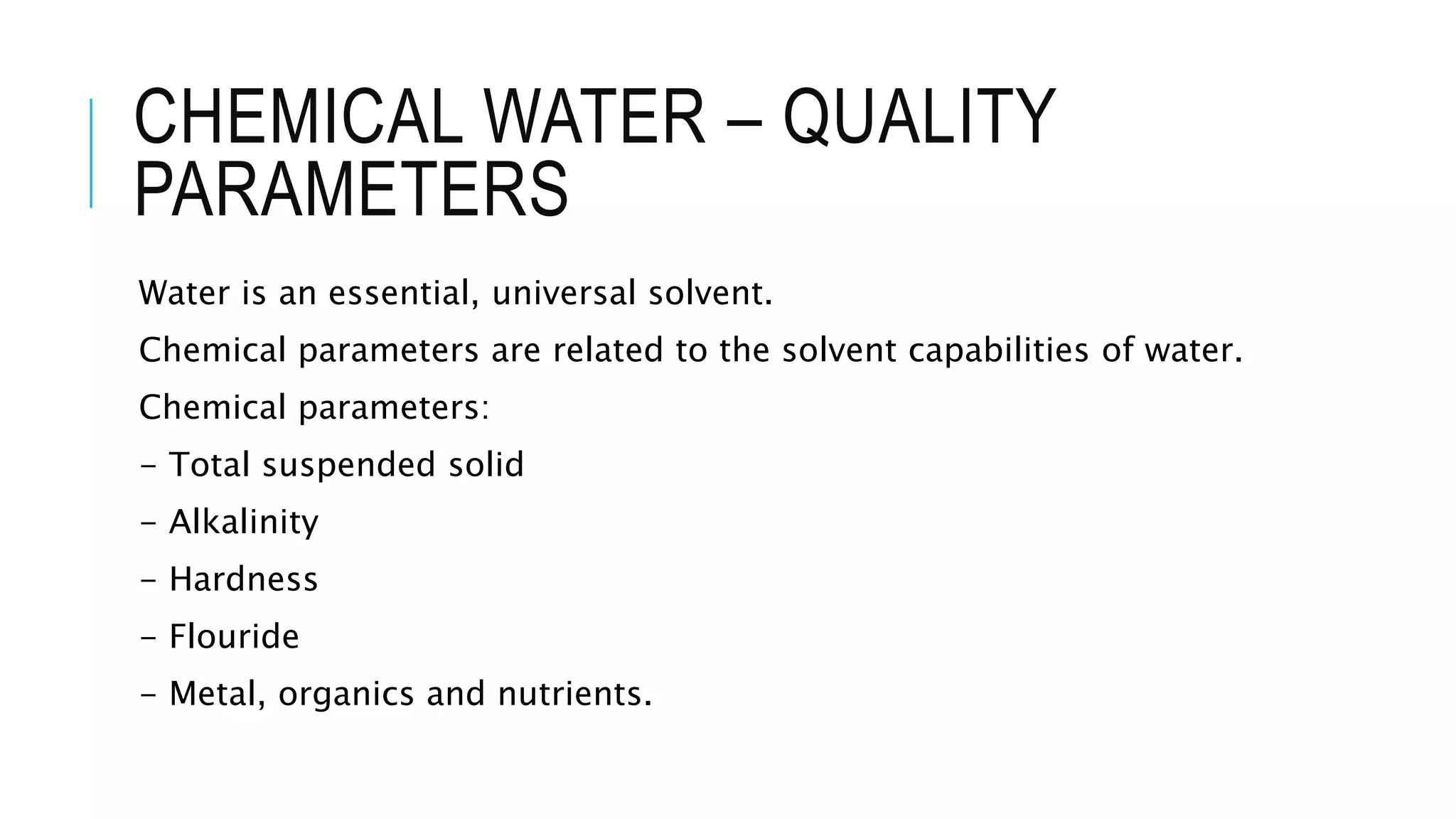
CHEMICAL WATER – QUALITY
PARAMETERS
Water is an essential, universal solvent.
Chemical parameters are related to the solvent capabilities of water.
Chemical parameters:
- Total suspended solid
- Alkalinity
- Hardness
- Flouride
- Metal, organics and nutrients.
CHEMISTRY OF SOLUTIONS
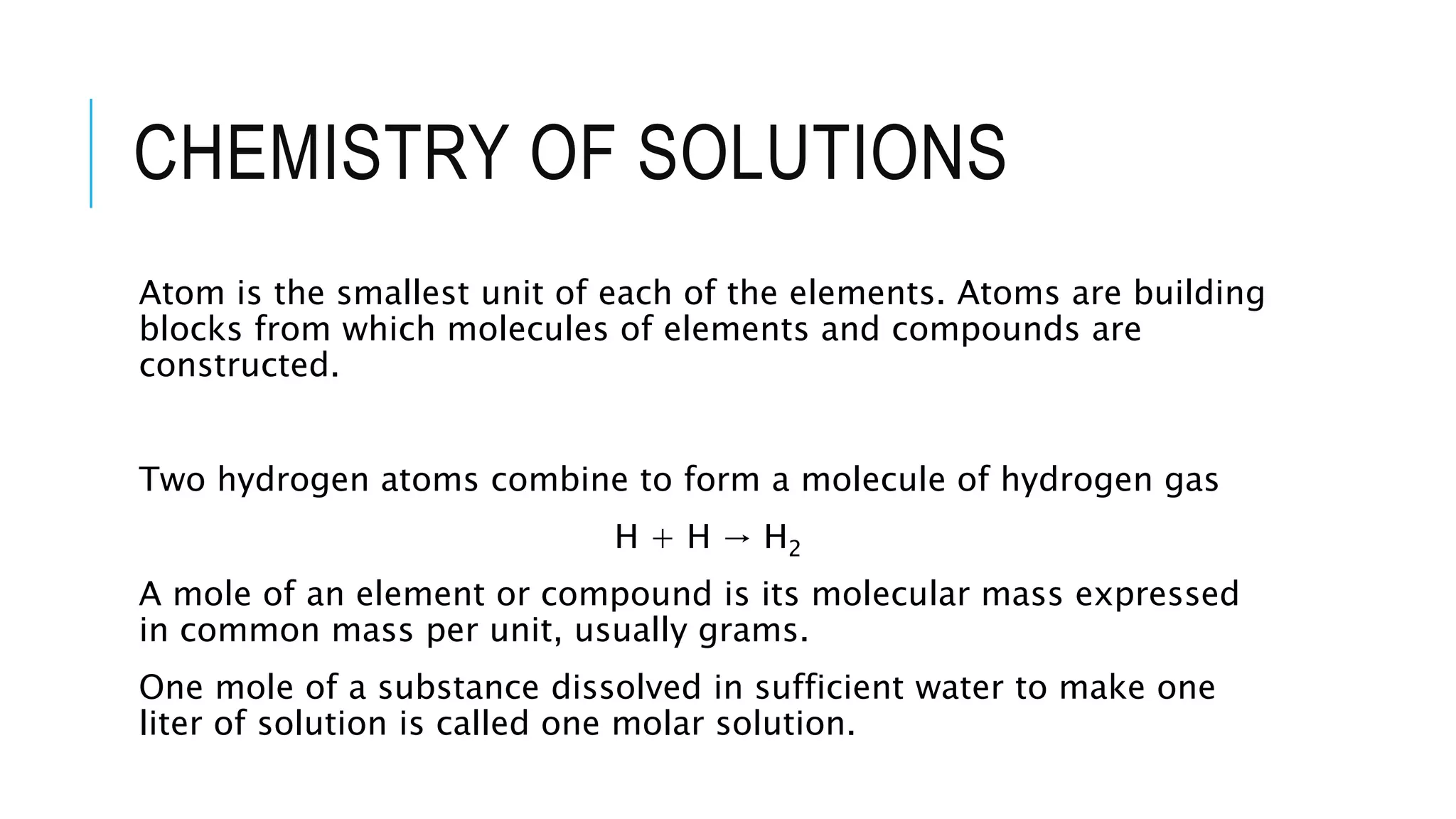
Atom is the smallest unit of each of the elements. Atoms are building
blocks from which molecules of elements and compounds are
constructed.
Two hydrogen atoms combine to form a molecule of hydrogen gas
H + H → H2
A mole of an element or compound is its molecular mass expressed
in common mass per unit, usually grams.
One mole of a substance dissolved in sufficient water to make one
liter of solution is called one molar solution.
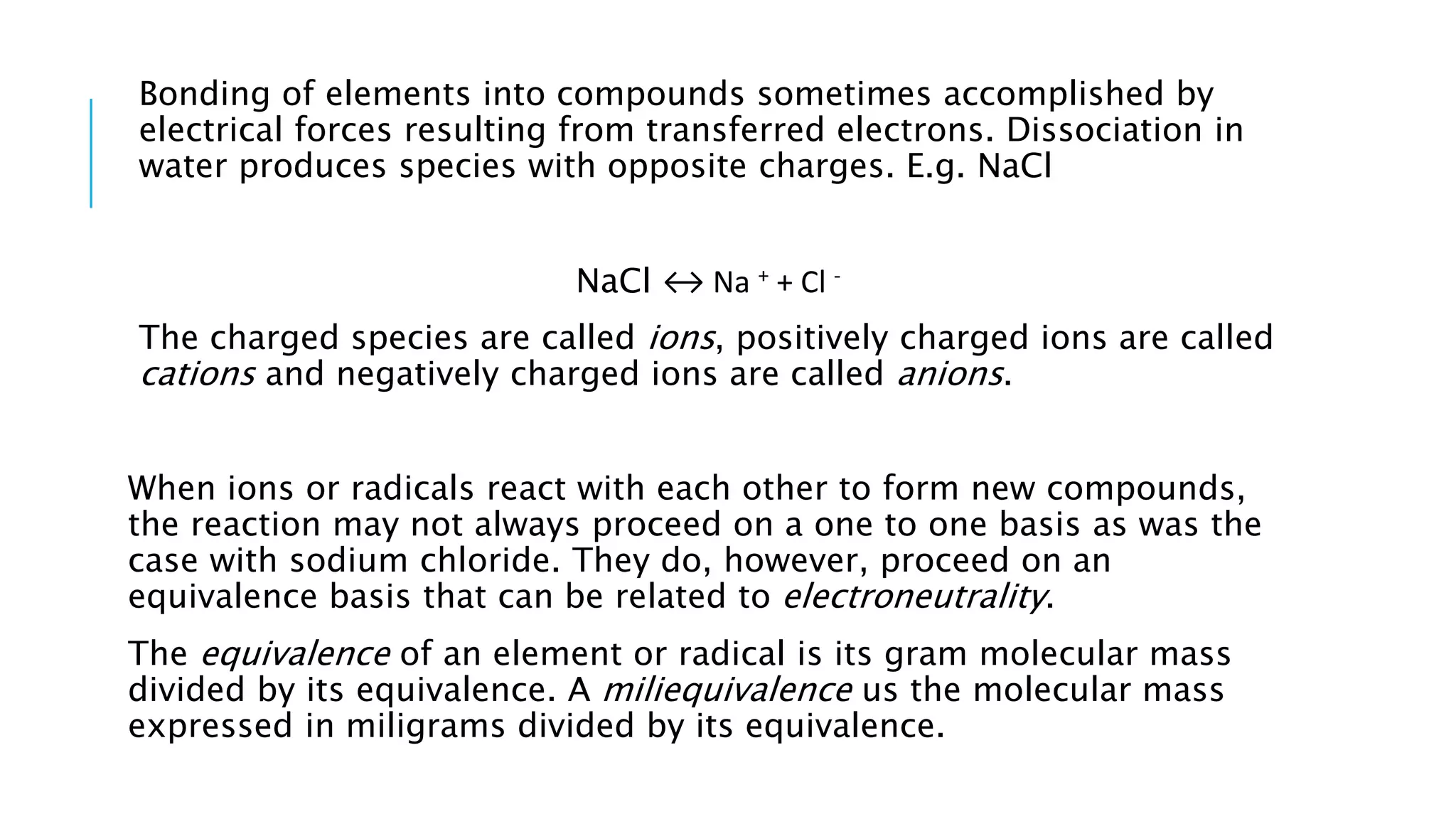
Bonding of elements into compounds sometimes accomplished by
electrical forces resulting from transferred electrons. Dissociation in
water produces species with opposite charges. E.g. NaCl
NaCl ↔ Na + + Cl -
The charged species are called ions, positively charged ions are called
cations and negatively charged ions are called anions.
When ions or radicals react with each other to form new compounds,
the reaction may not always proceed on a one to one basis as was the
case with sodium chloride. They do, however, proceed on an
equivalence basis that can be related to electroneutrality.
The equivalence of an element or radical is its gram molecular mass
divided by its equivalence. A miliequivalence us the molecular mass
expressed in miligrams divided by its equivalence.
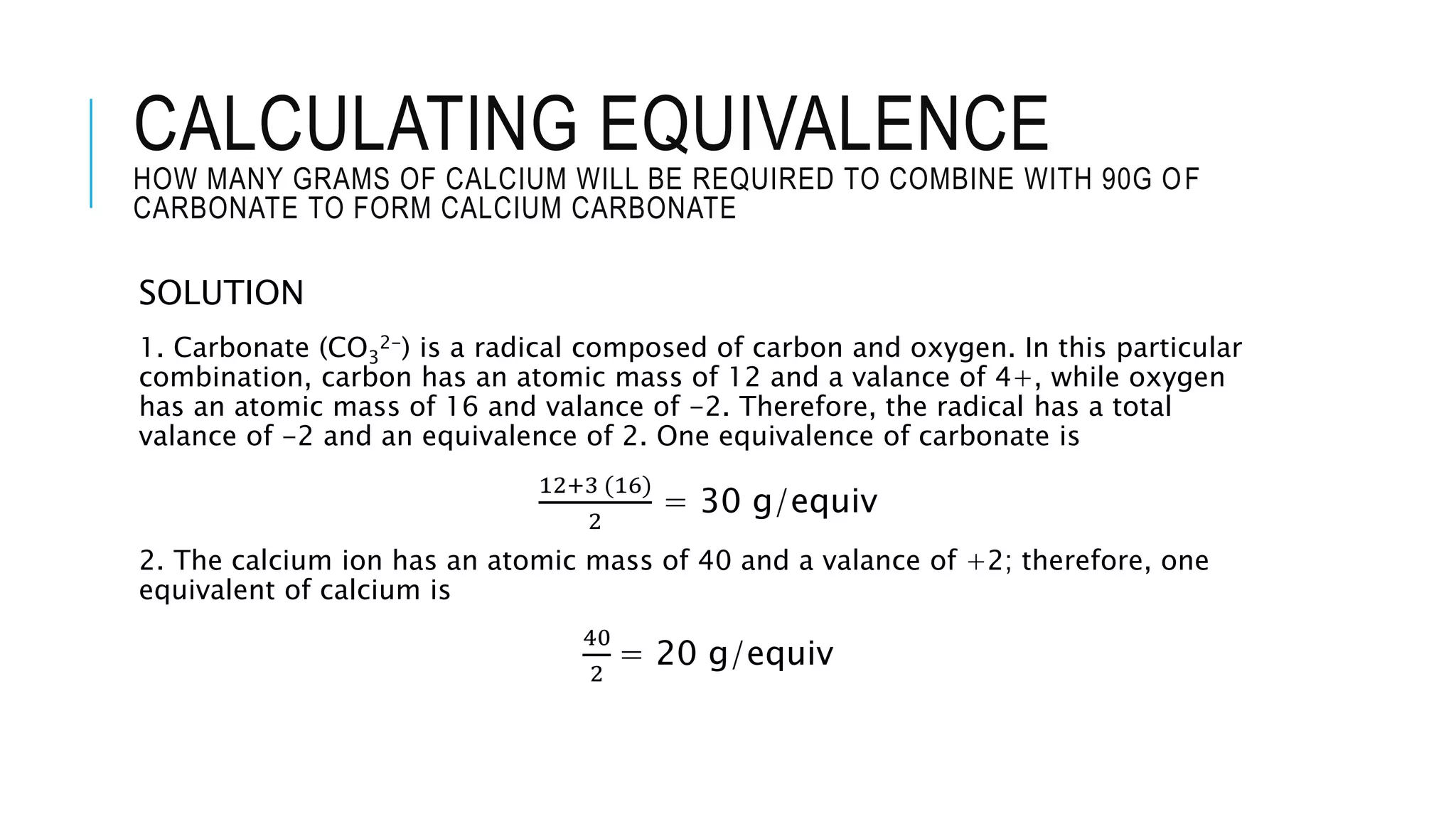
CALCULATING EQUIVALENCE
HOW MANY GRAMS OF CALCIUM WILL BE REQUIRED TO COMBINE WITH 90G OF
CARBONATE TO FORM CALCIUM CARBONATE
SOLUTION
1. Carbonate (CO3
2-) is a radical composed of carbon and oxygen. In this particular
combination, carbon has an atomic mass of 12 and a valance of 4+, while oxygen
has an atomic mass of 16 and valance of -2. Therefore, the radical has a total
valance of -2 and an equivalence of 2. One equivalence of carbonate is
12+3 (16)
2
= 30 g/equiv
2. The calcium ion has an atomic mass of 40 and a valance of +2; therefore, one
equivalent of calcium is
40
2
= 20 g/equiv
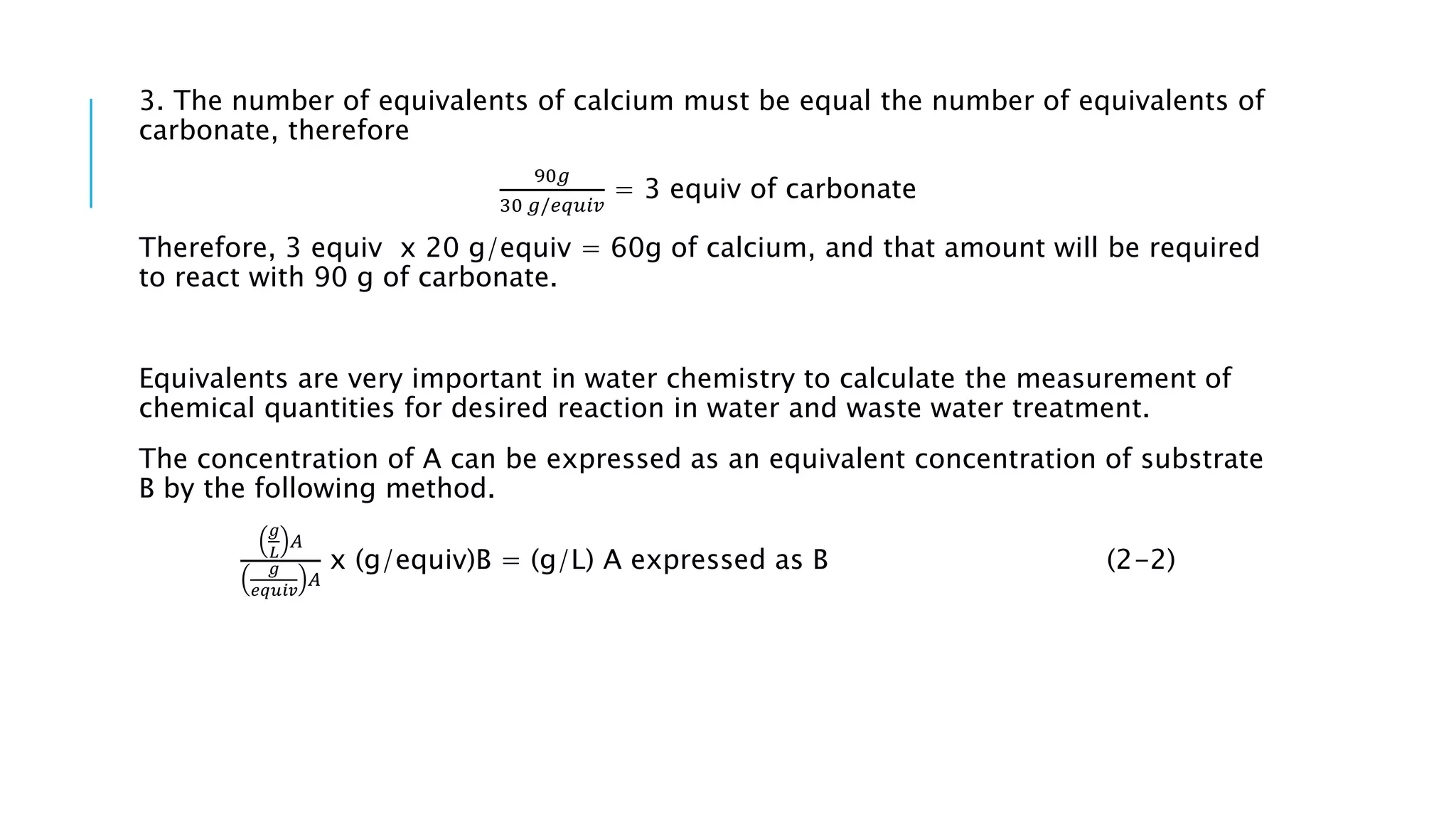
3. The number of equivalents of calcium must be equal the number of equivalents of
carbonate, therefore
90𝑔
30 𝑔/𝑒𝑞𝑢𝑖𝑣
= 3 equiv of carbonate
Therefore, 3 equiv x 20 g/equiv = 60g of calcium, and that amount will be required
to react with 90 g of carbonate.
Equivalents are very important in water chemistry to calculate the measurement of
chemical quantities for desired reaction in water and waste water treatment.
The concentration of A can be expressed as an equivalent concentration of substrate
B by the following method.
𝑔
𝐿
𝐴
𝑔
𝑒𝑞𝑢𝑖𝑣
𝐴
x (g/equiv)B = (g/L) A expressed as B (2-2)
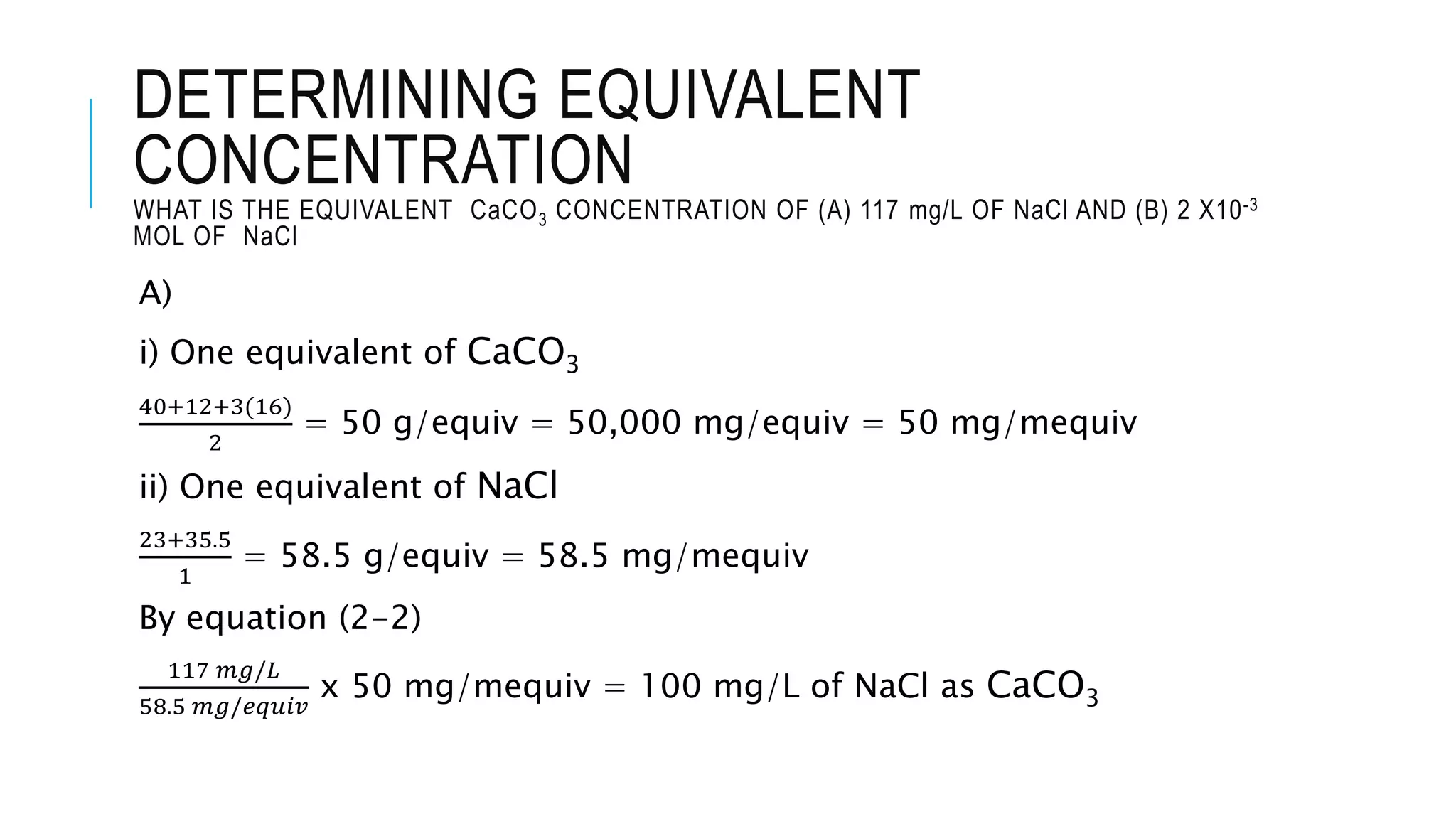
DETERMINING EQUIVALENT
CONCENTRATION
WHAT IS THE EQUIVALENT CaCO3 CONCENTRATION OF (A) 117 mg/L OF NaCl AND (B) 2 X10⁻³
MOL OF NaCl
A)
i) One equivalent of CaCO3
40+12+3(16)
2
= 50 g/equiv = 50,000 mg/equiv = 50 mg/mequiv
ii) One equivalent of NaCl
23+35.5
1
= 58.5 g/equiv = 58.5 mg/mequiv
By equation (2-2)
117 𝑚𝑔/𝐿
58.5 𝑚𝑔/𝑒𝑞𝑢𝑖𝑣
x 50 mg/mequiv = 100 mg/L of NaCl as CaCO3
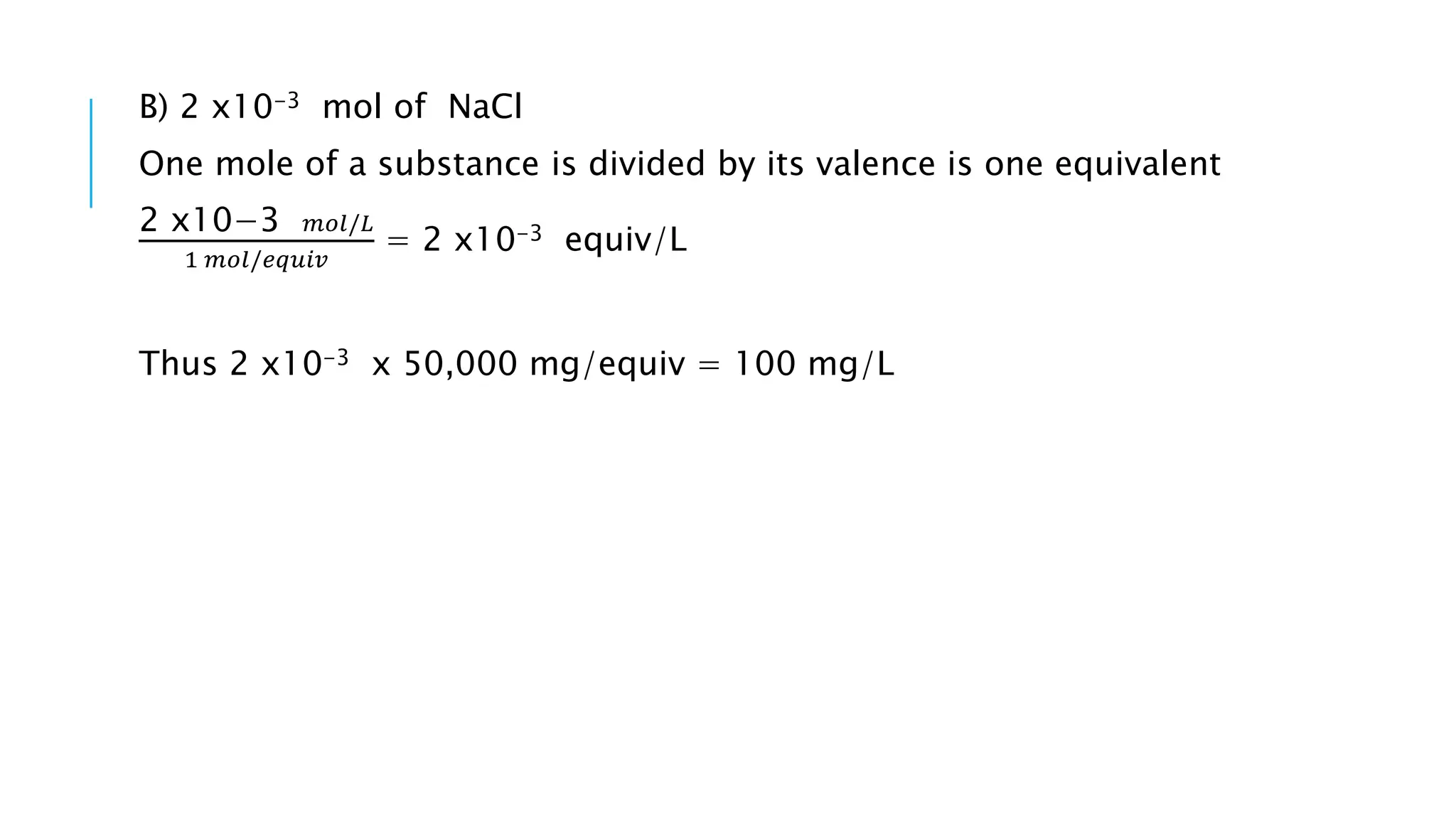
B) 2 x10⁻³ mol of NaCl
One mole of a substance is divided by its valence is one equivalent
2 x10⁻³ 𝑚𝑜𝑙/𝐿
1 𝑚𝑜𝑙/𝑒𝑞𝑢𝑖𝑣
= 2 x10⁻³ equiv/L
Thus 2 x10-3 x 50,000 mg/equiv = 100 mg/L
The solid form NaCl may be dissociating into its ionic components (dissolution) or
recombine to form solid (precipitation)
Conditions of equilibrium can be expressed by the mass action equation. For
generalized reaction
AxBy ↔ xA + yB
Solid compound Ionic compound
The mass action equation is
[𝐴] 𝑥[𝐵] 𝑦
[𝐴 𝑥 𝐵 𝑦]
= K
K value is an equilibrium constant for a given substance in pure water at
a given temperature.
[𝐴 𝑥 𝐵𝑦] = 𝐾𝑠 = constant and [𝐴] 𝑥
[𝐵] 𝑦
= K𝐾𝑠 = 𝐾𝑠𝑝
𝐾𝑠𝑝 is known as solubility product for the ion pair
DETERMINING EQUILIBRIUM
CONCENTRATIONS
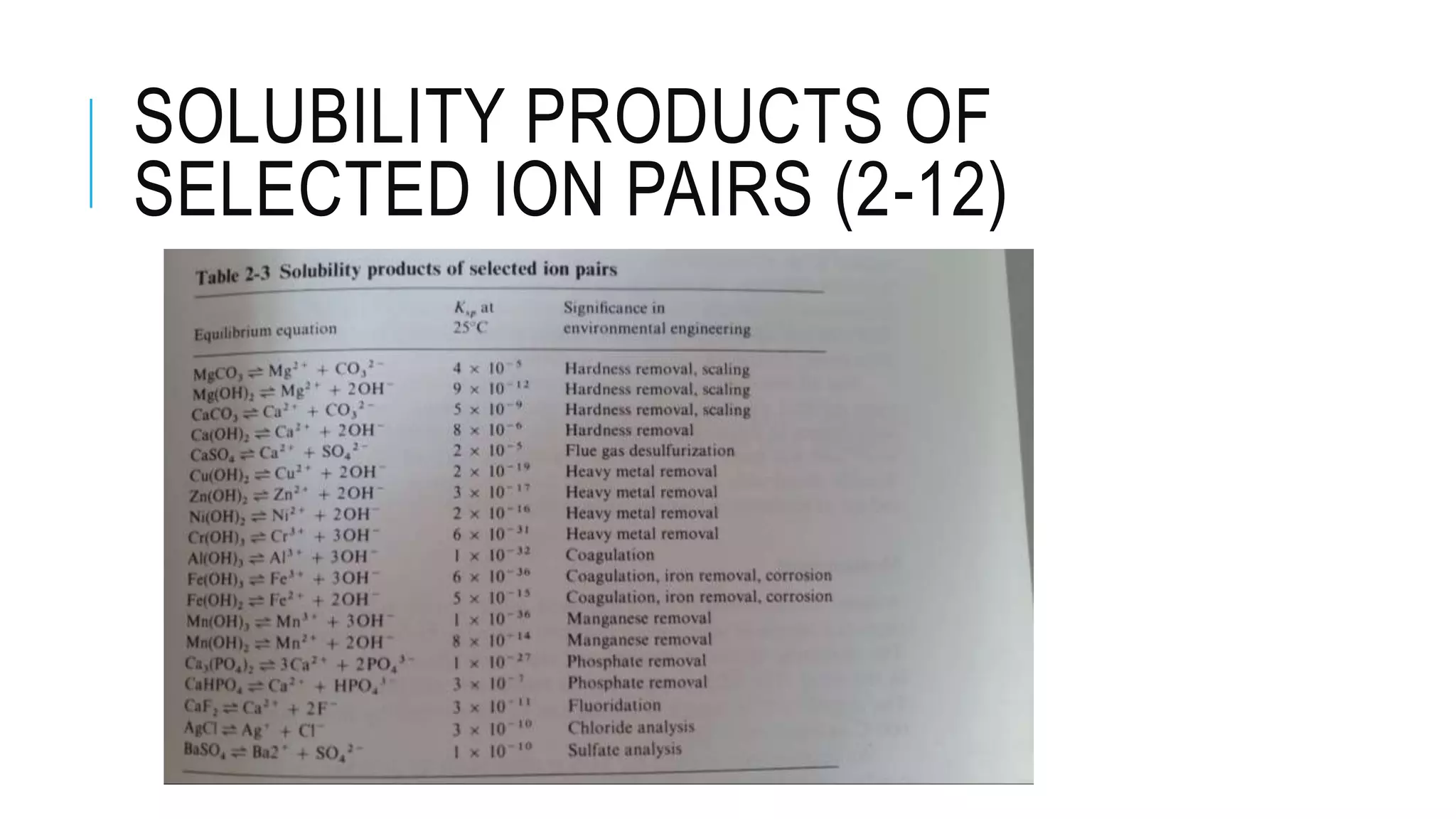
The solubility product for the dissociation of Mg(OH)2 is shown in Table 2-3 as
9x10-12 Determine the concentration of Mg2+ and OH -at equilibrium, expressed
as miligrams per liter of CaCO3
Solution
1. Write the equation for the reaction
Mg(OH)2 ↔ Mg2+ and 2OH-
2. The solubility of the product equation becomes
[Mg2+ ] [OH- ]2 = 9x10-12
If x is the number of moles of Mg2+ resulting from the dissociation, then OH- is
equal to 2x, Therefore
[x] [2x]2 = 9x10-12
4x3 = 9x10-12
X = 1.3𝑥10 − 4 𝑚𝑜𝑙/𝐿 = Mg
2X = 2.6x10⁻⁴ mol/L = OH
3.
1.3x10⁻⁴ mol/L
0.5 𝑚𝑜𝑙/𝑒𝑞𝑢𝑖𝑣
x 50,000 mg/equiv = 13.0 mg/L of Mg as CaCO3
4.
2.6x10⁻⁴ mol/L
1𝑚𝑜𝑙/𝑒𝑞𝑢𝑖𝑣
x 50,000 mg/equiv = 13.0 mg/L of Mg as CaCO3
SOLUBILITY PRODUCTS OF
SELECTED ION PAIRS (2-12)
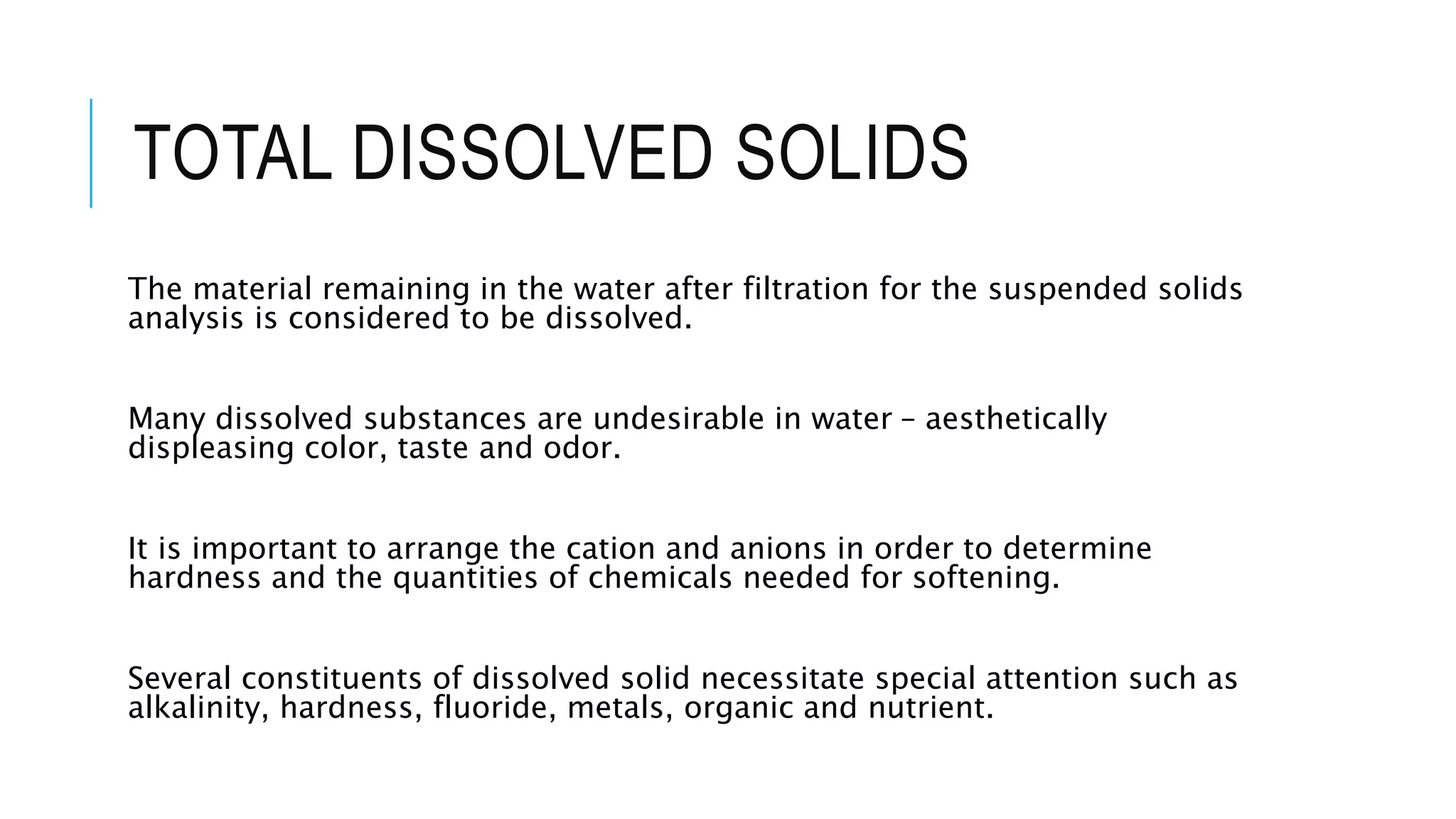
TOTAL DISSOLVED SOLIDS
The material remaining in the water after filtration for the suspended solids
analysis is considered to be dissolved.
Many dissolved substances are undesirable in water – aesthetically
displeasing color, taste and odor.
It is important to arrange the cation and anions in order to determine
hardness and the quantities of chemicals needed for softening.
Several constituents of dissolved solid necessitate special attention such as
alkalinity, hardness, fluoride, metals, organic and nutrient.
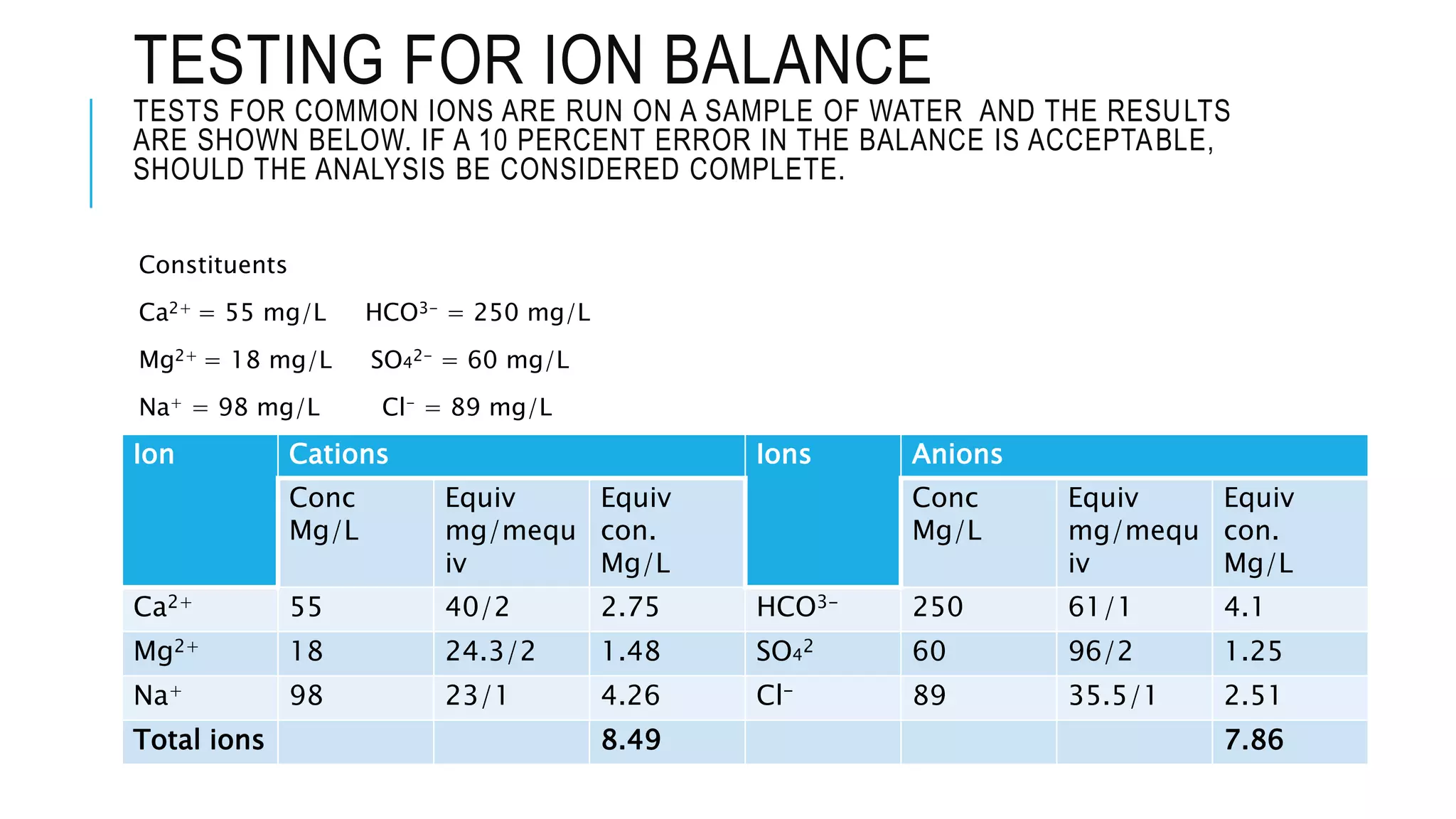
TESTING FOR ION BALANCE
TESTS FOR COMMON IONS ARE RUN ON A SAMPLE OF WATER AND THE RESULTS
ARE SHOWN BELOW. IF A 10 PERCENT ERROR IN THE BALANCE IS ACCEPTABLE,
SHOULD THE ANALYSIS BE CONSIDERED COMPLETE.
Constituents
Ca2+ = 55 mg/L HCO3- = 250 mg/L
Mg2+ = 18 mg/L SO42- = 60 mg/L
Na+ = 98 mg/L Cl- = 89 mg/L
Ion Cations Ions Anions
Conc
Mg/L
Equiv
mg/mequ
iv
Equiv
con.
Mg/L
Conc
Mg/L
Equiv
mg/mequ
iv
Equiv
con.
Mg/L
Ca2+ 55 40/2 2.75 HCO3- 250 61/1 4.1
Mg2+ 18 24.3/2 1.48 SO42 60 96/2 1.25
Na+ 98 23/1 4.26 Cl- 89 35.5/1 2.51
Total ions 8.49 7.86
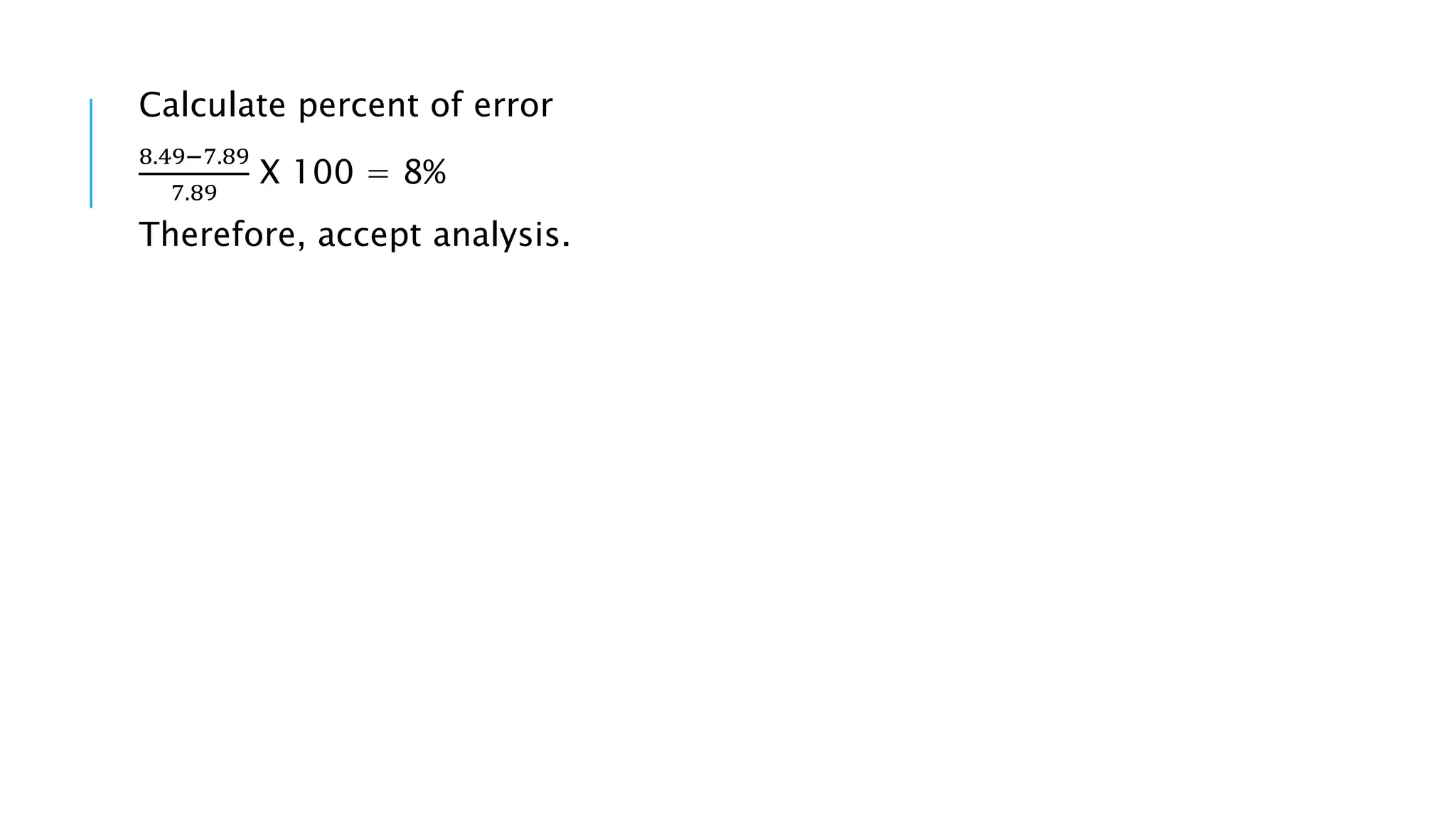
Calculate percent of error
8.49−7.89
7.89
X 100 = 8%
Therefore, accept analysis.
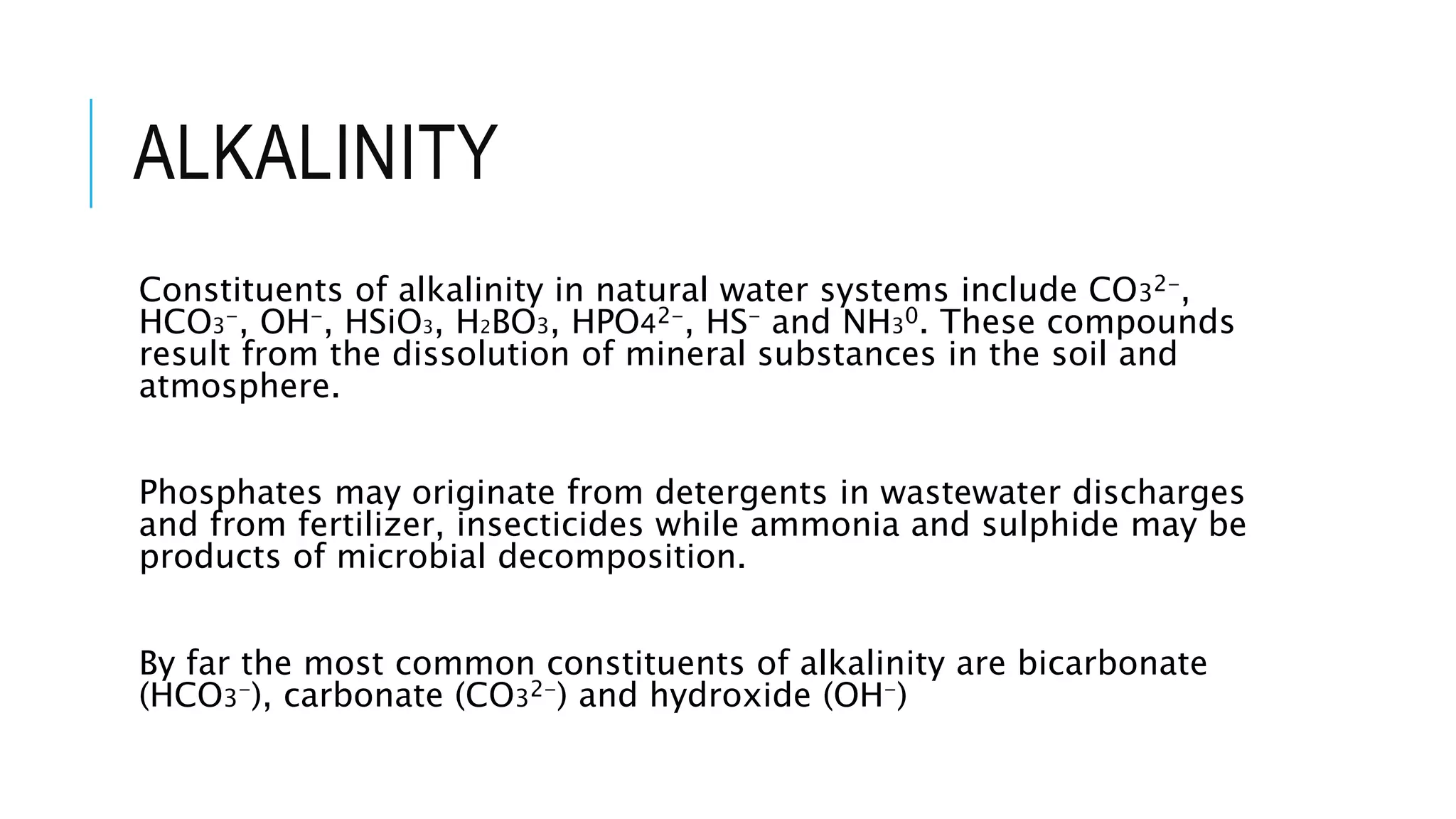
ALKALINITY
Constituents of alkalinity in natural water systems include CO32-,
HCO3-, OH-, HSiO3, H2BO3, HPO42-, HS- and NH30. These compounds
result from the dissolution of mineral substances in the soil and
atmosphere.
Phosphates may originate from detergents in wastewater discharges
and from fertilizer, insecticides while ammonia and sulphide may be
products of microbial decomposition.
By far the most common constituents of alkalinity are bicarbonate
(HCO3-), carbonate (CO32-) and hydroxide (OH-)
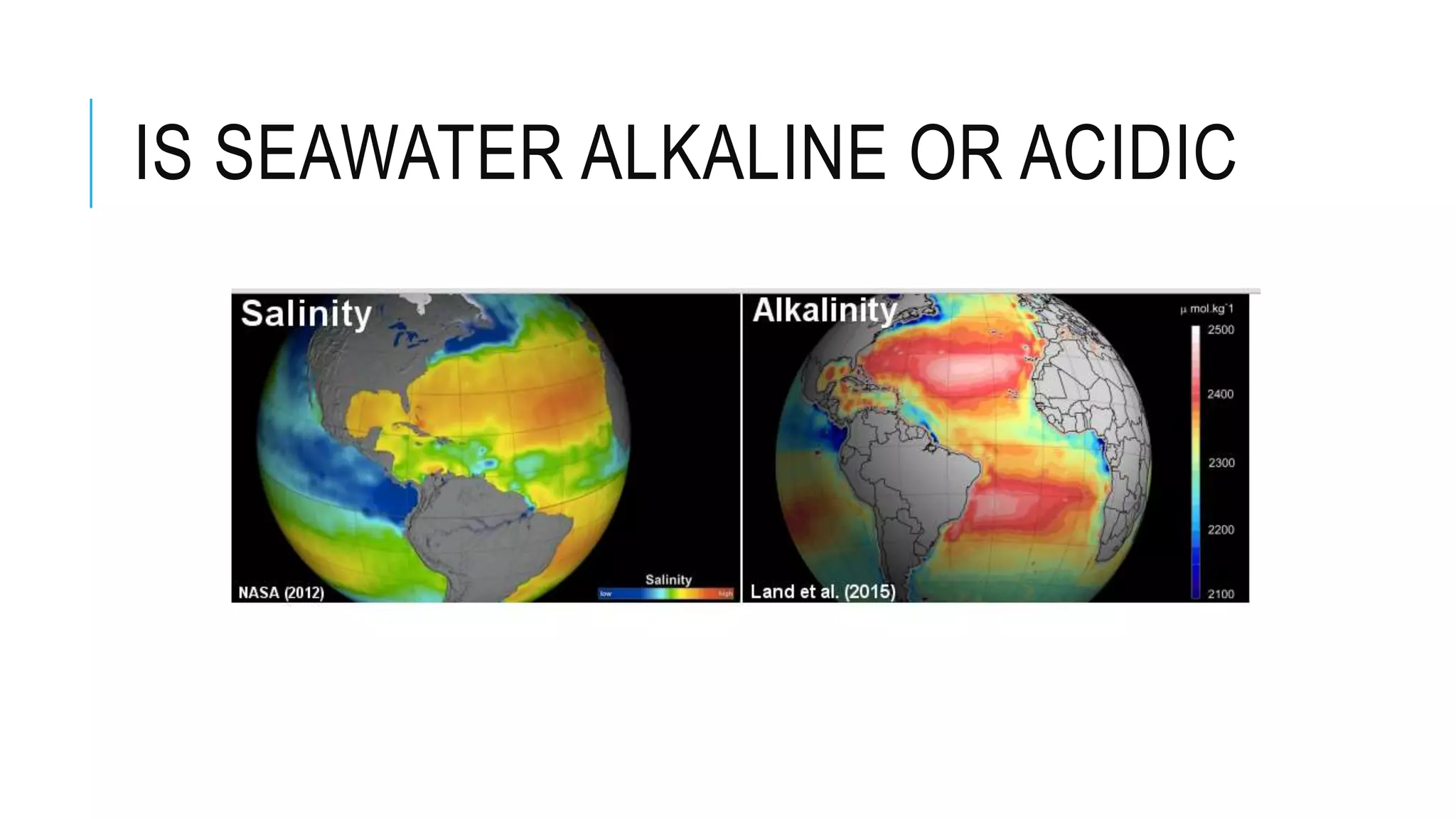
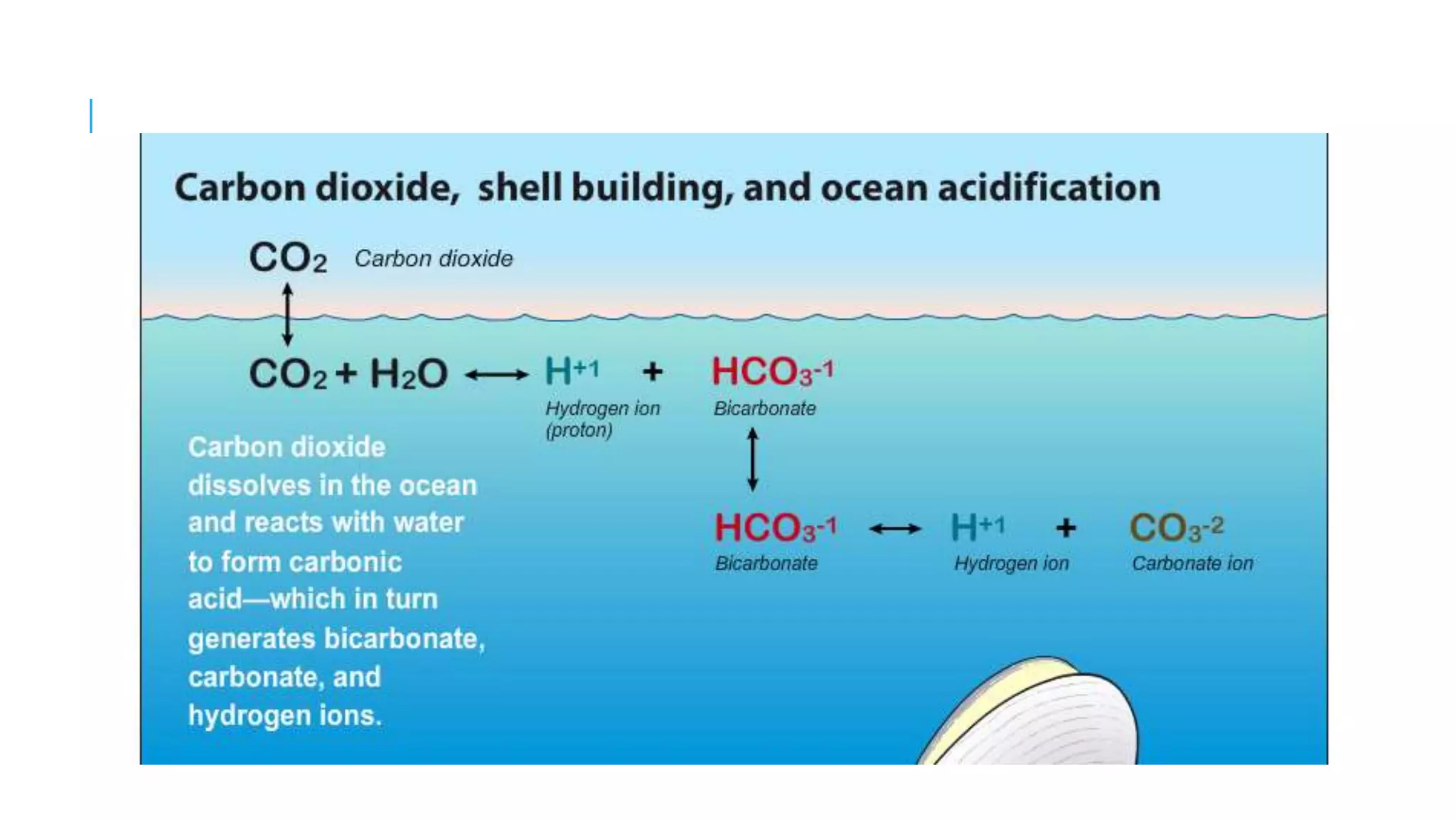
IS SEAWATER ALKALINE OR ACIDIC
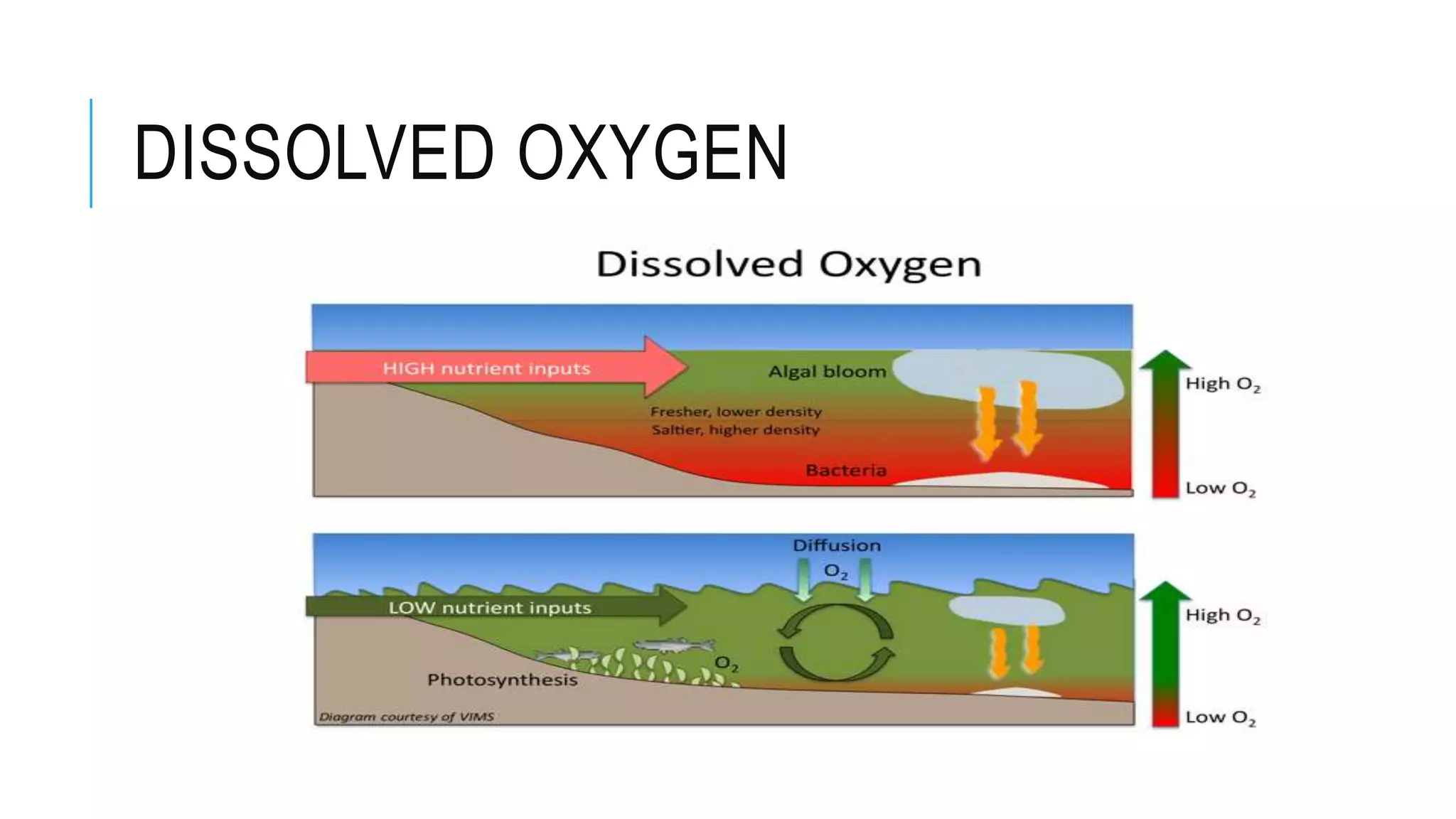
DISSOLVED OXYGEN
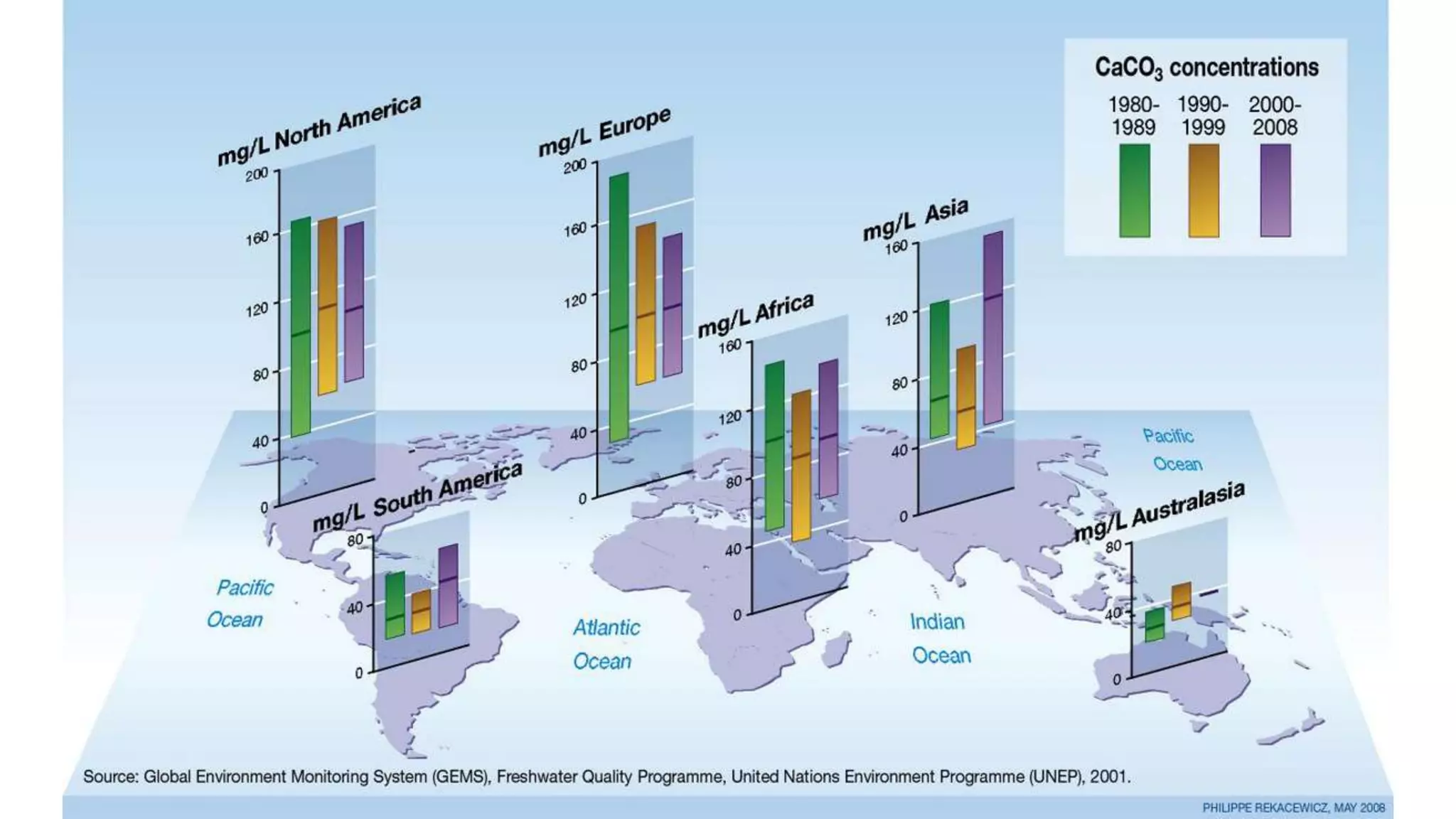
HARDNESS
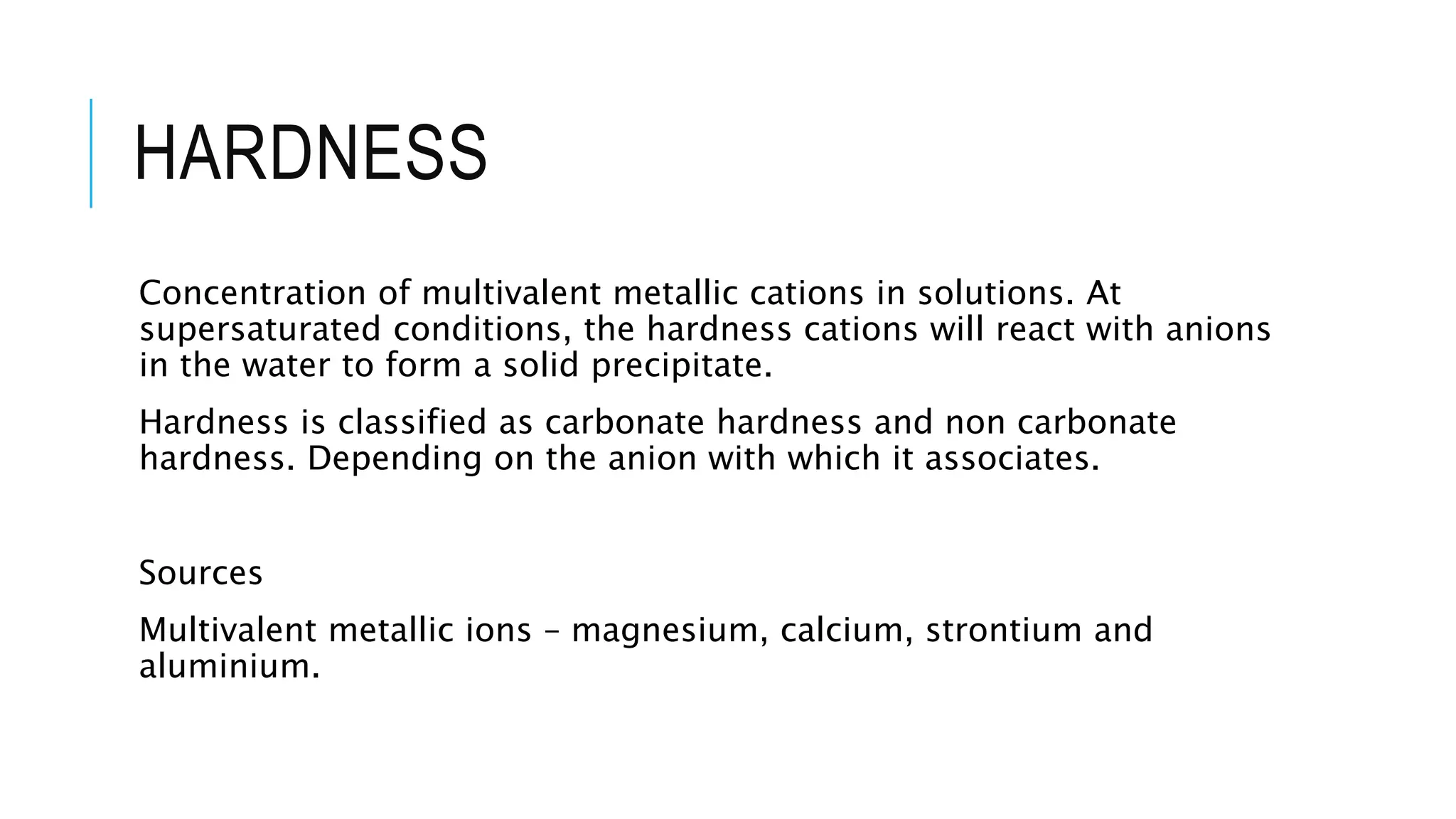
Concentration of multivalent metallic cations in solutions. At
supersaturated conditions, the hardness cations will react with anions
in the water to form a solid precipitate.
Hardness is classified as carbonate hardness and non carbonate
hardness. Depending on the anion with which it associates.
Sources
Multivalent metallic ions – magnesium, calcium, strontium and
aluminium.
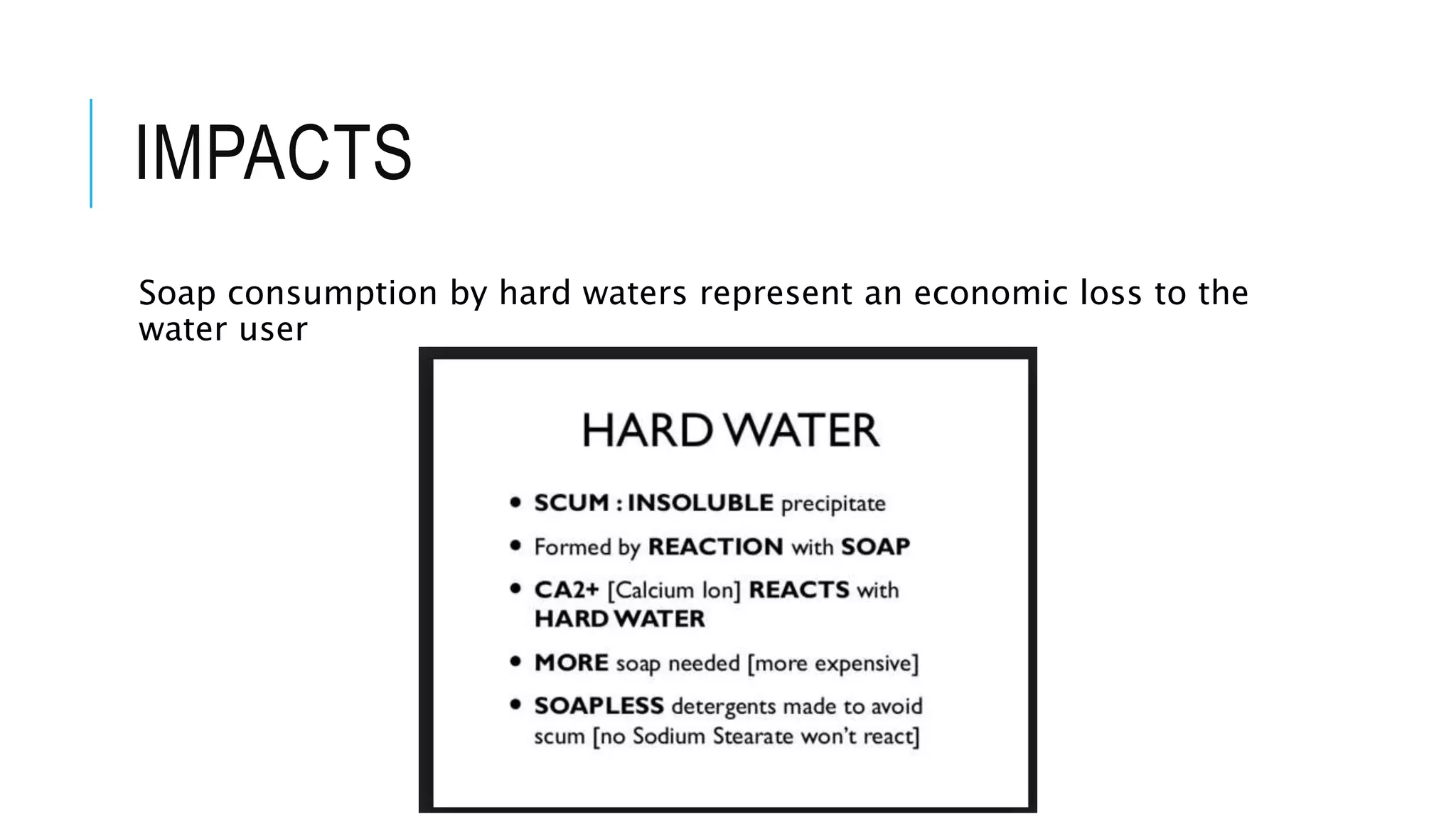
IMPACTS
Soap consumption by hard waters represent an economic loss to the
water user
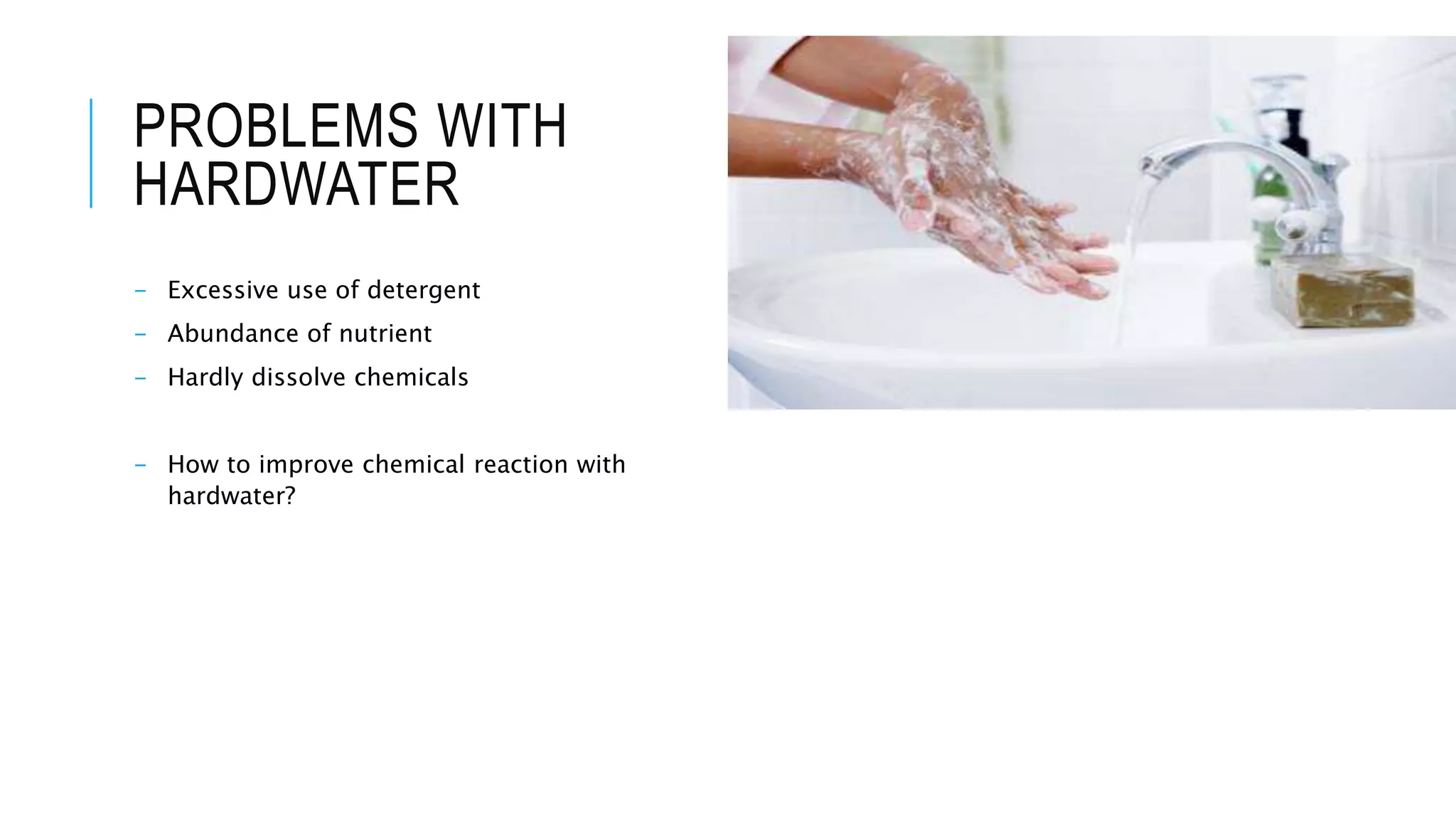
PROBLEMS WITH
HARDWATER
- Excessive use of detergent
- Abundance of nutrient
- Hardly dissolve chemicals
- How to improve chemical reaction with
hardwater?

Water Quality and System in Environmental Engineering

  • 1.
    CHAPTER 2. WATERQUALITY: DEFINITIONS, CHARACTERISTICS AND PERSPECTIVES DR. MUNIRA SHAHBUDDIN Introduction to Environmental Engineering IIUM, Malaysia.
  • 2.
    WORLD WATER DISTRIBUTION The earthis covered by 70% water Only 3% (fresh water) of the total water are consumable for drink, household, industrial, domestic purposes. From the 3%, less than 0.003% is accessible to human for use (which is unpolluted).
  • 3.
    WATER SUSTAINABILITY Water sustainabilityis essential to human existence. Civilization developed around water bodies that could support agriculture, domestic, transportation and as source for food. Water is in a constant state of motion, as depicted in the hydrologic cycle. Human activities contribute to contamination from industrial, agriculture, domestic use, waste. The impurities accumulated by water throughout the hydrologic cycle may be in both suspended and dissolved form – causing pollution in water reservoir.
  • 6.
    NUTRIENT LOADING INTO THEWATER RESERVOIR Abundance of nutrient – eutrophication – good, bad or should be balanced?
  • 8.
    FORMATION OF ACIDRAIN PRESENCE OF VOLATILE ORGANIC COMPOUND IN THE ATMOSPHERE
  • 9.
  • 10.
  • 11.
    WATER CRISIS –FLINT, MICHIGAN. http://www.nytimes.com/2016/02/09/us/regulatory-gaps-leave-unsafe-lead-levels-in-water- nationwide.html?_r=0
  • 13.
    LOVE CANAL, NEWYORK. The tragedy caused by chemical waste/contaminations sipped into groundwater reservoir.
  • 15.
    YELLOW SEA, CHINATURNED GREEN DUE TO ALGAE BLOOM
  • 18.
    BAOTOU, INNER MONGOLIA RAREEARTH EXTRACTION AND PROCESS
  • 20.
  • 21.
    - Abandon chemical plant -Presence of bacterias - Weather - Geographical condition - Human factor UNDERSTANDING THE CAUSE
  • 22.
    AZURE BLUE LAKES TasikGelugor, Penang, Malaysia. Buxton, Derbyshire, United Kingdom.
  • 24.
    CHEMICAL WATER –QUALITY PARAMETERS Water is an essential, universal solvent. Chemical parameters are related to the solvent capabilities of water. Chemical parameters: - Total suspended solid - Alkalinity - Hardness - Flouride - Metal, organics and nutrients.
  • 25.
    CHEMISTRY OF SOLUTIONS Atomis the smallest unit of each of the elements. Atoms are building blocks from which molecules of elements and compounds are constructed. Two hydrogen atoms combine to form a molecule of hydrogen gas H + H → H2 A mole of an element or compound is its molecular mass expressed in common mass per unit, usually grams. One mole of a substance dissolved in sufficient water to make one liter of solution is called one molar solution.
  • 26.
    Bonding of elementsinto compounds sometimes accomplished by electrical forces resulting from transferred electrons. Dissociation in water produces species with opposite charges. E.g. NaCl NaCl ↔ Na + + Cl - The charged species are called ions, positively charged ions are called cations and negatively charged ions are called anions. When ions or radicals react with each other to form new compounds, the reaction may not always proceed on a one to one basis as was the case with sodium chloride. They do, however, proceed on an equivalence basis that can be related to electroneutrality. The equivalence of an element or radical is its gram molecular mass divided by its equivalence. A miliequivalence us the molecular mass expressed in miligrams divided by its equivalence.
  • 27.
    CALCULATING EQUIVALENCE HOW MANYGRAMS OF CALCIUM WILL BE REQUIRED TO COMBINE WITH 90G OF CARBONATE TO FORM CALCIUM CARBONATE SOLUTION 1. Carbonate (CO3 2-) is a radical composed of carbon and oxygen. In this particular combination, carbon has an atomic mass of 12 and a valance of 4+, while oxygen has an atomic mass of 16 and valance of -2. Therefore, the radical has a total valance of -2 and an equivalence of 2. One equivalence of carbonate is 12+3 (16) 2 = 30 g/equiv 2. The calcium ion has an atomic mass of 40 and a valance of +2; therefore, one equivalent of calcium is 40 2 = 20 g/equiv
  • 28.
    3. The numberof equivalents of calcium must be equal the number of equivalents of carbonate, therefore 90𝑔 30 𝑔/𝑒𝑞𝑢𝑖𝑣 = 3 equiv of carbonate Therefore, 3 equiv x 20 g/equiv = 60g of calcium, and that amount will be required to react with 90 g of carbonate. Equivalents are very important in water chemistry to calculate the measurement of chemical quantities for desired reaction in water and waste water treatment. The concentration of A can be expressed as an equivalent concentration of substrate B by the following method. 𝑔 𝐿 𝐴 𝑔 𝑒𝑞𝑢𝑖𝑣 𝐴 x (g/equiv)B = (g/L) A expressed as B (2-2)
  • 29.
    DETERMINING EQUIVALENT CONCENTRATION WHAT ISTHE EQUIVALENT CaCO3 CONCENTRATION OF (A) 117 mg/L OF NaCl AND (B) 2 X10⁻³ MOL OF NaCl A) i) One equivalent of CaCO3 40+12+3(16) 2 = 50 g/equiv = 50,000 mg/equiv = 50 mg/mequiv ii) One equivalent of NaCl 23+35.5 1 = 58.5 g/equiv = 58.5 mg/mequiv By equation (2-2) 117 𝑚𝑔/𝐿 58.5 𝑚𝑔/𝑒𝑞𝑢𝑖𝑣 x 50 mg/mequiv = 100 mg/L of NaCl as CaCO3
  • 30.
    B) 2 x10⁻³mol of NaCl One mole of a substance is divided by its valence is one equivalent 2 x10⁻³ 𝑚𝑜𝑙/𝐿 1 𝑚𝑜𝑙/𝑒𝑞𝑢𝑖𝑣 = 2 x10⁻³ equiv/L Thus 2 x10-3 x 50,000 mg/equiv = 100 mg/L
  • 31.
    The solid formNaCl may be dissociating into its ionic components (dissolution) or recombine to form solid (precipitation) Conditions of equilibrium can be expressed by the mass action equation. For generalized reaction AxBy ↔ xA + yB Solid compound Ionic compound The mass action equation is [𝐴] 𝑥[𝐵] 𝑦 [𝐴 𝑥 𝐵 𝑦] = K K value is an equilibrium constant for a given substance in pure water at a given temperature. [𝐴 𝑥 𝐵𝑦] = 𝐾𝑠 = constant and [𝐴] 𝑥 [𝐵] 𝑦 = K𝐾𝑠 = 𝐾𝑠𝑝 𝐾𝑠𝑝 is known as solubility product for the ion pair
  • 32.
    DETERMINING EQUILIBRIUM CONCENTRATIONS The solubilityproduct for the dissociation of Mg(OH)2 is shown in Table 2-3 as 9x10-12 Determine the concentration of Mg2+ and OH -at equilibrium, expressed as miligrams per liter of CaCO3 Solution 1. Write the equation for the reaction Mg(OH)2 ↔ Mg2+ and 2OH- 2. The solubility of the product equation becomes [Mg2+ ] [OH- ]2 = 9x10-12 If x is the number of moles of Mg2+ resulting from the dissociation, then OH- is equal to 2x, Therefore
  • 33.
    [x] [2x]2 =9x10-12 4x3 = 9x10-12 X = 1.3𝑥10 − 4 𝑚𝑜𝑙/𝐿 = Mg 2X = 2.6x10⁻⁴ mol/L = OH 3. 1.3x10⁻⁴ mol/L 0.5 𝑚𝑜𝑙/𝑒𝑞𝑢𝑖𝑣 x 50,000 mg/equiv = 13.0 mg/L of Mg as CaCO3 4. 2.6x10⁻⁴ mol/L 1𝑚𝑜𝑙/𝑒𝑞𝑢𝑖𝑣 x 50,000 mg/equiv = 13.0 mg/L of Mg as CaCO3
  • 34.
  • 35.
    TOTAL DISSOLVED SOLIDS Thematerial remaining in the water after filtration for the suspended solids analysis is considered to be dissolved. Many dissolved substances are undesirable in water – aesthetically displeasing color, taste and odor. It is important to arrange the cation and anions in order to determine hardness and the quantities of chemicals needed for softening. Several constituents of dissolved solid necessitate special attention such as alkalinity, hardness, fluoride, metals, organic and nutrient.
  • 36.
    TESTING FOR IONBALANCE TESTS FOR COMMON IONS ARE RUN ON A SAMPLE OF WATER AND THE RESULTS ARE SHOWN BELOW. IF A 10 PERCENT ERROR IN THE BALANCE IS ACCEPTABLE, SHOULD THE ANALYSIS BE CONSIDERED COMPLETE. Constituents Ca2+ = 55 mg/L HCO3- = 250 mg/L Mg2+ = 18 mg/L SO42- = 60 mg/L Na+ = 98 mg/L Cl- = 89 mg/L Ion Cations Ions Anions Conc Mg/L Equiv mg/mequ iv Equiv con. Mg/L Conc Mg/L Equiv mg/mequ iv Equiv con. Mg/L Ca2+ 55 40/2 2.75 HCO3- 250 61/1 4.1 Mg2+ 18 24.3/2 1.48 SO42 60 96/2 1.25 Na+ 98 23/1 4.26 Cl- 89 35.5/1 2.51 Total ions 8.49 7.86
  • 37.
    Calculate percent oferror 8.49−7.89 7.89 X 100 = 8% Therefore, accept analysis.
  • 38.
    ALKALINITY Constituents of alkalinityin natural water systems include CO32-, HCO3-, OH-, HSiO3, H2BO3, HPO42-, HS- and NH30. These compounds result from the dissolution of mineral substances in the soil and atmosphere. Phosphates may originate from detergents in wastewater discharges and from fertilizer, insecticides while ammonia and sulphide may be products of microbial decomposition. By far the most common constituents of alkalinity are bicarbonate (HCO3-), carbonate (CO32-) and hydroxide (OH-)
  • 39.
  • 42.
  • 43.
    HARDNESS Concentration of multivalentmetallic cations in solutions. At supersaturated conditions, the hardness cations will react with anions in the water to form a solid precipitate. Hardness is classified as carbonate hardness and non carbonate hardness. Depending on the anion with which it associates. Sources Multivalent metallic ions – magnesium, calcium, strontium and aluminium.
  • 44.
    IMPACTS Soap consumption byhard waters represent an economic loss to the water user
  • 45.
    PROBLEMS WITH HARDWATER - Excessiveuse of detergent - Abundance of nutrient - Hardly dissolve chemicals - How to improve chemical reaction with hardwater?