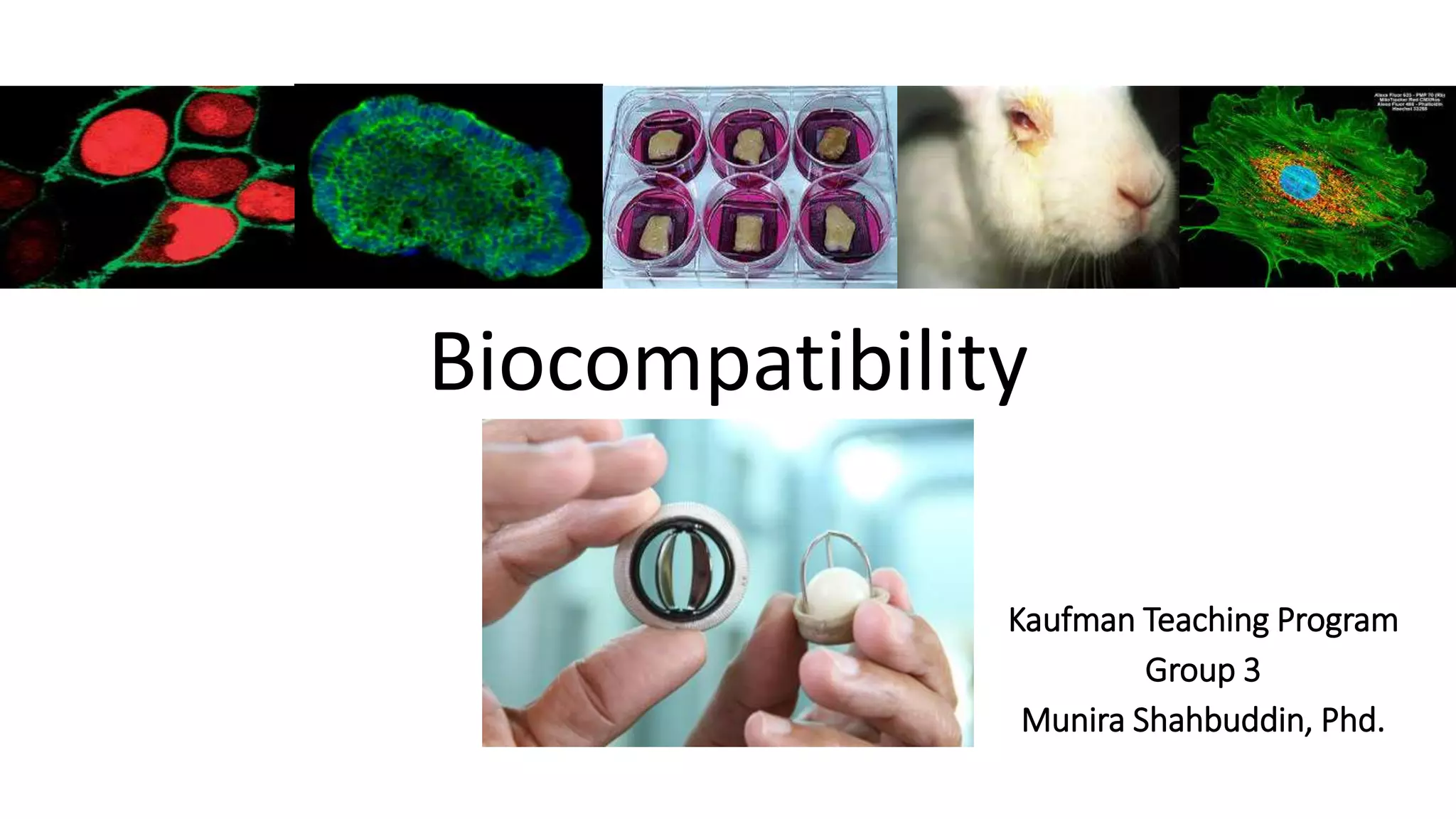
Biocompatibility
Kaufman Teaching Program
Group 3
Munira Shahbuddin, Phd.
BIOCOMPATIBILITY
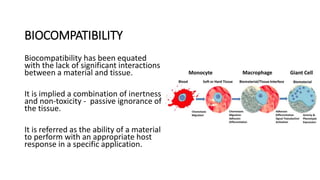
Biocompatibility has been equated
with the lack of significant interactions
between a material and tissue.
It is implied a combination of inertness
and non-toxicity - passive ignorance of
the tissue.
It is referred as the ability of a material
to perform with an appropriate host
response in a specific application.
BIOCOMPATIBILITY: DEFINITION
1. BIOCOMPATIBILITY IS NOT A SINGLE EVENT
OR A SINGLE PHENOMENON
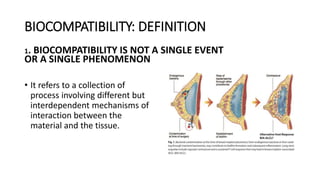
• It refers to a collection of
process involving different but
interdependent mechanisms of
interaction between the
material and the tissue.
2. BIOCOMPATIBILITY REFERS TO THE ABILITY OF THE
MATERIALS TO PERFORM A FUNCTION
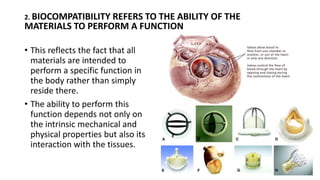
• This reflects the fact that all
materials are intended to
perform a specific function in
the body rather than simply
reside there.
• The ability to perform this
function depends not only on
the intrinsic mechanical and
physical properties but also its
interaction with the tissues.
3. BIOCOMPATIBILITY REFERS TO APPROPRIATE HOST
RESPONSE
• It does not stipulate that there should be no
response but rather that response should be
appropriate or acceptable in view of the function
that has to be performed.
4. BIOCOMPATIBILITY REFERS TO SPECIFIC APPLICATION
• It has to be described with reference to the
situation in which it is used.
• Different materials and tissues do not display the
same biocompatibility.

Biocompatibility

  • 1.
  • 2.
    BIOCOMPATIBILITY Biocompatibility has beenequated with the lack of significant interactions between a material and tissue. It is implied a combination of inertness and non-toxicity - passive ignorance of the tissue. It is referred as the ability of a material to perform with an appropriate host response in a specific application.
  • 5.
    BIOCOMPATIBILITY: DEFINITION 1. BIOCOMPATIBILITYIS NOT A SINGLE EVENT OR A SINGLE PHENOMENON • It refers to a collection of process involving different but interdependent mechanisms of interaction between the material and the tissue.
  • 6.
    2. BIOCOMPATIBILITY REFERSTO THE ABILITY OF THE MATERIALS TO PERFORM A FUNCTION • This reflects the fact that all materials are intended to perform a specific function in the body rather than simply reside there. • The ability to perform this function depends not only on the intrinsic mechanical and physical properties but also its interaction with the tissues.
  • 7.
    3. BIOCOMPATIBILITY REFERSTO APPROPRIATE HOST RESPONSE • It does not stipulate that there should be no response but rather that response should be appropriate or acceptable in view of the function that has to be performed. 4. BIOCOMPATIBILITY REFERS TO SPECIFIC APPLICATION • It has to be described with reference to the situation in which it is used. • Different materials and tissues do not display the same biocompatibility.