Water consumption &Purification
The Water in our livesWhere is Earth’s water?How much water is there?How much water is consumed in our daily livesHow much of the drinking water is free of contaminationWhat measures should we take to prevent wastage of water
Where is Earth’s Water ?There is no shortage of water on Earth. Most of our planet is covered by water  but very little of that water is available for humans to drink.Our “blue planet” is dominated by oceans that stretch across some two-thirds of its surface. These massive bodies of saltwater hold almost all the water on Earth.Less than three percent of the planet’s water exists as freshwater and not all of it is accessible for human use. In fact, more than two-thirds of the planet’s freshwater is not even liquid—it’s frozen in glaciers in places like the Antarctic and Greenland ice sheets.All Earth’s waterOcean 97%Fresh water 3%Surface Water1. Rivers: 2%2. Swamps: 11%3. Lakes: 87%Fresh waterIcecaps/Glaciers: 68.7%2. Ground: 30.1%3. Other: .9%4. Surface: .3%
Water on move       Water is continually moving around, through, and above the Earth as water vapor, liquid water, and ice. In fact, water is continually changing its form. The Earth is pretty much a "closed system," like a terrarium. That means that the Earth neither, as a whole, gains nor loses much matter, including water. The hydrological cycle moves water from the atmosphere to the Earth and back again in a process of perpetual motion powered by energy from the sun and by gravity. The cycle’s processes provide the water that flows through rivers, lakes, reservoirs, and aquifers from which many people get their drinking water. Indeed, the water cycle makes life on Earth possible.Precipitation: When these water droplets (or ice crystals) become to large to stay suspended in the air, they fall as precipitation—the rain and snow that eventually returns most atmospheric water to the Earth.Condensation: Water vapor cools as it expands and encounters cooler temperatures in the atmosphere. It may then condense into tiny water droplets, forming clouds. This process is called condensation.Infiltration: Instead of evaporating, some water that lands on continents runs off into rivers, streams, and lakes. The rest sinks through the soil to join underground aquifers. This is known as infiltration, or recharge.Evaporation: Solar energy heats surfaces (the oceans, lakes, reservoirs, plants and trees, and the land surface itself) and creates water vapor that returns to the atmosphere by evaporation and transpiration
   Water is one of our most natural resources. Without it, there would be no life on earth.
Groundwater     About 96 percent of all unfrozen fresh water is found below the Earth’s surface and is known as groundwater. Groundwater systems globally provide 25 to 40 percent of the world’s drinking water. Groundwater represents an enormous resource that can only be managed through an understanding of the different types of aquifers and their rates of renewal.     Aquifers that are located close to the surface are often intimately connected with surface water systems. They may be replenished directly by infiltration of precipitation and sometimes surface runoff, and may discharge to water bodies such as streams and lakes. When such aquifers are drawn down by pumping, they can cause a decrease in river flow, resulting in shortages of drinking water, water for agriculture, or water for the aquatic ecosystem. Deeper aquifers may also be replenished indirectly by water slowly leaking downward from shallower aquifersAquifers, particularly those close to the surface, are often connected with surface water systems. They may be replenished by recharge from precipitationRenewable Groundwater
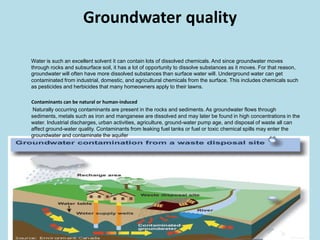
Groundwater quality        Water is such an excellent solvent it can contain lots of dissolved chemicals. And since groundwater moves through rocks and subsurface soil, it has a lot of opportunity to dissolve substances as it moves. For that reason, groundwater will often have more dissolved substances than surface water will.Underground water can get contaminated from industrial, domestic, and agricultural chemicals from the surface. This includes chemicals such as pesticides and herbicides that many homeowners apply to their lawns.          Contaminants can be natural or human-inducedNaturally occurring contaminants are present in the rocks and sediments. As groundwater flows through sediments, metals such as iron and manganese are dissolved and may later be found in high concentrations in the water. Industrial discharges, urban activities, agriculture, ground-water pump age, and disposal of waste all can affect ground-water quality. Contaminants from leaking fuel tanks or fuel or toxic chemical spills may enter the groundwater and contaminate the aquifer
Ground water Quality   Ground water quality is getting effected by many human activities Industrial wastes
    Bacteria's
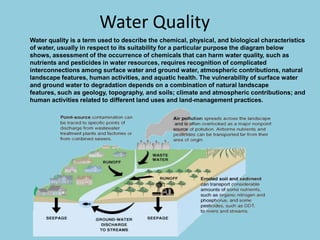
    PesticidesWater QualityWater quality is a term used to describe the chemical, physical, and biological characteristics of water, usually in respect to its suitability for a particular purpose the diagram below shows, assessment of the occurrence of chemicals that can harm water quality, such as nutrients and pesticides in water resources, requires recognition of complicated interconnections among surface water and ground water, atmospheric contributions, natural landscape features, human activities, and aquatic health. The vulnerability of surface water and ground water to degradation depends on a combination of natural landscape features, such as geology, topography, and soils; climate and atmospheric contributions; and human activities related to different land uses and land-management practices.
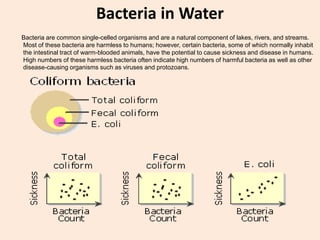
Bacteria in Water      Bacteria are common single-celled organisms and are a natural component of lakes, rivers, and streams. Most of these bacteria are harmless to humans; however, certain bacteria, some of which normally inhabit the intestinal tract of warm-blooded animals, have the potential to cause sickness and disease in humans. High numbers of these harmless bacteria often indicate high numbers of harmful bacteria as well as other disease-causing organisms such as viruses and protozoans.
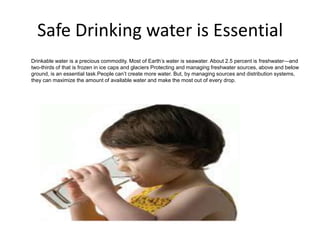
Safe Drinking water is Essential        Drinkable water is a precious commodity. Most of Earth’s water is seawater. About 2.5 percent is freshwater—and two-thirds of that is frozen in ice caps and glaciers Protecting and managing freshwater sources, above and below ground, is an essential task.People can’t create more water. But, by managing sources and distribution systems, they can maximize the amount of available water and make the most out of every drop.
Water Quality ParameterDissolved Oxygen
Turbidity
pH
Temperature                                The IndicatorsThe IndicatorsDissolved Oxygen:Dissolved Oxygen (DO) is important to the health of aquatic ecosystems. All aquatic animals need oxygen to survive. Natural waters with consistently high dissolved oxygen levels are most likely healthy and stable environments, and are capable of supporting a diversity of aquatic organisms.Turbidity :Turbidity is the measure of the relative clarity of water. Turbid water is caused by suspended and colloidal matter such as clay, silt, organic and inorganic matter, and microscopic organisms. Turbidity should not be confused with color since darkly colored water can still be clear and not turbid. Turbid water may be the result of soilerosion, urban runoff, algal blooms and bottom sediment disturbances, which can be caused by boat traffic and abundant bottom feeding fish.
                                The IndicatorsThe IndicatorspH :pH is a measurement of the acidic or basic quality of water. The pH scale ranges from a value of 0 (very acidic) to 14 (very basic), with 7 being neutral. Most aquatic animals prefer a range of 6.5 to 8.0. They are adapted to a specifi c pH level andmay die, stop reproducing or move away if the pH of the water varies beyond this range. Low pH can also allow toxic compounds to become more available to aquatic plants and animals. This can produce conditions that hurt aquatic life. pH can be affected by acid rain, wastewater discharges, drainage from mines and the type of rock naturally found in the area.Temperature :Aquatic animals (e.g. stream insects, trout and salmon) are sensitive to changes in water temperature and require a certain temperature range to survive and thrive. If water temperature is outside that range for a long time, organismscan be stressed and die. Temperature also erosion, urban runoff, algal blooms and bottom sediment disturbances, which can be caused by boat traffic and abundant bottom feeding fish.
Methods to remove contamination                                The IndicatorsActivated Carbon Filters
Deionization Method
Distillation Method
Filtration Method

Water consumption &purification

  • 1.
    Waterconsumption &Purification
  • 2.
    The Water inour livesWhere is Earth’s water?How much water is there?How much water is consumed in our daily livesHow much of the drinking water is free of contaminationWhat measures should we take to prevent wastage of water
  • 3.
    Where is Earth’sWater ?There is no shortage of water on Earth. Most of our planet is covered by water but very little of that water is available for humans to drink.Our “blue planet” is dominated by oceans that stretch across some two-thirds of its surface. These massive bodies of saltwater hold almost all the water on Earth.Less than three percent of the planet’s water exists as freshwater and not all of it is accessible for human use. In fact, more than two-thirds of the planet’s freshwater is not even liquid—it’s frozen in glaciers in places like the Antarctic and Greenland ice sheets.All Earth’s waterOcean 97%Fresh water 3%Surface Water1. Rivers: 2%2. Swamps: 11%3. Lakes: 87%Fresh waterIcecaps/Glaciers: 68.7%2. Ground: 30.1%3. Other: .9%4. Surface: .3%
  • 4.
    Water on move Water is continually moving around, through, and above the Earth as water vapor, liquid water, and ice. In fact, water is continually changing its form. The Earth is pretty much a "closed system," like a terrarium. That means that the Earth neither, as a whole, gains nor loses much matter, including water. The hydrological cycle moves water from the atmosphere to the Earth and back again in a process of perpetual motion powered by energy from the sun and by gravity. The cycle’s processes provide the water that flows through rivers, lakes, reservoirs, and aquifers from which many people get their drinking water. Indeed, the water cycle makes life on Earth possible.Precipitation: When these water droplets (or ice crystals) become to large to stay suspended in the air, they fall as precipitation—the rain and snow that eventually returns most atmospheric water to the Earth.Condensation: Water vapor cools as it expands and encounters cooler temperatures in the atmosphere. It may then condense into tiny water droplets, forming clouds. This process is called condensation.Infiltration: Instead of evaporating, some water that lands on continents runs off into rivers, streams, and lakes. The rest sinks through the soil to join underground aquifers. This is known as infiltration, or recharge.Evaporation: Solar energy heats surfaces (the oceans, lakes, reservoirs, plants and trees, and the land surface itself) and creates water vapor that returns to the atmosphere by evaporation and transpiration
  • 5.
    Water is one of our most natural resources. Without it, there would be no life on earth.
  • 6.
    Groundwater About 96 percent of all unfrozen fresh water is found below the Earth’s surface and is known as groundwater. Groundwater systems globally provide 25 to 40 percent of the world’s drinking water. Groundwater represents an enormous resource that can only be managed through an understanding of the different types of aquifers and their rates of renewal. Aquifers that are located close to the surface are often intimately connected with surface water systems. They may be replenished directly by infiltration of precipitation and sometimes surface runoff, and may discharge to water bodies such as streams and lakes. When such aquifers are drawn down by pumping, they can cause a decrease in river flow, resulting in shortages of drinking water, water for agriculture, or water for the aquatic ecosystem. Deeper aquifers may also be replenished indirectly by water slowly leaking downward from shallower aquifersAquifers, particularly those close to the surface, are often connected with surface water systems. They may be replenished by recharge from precipitationRenewable Groundwater
  • 7.
    Groundwater quality Water is such an excellent solvent it can contain lots of dissolved chemicals. And since groundwater moves through rocks and subsurface soil, it has a lot of opportunity to dissolve substances as it moves. For that reason, groundwater will often have more dissolved substances than surface water will.Underground water can get contaminated from industrial, domestic, and agricultural chemicals from the surface. This includes chemicals such as pesticides and herbicides that many homeowners apply to their lawns. Contaminants can be natural or human-inducedNaturally occurring contaminants are present in the rocks and sediments. As groundwater flows through sediments, metals such as iron and manganese are dissolved and may later be found in high concentrations in the water. Industrial discharges, urban activities, agriculture, ground-water pump age, and disposal of waste all can affect ground-water quality. Contaminants from leaking fuel tanks or fuel or toxic chemical spills may enter the groundwater and contaminate the aquifer
  • 8.
    Ground water Quality Ground water quality is getting effected by many human activities Industrial wastes
  • 9.
    Bacteria's
  • 10.
    PesticidesWater QualityWater quality is a term used to describe the chemical, physical, and biological characteristics of water, usually in respect to its suitability for a particular purpose the diagram below shows, assessment of the occurrence of chemicals that can harm water quality, such as nutrients and pesticides in water resources, requires recognition of complicated interconnections among surface water and ground water, atmospheric contributions, natural landscape features, human activities, and aquatic health. The vulnerability of surface water and ground water to degradation depends on a combination of natural landscape features, such as geology, topography, and soils; climate and atmospheric contributions; and human activities related to different land uses and land-management practices.
  • 11.
    Bacteria in Water Bacteria are common single-celled organisms and are a natural component of lakes, rivers, and streams. Most of these bacteria are harmless to humans; however, certain bacteria, some of which normally inhabit the intestinal tract of warm-blooded animals, have the potential to cause sickness and disease in humans. High numbers of these harmless bacteria often indicate high numbers of harmful bacteria as well as other disease-causing organisms such as viruses and protozoans.
  • 12.
    Safe Drinking wateris Essential Drinkable water is a precious commodity. Most of Earth’s water is seawater. About 2.5 percent is freshwater—and two-thirds of that is frozen in ice caps and glaciers Protecting and managing freshwater sources, above and below ground, is an essential task.People can’t create more water. But, by managing sources and distribution systems, they can maximize the amount of available water and make the most out of every drop.
  • 13.
  • 14.
  • 15.
  • 16.
    Temperature The IndicatorsThe IndicatorsDissolved Oxygen:Dissolved Oxygen (DO) is important to the health of aquatic ecosystems. All aquatic animals need oxygen to survive. Natural waters with consistently high dissolved oxygen levels are most likely healthy and stable environments, and are capable of supporting a diversity of aquatic organisms.Turbidity :Turbidity is the measure of the relative clarity of water. Turbid water is caused by suspended and colloidal matter such as clay, silt, organic and inorganic matter, and microscopic organisms. Turbidity should not be confused with color since darkly colored water can still be clear and not turbid. Turbid water may be the result of soilerosion, urban runoff, algal blooms and bottom sediment disturbances, which can be caused by boat traffic and abundant bottom feeding fish.
  • 17.
    The IndicatorsThe IndicatorspH :pH is a measurement of the acidic or basic quality of water. The pH scale ranges from a value of 0 (very acidic) to 14 (very basic), with 7 being neutral. Most aquatic animals prefer a range of 6.5 to 8.0. They are adapted to a specifi c pH level andmay die, stop reproducing or move away if the pH of the water varies beyond this range. Low pH can also allow toxic compounds to become more available to aquatic plants and animals. This can produce conditions that hurt aquatic life. pH can be affected by acid rain, wastewater discharges, drainage from mines and the type of rock naturally found in the area.Temperature :Aquatic animals (e.g. stream insects, trout and salmon) are sensitive to changes in water temperature and require a certain temperature range to survive and thrive. If water temperature is outside that range for a long time, organismscan be stressed and die. Temperature also erosion, urban runoff, algal blooms and bottom sediment disturbances, which can be caused by boat traffic and abundant bottom feeding fish.
  • 18.
    Methods to removecontamination The IndicatorsActivated Carbon Filters
  • 19.
  • 20.
  • 21.