AFIQ HANAFIE BIN AZLAN
2014222586
EMD7M7A
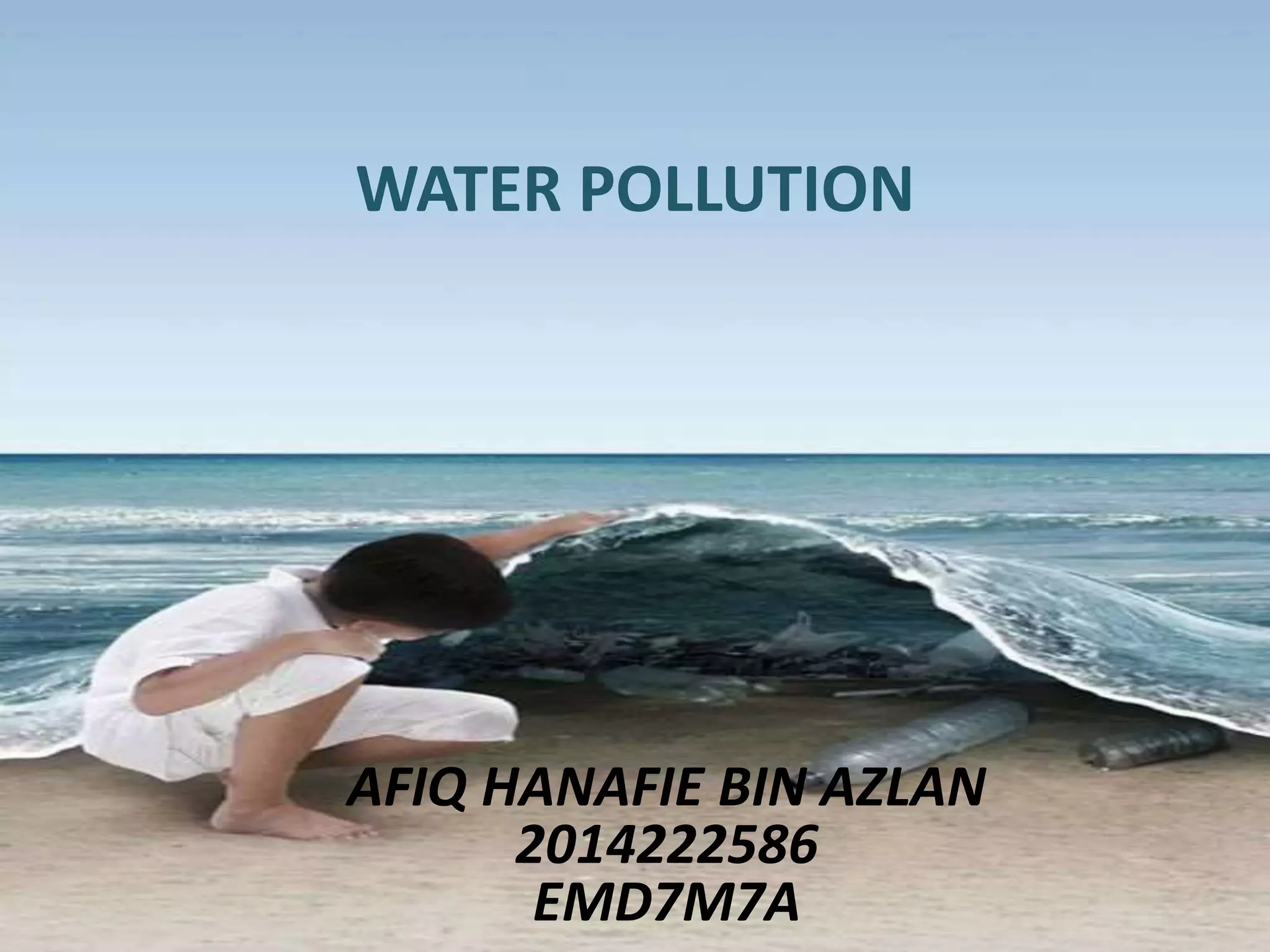
WATER POLLUTION
ABSTRACT
• This slides will discuss on the issues related to the
sustainability of the water pollution. There were
several issues will take it into account:
i. Identify the impact of professional engineering
solutions in societal and environmental contexts
and demonstrate knowledge of and need for
sustainable development [PO7, LO4,];{A4}.
ii. Identify ethical principles and commit to
professional ethics and responsibilities and
norms of engineering practice. [PO8 LO6];{A4}.
POLLUTION
Pollution can be defined an act or process,
whether natural or artificial, resulting in the
introduction of any pollutant into the
environment in contravention of the acceptable
conditions
WHAT IS WATER POLLUTION?
• Water pollution is the contamination of water
bodies such as lakes, rivers, oceans, aquifers
and groundwater. Usually it is causes by
human activities. It occurs when pollutants
(particles, chemicals or substances that make
water contaminated) are discharged directly
or indirectly into water bodies without enough
treatment to get rid of harmful compounds.
WATER POLLUTION
• In other word water pollution is defines as
any change in water quality that has a
negative effect on living organisms and those
who need to utilize the water supply. This
pollution can affect any large mass of water
such as streams, ponds, lakes, oceans.
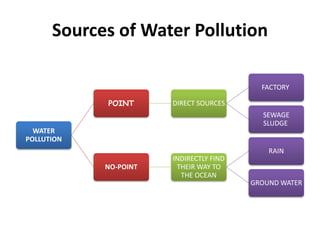
Sources of Water Pollution
WATER
POLLUTION
POINT DIRECT SOURCES
FACTORY
SEWAGE
SLUDGE
NO-POINT
INDIRECTLY FIND
THEIR WAY TO
THE OCEAN
RAIN
GROUND WATER
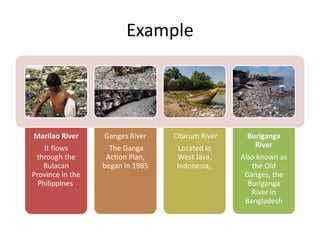
Example
Marilao River
It flows
through the
Bulacan
Province in the
Philippines
Ganges River
The Ganga
Action Plan,
began in 1985
Citarum River
Located in
West Java,
Indonesia,
Buriganga
River
Also known as
the Old
Ganges, the
Buriganga
River in
Bangladesh
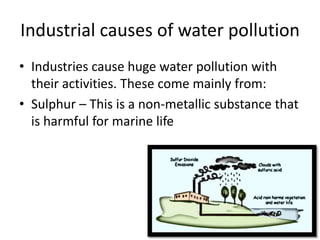
Industrial causes of water pollution
• Industries cause huge water pollution with
their activities. These come mainly from:
• Sulphur – This is a non-metallic substance that
is harmful for marine life
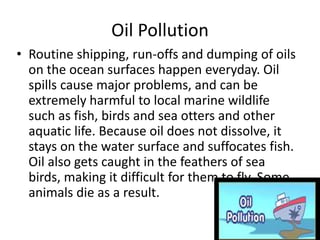
Oil Pollution
• Routine shipping, run-offs and dumping of oils
on the ocean surfaces happen everyday. Oil
spills cause major problems, and can be
extremely harmful to local marine wildlife
such as fish, birds and sea otters and other
aquatic life. Because oil does not dissolve, it
stays on the water surface and suffocates fish.
Oil also gets caught in the feathers of sea
birds, making it difficult for them to fly. Some
animals die as a result.
Oil Pollution
• Oil spills make up about 12% of the oil that enters the
ocean. The rest come from shipping travel, drains and
dumping.
• An oil spill from a tanker is a severe problem because there
is such a huge quantity of oil being spilt into one place.
• Oil spills cause a very localised problem but can be
catastrophic to local marine wildlife such as fish, birds and
sea otters.
• Oil cannot dissolve in water and forms a thick sludge in the
water. This suffocates fish, gets caught in the feathers of
marine birds stopping them from flying and blocks light
from photosynthetic aquatic plants.
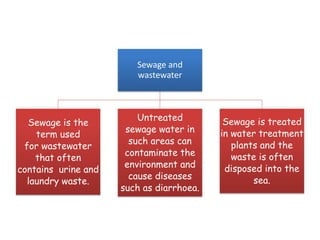
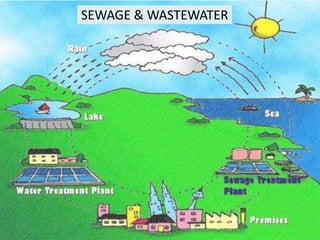
Sewage and
wastewater
Sewage is the
term used
for wastewater
that often
contains urine and
laundry waste.
Untreated
sewage water in
such areas can
contaminate the
environment and
cause diseases
such as diarrhoea.
Sewage is treated
in water treatment
plants and the
waste is often
disposed into the
sea.
SEWAGE & WASTEWATER
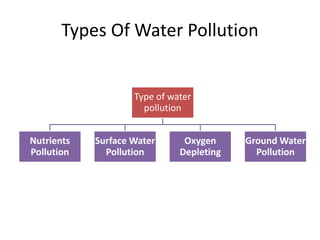
Types Of Water Pollution
Type of water
pollution
Nutrients
Pollution
Surface Water
Pollution
Oxygen
Depleting
Ground Water
Pollution
Nutrients Pollution
Fertilizers, wastewater, and sewage containing
high levels of nutrients encourage weed and
algae growth in the water, making it
undrinkable. Besides, an increase in algae
formation can also deplete the level of oxygen in
the water. This causes other water organisms to
die because of oxygen starvation.
Surface Water Pollution
When hazardous substances like chemicals,
wastes, and insecticides dissolve or mix with
surface water, it is called surface water
pollution.
Oxygen Depleting
Water bodies contain both aerobic and
anaerobic organisms. An influx of biodegradable
matter in the water encourages the growth of
anaerobic microorganisms. This in turn can
deplete the level of oxygen, leading to the death
of aerobic organisms.
Ground Water Pollution
Pesticides and chemicals used to promote the
growth of the crops enter into the ground with
rainwater causing ground water pollution. They
can contaminate lakes and rivers through
accidental spills too.
EFFECTS OF WATER POLLUTION
• As mentioned earlier, water pollution is very
harmful to animals, aquatic life, as well as
humans. Its effect can be catastrophic,
depending on the concentrations of the
pollutants, chemicals, and area. Here are a
few ways water pollution can affect the
environment.
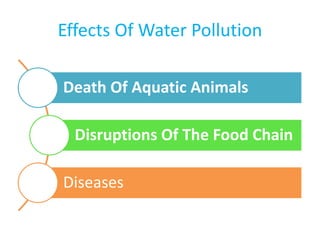
Effects Of Water Pollution
Death Of Aquatic Animals
Disruptions Of The Food Chain
Diseases
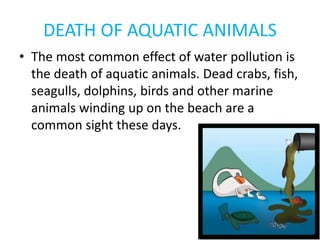
DEATH OF AQUATIC ANIMALS
• The most common effect of water pollution is
the death of aquatic animals. Dead crabs, fish,
seagulls, dolphins, birds and other marine
animals winding up on the beach are a
common sight these days.
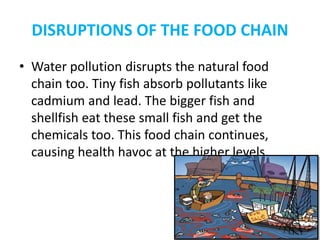
DISRUPTIONS OF THE FOOD CHAIN
• Water pollution disrupts the natural food
chain too. Tiny fish absorb pollutants like
cadmium and lead. The bigger fish and
shellfish eat these small fish and get the
chemicals too. This food chain continues,
causing health havoc at the higher levels.
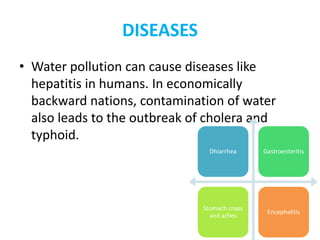
DISEASES
• Water pollution can cause diseases like
hepatitis in humans. In economically
backward nations, contamination of water
also leads to the outbreak of cholera and
typhoid.
Dhiarrhea Gastroenteritis
Stomach craps
and aches
Encephalitis
ENVIRONMENTAL QUALITY ACT 1974
 Environmental Quality Act 1974 – Inland waters
 Section 24 (Restrictions on pollution of the soil)
 Section 29A (Restrictions on pollution of inland waters)
 Section 51 (The Minister may have power to make regulations)
 e.g. EQ (Industrial Effluent) Regulations 2009; EQ (Sewage)
Regulations 2009; and, EQ (Control of Pollution from solid waste
transfer station and landfill) Regulation 1996
 Environmental Quality Act 1974 - Malaysian waters
 Section 27 (Prohibition of discharge of oil into Malaysian waters)
 Section 29 (Prohibition of discharge of wastes into Malaysian
waters)
INTERNATIONAL LAW
• Exclusive Economic Zone Act 1984
• Continental Shelf Act 1996
• Petroleum Mining Act 1966
• United Nations Conventions on the Law of the Sea (UNCLOS)
• International Convention on Marine Pollution from Ships
(MARPOL), 73/78
• International Convention on Civil Liability for Oil Pollution Damage
(CLC) 1992
• International Compensation Fund for Oil Pollution Damage (IOPC
Fund) 1992
• International Convention on Oil Pollution Preparedness, Response
and Cooperation (OPRC) 1990
CHALLENGES TO ENFORCE LAW
• Public education
• Public apathy
• Limited resources in enforcement
• Influx of illegal immigrants
• To strike the balance between the development and
conservation of the environment
• Delays in reporting any untreated illegal discharges
from factories and industrial premises which may cause
an incomplete investigation
• Most of the cases are involved with international
waters- destruction of coral reefs and other marine live
CHALLENGES TO ENFORCE LAW
• Enhancing awareness and alternatives to
control water pollution among the shifting
cultivators and small farmers; and
• Factors that limits enforcement action, among
others :
• shortage of manpower
• poor accessibility of the site.
WAYS CONSERVE WATER
Conserve water by turning off the tap when
running water is not necessary. This helps
prevent water shortages and reduces the amount
of contaminated water that needs treatment.
Be careful about what you throw down your sink
or toilet. Don’t throw paints, oils or other forms
of litter down the drain.
Use environmentally household products, such as
washing powder, household cleaning agents and
toiletries.
WAYS CONSERVE WATER
Take great care not to overuse pesticides and fertilisers.
This will prevent runoffs of the material into nearby water
sources.
By having more plants in your garden you are preventing
fertiliser, pesticides and contaminated water from running
off into nearby water sources.
Don’t throw litter into rivers, lakes or oceans. Help clean
up any litter you see on beaches or in rivers and lakes,
make sure it is safe to collect the litter and put it in a
nearby dustbin.
THANK YOU
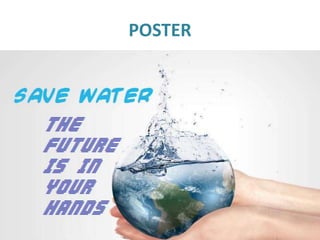
POSTER

WATER POLLUTION

  • 1.
    AFIQ HANAFIE BINAZLAN 2014222586 EMD7M7A WATER POLLUTION
  • 2.
    ABSTRACT • This slideswill discuss on the issues related to the sustainability of the water pollution. There were several issues will take it into account: i. Identify the impact of professional engineering solutions in societal and environmental contexts and demonstrate knowledge of and need for sustainable development [PO7, LO4,];{A4}. ii. Identify ethical principles and commit to professional ethics and responsibilities and norms of engineering practice. [PO8 LO6];{A4}.
  • 3.
    POLLUTION Pollution can bedefined an act or process, whether natural or artificial, resulting in the introduction of any pollutant into the environment in contravention of the acceptable conditions
  • 4.
    WHAT IS WATERPOLLUTION? • Water pollution is the contamination of water bodies such as lakes, rivers, oceans, aquifers and groundwater. Usually it is causes by human activities. It occurs when pollutants (particles, chemicals or substances that make water contaminated) are discharged directly or indirectly into water bodies without enough treatment to get rid of harmful compounds.
  • 5.
    WATER POLLUTION • Inother word water pollution is defines as any change in water quality that has a negative effect on living organisms and those who need to utilize the water supply. This pollution can affect any large mass of water such as streams, ponds, lakes, oceans.
  • 6.
    Sources of WaterPollution WATER POLLUTION POINT DIRECT SOURCES FACTORY SEWAGE SLUDGE NO-POINT INDIRECTLY FIND THEIR WAY TO THE OCEAN RAIN GROUND WATER
  • 8.
    Example Marilao River It flows throughthe Bulacan Province in the Philippines Ganges River The Ganga Action Plan, began in 1985 Citarum River Located in West Java, Indonesia, Buriganga River Also known as the Old Ganges, the Buriganga River in Bangladesh
  • 9.
    Industrial causes ofwater pollution • Industries cause huge water pollution with their activities. These come mainly from: • Sulphur – This is a non-metallic substance that is harmful for marine life
  • 10.
    Oil Pollution • Routineshipping, run-offs and dumping of oils on the ocean surfaces happen everyday. Oil spills cause major problems, and can be extremely harmful to local marine wildlife such as fish, birds and sea otters and other aquatic life. Because oil does not dissolve, it stays on the water surface and suffocates fish. Oil also gets caught in the feathers of sea birds, making it difficult for them to fly. Some animals die as a result.
  • 11.
    Oil Pollution • Oilspills make up about 12% of the oil that enters the ocean. The rest come from shipping travel, drains and dumping. • An oil spill from a tanker is a severe problem because there is such a huge quantity of oil being spilt into one place. • Oil spills cause a very localised problem but can be catastrophic to local marine wildlife such as fish, birds and sea otters. • Oil cannot dissolve in water and forms a thick sludge in the water. This suffocates fish, gets caught in the feathers of marine birds stopping them from flying and blocks light from photosynthetic aquatic plants.
  • 12.
    Sewage and wastewater Sewage isthe term used for wastewater that often contains urine and laundry waste. Untreated sewage water in such areas can contaminate the environment and cause diseases such as diarrhoea. Sewage is treated in water treatment plants and the waste is often disposed into the sea.
  • 13.
  • 14.
    Types Of WaterPollution Type of water pollution Nutrients Pollution Surface Water Pollution Oxygen Depleting Ground Water Pollution
  • 15.
    Nutrients Pollution Fertilizers, wastewater,and sewage containing high levels of nutrients encourage weed and algae growth in the water, making it undrinkable. Besides, an increase in algae formation can also deplete the level of oxygen in the water. This causes other water organisms to die because of oxygen starvation.
  • 16.
    Surface Water Pollution Whenhazardous substances like chemicals, wastes, and insecticides dissolve or mix with surface water, it is called surface water pollution.
  • 17.
    Oxygen Depleting Water bodiescontain both aerobic and anaerobic organisms. An influx of biodegradable matter in the water encourages the growth of anaerobic microorganisms. This in turn can deplete the level of oxygen, leading to the death of aerobic organisms.
  • 18.
    Ground Water Pollution Pesticidesand chemicals used to promote the growth of the crops enter into the ground with rainwater causing ground water pollution. They can contaminate lakes and rivers through accidental spills too.
  • 19.
    EFFECTS OF WATERPOLLUTION • As mentioned earlier, water pollution is very harmful to animals, aquatic life, as well as humans. Its effect can be catastrophic, depending on the concentrations of the pollutants, chemicals, and area. Here are a few ways water pollution can affect the environment.
  • 20.
    Effects Of WaterPollution Death Of Aquatic Animals Disruptions Of The Food Chain Diseases
  • 21.
    DEATH OF AQUATICANIMALS • The most common effect of water pollution is the death of aquatic animals. Dead crabs, fish, seagulls, dolphins, birds and other marine animals winding up on the beach are a common sight these days.
  • 22.
    DISRUPTIONS OF THEFOOD CHAIN • Water pollution disrupts the natural food chain too. Tiny fish absorb pollutants like cadmium and lead. The bigger fish and shellfish eat these small fish and get the chemicals too. This food chain continues, causing health havoc at the higher levels.
  • 23.
    DISEASES • Water pollutioncan cause diseases like hepatitis in humans. In economically backward nations, contamination of water also leads to the outbreak of cholera and typhoid. Dhiarrhea Gastroenteritis Stomach craps and aches Encephalitis
  • 24.
    ENVIRONMENTAL QUALITY ACT1974  Environmental Quality Act 1974 – Inland waters  Section 24 (Restrictions on pollution of the soil)  Section 29A (Restrictions on pollution of inland waters)  Section 51 (The Minister may have power to make regulations)  e.g. EQ (Industrial Effluent) Regulations 2009; EQ (Sewage) Regulations 2009; and, EQ (Control of Pollution from solid waste transfer station and landfill) Regulation 1996  Environmental Quality Act 1974 - Malaysian waters  Section 27 (Prohibition of discharge of oil into Malaysian waters)  Section 29 (Prohibition of discharge of wastes into Malaysian waters)
  • 25.
    INTERNATIONAL LAW • ExclusiveEconomic Zone Act 1984 • Continental Shelf Act 1996 • Petroleum Mining Act 1966 • United Nations Conventions on the Law of the Sea (UNCLOS) • International Convention on Marine Pollution from Ships (MARPOL), 73/78 • International Convention on Civil Liability for Oil Pollution Damage (CLC) 1992 • International Compensation Fund for Oil Pollution Damage (IOPC Fund) 1992 • International Convention on Oil Pollution Preparedness, Response and Cooperation (OPRC) 1990
  • 26.
    CHALLENGES TO ENFORCELAW • Public education • Public apathy • Limited resources in enforcement • Influx of illegal immigrants • To strike the balance between the development and conservation of the environment • Delays in reporting any untreated illegal discharges from factories and industrial premises which may cause an incomplete investigation • Most of the cases are involved with international waters- destruction of coral reefs and other marine live
  • 27.
    CHALLENGES TO ENFORCELAW • Enhancing awareness and alternatives to control water pollution among the shifting cultivators and small farmers; and • Factors that limits enforcement action, among others : • shortage of manpower • poor accessibility of the site.
  • 28.
    WAYS CONSERVE WATER Conservewater by turning off the tap when running water is not necessary. This helps prevent water shortages and reduces the amount of contaminated water that needs treatment. Be careful about what you throw down your sink or toilet. Don’t throw paints, oils or other forms of litter down the drain. Use environmentally household products, such as washing powder, household cleaning agents and toiletries.
  • 29.
    WAYS CONSERVE WATER Takegreat care not to overuse pesticides and fertilisers. This will prevent runoffs of the material into nearby water sources. By having more plants in your garden you are preventing fertiliser, pesticides and contaminated water from running off into nearby water sources. Don’t throw litter into rivers, lakes or oceans. Help clean up any litter you see on beaches or in rivers and lakes, make sure it is safe to collect the litter and put it in a nearby dustbin.
  • 30.
  • 31.