HYDROSPHEREHYDROSPHERE
All of the
Earth’s water
found in the
oceans,
glaciers,
streams,
lakes, soil,
groundwater,
living
organisms,
and air.
Water in motion
Water in motion
Water in motion
Can you spot the water molecules?
liquid
water
water
vapor ice
The Water Molecule
a water molecule is
composed of two hydrogen
atoms covalently bonded to a
single oxygen atom
O
H H
HHO + +
The Water Molecule
O
H H
-
+ +
+
+
_
+
+
_
++
_
+
+
_ +
+
_
hydrogen bond
water
molecule
++
_
+
+
_
Hydrogen bonds
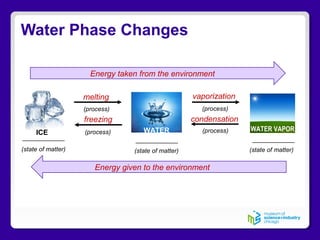
Solid = Ice
Liquid = water
Gas = water vapor
Water Phase Changes
(state of matter) (state of matter)
WATER
(state of matter)
WATER VAPOR
(process) (process)
(process)(process)ICE
melting
condensationfreezing
vaporization
Energy taken from the environment
Energy given to the environment
Energy-Temperature Graph
100
0
Energy Input
Energy-Temperature Graph
100
0
Energy Input
Energy-Temperature Graph
100
0
Energy Input
Energy-Temperature Graph
solid
solid - liquid
gas
liquid
liquid - gas
100
0
Energy Input
ice
water
vapor
water
100
SO
LID
LIQ
UID
G
AS
melting
vaporization
freezing
condensation
addedremoved
Temperature(°C)
0
Energy
Water phase changes

Water phase changes

Editor's Notes

  • #2 “Water, water, everywhere,And all the boards did shrink;Water, water, everywhere,Nor any drop to drink.” Rhyme of the Ancient Mariner, Samuel Taylor Coleridge
  • #3 Water is in a continuous state of change and movement… We typically notice water when it is liquid form and it is moving: it carves canyons and falls from the sky. It roars as it falls down waterfalls and crashes on the shore.
  • #4 But water doesn’t have to be liquid to move… It can move in the river of ice that are alpine glaciers Or in the atmosphere as water vapor condenses to form giant convective clouds.
  • #5 Nor does it have to be visible … It may be underground below the water table, or as water vapor in the atmosphere. Water resides in many different kinds of places, and takes many different pathways in its movement. The combination of all these different movements is called the water (or hydrologic) cycle. We will talk about this later today, but before we learn about the path that water takes as it moves from reservoir to reservoir, lets discuss the processes that water molecules go through in order to move.
  • #6 Water resides in many different kinds of places, and takes many different pathways in its movement. The combination of all these different movements is called the water (or hydrologic) cycle. We will talk about this later today, but before we learn about the path that water takes as it moves from reservoir to reservoir, lets discuss the processes that water molecules go through in order to move.
  • #7 Water is the only common substance that exists at the Earth’s surface as a solid, liquid, and a gas. Furthermore, Earth is the only planet we know of where this is true.
  • #8 A molecule is an electrically neutral group of two or more atoms held together by covalent chemical bonds. They may be composed of atoms of the same element or of different elements. Covalent bonds form when atoms share electrons. A water molecule is made up of two positively-charged hydrogen atoms and one negatively charged oxygen atom, giving it the formula H20. A water molecule is formed when two atoms of H bond covalently with an atom of O. In a covalent bond electrons are shared between atoms. Oxygen also has two unshared pairs of electrons. Thus there are 4 pairs of electrons surrounding the oxygen atom, two pairs involved in covalent bonds with hydrogen, and two unshared pairs on the opposite side of the oxygen atom Mention Covalent/Hydrogen Bonds h-out
  • #9 Oxygen is much more electronegative than hydrogen and the unshared electrons spend more time closer to the oxygen part of the molecule than to the hydrogen part. Uneven distribution of electron density results in the oxygen having a partial negative charge (due to unshared e-) and the hydrogen atoms having a partial positive charge. This gives water an asymmetrical distribution of charge. Molecules that have ends with partial negative and positive charges are known as polar molecules. The polar nature of water molecules makes them attract each other and stick together.
  • #10 When water molecules are close together, their positive and negative regions are attracted to the oppositely-charged regions of nearby molecules (like magnets). The force of attraction, shown here as a dotted line, is called a hydrogen bond. Each water molecule can take part in four hydrogen bonds with neighboring molecules - it has two partially positive Hs and two partially negative sites on the O. Because of this arrangement, each water molecule can interact through H-bonds with four other water molecules.  To remove a molecule from its neighbors, four H-bonds must be broken! An electrostatic attraction between the partial positive charge near the hydrogen atoms and the partial negative charge near the oxygen results in the formation of a hydrogen bond as shown in the illustration. LETS GO PRETEND TO BE WATER MOLECULES.
  • #11 When water is in its solid state, known as ice, hydrogen bonds firmly hold molecules in a six-sided lattice pattern. Because of this rigid structure, ice does not change its shape or its volume, and creates a pattern that keeps molecules apart from each other. This does not mean that molecules are completely still, however. Even as part of a solid, the molecules of all materials, including ice, vibrate back and forth, energized by thermal energy. Because the molecules are kept at a certain distance dictated by the lattice, the density of ice is less than that of water; thus, the solid phase of water floats on the liquid, unlike most other substances. SHOW VIDEO OF MELTING ICE CUBES Melting ice takes energy from the environment – water molecules become more energetic as they melt If we add heat to ice, we give thermal energy to the water molecules in their solid-state lattice. This extra energy allows for the molecules to move more, and, once the temperature reaches 0°C (32°F), have enough energy to break from the rigid lattice structure and move around. This change is called melting, and it turns ice into water by adding energy (breaking up crystalline structure) While melting is occurring, the temperature remains the same even though energy continues to be added to the water molecules: latent heat (added heat without temperature increase, “hidden” heat, as opposed to sensible heat loss where adding heat results in increasing T) The process of melting ice into water requires 80 calories of heat per gram of water, and this added energy is held by the water molecules in liquid form.
  • #12 Since water molecules in water are free to move around within the liquid, they are able to change the shape of the water body, even as they are not able to change its volume since they are no longer bound to a crystalline structure, they can move closer to each other and take up less space than they did when they were ice. This makes water denser that ice and is the reason ice floats on water. In the liquid state, molecules jostle one another and change their H-bonded interaction partners constantly. Yet, each water molecule remains linked to multiple neighbors via H-bonds.   This molecular hand-holding leads to water's high melting and boiling points – it takes a lot of energy to break these bonds! - as well as its high surface tension. Liquid water's high boiling point is due to the high number of hydrogen bonds each molecule can form relative to its low molecular mass. Owing to the difficulty of breaking these bonds, water has a very high boiling point, melting point, and viscosity compared to otherwise similar liquids not conjoined by hydrogen bonds. Water gains 100 calories of heat per gram as it goes from 0 degrees to 100 degrees – energy is added and temperature increases. ON THE WAY THERE: SHOW VIDEO OF BOILING WATER Vaporizing water takes energy from the environment The energy required to break multiple hydrogen bonds causes water to have a high heat of vaporization: a large amount of energy is needed to convert liquid water, where the molecules are attracted through their hydrogen bonds, to water vapor, where they are not. If enough thermal energy is added, the temperature of the liquid will reach 100°C (212°F) and the molecules, moving too quickly to create any hydrogen bond, will begin to break away from the liquid and vaporize. The water molecules are now in gaseous form, and called water vapor. The energy absorbed by the water molecules during evaporation, the latent heat of vaporization (540 calories/gram), is used solely to give them the motion needed to escape the surface of the liquid and become a gas. ON THE WAY BACK: SHOW VIDEO OF FREEZING WATER  Freezing releases energy into the environment (80 calories/gram – what they gained during melting)
  • #13 The water molecules are now in gaseous form, and called water vapor. The energy absorbed by the water molecules during evaporation, the latent heat of vaporization, is used solely to give them the motion needed to escape the surface of the liquid and become a gas. The process of evaporation takes 540 calories per gram of water, and this energy is held by the water molecules in gaseous form. Water molecules can transition from the liquid phase to the gaseous phase even if the temperature of the liquid is below 100°C. This happens when the molecules at the surface of the liquid gain enough energy that they can free themselves from all hydrogen bonds and leave the surface of the liquid as a gas. This process is called evaporation. ON THE WAY BACK: SHOW VIDEO OF CONDENSATION  Condensation releases energy into the environment (540 calories/gram) – what they gained during vaporization
  • #14 Return to the classroom and have students complete the first part of the student worksheet, identifying the states of matter, phase change processes, and energy addition or subtraction. As students complete the chart, walk around the classroom and check students’ work. Debrief the chart as a whole class and create a large version of it as you do for students to refer to as the lesson continues. This large version can be used as an anchor chart as for your classroom.  
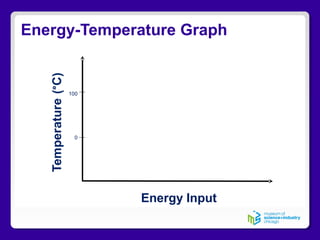
  • #15 Explain to students that, because phase changes at the surface of the Earth are caused by energy changes, it is useful to look at a graph that plots the relationship between temperature and energy during phase changes. Draw a graph on the board with energy on the x-axis and temperature on the y-axis (see example in student worksheet). Ask students to think about the model they just engaged with, and ask them to plot on the graph what they experienced as molecules. Scaffold this activity according to the needs of your students: you may choose to make it a guided class discussion if your students are not as familiar with graphing data, or an independent student exercise if your students have more experience with graphing and analyzing data.
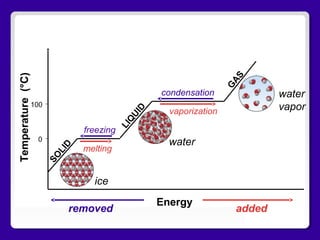
  • #16 Have students share their graphs. Based on the kinesthetic model they engaged with in Part 1, students are likely to draw a graph that looks like this Ask students to explain why they drew the graph the way they did, and point out that, based on what they experienced, this graph is an accurate depiction of what happened: as the temperature increased, the molecules gained energy. Have a version of the graph on the board to refer to during the share out and discussion. Explain to students that part of the work of scientists is to repeatedly test their ideas, and a way to do that in this case is to actually measure the temperature of water as it is heated. Play the Latent Heat of Vaporization video and tell to watch what happens to the temperature of water as it is heated to a boil.
  • #17 Ask students to describe what they noticed. What happened to the temperature as the water was initially heated? What happened to the temperature once boiling began? Go back to the large version of the graph on the board, and talk about what happened in the video. Point out that at first, while the water was being heated, the temperature rose as energy was added—the diagonal line of the graph makes sense. But when the water got to the boiling point, the temperature stopped rising even though energy continued to be added. How might we represent this on a graph? Allow students think time before showing that increasing energy with no temperature change will look like a horizontal line on the graph. Change the graph on the board to look like this (slide) Point out that as the water was heated it was liquid, but as it began to boil it was both liquid and gas. NOTE: It is important to emphasize that water molecules can transition from liquid phase to gas phase even if the temperature of the water is below 100°C. This happens when molecules at the surface of the liquid gain enough energy that they free themselves from all hydrogen bonds and leave the surface of the liquid as a gas. This process is called evaporation. Boiling or vaporization, on the other hand, happens throughout the bulk of the liquid (as we saw in the video) and only happens when the temperature is above 100°C.   Ask students if they can think of why it might be that, while water changes phase, the temperature of it stays the same even though energy is added. Guide the discussion so students focus on the energy, and remind them of that when they were molecules of water in the model of Part 1, they were connected to each other through hydrogen bonds. Explain that it takes energy to break these bonds, so when the liquid begins to boil, the energy added to the water is used for this purpose. As a result, the temperature of the water does not increase.  
  • #18 Explain that the same things happens during condensation (gas to liquid, energy released into environment), freezing (liquid to solid, energy into environment), and melting (solid to liquid, energy from environment). The graph, therefore has a stepped outline In the flat spots, water exists/is present in both phases
  • #19 Have students look at the blank phase diagram in question 3 of their student worksheet. As a class, work through this phase diagram, making sure to emphasize the fact that temperature changes when water is in a given state (solid, liquid, or gas) but that temperature stays the same when a phase change is occurring (the flat parts of the graph). During those times, energy added to the molecules does not change the temperature, but rather allows them to move more rapidly and break free of the crystal lattice (melting) or break free from hydrogen bonds (vaporization), and energy released from molecules makes them move more slowly and make hydrogen bonds with other molecules (condensation) or settle into the crystalline structure of ice (freezing).  
  • #20 Why does ice float on water?