Earth TimelineEarth Timeline
When did these events occur?
1. Find the length of masking tape at your table.
2. Write 4.6 billion years ago on one end of the
tape, and today on the other end.
3. As a group, place the following six events in
the timeline:
a. Mammals first appear
b. Amphibians first appear
c. Fish first appear
d. Birds first appear
e. Reptiles first appear
f. Dinosaurs first appear
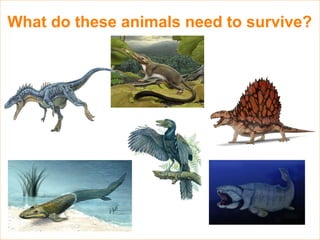
What do these animals need to survive?
Earth’s Calendar
1 2 3 4 5 6 7 8 9 10 11 12 13 14 15 16 17 18 19 20 21 22 23 24 25 26 27 28 29 30 31
1 2 3 4 5 6 7 8 9 10 11 12 13 14 15 16 17 18 19 20 21 22 23 24 25 26 27 28 29 30 31
Earth forms from
planetary nebula
today
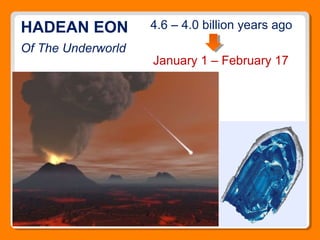
HADEAN EON
Of The Underworld
4.6 – 4.0 billion years ago
January 1 – February 17
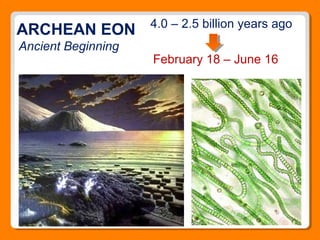
ARCHEAN EON
Ancient Beginning
4.0 – 2.5 billion years ago
February 18 – June 16
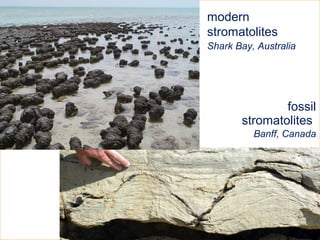
fossil
stromatolites
Banff, Canada
How do we know?
modern
stromatolites
Shark Bay, Australia
Collecting More Information
1. Read the information at your table:
• Banded Iron Formations
• Prokaryotes and Eukaryotes
• Life on Land
1. Discuss the questions with your table group
2. Prepare to share out
Banded Iron Formations
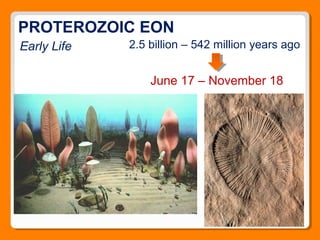
PROTEROZOIC EON
Early Life 2.5 billion – 542 million years ago
June 17 – November 18
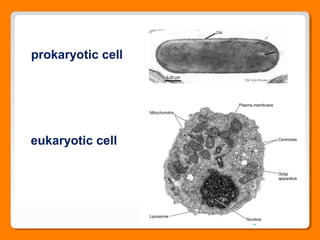
eukaryotic cell
prokaryotic cell
PROTEROZOIC EON
Early Life 2.5 billion – 542 million years ago
June 17 – November 18
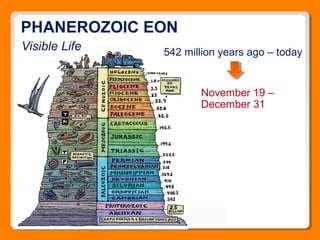
PHANEROZOIC EON
Visible Life 542 million years ago – today
November 19 –
December 31
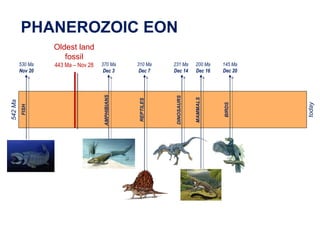
PHANEROZOIC EON
542Ma
today
AMPHIBIANS
370 Ma
Dec 3
Oldest land
fossil
443 Ma – Nov 28
MAMMALS
200 Ma
Dec 16
DINOSAURS
231 Ma
Dec 14
BIRDS
145 Ma
Dec 20
REPTILES
310 Ma
Dec 7
FISH
530 Ma
Nov 20
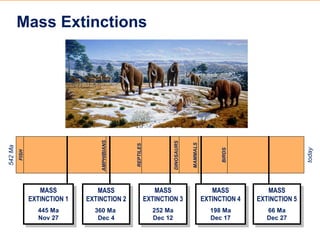
MASS
EXTINCTION 1
445 Ma
Nov 27
MASS
EXTINCTION 1
445 Ma
Nov 27
MASS
EXTINCTION 3
252 Ma
Dec 12
MASS
EXTINCTION 3
252 Ma
Dec 12
MASS
EXTINCTION 5
66 Ma
Dec 27
MASS
EXTINCTION 5
66 Ma
Dec 27
MASS
EXTINCTION 2
360 Ma
Dec 4
MASS
EXTINCTION 2
360 Ma
Dec 4
MASS
EXTINCTION 4
198 Ma
Dec 17
MASS
EXTINCTION 4
198 Ma
Dec 17
Mass Extinctions
542Ma
today
FISH
AMPHIBIANS
REPTILES
DINOSAURS
MAMMALS
BIRDS
Common Ancestry

Earth's timeline short

Editor's Notes

  • #2 Today we will explore the evidence for evolution How do we know that species have changed over time to produce the diversity of life forms that exist and have exited (but have gone extinct) over time? In this lesson we will begin with a few pieces of data: The Earth is 4.6 billion years old There is a huge diversity of life on Earth, but we will begin by focusing on only a few classes of living things: mammals, fish, amphibians, reptiles, and birds
  • #3 When geologists look at rocks, they examine a variety of characteristics (composition, structure, deformation features, etc) including biological/fossil assemblages. These assemblages are snapshots of some of the organisms that existed at a given point in the past. By figuring out how old the rocks are (radiometric dating, relative dating), they can then determine the (minimum) age of the fossils found in them. For instance: Neanderthal fossils have been found in rocks as old as 400,000 years  in other words, Neanderthals first appeared 400,000 years ago. We are going to look at the Earth’s history and together use evidence to figure out where these animals first evolved. First, I want to see where your thinking is, so at your table groups place the 6 events in the timeline. Share out, come up with whole class starting point. walk around to see if all groups have the same order  debrief accordingly Talk about how 4.6 billion is a very big number. It is hard to comprehend how big. If we counted to 4.6 billion, one number at a time, and said one number per second, it would take us 146 years to get there….for this reason, we will use some tools to help us scale time to something we can comprehend. Large timeline, place images where everyone agrees, change location as we go on Agreed upon order, agreed upon placement on the line
  • #4 Brainstorm in small groups Share out All need oxygen Some need water (oceans) Some need land Let’s look at the history of the Earth and see When the required conditions were present What the fossil record tells us In order to do that, we need a model that will allow us to scale time to an understandable format. We do this with maps
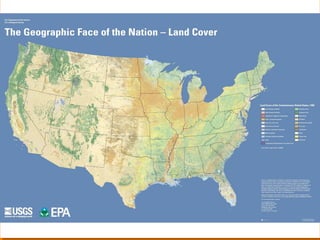
  • #5 A map is a way of looking at very large areas on a small surface – for geographical navigation, display of resources or topography, or other geographical based distribution of information. Maps are a scaled down version of the real world We need a scale to tell us how the map relates to the real world. This map is at a 1:4,000,000 scale That means that 1 unit on the map equals 4 million units on the ground  1 cm on the map equals 4,000,000 cm in the real world A MAP IS A WAY TO SCALE SPACE BUT YOU CAN ALSO SCALE TIME This is scaling (one of the CCC) a concept that we can use with other very large distributions of information, like time. In fact, you just did that with the masking tape and the different classes of animals. Your whole 100cm-strip is meant to represent 4.6 billion years (4,600,000,000), so each cm represents 46 million years.
  • #6 This may seem pretty abstract to a middle schooler, so we’re going to use something familiar to help make sense of the vast time that we’re working with. We’re going to use a calendar as our scale model for geologic time. Carl Sagan did this in his book The Dragon’s Eden and in his Cosmos tv show – he used a calendar to visualize the vast history of the universe, which is 13.8 billion years old. In his model, January 1st is the Big Bang, and December 31st is today. We’ll take this model, but modify it to only look at the history of the Earth – only 4.6 billion years! So January 1st will represent the Earth’s formation, and December 31st (the very last milliseconds of it) will represent today. (write on the board) 1 day = 12.6 million years 1 hour = 525,000 years 1 minute = 8,750 years 1 second = 145.8 years
  • #7 Hadean Eon = 4.6 – 4 Ga = Jan 1-17 Color calendar Name means of the underworld – this was a very inhospitable world Earth forms – 4.6 Ga = January 1 Planet had just formed and was cooling Very high volcanism, partially molten surface Frequent collisions with other solar system bodies (Late Heavy Bombardment) 100 million years into Earth’s history: solid crust had formed, oceans began to form (from comets and volcanic outgassing), and an atmosphere began to accumulate. Solid Crust, atmosphere, and oceans January 7 Key aspects of the Earth that allow this to happen: Earth is the right distance from the Sun – the atmosphere and oceans regulate the temperature, and keep it within the range where liquid water is stable Earth is big enough for its gravity to keep the atmosphere in place The atmosphere and the magnetic field protect the earth’s surface from harmful UV rays It is possible that some microbial life may have also existed, but there is no evidence left. How do we know? Oldest zircon (Jack Hills, western Australia) – 4.4 billion years old. Dated using Ur  Pb January 16 Does this look like the kind of place where the animals we sorted could live? Is there oxygen? No, not free oxygen in the atmosphere Are there oceans? Yes Is there land? Yes NO – these organisms could not live in this environment (move organisms in timeline, if needed)
  • #8 Archean Eon = 4 – 2.5 Ga = Feb 18 – June 16 Name means ancient beginning Earth’s heat flow was nearly 3X as high as it is today – remnant heat from planetary accretion, from core formation, and radioactive decay. High volcanic activity Sun had 70-75 % present luminosity Reducing atmosphere consisting primarily of methane, ammonia and other gases that would be toxic to modern life forms – NO FREE OXYGEN Beginning of formation of continents, but liquid water was prevalent – shallow and deep water deposits exist. First traces of life – simple, unicellular organisms (microbial communities found in Australia) - appear 3.5 Ga = March 28 Fossils are stromatolites: layered mounds of mud produced by the growth of microbial mats. These organisms photosynthesize But there is still no free oxygen throughout this eon Does this look like the kind of place where the animals we sorted could live? Is there oxygen? No, not free oxygen in the atmosphere Are there oceans? Yes Is there land? Yes  NO – these organisms could not live in this environment (move organisms in timeline, if needed)
  • #9 You may wonder, or students might ask questions like “How do we know? How do we know that stromatolites photosynthesized?” Turn to shoulder partner and share ideas – share out w/ whole class We have fossil evidence of organisms that has been dated using radioactive dating techniques Some organisms, like stromatolites, are still alive today – we can see how they live, grow, and undergo life processes today, and work with the concept that the processes that created the fossil stromatolites are the same as the ones that are creating modern stromatolites today (the present is the key to the past) We will use this idea of using information from rocks to tell us about the past to decipher the second half of the year, and to narrow down where the classes of animals belong in the timeline.
  • #11 GROUP 1 DEBRIEFS What are BIF’s? Iron-rich rock formations that were formed when iron was precipitated from sea water Why are BIF’s significant? A lot of reasons – they are found around the globe, they are our largest ores of iron, they can only be formed in anoxic environments (i.e. in places where there is no free oxygen) What do BIF’s tell us about the Earth’s atmosphere? All BIFS were deposited before 2.2 Ga, when the ocean/atmosphere system had no (significant) free oxygen. After 2.2 Ga, the ocean/atmosphere system became oxygenated. What does the age of the BIFs tell us about when our animal classes could have evolved? Since all of these organisms require oxygen in the atmosphere to exist, these organisms could not have existed before the atmosphere had oxygen, i.e. before 2.2 Ga Move organisms in timeline as needed This happened in the Proterozoic Eon
  • #12 Proterozoic Eon = 2.5 Ga – 542 Ma = June 17 – November 18 Name means early life First stable continents first appeared and began to accrete First abundant fossils of living organisms, mostly bacteria and archea (microbial prokaryotes – no cell nucleus, nor any membrane-bound organelle in cells) Atmospheric Oxygenation 2.2 Ga = July 9 First evidence of oxygen buildup in the atmosphere = global catastrophe – was doom for most living organisms of the time, but made possible the explosion of eukaryotic forms (multicellular algae, and eventually the first animals) considered Earth’s first large-scale pollution event evidence points to a fairly rapid in crease in O2 levels (in Archean = 1%, Proterozoic = 15%, now = 21%) Oxygen is a powerful degrader of organic compounds, and so lethal to many life forms Organisms had to evolve biochemical methods for rendering oxygen harmless – one of these methods, oxidative respiration, had the advantage if producing large amounts of energy for the cell, and is now found in most eukaryotes. Something else happened in this Eon…
  • #13 GROUP 2 DEBRIEFS What are prokaryotes and eukaryotes? Different types of cells. Eukaryotic cells have a nucleus and many different organelles Prokaryotic cells don’t have much – a cell wall, a cell membrane, and a few ribosomes are visible here. The cell has no nucleus or any of the other organelles that are common in eukaryotic cells Why are these 2 types of cells significant for our story? Prokaryotic cells appeared first (starting with the stromatolites). Eukaryotic cells do not appear until 2.1 Ga – that’s the oldest eukaryotic cell fossil. What does the age of the eukaryotes tell us about when our animal classes could have evolved? Since all of these organisms are made of eukaryotic cells, these organisms could not have existed before these cells evolved, i.e. before 2.1 Ga Move organisms in timeline as needed First Eukaryotic Cells 2.1 Ga = July 17 After eukaryotic cells evolve we have: Oceans Land Oxygen Evidence for building blocks of organisms
  • #14 No, Life was still entirely ocean-bound and quite simple and small… we have to wait until…
  • #15 Phanerozoic Eon = 541 Ma – present = November 19 – December 31 Name means visible life Current geologic eon Only eon during which abundant animal and plant life has existed. This time includes the rapid emergence of a number of animal phyla, the evolution of these phyla into diverse and complex life forms. 541 million years to the present Let’s hear from our last group to get one more piece of information to help us place our organisms GROUP 3 DEBRIEF Where did all life live at the beginning of the Phanerozoic? At that time, all life was bound to the ocean. What does your data tell you about when life emerged from the oceans? The data shows that the earliest/oldest land fossils (plants) show up in the rock record 443 Ma = November 27 What does the age of the oldest land fossil tell us about when our animal classes could have evolved? The fish could have evolved before 443 Ma But since amphibians, reptiles, dinos, mammals, and birds live on and depend on land, these organisms could not have existed before life existed on land, i.e. before 443 Ma Move organisms in timeline as needed Life in the Phanerozoic Because the Phanerozoic is characterized by greater diversity and greater amount of biomass, and also because the rocks record is younger and less likely to have been destroyed by Earth’s dynamic processes (weathering & erosion, plate tectonics), we have a much more detailed fossil record of life and how it changed over time. The story of this eon is one of life, but also one of mass extinctions. Let’s explore After debrief A key event in the evolution of life, the emergence of life from the oceans and the conquering of land, did occur in the Phanerozoic – we will get to that in a minute. An important aspect of this Eon is that it also holds the 5 major mass extinctions of multicellular life that we know of in Earth’s history  we will explore this eon through that lens.
  • #16 With that last piece of information, we can now place (at least relatively) where our organisms would fall on the timeline – fish are only organisms that can go to the left, rest have to be to the right The emergence of life from the oceans and the conquering of land is a key event of the Phanerozoic. There is another important story here
  • #17 A key event in the evolution of life, the emergence of life from the oceans and the conquering of land, did occur in the Phanerozoic – we will get to that in a minute. An important aspect of this Eon is that it also holds the 5 major mass extinctions of multicellular life that we know of in Earth’s history  we will explore this eon through that lens. If we look at the fossil record of the Phanerozoic, we see the story of life becoming more complex and diversified, and we also see the story of mass extinctions The 5 major extinctions of multicellular life happened in the Phanerozoic Go through (briefly or extensively – choose short or regular version of pwp) Phanerozoic begins with life entirely confined to the oceans; great explosion of life forms Extinction 1 – caused by drop of CO2 in atmosphere and tectonic movements placing Gondwanaland in polar regions; 82-88% of species died off After extinction, diversity increases again, fish dominate marine and freshwater, plants conquer land Extinction 2 – caused by drop of CO2 because of increased plant photosynthesis on land After extinction, sharks fill ecological gap left by placoderm extinction, reptiles evolve on land Extinction 3 – The Great Dying, over 90% of all species died off – life almost eliminated After extinction, it took a long time for life to recover, mammal-like reptiles flourished, dinos and mammals evolve Extinction 4 – MAR rift begins, increased volcanism  increase CO2 76-84% species After extinction, with most large amphibians and mammal-like reptiles gone, there was an opening for a new dominant land animal = age of the dinos. Extinction 5 – ongoing massive volcanism followed by the famous asteroid impact After extinction, the age of mammals A NOTE ON EXTINCTION How do you think extinctions may be important in the context of evolution? Mass extinctions have played many evolutionary roles: differential survivorship or selectivity of taxa and traits the disruption or preservation of evolutionary trends and ecosystem organization the promotion of taxonomic and morphological diversifications—often along unexpected trajectories—after the destruction or marginalization of once-dominant clades. This is a very active area of research