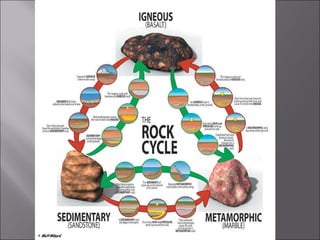
3 types of rocks

Igneous rocks - produced when magma from the
mantle cools and solidifies.

Sedimentary rocks - formed by burial,
compression, and chemical modification of
deposited weathered rock debris or sediments at
the earth's surface.

Metamorphic rocks - created when existing rock is
chemically or physically modified by intense heat
or pressure.
•Where rocks come from.
•Importance of rocks.

•Types of rocks.

•Formation of rocks.
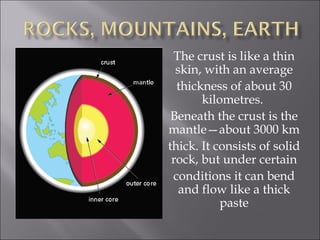
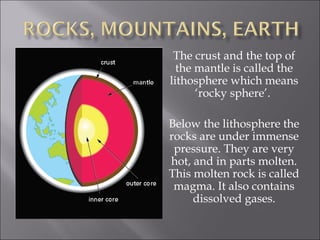
The crust is like a thin
  skin, with an average
  thickness of about 30
       kilometres.
 Beneath the crust is the
mantle—about 3000 km
thick. It consists of solid
 rock, but under certain
 conditions it can bend
   and flow like a thick
           paste
The crust and the top of
  the mantle is called the
lithosphere which means
      ‘rocky sphere’.

Below the lithosphere the
rocks are under immense
 pressure. They are very
hot, and in parts molten.
This molten rock is called
 magma. It also contains
     dissolved gases.
A rock is a solid substance that occurs naturally
because of the effects of three basic geological
processes;

     Magma Solidification;
     Sedimentation of weathered rock debris;
     Metamorphism.
3 types of rock formations

Igneous rocks - produced when magma from the
mantle cools and solidifies.

Sedimentary rocks - formed by burial,
compression, and chemical modification of
deposited weathered rock debris or sediments at
the earth's surface.

Metamorphic rocks - created when existing rock is
chemically or physically modified by intense heat
or pressure.
Rocks can tell us many stories;

Where the rock was formed;
The general water depth (if marine or fresh water)
The relative age of the rock (using fossils)
Or it’s absolute age (if radioactive materials are
present)
Its original position and orientation on the surface
of the earth
Igneous rocks – 2 types

Intrusive (Plutonic) rock the magma has cooled and
solidified within the earths crust

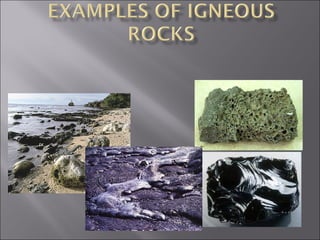
Extrusive (Volcanic) rock the magma cools and
solidifies on the earth’s surface.
Rate of cooling & temperature changes determine the
texture & degree of crystallization

The composition of the magma will determine the
composition of the igneous rock
Volcanoes form through weak spots in the earth’s
crust.
These may crack and allow magma to flow from
the mantle to the surface.
When this happens a volcano forms.
The pressure inside the Earth pushes the magma
upwards. Sometimes the molten rock oozes out
steadily. At other times it blasts out with incredible
force.
Usually have no or small crystals
Intrusive (Plutonic) rock the magma has cooled
and solidified within the earths crust
The longer Magma has to cool down the
larger the crystals will form in the rock.

The size of the crystals demonstrates where
it came from
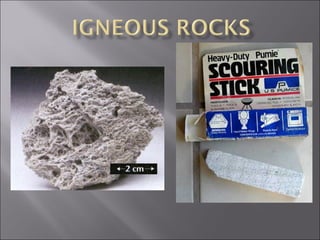
What rock can float on water?
C)Aerolite

D)Pumice

E)Chalk

F)Eolianite
Pumice is a type of lava full of gas bubbles. It can
be as light as Styrofoam, or nearly as dense as
normal rock.

Aerolite is an old name for meteorites, and
Eolianite is any rock type that is made of
windblown sediment. Chalk is a lightweight rock,
but not that light.
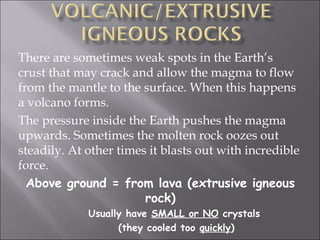
There are sometimes weak spots in the Earth’s
crust that may crack and allow the magma to flow
from the mantle to the surface. When this happens
a volcano forms.
The pressure inside the Earth pushes the magma
upwards. Sometimes the molten rock oozes out
steadily. At other times it blasts out with incredible
force.
  Above ground = from lava (extrusive igneous
                        rock)
             Usually have SMALL or NO crystals
                   (they cooled too quickly)
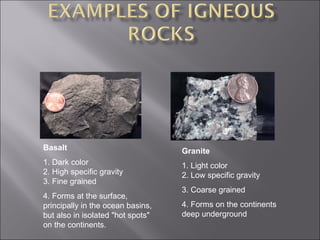
Basalt                             Granite
1. Dark color                      1. Light color
2. High specific gravity           2. Low specific gravity
3. Fine grained
                                   3. Coarse grained
4. Forms at the surface,
principally in the ocean basins,   4. Forms on the continents
but also in isolated "hot spots"   deep underground
on the continents.
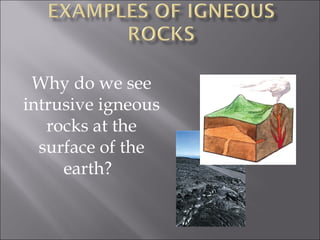
Why do we see
intrusive igneous
   rocks at the
  surface of the
     earth? 
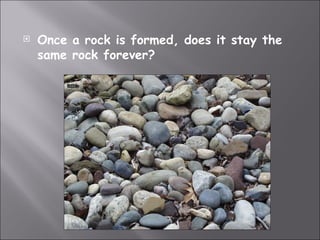
   Once a rock is formed, does it stay the
    same rock forever?
3 types of rocks

Igneous rocks - produced when magma from the
mantle cools and solidifies.

Sedimentary rocks - formed by burial,
compression, and chemical modification of
deposited weathered rock debris or sediments at
the earth's surface.

Metamorphic rocks - created when existing rock is
chemically or physically modified by intense heat
or pressure.
How many main types of Rocks are there?
Igneous rocks are formed sediments?
Rocks can break down from rain?
The Majority of rocks found on the surface of the
planet are Metamorphic rocks.
2 Types of Igneous Rocks are?
How are extrusive (plutonic) rocks exposed?
Igneous rocks – 2 types

Intrusive (Plutonic) rock the magma has cooled and
solidified within the earths crust

Extrusive (Volcanic) rock the magma cools and
solidifies on the earth’s surface.
Do you know the Rock Cycle?
How are sedimentary rocks formed?
What can sedimentary rock tell us?
How are Metamorphic rock formed?
What change occurs to the mineral grains when a
Sedimentary or Igneous rock changes to
metamorphic rock?
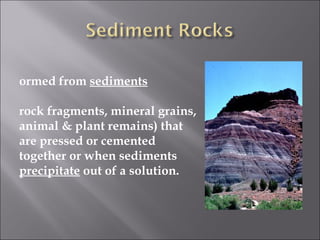
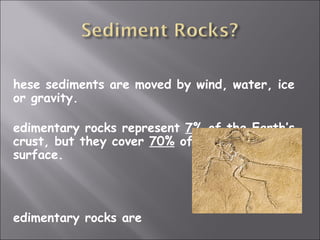
ormed from sediments

rock fragments, mineral grains,
animal & plant remains) that
are pressed or cemented
together or when sediments
precipitate out of a solution.
hese sediments are moved by wind, water, ice
or gravity.

edimentary rocks represent 7% of the Earth’s
crust, but they cover 70% of the Earth’s
surface.


edimentary rocks are
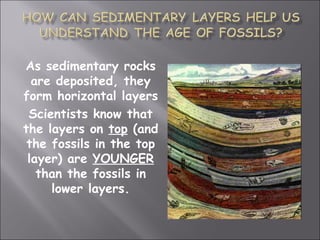
As sedimentary rocks
  are deposited, they
form horizontal layers
 Scientists know that
the layers on top (and
 the fossils in the top
 layer) are YOUNGER
   than the fossils in
     lower layers.
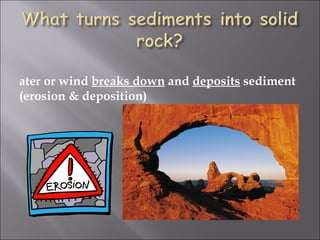
ater or wind breaks down and deposits sediment
(erosion & deposition)
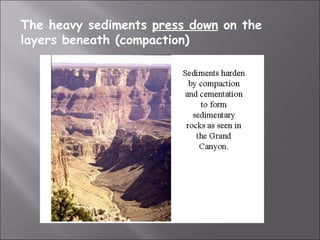
The heavy sediments press down on the
layers beneath (compaction)
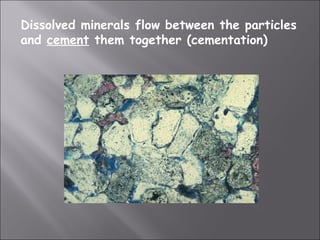
Dissolved minerals flow between the particles
and cement them together (cementation)
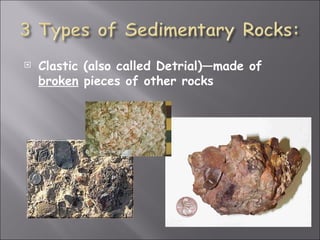
   Clastic (also called Detrial)—made of
    broken pieces of other rocks
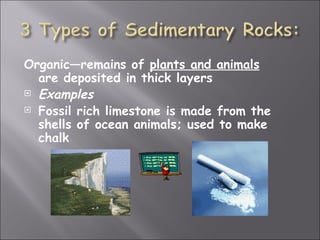
Organic—remains of plants and animals
  are deposited in thick layers
 Examples

 Fossil rich limestone is made from the
  shells of ocean animals; used to make
  chalk
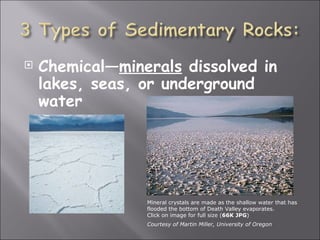
   Chemical—minerals dissolved in
    lakes, seas, or underground
    water


                 Mineral crystals are made as the shallow water that has
                 flooded the bottom of Death Valley evaporates.
                 Click on image for full size (66K JPG)
                 Courtesy of Martin Miller, University of Oregon
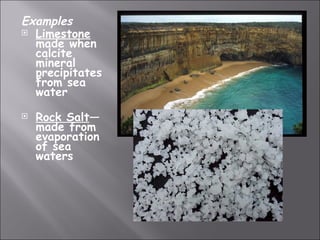
Examples
 Limestone
  made when
  calcite
  mineral
  precipitates
  from sea
  water
   Rock Salt—
    made from
    evaporation
    of sea
    waters
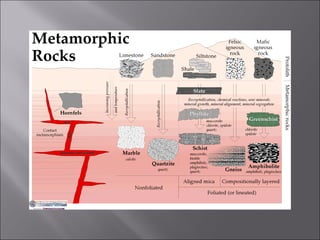
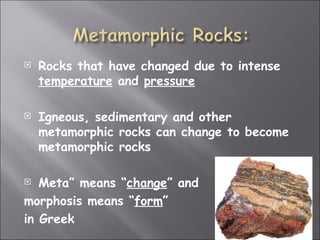
   Rocks that have changed due to intense
    temperature and pressure

   Igneous, sedimentary and other
    metamorphic rocks can change to become
    metamorphic rocks

  Meta” means “change” and
morphosis means “form”
in Greek
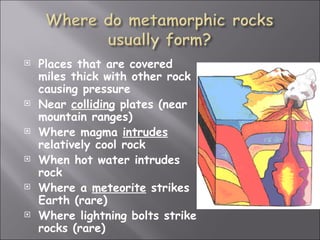
   Places that are covered
    miles thick with other rock
    causing pressure
   Near colliding plates (near
    mountain ranges)
   Where magma intrudes
    relatively cool rock
   When hot water intrudes
    rock
   Where a meteorite strikes
    Earth (rare)
   Where lightning bolts strike
    rocks (rare)
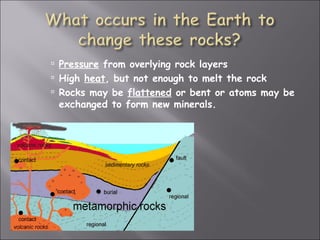
 Pressure from overlying rock layers
 High heat, but not enough to melt the rock
 Rocks may be flattened or bent or atoms may be
 exchanged to form new minerals.
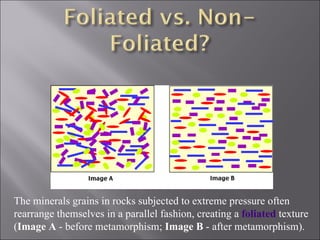
The minerals grains in rocks subjected to extreme pressure often
rearrange themselves in a parallel fashion, creating a foliated texture
(Image A - before metamorphism; Image B - after metamorphism).
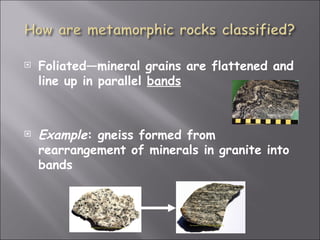
   Foliated—mineral grains are flattened and
    line up in parallel bands


   Example: gneiss formed from
    rearrangement of minerals in granite into
    bands
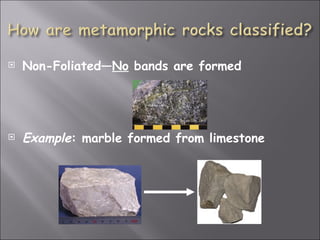
   Non-Foliated—No bands are formed


   Example: marble formed from limestone
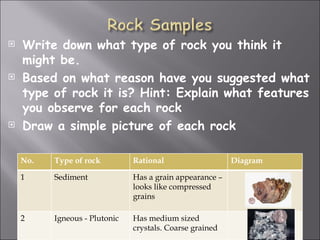
   Write down what type of rock you think it
    might be.
   Based on what reason have you suggested what
    type of rock it is? Hint: Explain what features
    you observe for each rock
   Draw a simple picture of each rock

    No.   Type of rock         Rational                   Diagram

    1     Sediment             Has a grain appearance –
                               looks like compressed
                               grains

    2     Igneous - Plutonic   Has medium sized
                               crystals. Coarse grained
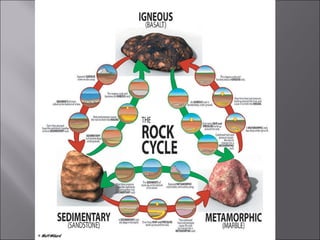
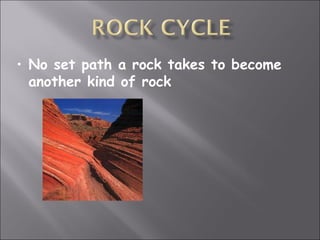
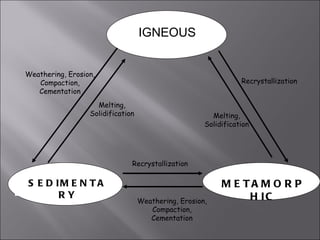
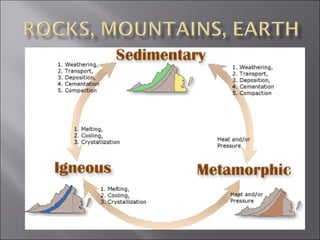
• No set path a rock takes to become
  another kind of rock
http://www.classzone.com/books/earth_science/terc/content/investigations/es06
IGNEOUS
                                      1


Weathering, Erosion,
   Compaction,                                                   Recrystallization
   Cementation
                    Melting,
                  Solidification                        Melting,
                                                      Solidification


                               Recrystallization

S E D 2M E N T A
      I                                                         3
                                                           M E TA M O R P
       RY                                                       H IC
                                   Weathering, Erosion,
                                      Compaction,
                                      Cementation
P226 – Q1, 2, 3, 5, 8
P232 – Q1 – 12
P240 – Q1 - 8
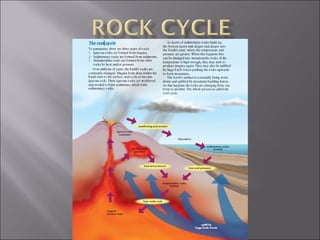
Rocks are continually changed by many processes,
such as weathering, erosion, compaction,
cementation, melting, and cooling
Rocks formation and cycle

Rocks formation and cycle

  • 1.
    3 types ofrocks Igneous rocks - produced when magma from the mantle cools and solidifies. Sedimentary rocks - formed by burial, compression, and chemical modification of deposited weathered rock debris or sediments at the earth's surface. Metamorphic rocks - created when existing rock is chemically or physically modified by intense heat or pressure.
  • 2.
    •Where rocks comefrom. •Importance of rocks. •Types of rocks. •Formation of rocks.
  • 3.
    The crust islike a thin skin, with an average thickness of about 30 kilometres. Beneath the crust is the mantle—about 3000 km thick. It consists of solid rock, but under certain conditions it can bend and flow like a thick paste
  • 4.
    The crust andthe top of the mantle is called the lithosphere which means ‘rocky sphere’. Below the lithosphere the rocks are under immense pressure. They are very hot, and in parts molten. This molten rock is called magma. It also contains dissolved gases.
  • 5.
    A rock isa solid substance that occurs naturally because of the effects of three basic geological processes; Magma Solidification; Sedimentation of weathered rock debris; Metamorphism.
  • 6.
    3 types ofrock formations Igneous rocks - produced when magma from the mantle cools and solidifies. Sedimentary rocks - formed by burial, compression, and chemical modification of deposited weathered rock debris or sediments at the earth's surface. Metamorphic rocks - created when existing rock is chemically or physically modified by intense heat or pressure.
  • 8.
    Rocks can tellus many stories; Where the rock was formed; The general water depth (if marine or fresh water) The relative age of the rock (using fossils) Or it’s absolute age (if radioactive materials are present) Its original position and orientation on the surface of the earth
  • 9.
    Igneous rocks –2 types Intrusive (Plutonic) rock the magma has cooled and solidified within the earths crust Extrusive (Volcanic) rock the magma cools and solidifies on the earth’s surface.
  • 10.
    Rate of cooling& temperature changes determine the texture & degree of crystallization The composition of the magma will determine the composition of the igneous rock
  • 11.
    Volcanoes form throughweak spots in the earth’s crust. These may crack and allow magma to flow from the mantle to the surface. When this happens a volcano forms. The pressure inside the Earth pushes the magma upwards. Sometimes the molten rock oozes out steadily. At other times it blasts out with incredible force. Usually have no or small crystals
  • 12.
    Intrusive (Plutonic) rockthe magma has cooled and solidified within the earths crust
  • 13.
    The longer Magmahas to cool down the larger the crystals will form in the rock. The size of the crystals demonstrates where it came from
  • 14.
    What rock canfloat on water? C)Aerolite D)Pumice E)Chalk F)Eolianite
  • 15.
    Pumice is atype of lava full of gas bubbles. It can be as light as Styrofoam, or nearly as dense as normal rock. Aerolite is an old name for meteorites, and Eolianite is any rock type that is made of windblown sediment. Chalk is a lightweight rock, but not that light.
  • 17.
    There are sometimesweak spots in the Earth’s crust that may crack and allow the magma to flow from the mantle to the surface. When this happens a volcano forms. The pressure inside the Earth pushes the magma upwards. Sometimes the molten rock oozes out steadily. At other times it blasts out with incredible force. Above ground = from lava (extrusive igneous rock) Usually have SMALL or NO crystals (they cooled too quickly)
  • 18.
    Basalt Granite 1. Dark color 1. Light color 2. High specific gravity 2. Low specific gravity 3. Fine grained 3. Coarse grained 4. Forms at the surface, principally in the ocean basins, 4. Forms on the continents but also in isolated "hot spots" deep underground on the continents.
  • 20.
    Why do wesee intrusive igneous rocks at the surface of the earth? 
  • 21.
    Once a rock is formed, does it stay the same rock forever?
  • 22.
    3 types ofrocks Igneous rocks - produced when magma from the mantle cools and solidifies. Sedimentary rocks - formed by burial, compression, and chemical modification of deposited weathered rock debris or sediments at the earth's surface. Metamorphic rocks - created when existing rock is chemically or physically modified by intense heat or pressure.
  • 23.
    How many maintypes of Rocks are there? Igneous rocks are formed sediments? Rocks can break down from rain? The Majority of rocks found on the surface of the planet are Metamorphic rocks. 2 Types of Igneous Rocks are? How are extrusive (plutonic) rocks exposed?
  • 24.
    Igneous rocks –2 types Intrusive (Plutonic) rock the magma has cooled and solidified within the earths crust Extrusive (Volcanic) rock the magma cools and solidifies on the earth’s surface.
  • 26.
    Do you knowthe Rock Cycle? How are sedimentary rocks formed? What can sedimentary rock tell us? How are Metamorphic rock formed? What change occurs to the mineral grains when a Sedimentary or Igneous rock changes to metamorphic rock?
  • 27.
    ormed from sediments rockfragments, mineral grains, animal & plant remains) that are pressed or cemented together or when sediments precipitate out of a solution.
  • 28.
    hese sediments aremoved by wind, water, ice or gravity. edimentary rocks represent 7% of the Earth’s crust, but they cover 70% of the Earth’s surface. edimentary rocks are
  • 29.
    As sedimentary rocks are deposited, they form horizontal layers Scientists know that the layers on top (and the fossils in the top layer) are YOUNGER than the fossils in lower layers.
  • 30.
    ater or windbreaks down and deposits sediment (erosion & deposition)
  • 31.
    The heavy sedimentspress down on the layers beneath (compaction)
  • 32.
    Dissolved minerals flowbetween the particles and cement them together (cementation)
  • 33.
    Clastic (also called Detrial)—made of broken pieces of other rocks
  • 34.
    Organic—remains of plantsand animals are deposited in thick layers  Examples  Fossil rich limestone is made from the shells of ocean animals; used to make chalk
  • 35.
    Chemical—minerals dissolved in lakes, seas, or underground water Mineral crystals are made as the shallow water that has flooded the bottom of Death Valley evaporates. Click on image for full size (66K JPG) Courtesy of Martin Miller, University of Oregon
  • 36.
    Examples  Limestone made when calcite mineral precipitates from sea water  Rock Salt— made from evaporation of sea waters
  • 37.
    Rocks that have changed due to intense temperature and pressure  Igneous, sedimentary and other metamorphic rocks can change to become metamorphic rocks  Meta” means “change” and morphosis means “form” in Greek
  • 38.
    Places that are covered miles thick with other rock causing pressure  Near colliding plates (near mountain ranges)  Where magma intrudes relatively cool rock  When hot water intrudes rock  Where a meteorite strikes Earth (rare)  Where lightning bolts strike rocks (rare)
  • 39.
     Pressure fromoverlying rock layers  High heat, but not enough to melt the rock  Rocks may be flattened or bent or atoms may be exchanged to form new minerals.
  • 40.
    The minerals grainsin rocks subjected to extreme pressure often rearrange themselves in a parallel fashion, creating a foliated texture (Image A - before metamorphism; Image B - after metamorphism).
  • 41.
    Foliated—mineral grains are flattened and line up in parallel bands  Example: gneiss formed from rearrangement of minerals in granite into bands
  • 42.
    Non-Foliated—No bands are formed  Example: marble formed from limestone
  • 44.
    Write down what type of rock you think it might be.  Based on what reason have you suggested what type of rock it is? Hint: Explain what features you observe for each rock  Draw a simple picture of each rock No. Type of rock Rational Diagram 1 Sediment Has a grain appearance – looks like compressed grains 2 Igneous - Plutonic Has medium sized crystals. Coarse grained
  • 45.
    • No setpath a rock takes to become another kind of rock
  • 47.
  • 48.
    IGNEOUS 1 Weathering, Erosion, Compaction, Recrystallization Cementation Melting, Solidification Melting, Solidification Recrystallization S E D 2M E N T A I 3 M E TA M O R P RY H IC Weathering, Erosion, Compaction, Cementation
  • 51.
    P226 – Q1,2, 3, 5, 8 P232 – Q1 – 12 P240 – Q1 - 8
  • 52.
    Rocks are continuallychanged by many processes, such as weathering, erosion, compaction, cementation, melting, and cooling