Heat Source Heat Sink
Great Lakes Rocks
Teacher Education Course
School Year 2016-2017
Vocabulary Preview
 Temperature
 Energy
•Heat
•Internal Energy (thermal energy)
 Heat Transfer Methods
•Conduction
•Convection
•Radiation
 Specific Heat
 Heat Capacity
Units
 Temperature
• Celsius
• Kelvin
• Fahrenheit
 Energy
• Joules
• calories
 Mass
• kilograms
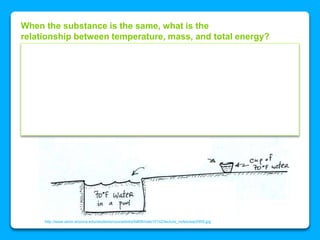
http://www.atmo.arizona.edu/students/courselinks/fall06/nats101s2/lecture_notes/sep2905.jpg
When the substance is the same, what is the
relationship between temperature, mass, and total energy?
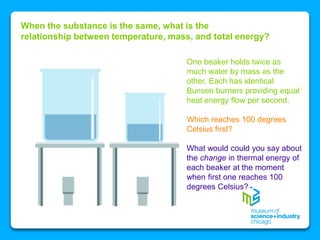
When the substance is the same, what is the
relationship between temperature, mass, and total energy?
One beaker holds twice as
much water by mass as the
other. Each has identical
Bunsen burners providing equal
heat energy flow per second.
Which reaches 100 degrees
Celsius first?
What would could you say about
the change in thermal energy of
each beaker at the moment
when first one reaches 100
degrees Celsius?
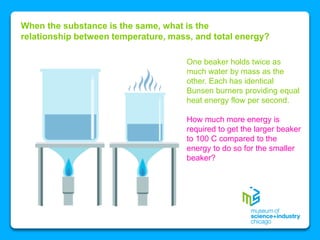
When the substance is the same, what is the
relationship between temperature, mass, and total energy?
One beaker holds twice as
much water by mass as the
other. Each has identical
Bunsen burners providing equal
heat energy flow per second.
How much more energy is
required to get the larger beaker
to 100 C compared to the
energy to do so for the smaller
beaker?
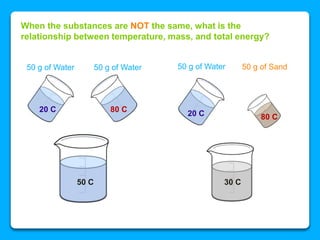
When the substances are NOT the same, what is the
relationship between temperature, mass, and total energy?
50 g of Water 50 g of Water 50 g of Water 50 g of Sand
20 C
20 C
80 C
80 C
50 C 30 C
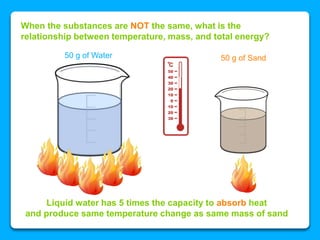
When the substances are NOT the same, what is the
relationship between temperature, mass, and total energy?
50 g of Water 50 g of Sand
Liquid water has 5 times the capacity to absorb heat
and produce same temperature change as same mass of sand
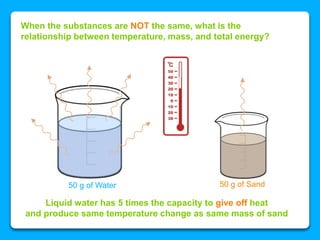
When the substances are NOT the same, what is the
relationship between temperature, mass, and total energy?
50 g of Water 50 g of Sand
Liquid water has 5 times the capacity to give off heat
and produce same temperature change as same mass of sand
Water Sand
Mass
Specific Heat
(J/g·C°)
Heat Capacity
(J/C°)
Specific Heat
(J/g·C°)
Heat Capacity
(J/C°)
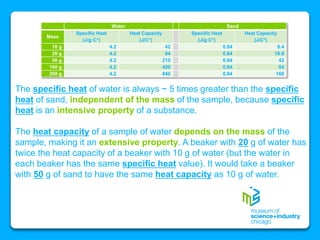
10 g 4.2 42 0.84 8.4
20 g 4.2 84 0.84 16.8
50 g 4.2 210 0.84 42
100 g 4.2 420 0.84 84
200 g 4.2 840 0.84 168
The specific heat of water is always ~ 5 times greater than the specific
heat of sand, independent of the mass of the sample, because specific
heat is an intensive property of a substance.
The heat capacity of a sample of water depends on the mass of the
sample, making it an extensive property. A beaker with 20 g of water has
twice the heat capacity of a beaker with 10 g of water (but the water in
each beaker has the same specific heat value). It would take a beaker
with 50 g of sand to have the same heat capacity as 10 g of water.
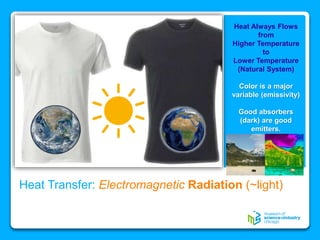
Heat Transfer: Electromagnetic Radiation (~light)
Heat Always Flows
from
Higher Temperature
to
Lower Temperature
(Natural System)
Color is a major
variable (emissivity)
Good absorbers
(dark) are good
emitters.
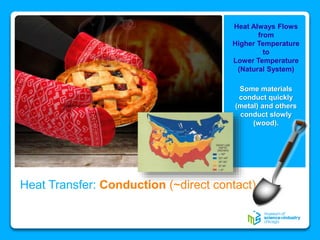
Heat Transfer: Conduction (~direct contact)
Heat Always Flows
from
Higher Temperature
to
Lower Temperature
(Natural System)
Some materials
conduct quickly
(metal) and others
conduct slowly
(wood).
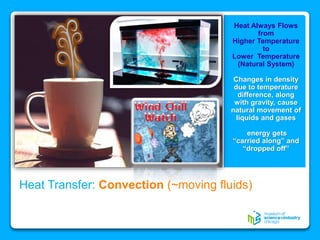
Heat Transfer: Convection (~moving fluids)
Heat Always Flows
from
Higher Temperature
to
Lower Temperature
(Natural System)
Changes in density
due to temperature
difference, along
with gravity, cause
natural movement of
liquids and gases
energy gets
“carried along” and
“dropped off”
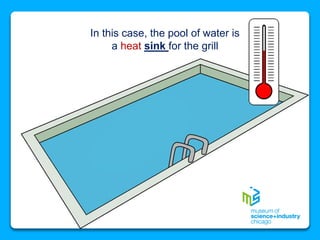
In this case, the pool of water is
a heat sink for the grill
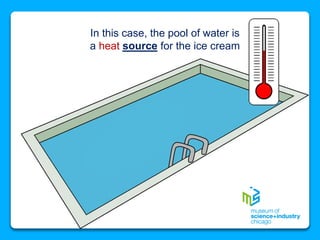
In this case, the pool of water is
a heat source for the ice cream
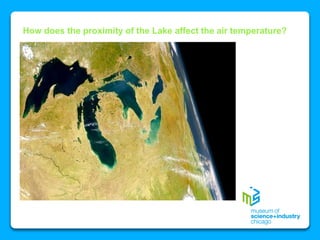
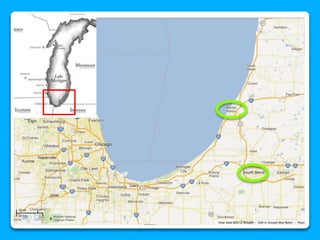
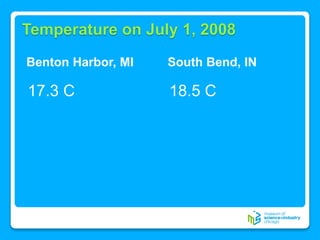
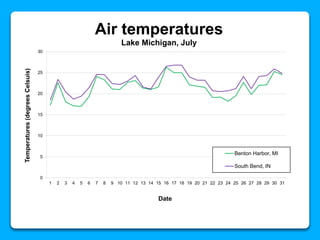
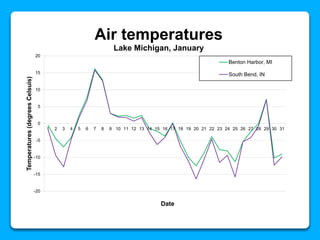
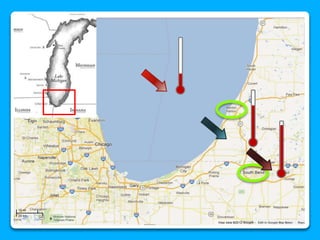
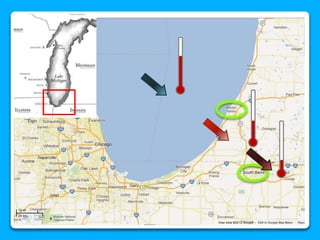
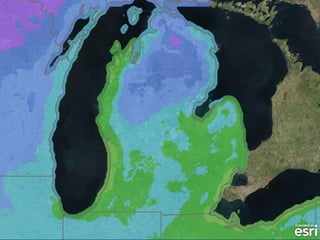
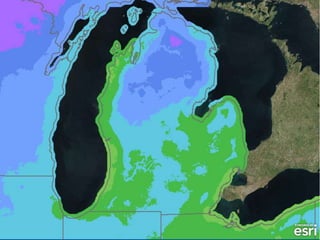
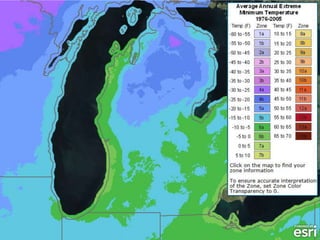
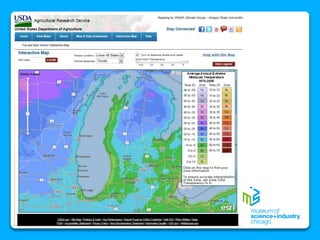
How does the proximity of the Lake affect the air temperature?
Temperature on July 1, 2008
Benton Harbor, MI
17.3 C
South Bend, IN
18.5 C
0
5
10
15
20
25
30
1 2 3 4 5 6 7 8 9 10 11 12 13 14 15 16 17 18 19 20 21 22 23 24 25 26 27 28 29 30 31
Temperatures(degreesCelsuis)
Date
Air temperatures
Lake Michigan, July
Benton Harbor, MI
South Bend, IN
-20
-15
-10
-5
0
5
10
15
20
1 2 3 4 5 6 7 8 9 10 11 12 13 14 15 16 17 18 19 20 21 22 23 24 25 26 27 28 29 30 31
Temperatures(degreesCelsuis)
Date
Air temperatures
Lake Michigan, January
Benton Harbor, MI
South Bend, IN
Great Lakes Heat Source Heat Sink

Great Lakes Heat Source Heat Sink

  • 1.
    Heat Source HeatSink Great Lakes Rocks Teacher Education Course School Year 2016-2017
  • 2.
    Vocabulary Preview  Temperature Energy •Heat •Internal Energy (thermal energy)  Heat Transfer Methods •Conduction •Convection •Radiation  Specific Heat  Heat Capacity Units  Temperature • Celsius • Kelvin • Fahrenheit  Energy • Joules • calories  Mass • kilograms
  • 3.
    http://www.atmo.arizona.edu/students/courselinks/fall06/nats101s2/lecture_notes/sep2905.jpg When the substanceis the same, what is the relationship between temperature, mass, and total energy?
  • 4.
    When the substanceis the same, what is the relationship between temperature, mass, and total energy? One beaker holds twice as much water by mass as the other. Each has identical Bunsen burners providing equal heat energy flow per second. Which reaches 100 degrees Celsius first? What would could you say about the change in thermal energy of each beaker at the moment when first one reaches 100 degrees Celsius?
  • 5.
    When the substanceis the same, what is the relationship between temperature, mass, and total energy? One beaker holds twice as much water by mass as the other. Each has identical Bunsen burners providing equal heat energy flow per second. How much more energy is required to get the larger beaker to 100 C compared to the energy to do so for the smaller beaker?
  • 6.
    When the substancesare NOT the same, what is the relationship between temperature, mass, and total energy? 50 g of Water 50 g of Water 50 g of Water 50 g of Sand 20 C 20 C 80 C 80 C 50 C 30 C
  • 7.
    When the substancesare NOT the same, what is the relationship between temperature, mass, and total energy? 50 g of Water 50 g of Sand Liquid water has 5 times the capacity to absorb heat and produce same temperature change as same mass of sand
  • 8.
    When the substancesare NOT the same, what is the relationship between temperature, mass, and total energy? 50 g of Water 50 g of Sand Liquid water has 5 times the capacity to give off heat and produce same temperature change as same mass of sand
  • 9.
    Water Sand Mass Specific Heat (J/g·C°) HeatCapacity (J/C°) Specific Heat (J/g·C°) Heat Capacity (J/C°) 10 g 4.2 42 0.84 8.4 20 g 4.2 84 0.84 16.8 50 g 4.2 210 0.84 42 100 g 4.2 420 0.84 84 200 g 4.2 840 0.84 168 The specific heat of water is always ~ 5 times greater than the specific heat of sand, independent of the mass of the sample, because specific heat is an intensive property of a substance. The heat capacity of a sample of water depends on the mass of the sample, making it an extensive property. A beaker with 20 g of water has twice the heat capacity of a beaker with 10 g of water (but the water in each beaker has the same specific heat value). It would take a beaker with 50 g of sand to have the same heat capacity as 10 g of water.
  • 10.
    Heat Transfer: ElectromagneticRadiation (~light) Heat Always Flows from Higher Temperature to Lower Temperature (Natural System) Color is a major variable (emissivity) Good absorbers (dark) are good emitters.
  • 11.
    Heat Transfer: Conduction(~direct contact) Heat Always Flows from Higher Temperature to Lower Temperature (Natural System) Some materials conduct quickly (metal) and others conduct slowly (wood).
  • 12.
    Heat Transfer: Convection(~moving fluids) Heat Always Flows from Higher Temperature to Lower Temperature (Natural System) Changes in density due to temperature difference, along with gravity, cause natural movement of liquids and gases energy gets “carried along” and “dropped off”
  • 13.
    In this case,the pool of water is a heat sink for the grill
  • 14.
    In this case,the pool of water is a heat source for the ice cream
  • 15.
    How does theproximity of the Lake affect the air temperature?
  • 17.
    Temperature on July1, 2008 Benton Harbor, MI 17.3 C South Bend, IN 18.5 C
  • 18.
    0 5 10 15 20 25 30 1 2 34 5 6 7 8 9 10 11 12 13 14 15 16 17 18 19 20 21 22 23 24 25 26 27 28 29 30 31 Temperatures(degreesCelsuis) Date Air temperatures Lake Michigan, July Benton Harbor, MI South Bend, IN
  • 19.
    -20 -15 -10 -5 0 5 10 15 20 1 2 34 5 6 7 8 9 10 11 12 13 14 15 16 17 18 19 20 21 22 23 24 25 26 27 28 29 30 31 Temperatures(degreesCelsuis) Date Air temperatures Lake Michigan, January Benton Harbor, MI South Bend, IN

Editor's Notes

  • #29 http://planthardiness.ars.usda.gov/phzmweb/interactivemap.aspx USDA Plant Hardiness Zone Map The 2012 USDA Plant Hardiness Zone Map is the standard by which gardeners and growers can determine which plants are most likely to thrive at a location. The map is based on the average annual minimum winter temperature, divided into 10-degree F zones. Hardiness zones are based on the average annual extreme minimum temperature during a 30-year period in the past, not the lowest temperature that has ever occurred in the past or might occur in the future. Gardeners should keep that in mind when selecting plants, especially if they choose to "push" their hardiness zone by growing plants not rated for their zone. In addition, although this edition of the USDA PHZM is drawn in the most detailed scale to date, there might still be microclimates that are too small to show up on the map. Microclimates, which are fine-scale climate variations, can be small heat islands—such as those caused by blacktop and concrete—or cool spots caused by small hills and valleys. Individual gardens also may have very localized microclimates. Your entire yard could be somewhat warmer or cooler than the surrounding area because it is sheltered or exposed. You also could have pockets within your garden that are warmer or cooler than the general zone for your area or for the rest of your yard, such as a sheltered area in front of a south-facing wall or a low spot where cold air pools first. No hardiness zone map can take the place of the detailed knowledge that gardeners pick up about their own gardens through hands-on experience.