
MOHSIN ZAFAR
     Lecturer, Soil Science
Faculty of Agriculture, Rawalakot
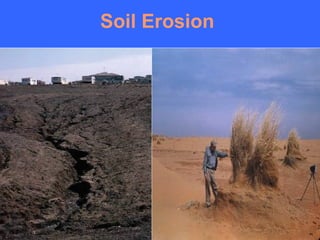
Soil Erosion
Soil Erosion Global Problem

 • Soil erosion ranks as one of the most serious
 environmental problems in the world
 • 75 billion tons of fertile soil lost annually around
 the world
 • Africa, Europe & Australia : 5-10 tons/ha/y
 • North, Central & South America: 10-20
 tons/ha/y
 • Asia: 30 tons/ha/y
 • Soils essentially non-renewable as 2.54 cm of
 soil estimated to take 200-1000 years to form……
 • Annual costs of soil erosion in U.S. estimated
 between $30-44 billion in 2002
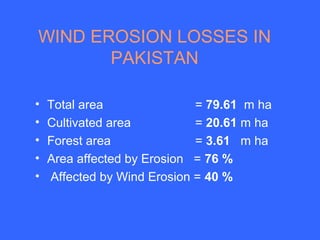
WIND EROSION LOSSES IN
       PAKISTAN

•   Total area               = 79.61 m ha
•   Cultivated area          = 20.61 m ha
•   Forest area              = 3.61 m ha
•   Area affected by Erosion = 76 %
•   Affected by Wind Erosion = 40 %
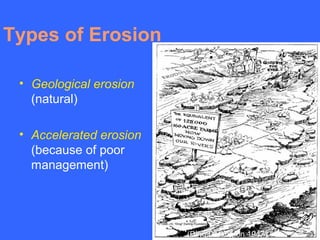
Types of Erosion

 • Geological erosion
   (natural)

 • Accelerated erosion
   (because of poor
   management)


                         (Ding Darlington 1947)
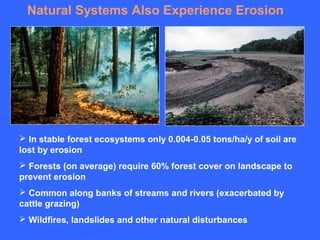
Natural Systems Also Experience Erosion


 In stable forest ecosystems only 0.004-0.05 tons/ha/y of soil are
lost by erosion
 Forests (on average) require 60% forest cover on landscape to
prevent erosion
 Common along banks of streams and rivers (exacerbated by
cattle grazing)
 Wildfires, landslides and other natural disturbances
EROSION
• Erosion is a natural process, accelerated by farming
  activity, that removes topsoil, reduces levels of soil
  organic matter, and contributes to the breakdown of soil
  structure.
• Erosion is a process by which soil is moved from one
  area to another. In the geological past, huge volumes of
  land surface materials were moved by glaciers.
• At present, the main natural agents of erosion are wind
  and water.
• Erosion occurs naturally on cropland, forested land, and
  in urban areas, but this process can be accelerated by
  human activity (such as agriculture, forestry, and urban
  development) to levels that cause environmental and
  economic problems.
WIND STORMS
Factors of Wind Erosion
                  E = f(I, C, K, L, V)


I is the soil erodibility by wind (related to relative amount of
  particles > 0.84 mm dia.
C is the local wind erosion climatic factor (product of
  average wind velocity and average moisture of soil
  surface)
K is the soil surface roughness (expressed in height of
  ridges; more roughness increases resistance to wind
  erosion)
L is the unprotected width of the field (protection provided
  by wind breaks)
V is the equivalent quantity of vegetative cover (includes
  quantity, kind, and orientation of vegetative cover
Factors Affecting Wind Erosion

  Several factors relating to soil, landscape and
  climate that affects wind erosion are


      •   soil texture
      •   soil structure
      •   surface relief
      •   soil protection by plants or plant residues
      •   rainfall
      •   wind force.
• Erosion works on loosely held soil particles at the soil
  surface.
• Silty and very fine sandy soils are particularly vulnerable to
  erosion.
• Poorly structured soils whose aggregates (clumps) have
  been broken down into fine particles by tillage and other
  forces are also easily eroded.

 •Surface relief (shape and slope) affects the direction and rate
 of erosion. It also affects the location of soil deposition,
 because eroded soil tends to accumulate at the base of
 slopes and in depressions.
• Exposed soils suffer greater erosion than soils well
protected by standing plants or plant residues
• Climate affects erosion mainly through the moisture
conditions of the soil and specific climatic events (wind and
rainstorms).
• Soils are most vulnerable to wind erosion when the soil
surface dries out rapidly during periods of low or no rainfall,
such as the drought during the "dirty thirties" in the prairies
or in early spring when the soil is not protected by
vegetation.
• Wind speed and the length of time the wind blows are
major factors in wind erosion.
Causes of Wind Erosion

• Bare, unprotected soil is extremely vulnerable to
  wind erosion
• Erosion occurs with strong, turbulent winds
  blowing across a soil surface that is smooth,
  loose, dry and finely granulated.
• Slightly larger soil particles bounce or roll along
  the soil surface.
• Loose particles drift along, bombarding and
  dislodging still more particles with the same
  effect on clods or growing plants as
  sandblasting.
Over-grazing by livestock
SIGNS OF WIND EROSION

Sometimes erosion is spotted easily in the field.
Common signs of wind erosion include:

   • Dust clouds
   • Accumulation of soil along fence lines and banks
   • Drifted appearance of the soil surface.
WIND
EROSION


  Rarely produces the catastrophic dust storms
  known as the Dust Bowl in the 1930s in the US,
  but damages soil like water erosion by removing
  organic matter and plant nutrients and by
  decreasing soil thickness
Wind Erosion


  • Both wind and water
    behave as fluids, so
    processes of erosion
    similar
  • When the wind force
    (function of velocity)
    exceeds forces holding
    particle in the pedon, it
    moves the particle
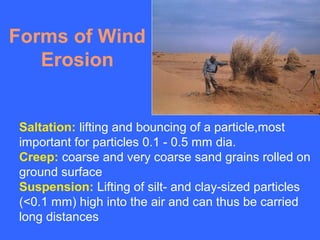
Forms of Wind
   Erosion


Saltation: lifting and bouncing of a particle,most
important for particles 0.1 - 0.5 mm dia.
Creep: coarse and very coarse sand grains rolled on
ground surface
Suspension: Lifting of silt- and clay-sized particles
(<0.1 mm) high into the air and can thus be carried
long distances
MECHANISM OF SOIL PARTICLE
       MIOVEMENT

  DETRUSION
  EFFLUXION
  EXTRUSION
  EFFLATION
  ABRASION
Figure 15–21 This hydromulcher is spraying a mixture of seed, fertilizer, and chemical
mulch on the road cut. The chemical mulch holds the seed in place and protects the
slope from erosion until the grass germinates and becomes established. (Photo: B. Kay.)
Damages of Wind Erosion
• Losing topsoil has a direct effect on the productivity of
  the land. A loss of 2.5 cm of soil can reduce wheat yields
  by 5-10% while a loss of 20 cm can reduce yields to 1/3
  of their previous levels. Estimated soil loss by wind
  erosion on the is 160 million tones per year.

• As soil productivity decreases due to a decrease in
  topsoil, soil fertility becomes less.

• Organic material is reduced and hence, less plant growth
  occurs.
•The effect of wind erosion on the soil is the impact of drifting
soil itself.

•Young seedlings are uprooted.
•Soil covers plants and seeds.
•Roads,railways and fences are covered by soil.
•It creates air pollution
How to control wind erosion?

 • Proper soil and range land management is the key
   to reducing the effects of wind on the land.

 • Following are the main steps to control wind
   erosion.
 • Planting shelterbelts (trees may be obtained from
   the Tree Nursery) to help reduce the velocity of the
   wind
 • Increasing the organic content of the soil
 • Using fertilizers to increase soil productivity
• Alternating narrow strips of summer fallow and
 crop perpendicular to the prevailing winds
 (strip cropping)
• Leaving stubble barriers
• Using trash cover and green manure
• Reducing tillage

• Using marginal land for livestock rather than
crop production
• Reducing the speed of tillage
• Planting of fall cover crops (winter wheat or rye) in
areas of light, sandy soil which are particularly prone
to wind erosion
• Using marginal land for livestock rather than crop
production
• Reducing the speed of tillage
• Planting perennial grass or legumes on grazing
lands
• Zero tillage - planting crops in to last years' stubble
•The more organic material present in the soil, the
greater the resistance of the soil to be broken into
particles small enough to be carried away by wind or
water, and the more moisture the soil will hold.
Adding fertilizers to the soil aids in making the soil
more productive, which protects it against the
effects of erosion.
• USE OF CROP RESIDUES TO COVER
  SOIL
• Shelterbelts are designed to slow down the
  speed of the wind. Along with upright stubble,
  shelterbelts can help to accumulate snow cover
  in the winter.
• Mulching
• Strip Cropping
• STRIP CROPPING
Some Additional Points For Controlling
           Wind Erosion
  • sufficient area upwind should be tilled -- not just
    the area presently blowing.
  • The direction of emergency tillage should always
    be at a right angle to the wind for maximum
    protection.
  • For row crops, it may be necessary to compromise
    by following the row pattern instead of the
    prevailing winds. If old crop stubble remains, the
    emergency tillage tool should run between rows,
    leaving as much upright stubble in the rows as
    possible.
  • Tractor speed and tillage depth should be varied
    as needed to bring clods to the surface. The best,
    most effective clods come from moist soil. Slower
    travel speeds with tillage implements will build
    higher ridges and more protection.
Wind erosion

Wind erosion

  • 1.
    MOHSIN ZAFAR Lecturer, Soil Science Faculty of Agriculture, Rawalakot
  • 2.
  • 3.
    Soil Erosion GlobalProblem • Soil erosion ranks as one of the most serious environmental problems in the world • 75 billion tons of fertile soil lost annually around the world • Africa, Europe & Australia : 5-10 tons/ha/y • North, Central & South America: 10-20 tons/ha/y • Asia: 30 tons/ha/y • Soils essentially non-renewable as 2.54 cm of soil estimated to take 200-1000 years to form…… • Annual costs of soil erosion in U.S. estimated between $30-44 billion in 2002
  • 4.
    WIND EROSION LOSSESIN PAKISTAN • Total area = 79.61 m ha • Cultivated area = 20.61 m ha • Forest area = 3.61 m ha • Area affected by Erosion = 76 % • Affected by Wind Erosion = 40 %
  • 6.
    Types of Erosion • Geological erosion (natural) • Accelerated erosion (because of poor management) (Ding Darlington 1947)
  • 7.
    Natural Systems AlsoExperience Erosion  In stable forest ecosystems only 0.004-0.05 tons/ha/y of soil are lost by erosion  Forests (on average) require 60% forest cover on landscape to prevent erosion  Common along banks of streams and rivers (exacerbated by cattle grazing)  Wildfires, landslides and other natural disturbances
  • 8.
    EROSION • Erosion isa natural process, accelerated by farming activity, that removes topsoil, reduces levels of soil organic matter, and contributes to the breakdown of soil structure. • Erosion is a process by which soil is moved from one area to another. In the geological past, huge volumes of land surface materials were moved by glaciers. • At present, the main natural agents of erosion are wind and water.
  • 9.
    • Erosion occursnaturally on cropland, forested land, and in urban areas, but this process can be accelerated by human activity (such as agriculture, forestry, and urban development) to levels that cause environmental and economic problems.
  • 10.
  • 11.
    Factors of WindErosion E = f(I, C, K, L, V) I is the soil erodibility by wind (related to relative amount of particles > 0.84 mm dia. C is the local wind erosion climatic factor (product of average wind velocity and average moisture of soil surface) K is the soil surface roughness (expressed in height of ridges; more roughness increases resistance to wind erosion) L is the unprotected width of the field (protection provided by wind breaks) V is the equivalent quantity of vegetative cover (includes quantity, kind, and orientation of vegetative cover
  • 12.
    Factors Affecting WindErosion Several factors relating to soil, landscape and climate that affects wind erosion are • soil texture • soil structure • surface relief • soil protection by plants or plant residues • rainfall • wind force.
  • 13.
    • Erosion workson loosely held soil particles at the soil surface. • Silty and very fine sandy soils are particularly vulnerable to erosion. • Poorly structured soils whose aggregates (clumps) have been broken down into fine particles by tillage and other forces are also easily eroded. •Surface relief (shape and slope) affects the direction and rate of erosion. It also affects the location of soil deposition, because eroded soil tends to accumulate at the base of slopes and in depressions.
  • 14.
    • Exposed soilssuffer greater erosion than soils well protected by standing plants or plant residues • Climate affects erosion mainly through the moisture conditions of the soil and specific climatic events (wind and rainstorms). • Soils are most vulnerable to wind erosion when the soil surface dries out rapidly during periods of low or no rainfall, such as the drought during the "dirty thirties" in the prairies or in early spring when the soil is not protected by vegetation. • Wind speed and the length of time the wind blows are major factors in wind erosion.
  • 15.
    Causes of WindErosion • Bare, unprotected soil is extremely vulnerable to wind erosion • Erosion occurs with strong, turbulent winds blowing across a soil surface that is smooth, loose, dry and finely granulated. • Slightly larger soil particles bounce or roll along the soil surface. • Loose particles drift along, bombarding and dislodging still more particles with the same effect on clods or growing plants as sandblasting.
  • 16.
  • 17.
    SIGNS OF WINDEROSION Sometimes erosion is spotted easily in the field. Common signs of wind erosion include: • Dust clouds • Accumulation of soil along fence lines and banks • Drifted appearance of the soil surface.
  • 18.
    WIND EROSION Rarelyproduces the catastrophic dust storms known as the Dust Bowl in the 1930s in the US, but damages soil like water erosion by removing organic matter and plant nutrients and by decreasing soil thickness
  • 19.
    Wind Erosion • Both wind and water behave as fluids, so processes of erosion similar • When the wind force (function of velocity) exceeds forces holding particle in the pedon, it moves the particle
  • 20.
    Forms of Wind Erosion Saltation: lifting and bouncing of a particle,most important for particles 0.1 - 0.5 mm dia. Creep: coarse and very coarse sand grains rolled on ground surface Suspension: Lifting of silt- and clay-sized particles (<0.1 mm) high into the air and can thus be carried long distances
  • 21.
    MECHANISM OF SOILPARTICLE MIOVEMENT DETRUSION EFFLUXION EXTRUSION EFFLATION ABRASION
  • 22.
    Figure 15–21 Thishydromulcher is spraying a mixture of seed, fertilizer, and chemical mulch on the road cut. The chemical mulch holds the seed in place and protects the slope from erosion until the grass germinates and becomes established. (Photo: B. Kay.)
  • 23.
    Damages of WindErosion • Losing topsoil has a direct effect on the productivity of the land. A loss of 2.5 cm of soil can reduce wheat yields by 5-10% while a loss of 20 cm can reduce yields to 1/3 of their previous levels. Estimated soil loss by wind erosion on the is 160 million tones per year. • As soil productivity decreases due to a decrease in topsoil, soil fertility becomes less. • Organic material is reduced and hence, less plant growth occurs.
  • 24.
    •The effect ofwind erosion on the soil is the impact of drifting soil itself. •Young seedlings are uprooted. •Soil covers plants and seeds. •Roads,railways and fences are covered by soil. •It creates air pollution
  • 25.
    How to controlwind erosion? • Proper soil and range land management is the key to reducing the effects of wind on the land. • Following are the main steps to control wind erosion. • Planting shelterbelts (trees may be obtained from the Tree Nursery) to help reduce the velocity of the wind • Increasing the organic content of the soil • Using fertilizers to increase soil productivity
  • 26.
    • Alternating narrowstrips of summer fallow and crop perpendicular to the prevailing winds (strip cropping) • Leaving stubble barriers • Using trash cover and green manure • Reducing tillage • Using marginal land for livestock rather than crop production
  • 27.
    • Reducing thespeed of tillage • Planting of fall cover crops (winter wheat or rye) in areas of light, sandy soil which are particularly prone to wind erosion • Using marginal land for livestock rather than crop production • Reducing the speed of tillage • Planting perennial grass or legumes on grazing lands • Zero tillage - planting crops in to last years' stubble
  • 28.
    •The more organicmaterial present in the soil, the greater the resistance of the soil to be broken into particles small enough to be carried away by wind or water, and the more moisture the soil will hold. Adding fertilizers to the soil aids in making the soil more productive, which protects it against the effects of erosion.
  • 29.
    • USE OFCROP RESIDUES TO COVER SOIL
  • 30.
    • Shelterbelts aredesigned to slow down the speed of the wind. Along with upright stubble, shelterbelts can help to accumulate snow cover in the winter. • Mulching • Strip Cropping
  • 31.
  • 32.
    Some Additional PointsFor Controlling Wind Erosion • sufficient area upwind should be tilled -- not just the area presently blowing. • The direction of emergency tillage should always be at a right angle to the wind for maximum protection. • For row crops, it may be necessary to compromise by following the row pattern instead of the prevailing winds. If old crop stubble remains, the emergency tillage tool should run between rows, leaving as much upright stubble in the rows as possible. • Tractor speed and tillage depth should be varied as needed to bring clods to the surface. The best, most effective clods come from moist soil. Slower travel speeds with tillage implements will build higher ridges and more protection.