WATER EROSION


    Muhammad Nadeem Ashraf
    Student, Soil & Environmental Science
    Faculty of Agriculture, Rawalakot
EROSION

“Removal of soil from its original position”
                   Or
 “It is the process of detachment,
  transportation & deposition of soil
  materials from one place to another by
  erusive agents”
Some Facts
A) Detachment.

B) Transportation.

C) Deposition.
Types of Erosion

In general there are two types of soil erosion.


1. Geological Erosion.


2. Accelerated Erosion.
Main causes of soil Erosion

1. Misuse of land.

2. Mismanagement of arable land.

3. Deforestation.

4. Poor soil & water management practices.
Agents of Erosion
1. Wind.

2. Water.

3. Temperature.

4. Biological Factors.
Classification of Erosion
(Depending upon the erosion causing factors )

A) Wind Erosion.

B) Water Erosion.
Water Erosion
“ It is the detachment, transportation & deposition
 of soil particles by the force of water from one
 place to another.”

 Soil erosion by water is the result of rain
 detaching & transporting of vulnerable soil,either
 directly by means of rain splash or indirectly by
 rill & gully erosion.
Forms of water erosion

A). Rain Splash Erosion:
     Rain splash erosion is caused by the impact of
     water striking the surface of soil.
It takes place in two steps.
1. As precipitation fills the pore spaces, loosening
     & driving soil particles apart.
2. Impact of subsequent rain drops hitting the
     surface, transporting particles to other area.
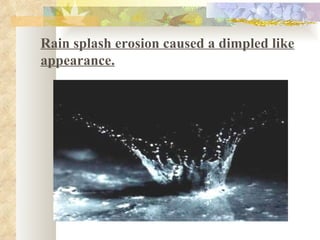
Rain splash erosion caused a dimpled like
appearance.
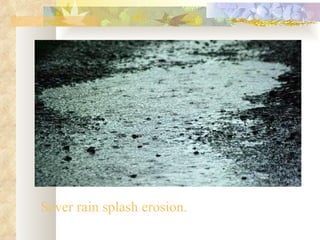
Sever rain splash erosion.
B) Sheet Erosion.
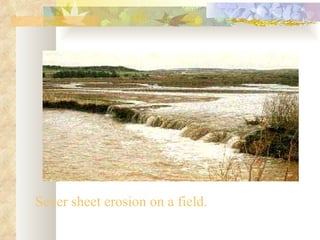
“ It is the uniform removal of soil in thin
   layers in sloping land resulting from rain
   splash erosion.”

 surface runoff forms when the rainfall
 intensity of a storm exceeds the infiltration
 capacity of soil.
Sever sheet erosion on a field.
C) Rill Erosion.
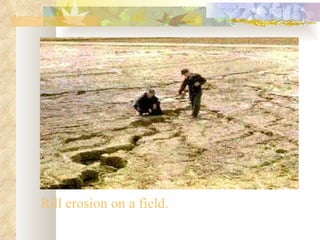
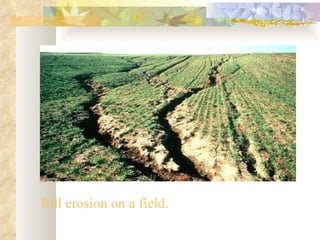
It is caused by water concentrating into
innumerable, closely spaced small
channels. Left unchecked, rills can cut
vertically & horizontally and when joined
form gullies.
Rill erosion on a field.
D) Gully Erosion.
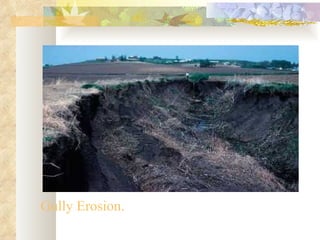
  Gullies are steep-sided trenches formed by
   the coalescence of many rills.Once they are
   started difficult to stop.
Stages of gully erosion.
Stage-1. Cutting top soil.
Stage-2. Enlargement of gullies.
Stage-3. Healing stage.
Stage-4. Stablization.
Gully Erosion.
Types of Gullies.
1. U-shaped.

2. V-shaped.
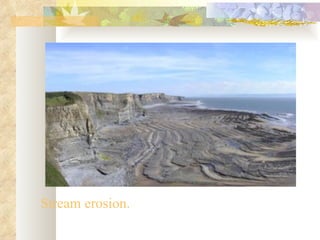
E) Stream Erosion.

When flow in gullies become permanent, it
is called a stream which may be permanent
or seasonal is called as stream erosion.
Stream erosion.
Factors affecting water Erosion
A) Climate.
  1. Precipitation.
  2. Temperature.
  3. Wind.
  4. Humidity.
  5. Solar radiation.
B) Soil.
  1. Physical properties of soil.
  2. Vegetation cover.
  3. Organic matter contents in soil.
  4. Moisture contents of soil.
  5. Soil density

C) Topography.
Water erosion

Water erosion

  • 1.
    WATER EROSION Muhammad Nadeem Ashraf Student, Soil & Environmental Science Faculty of Agriculture, Rawalakot
  • 2.
    EROSION “Removal of soilfrom its original position” Or “It is the process of detachment, transportation & deposition of soil materials from one place to another by erusive agents”
  • 3.
    Some Facts A) Detachment. B)Transportation. C) Deposition.
  • 4.
    Types of Erosion Ingeneral there are two types of soil erosion. 1. Geological Erosion. 2. Accelerated Erosion.
  • 5.
    Main causes ofsoil Erosion 1. Misuse of land. 2. Mismanagement of arable land. 3. Deforestation. 4. Poor soil & water management practices.
  • 6.
    Agents of Erosion 1.Wind. 2. Water. 3. Temperature. 4. Biological Factors.
  • 7.
    Classification of Erosion (Dependingupon the erosion causing factors ) A) Wind Erosion. B) Water Erosion.
  • 8.
    Water Erosion “ Itis the detachment, transportation & deposition of soil particles by the force of water from one place to another.” Soil erosion by water is the result of rain detaching & transporting of vulnerable soil,either directly by means of rain splash or indirectly by rill & gully erosion.
  • 9.
    Forms of watererosion A). Rain Splash Erosion: Rain splash erosion is caused by the impact of water striking the surface of soil. It takes place in two steps. 1. As precipitation fills the pore spaces, loosening & driving soil particles apart. 2. Impact of subsequent rain drops hitting the surface, transporting particles to other area.
  • 10.
    Rain splash erosioncaused a dimpled like appearance.
  • 11.
  • 12.
    B) Sheet Erosion. “It is the uniform removal of soil in thin layers in sloping land resulting from rain splash erosion.” surface runoff forms when the rainfall intensity of a storm exceeds the infiltration capacity of soil.
  • 13.
  • 14.
    C) Rill Erosion. Itis caused by water concentrating into innumerable, closely spaced small channels. Left unchecked, rills can cut vertically & horizontally and when joined form gullies.
  • 15.
  • 16.
  • 17.
    D) Gully Erosion. Gullies are steep-sided trenches formed by the coalescence of many rills.Once they are started difficult to stop. Stages of gully erosion. Stage-1. Cutting top soil. Stage-2. Enlargement of gullies. Stage-3. Healing stage. Stage-4. Stablization.
  • 18.
  • 19.
    Types of Gullies. 1.U-shaped. 2. V-shaped.
  • 20.
    E) Stream Erosion. Whenflow in gullies become permanent, it is called a stream which may be permanent or seasonal is called as stream erosion.
  • 21.
  • 22.
    Factors affecting waterErosion A) Climate. 1. Precipitation. 2. Temperature. 3. Wind. 4. Humidity. 5. Solar radiation.
  • 23.
    B) Soil. 1. Physical properties of soil. 2. Vegetation cover. 3. Organic matter contents in soil. 4. Moisture contents of soil. 5. Soil density C) Topography.