Water Supply and Demand A2 Geography
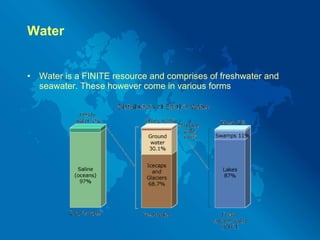
Water Water is a FINITE resource and comprises of freshwater and seawater. These however come in various forms
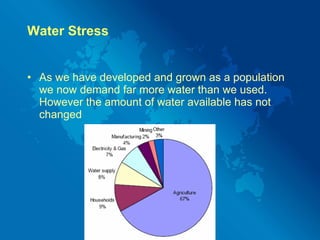
Water Stress As we have developed and grown as a population we now demand far more water than we used. However the amount of water available has not changed
Agriculture Takes the lion share of all water as we struggle to feed the growing world population. 67% (69% in 2007) Some produce is less water efficient than others.
1 kg of beef is 10 times more costly than 1kg of rice 17% of world crops are from irrigated fields These systems can be very wasteful Bad management can lead to problems
Industry Uses 21% of all water globally and though increases have been slow this is expected to rise rapidly as developing countries progress HEP uses vast amounts of water but is available to other users afterwards Industry is generally more efficient than agriculture
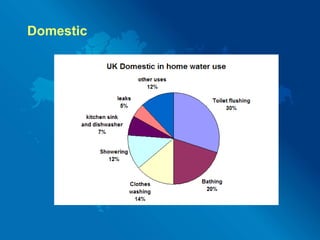
Domestic
Uses only about 10% of all freshwater but this varies enormously between countries Developed nations use approx. 100,000 litres per year  Developing nations far less than 50,000 litres per year Domestic use globally doubles every 20 years Quality varies considerably
Sources Surface Water (Short term hydrological cycle) Rivers, lakes, reservoirs Aquifers (Long term hydrological cycle) Underground supplies, ¾ of Europe's drinking water comes from this. Water is being abstracted faster than it can be replaced in India, USA, China and middle east. Leads to issues of dwindling supplies, falling water tables (Subsidence) and seawater contamination.
Activity 1 Using your own knowledge draw a spider diagrams to show the links between: Economic growth and water supply Water insecurity and poverty
Supply In theory there is enough water for everyone We only use about 50% of global freshwater Rapid pop’n growth in areas with a limited supply leads to water shortages A  Water Gap  Between the have and have not's has appeared
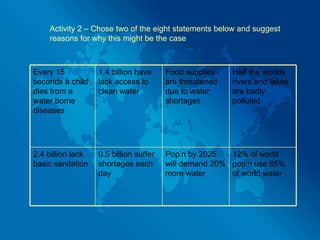
Activity 2 – Chose two of the eight statements below and suggest reasons for why this might be the case Every 15 seconds a child dies from a water borne diseases 1.4 billion have lack access to clean water Food supplies are threatened due to water shortages Half the worlds rivers and lakes are badly polluted 2.4 billion lack basic sanitation 0.5 billion suffer shortages each day Pop’n by 2025 will demand 20% more water 12% of world pop’n use 85% of world water
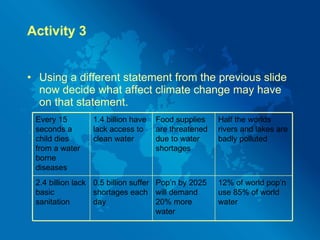
Activity 3 Using a different statement from the previous slide now decide what affect climate change may have on that statement. Every 15 seconds a child dies from a water borne diseases 1.4 billion have lack access to clean water Food supplies are threatened due to water shortages Half the worlds rivers and lakes are badly polluted 2.4 billion lack basic sanitation 0.5 billion suffer shortages each day Pop’n by 2025 will demand 20% more water 12% of world pop’n use 85% of world water
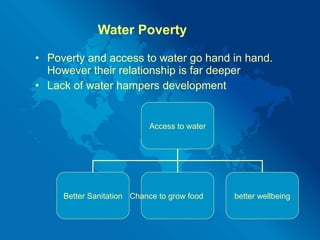
Water Poverty Poverty and access to water go hand in hand. However their relationship is far deeper Lack of water hampers development Access to water Better Sanitation Chance to grow food better wellbeing
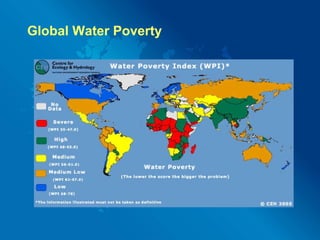
Global Water Poverty
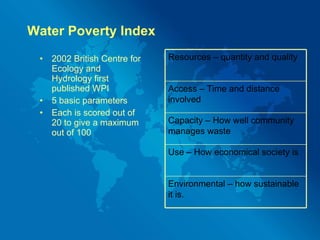
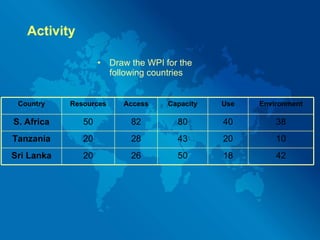
Water Poverty Index 2002 British Centre for Ecology and Hydrology first published WPI 5 basic parameters Each is scored out of 20 to give a maximum out of 100 Resources – quantity and quality Access – Time and distance involved  Capacity – How well community manages waste Use – How economical society is Environmental – how sustainable it is.
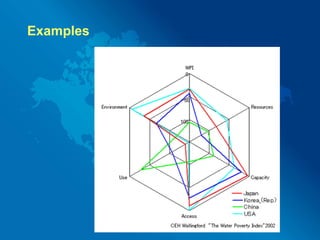
Examples
Activity Draw the WPI for the following countries Country Resources Access Capacity Use Environment S. Africa 50 82 80 40 38 Tanzania 20 28 43 20 10 Sri Lanka 20 26 50 18 42
We now know There is enough water on the planet it’s just in the wrong place There is a finite amount on the planet Scarcity will increase with pop’n growth and development of developing countries Water poverty and the water poverty index exists and there is a link between water poverty and poverty.

Water Conflicts Supply And Demand

  • 1.
    Water Supply andDemand A2 Geography
  • 2.
    Water Water isa FINITE resource and comprises of freshwater and seawater. These however come in various forms
  • 3.
    Water Stress Aswe have developed and grown as a population we now demand far more water than we used. However the amount of water available has not changed
  • 4.
    Agriculture Takes thelion share of all water as we struggle to feed the growing world population. 67% (69% in 2007) Some produce is less water efficient than others.
  • 5.
    1 kg ofbeef is 10 times more costly than 1kg of rice 17% of world crops are from irrigated fields These systems can be very wasteful Bad management can lead to problems
  • 6.
    Industry Uses 21%of all water globally and though increases have been slow this is expected to rise rapidly as developing countries progress HEP uses vast amounts of water but is available to other users afterwards Industry is generally more efficient than agriculture
  • 7.
  • 8.
    Uses only about10% of all freshwater but this varies enormously between countries Developed nations use approx. 100,000 litres per year Developing nations far less than 50,000 litres per year Domestic use globally doubles every 20 years Quality varies considerably
  • 9.
    Sources Surface Water(Short term hydrological cycle) Rivers, lakes, reservoirs Aquifers (Long term hydrological cycle) Underground supplies, ¾ of Europe's drinking water comes from this. Water is being abstracted faster than it can be replaced in India, USA, China and middle east. Leads to issues of dwindling supplies, falling water tables (Subsidence) and seawater contamination.
  • 10.
    Activity 1 Usingyour own knowledge draw a spider diagrams to show the links between: Economic growth and water supply Water insecurity and poverty
  • 11.
    Supply In theorythere is enough water for everyone We only use about 50% of global freshwater Rapid pop’n growth in areas with a limited supply leads to water shortages A Water Gap Between the have and have not's has appeared
  • 12.
    Activity 2 –Chose two of the eight statements below and suggest reasons for why this might be the case Every 15 seconds a child dies from a water borne diseases 1.4 billion have lack access to clean water Food supplies are threatened due to water shortages Half the worlds rivers and lakes are badly polluted 2.4 billion lack basic sanitation 0.5 billion suffer shortages each day Pop’n by 2025 will demand 20% more water 12% of world pop’n use 85% of world water
  • 13.
    Activity 3 Usinga different statement from the previous slide now decide what affect climate change may have on that statement. Every 15 seconds a child dies from a water borne diseases 1.4 billion have lack access to clean water Food supplies are threatened due to water shortages Half the worlds rivers and lakes are badly polluted 2.4 billion lack basic sanitation 0.5 billion suffer shortages each day Pop’n by 2025 will demand 20% more water 12% of world pop’n use 85% of world water
  • 14.
    Water Poverty Povertyand access to water go hand in hand. However their relationship is far deeper Lack of water hampers development Access to water Better Sanitation Chance to grow food better wellbeing
  • 15.
  • 16.
    Water Poverty Index2002 British Centre for Ecology and Hydrology first published WPI 5 basic parameters Each is scored out of 20 to give a maximum out of 100 Resources – quantity and quality Access – Time and distance involved Capacity – How well community manages waste Use – How economical society is Environmental – how sustainable it is.
  • 17.
  • 18.
    Activity Draw theWPI for the following countries Country Resources Access Capacity Use Environment S. Africa 50 82 80 40 38 Tanzania 20 28 43 20 10 Sri Lanka 20 26 50 18 42
  • 19.
    We now knowThere is enough water on the planet it’s just in the wrong place There is a finite amount on the planet Scarcity will increase with pop’n growth and development of developing countries Water poverty and the water poverty index exists and there is a link between water poverty and poverty.